
Gut Health Guide: The Difference Between Probiotic and Prebiotic For Your Gut
Ever feel like your stomach inflates like a balloon by afternoon? You’re not alone- and it’s not just what you ate. We get the frustration of bloating and digestive discomfort, and we're here to help clear up the confusion.
So, let's get right to it: the core difference between a probiotic and prebiotic boils down to their very specific jobs in your gut. Think of probiotics as the live, helpful bacteria (the tenants) and prebiotics as their favorite food (the welcome feast). Understanding this partnership is the first step toward a happier gut, and we promise to make it simple.
Probiotics vs Prebiotics: Your Quick Guide to Gut Health
Navigating the world of gut health can feel like a maze, especially with terms like "probiotic" and "prebiotic" popping up everywhere. But getting a handle on these two is a huge step toward feeling your best.
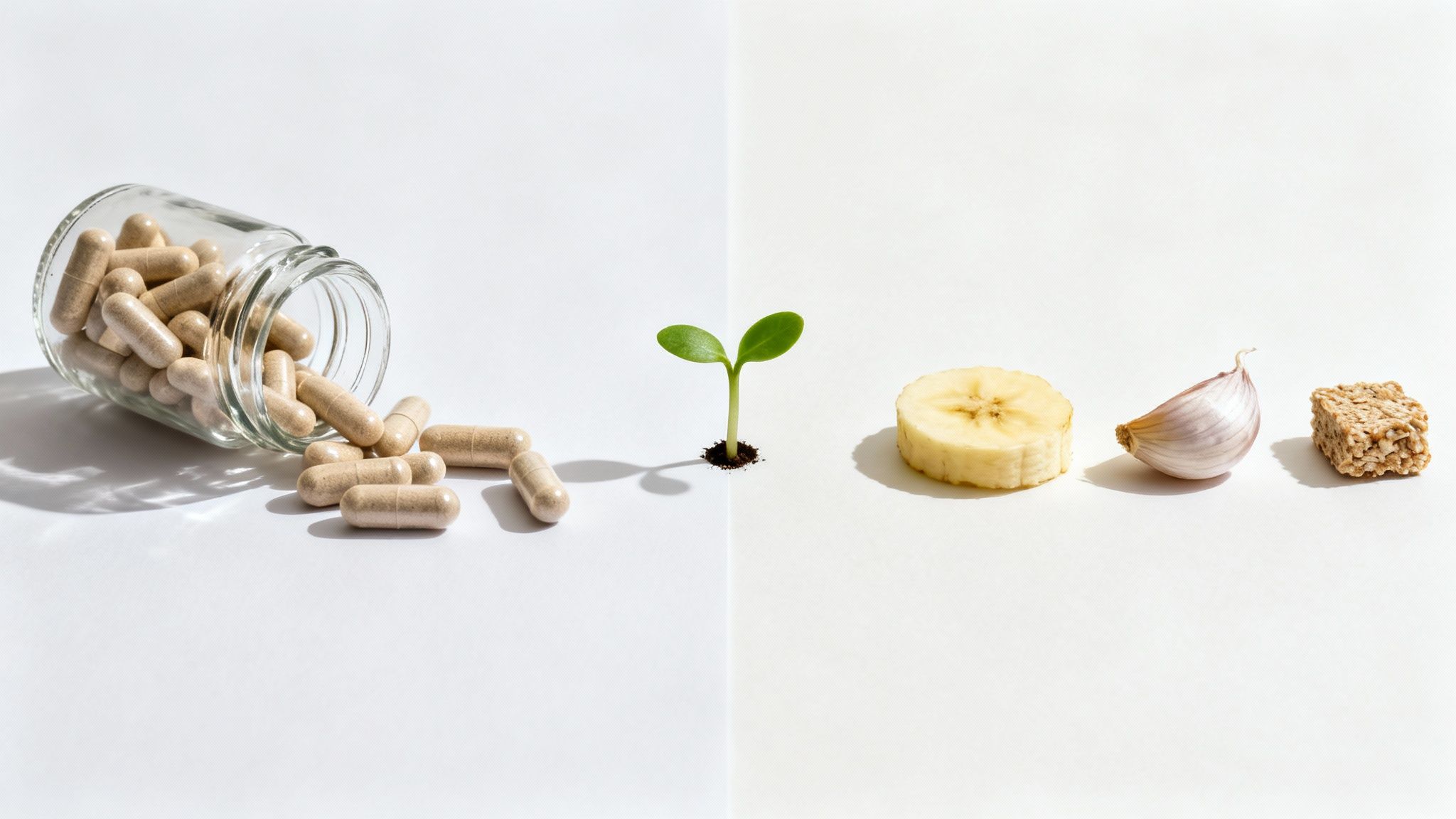
Let's use an analogy. Imagine your gut is a bustling garden. For it to truly thrive, you need both good seeds and quality fertilizer.
- Probiotics are the seeds- the living, friendly bacteria that take root and populate your digestive tract.
- Prebiotics are the fertilizer- the food that nourishes those good bacteria, helping them grow strong and multiply.
By the end of this guide, you’ll see how they work together to create a balanced digestive system, which is the foundation for better energy, a stronger immune response, and overall wellness. Let’s dive in.
Probiotics vs Prebiotics at a Glance
To make it even clearer, let’s break down the essential distinction between a probiotic and a prebiotic. Seeing them side-by-side really helps highlight their individual jobs.
| Attribute | Probiotics | Prebiotics |
|---|---|---|
| Primary Role | Adds beneficial live bacteria to your gut microbiome. | Feeds the good bacteria already living in your gut. |
| What They Are | Live microorganisms, typically bacteria and yeasts. | Non-digestible plant fibers (a type of carbohydrate). |
| Key Function | Help digest food, produce vitamins, and support immunity. | Stimulate the growth and activity of helpful gut bacteria. |
| Common Sources | Yogurt, kefir, kombucha, kimchi, and supplements. | Garlic, onions, bananas, asparagus, and whole grains. |
| Analogy | The seeds you plant in your gut garden. | The fertilizer that helps your garden grow. |
Grasping this fundamental partnership is crucial. Probiotics introduce the "good guys," but it's the prebiotics that ensure they have the fuel to stick around and do their job effectively. According to experts at the International Scientific Association for Probiotics and Prebiotics (ISAPP), this synergistic relationship is the key to maintaining a healthy gut ecosystem.
What Are Probiotics? The Live Helpers for Your Gut
Let's start with the superstars of gut health: probiotics. Put simply, probiotics are live microorganisms- beneficial bacteria and yeasts- that deliver a real health benefit when you get enough of them.
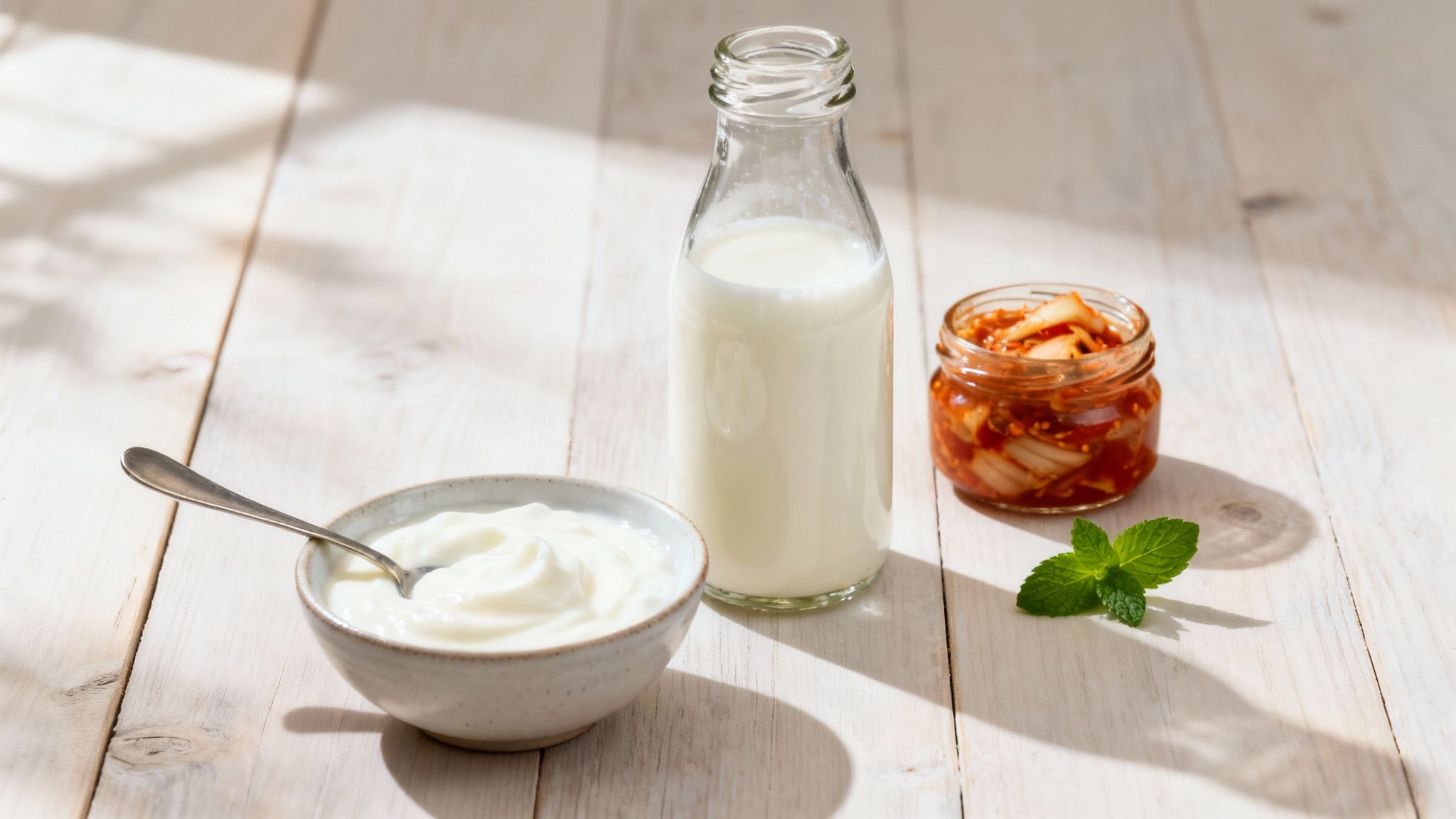
Think of them as friendly reinforcements arriving to support your gut's resident team. They are the "good guys" that help keep your internal ecosystem balanced and thriving.
The Power Players: Lactobacillus and Bifidobacterium
Not all probiotics are the same. Different types, known as "strains," perform different jobs. Two of the most well-known groups are Lactobacillus and Bifidobacterium.
- Lactobacillus: You've probably heard of this one. It’s the most common probiotic, famous for its presence in yogurt. It helps your system break down food, absorb nutrients, and fend off less friendly organisms.
- Bifidobacterium: These bacteria are essential for digesting fiber and complex carbs your body can't handle on its own. They also help produce vital nutrients that keep your gut lining healthy and strong.
These powerful strains work by competing with harmful bacteria for real estate and resources, essentially crowding them out.
A Note From Our Founder, Sam: "For years, I struggled with that awful, constant bloating. It wasn't until I started focusing on repopulating my gut with specific, high-quality probiotic strains that I finally felt relief. It was a game-changer for me and the reason I wanted to create a solution that made a real difference."
Food Sources vs. Targeted Supplements
You can definitely get probiotics from food, and it can be a delicious way to do it.
Common Probiotic-Rich Foods:
- Yogurt (check the label for "live and active cultures")
- Kefir, a tangy fermented milk drink
- Sauerkraut and kimchi (make sure they're unpasteurized)
- Kombucha
- Miso
While these foods are fantastic, getting a consistent, therapeutic dose can be a challenge. The quantity and types of bacteria can vary wildly from batch to batch. For those of us with dietary restrictions or specific health goals, a targeted supplement often provides a more reliable and potent approach.
The demand for effective digestive support is skyrocketing. The global probiotics market is projected to be worth USD 114.31 billion in 2025 and is expected to climb to an incredible USD 429.01 billion by 2035. You can dive deeper into this trend on Towards Healthcare. For anyone serious about improving their gut health, figuring out the best probiotics for digestion is a crucial next step.
Understanding Prebiotics: The Fuel for Your Good Bacteria
Now, let's turn our attention to the unsung heroes of gut health: prebiotics. If probiotics are the beneficial new residents in your gut, think of prebiotics as the five-star welcome feast that helps them flourish.
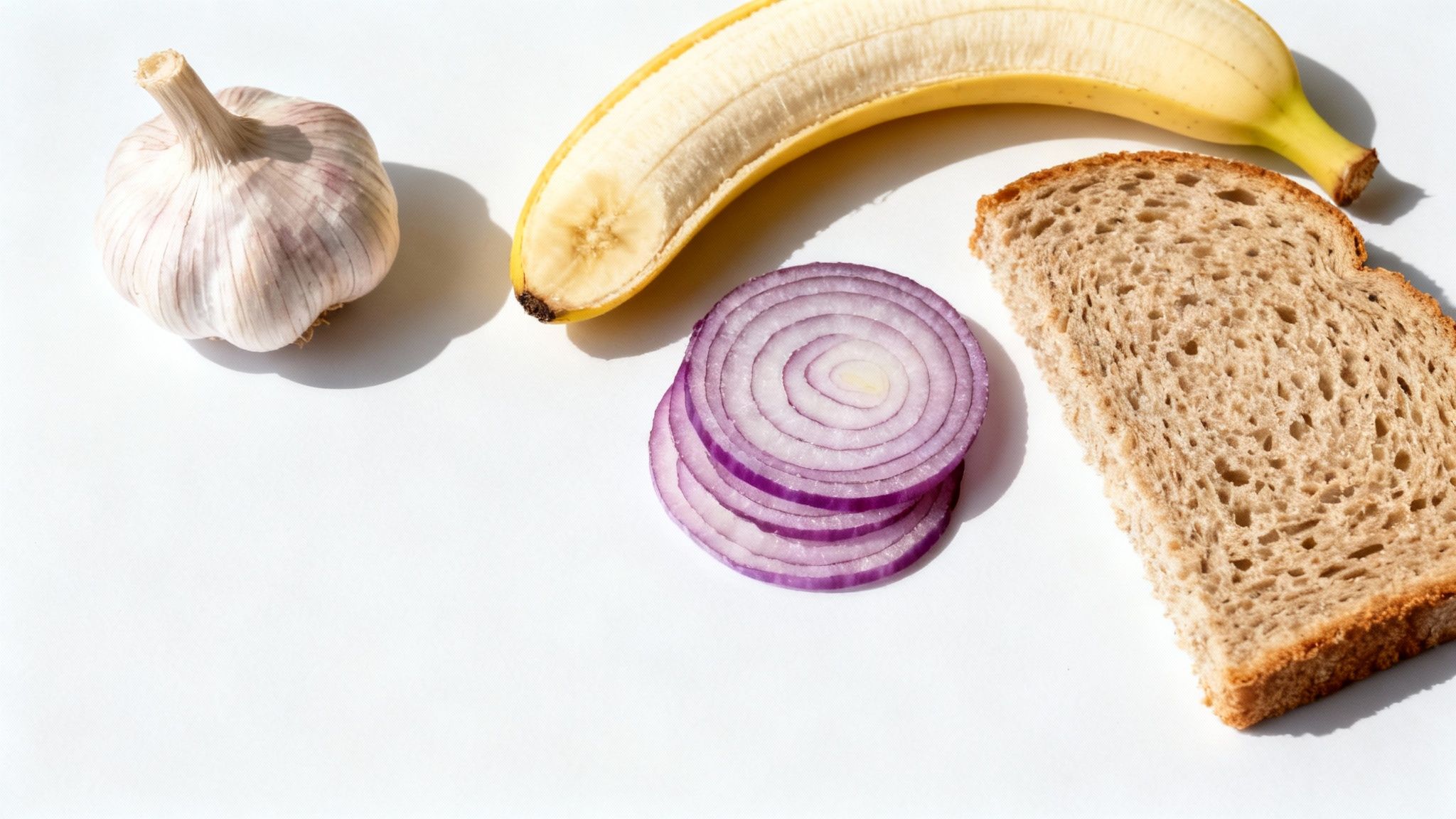
So, what are they? Prebiotics are specific types of plant fibers that your body can't digest. But that's a good thing. These fibers pass through your system untouched until they reach your colon, where your beneficial gut microbes eagerly devour them.
What Do Prebiotics Actually Do?
When your friendly gut bacteria metabolize prebiotic fiber, they create powerful byproducts called short-chain fatty acids (SCFAs). These SCFAs are absolute workhorses. They act as the main energy source for the cells lining your colon, which helps maintain a strong, healthy gut barrier. A strong barrier is vital for preventing harmful substances from leaking into your bloodstream. This is the real magic of prebiotics.
Common Types of Prebiotics You Should Know
You don't need to be a scientist to find prebiotics; they're in many plant-based foods you might already enjoy.
- Inulin: A soluble fiber you’ll find in foods like chicory root, garlic, onions, and asparagus.
- Fructo-oligosaccharides (FOS): These are naturally occurring in bananas, garlic, and onions.
- Galacto-oligosaccharides (GOS): Often found in legumes and beans.
A healthy gut isn't just about adding good bacteria; it's about creating an environment where they can thrive for the long haul. That’s the real power of prebiotics.
Weaving these foods into your daily meals is a fantastic way to nourish your gut. Of course, getting enough prebiotics from diet alone can be a challenge. That's why pairing prebiotic-rich foods with a targeted supplement provides consistent support. To dig deeper, check out our guide on what foods are high in prebiotics.
How Probiotics and Prebiotics Work Together: The Power of Synergy
People often get stuck thinking it’s an either/or choice: probiotics or prebiotics. The truth is, they’re a team. Their combined effect is so powerful, it has its own name: synbiotics.
Let's go back to our garden analogy.
- Probiotics are the new seeds you plant.
- Prebiotics are the high-quality fertilizer that helps them grow.
Without the fertilizer, your seeds might struggle to take root. By giving your gut both, you're not just adding good bacteria; you're providing the exact fuel they need to do their jobs effectively.
The Synbiotic Effect in Action
The "synbiotic effect" is simple: the benefit of taking both together is far greater than their individual effects. Prebiotics essentially roll out the welcome mat, helping probiotics survive the harsh journey through your stomach and successfully set up shop in your intestines.
Once settled, this well-fed gut bacteria can get to work producing more of those incredible short-chain fatty acids (SCFAs). More SCFAs lead to a stronger gut barrier, less inflammation, and better overall function. It's a beautiful, self-sustaining cycle.
A Personal Journey to Gut Balance
Our founder, Sam, discovered this the hard way. He spent a long time focused only on taking probiotics. While he saw some minor improvements, the bloating and nagging discomfort just wouldn't quit.
"I was convinced I was doing everything right. It wasn’t until I started deliberately adding prebiotic fiber from foods and my supplement that everything finally clicked into place. The synergy was undeniable. That combination was the missing link I needed to finally feel my best."
Sam’s experience is the foundation of our philosophy. This understanding is catching on. While the global probiotics market is projected to grow from USD 79.2 billion in 2025 to USD 165.1 billion by 2034, the prebiotic market is also seeing consistent growth. You can explore more insights on these market dynamics here.
Creating Your Own Gut Synergy
So, how do you put this synergy to work for you?
- Diversify Your Plate: Include a wide variety of prebiotic-rich plants in your meals. Think garlic, onions, and bananas.
- Add Fermented Foods: Introduce probiotic powerhouses like kimchi, sauerkraut, or kombucha.
- Find a Smart Supplement: For a consistent and reliable dose, a combined supplement is often the simplest solution. Our Yuve Vegan Probiotic Gummies with Prebiotic were specifically designed around this synergy, delivering both the beneficial bacteria (Bacillus Coagulans) and the prebiotic fiber (inulin) in one easy step.
By adopting a synbiotic approach, you start actively cultivating a resilient, balanced, and thriving gut for the long haul.
How To Choose The Right Gut Support For You
Deciding between a probiotic, a prebiotic, or both can feel overwhelming. I get it. The right choice often comes down to your unique situation. Let’s walk through a few common scenarios.
When A Probiotic Is Your Priority
There are specific times when introducing live bacteria should be your main focus. Consider prioritizing a probiotic in these situations:
- After a course of antibiotics: Antibiotics can wipe out both good and bad bacteria. A targeted probiotic is crucial for repopulating your microbiome.
- If you struggle with traveler’s gut: A probiotic before and during your trip can help fortify your gut’s defenses.
- When you’ve had a recent bout of illness: Probiotics can help reinforce your gut lining and support your immune system’s recovery.
In these cases, the primary goal is to reintroduce beneficial organisms. You can dive deeper into what to look for when buying probiotics in our detailed guide.
When Focusing On Prebiotics Makes Sense
What if your digestion is generally okay, but you want to maintain that balance? This is where prebiotics really shine.
You might want to double down on prebiotics if:
- You feel pretty good but want to support long-term gut health: Increasing your intake of prebiotic-rich foods nourishes the good bacteria you already have.
- Your diet lacks fiber and plant diversity: If your meals are low on fruits, veggies, and whole grains, making a conscious effort to add more is a powerful first step.
The goal here is maintenance and optimization.
Why A Combined Synbiotic Approach Is Often Best
For many of us dealing with persistent issues like gas, bloating, and general digestive discomfort, dun, dun, dun- a combined approach is the most effective solution. This is where synbiotics come in.
A synbiotic strategy is your gut’s ultimate support system. You’re not just sending in reinforcements (probiotics); you're also equipping them with the exact fuel they need to thrive (prebiotics).
This approach addresses both needs simultaneously, ensuring your gut has everything it requires to rebalance. For a smart, proactive strategy, a formula that provides both is an efficient way to support your gut from every angle.
Which Gut Support Do You Need?
| Your Situation | Primary Recommendation | Why It Works |
|---|---|---|
| "I just finished a round of antibiotics and my stomach is a mess." | Probiotic | Your gut needs immediate reinforcements. Probiotics reintroduce the good bacteria that were wiped out, helping restore balance quickly. |
| "I want to proactively keep my gut healthy for the long term." | Prebiotic | You're not fixing a problem; you're building resilience. Prebiotics nourish your existing good gut flora, keeping them strong and diverse. |
| "I frequently deal with bloating, gas, and digestive unpredictability." | Synbiotic (Probiotic + Prebiotic) | This is a two-pronged attack. You're adding new beneficial bacteria while also feeding the entire community to create a stable, well-functioning gut. |
| "My diet isn't very diverse, and I rely on a lot of processed foods." | Start with Prebiotics, then consider a Synbiotic | Your gut's existing good bacteria are likely starved for fuel. Start by feeding them with prebiotics. A synbiotic can then help diversify the population. |
Ultimately, listening to your body is key.
Your Practical Action Plan for a Healthier Gut
Alright, let's turn that knowledge into action with a straightforward plan to start improving your gut health right now. Feeling better doesn't need to be complicated.
Quick Wins for Immediate Impact
You can start feeding your gut microbiome with your very next meal.
- Aim for 3-5 different prebiotic foods each week. Try adding sliced banana to your oatmeal or tossing garlic and onion into your pasta sauce.
- Read supplement labels carefully. Look for specific, well-researched strains like Bacillus Coagulans and a clear CFU (colony-forming unit) count.
- Stay hydrated. Water is crucial for helping prebiotic fiber move through your system.
- Bring in a high-quality supplement for consistent support. Let’s be real- life gets busy. Yuve Vegan Probiotic Gummies are an easy, tasty way to guarantee you’re getting both probiotics and prebiotics daily.
Science Corner: A Closer Look at Bloating Relief
Solid science backs up the power of probiotics for digestive comfort. Researchers at the National Institutes of Health (NIH) have consistently found that certain probiotic strains can significantly reduce bloating and gas. What does this mean for you? It confirms that adding the right live bacteria to your gut can have a direct, noticeable impact on those uncomfortable symptoms.
Your Gut Health Checklist
- Add One Prebiotic Food Today: Could you toss a handful of asparagus into dinner? Start small.
- Take Your Probiotic Consistently: Make it part of your morning or evening routine.
- Evaluate Your Beverages: As part of a holistic approach, it's beneficial to evaluate your daily consumption habits, including making informed beverage choices to avoid gut-disrupting sugars.
- Listen to Your Body: Pay attention to how you feel. Small changes can bring big results.
Real change comes from taking clear, manageable steps. Your journey to a happier gut starts with that very first choice. You've got this.
Got Questions About Probiotics and Prebiotics?
It's natural to have questions. We get asked these all the time, so let's break down some of the most common ones.
Can I Get All I Need From Food?
A diet packed with fiber-rich plants and fermented foods is the best place to start. The challenge, however, is consistency and dosage. The amount of live bacteria in yogurt can vary wildly. A well-formulated supplement gives you a targeted, potent dose of specific strains, removing the guesswork.
How Long Does It Take to Feel a Difference?
Patience is key. While some people notice improvements within a few days, it generally takes about 2-4 weeks of consistent use to see significant, lasting benefits. You're giving the beneficial bacteria time to properly colonize your gut and multiply.
Should I Expect Any Side Effects?
As you introduce new probiotics and prebiotics, it's possible to experience some temporary gas or bloating. Yikes! But don't worry. It's usually a positive sign that the good bacteria are getting to work and your gut is adjusting. This initial phase typically subsides within a week or so.
Do Probiotics Always Need to Be Refrigerated?
It depends. Many traditional probiotics require refrigeration, but advances in encapsulation have led to fantastic shelf-stable options. This is a game-changer for convenience. Modern formulas are designed to stay potent at room temperature, making them perfect for travel or simplifying your daily routine.
At Yuve, our goal is to make supporting your gut easy and effective. Our Vegan Probiotic Gummies with Prebiotic offer a powerful synbiotic blend in a simple, tasty gummy, giving your gut the comprehensive support it needs to thrive.


