Ever feel like your stomach inflates like a balloon by afternoon? We get it. That frustrating, uncomfortable bloating can throw off your whole day, and it's not always just about what you ate. You’re not alone in this, and thankfully, you’re in the right place to figure it out.
The secret to better digestion often comes down to two key players: prebiotics and probiotics. Understanding this dynamic duo is your first step toward finally feeling comfortable, energized, and in control of your digestive health.
Think of us as your gut-health partner. In this guide, we'll break down:
- What probiotics and prebiotics actually are, without the confusing jargon.
- Why you absolutely need both for your gut to feel its best.
- How their teamwork can ease bloating, boost your energy, and help you enjoy food again.
By the end, you'll know exactly how to support your gut microbiome with the right foods and supplements. It’s time to stop guessing and start feeling great.
Your Gut's Dream Team: Prebiotics and Probiotics
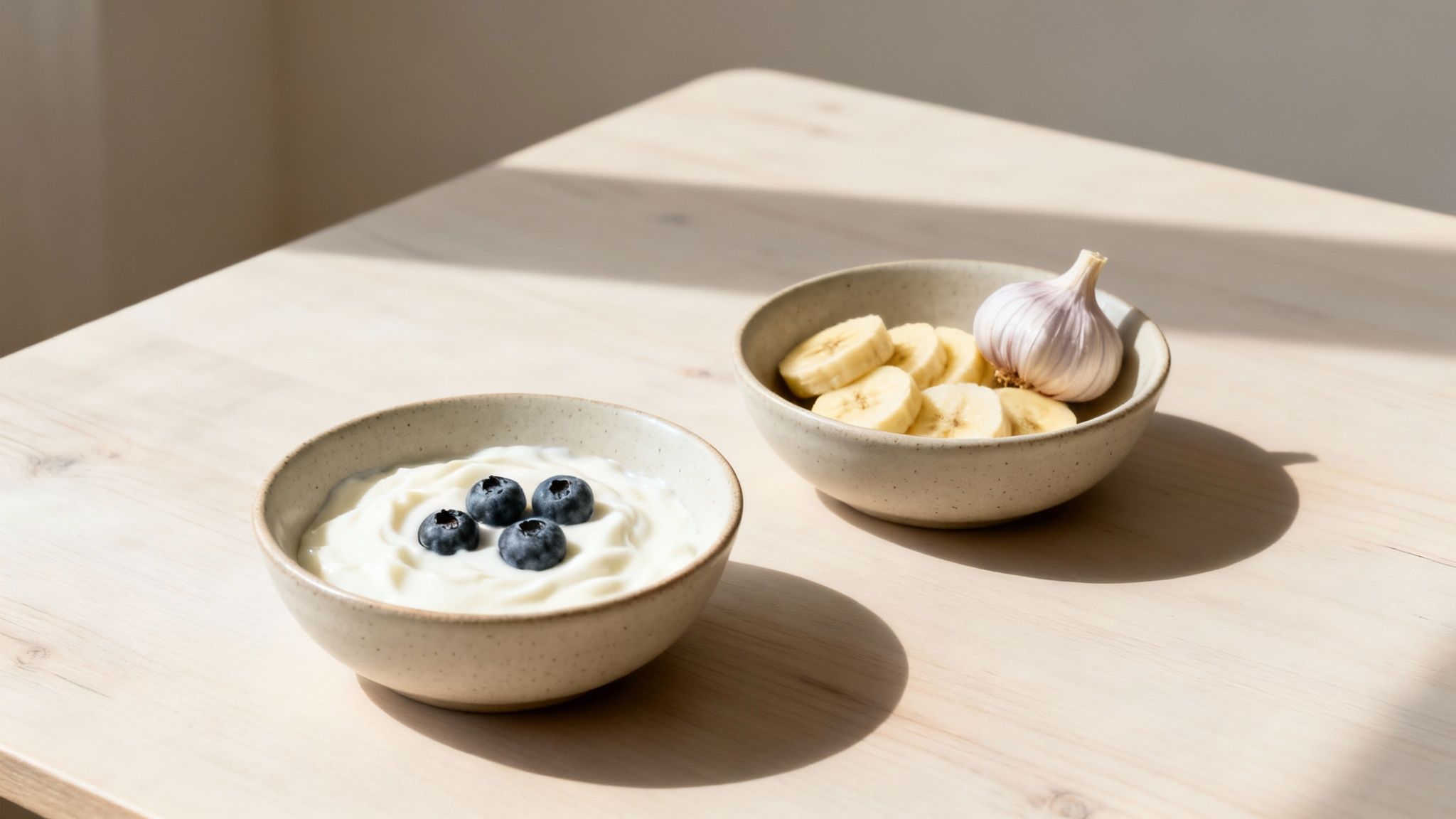
When we talk about prebiotics vs probiotics, the simplest way to think about it is like planting a garden inside your gut.
- Probiotics are the good, live bacteria-the seeds you plant to grow a healthy garden.
- Prebiotics are the special plant fibers that act as fertilizer, feeding those seeds so they can grow strong and flourish.
You need both to create a thriving ecosystem.
Quick Look: Prebiotics vs Probiotics at a Glance
Diving into the science can feel like a lot, but the basics are pretty straightforward. This table cuts through the noise and gives you the core differences in a single glance.
| Characteristic | Probiotics | Prebiotics |
|---|---|---|
| What They Are | Live, beneficial bacteria and yeasts that live in your gut. | Non-digestible plant fibers that act as food for those good bacteria. |
| Primary Role | Replenish and maintain a healthy population of microorganisms. | Selectively feed and stimulate the growth of your beneficial gut flora. |
| Common Sources | Fermented foods like yogurt, kefir, kimchi, and kombucha. | High-fiber foods like garlic, onions, bananas, and asparagus. |
| Main Benefit | Directly adds more "good guys" to your gut ecosystem. | Nourishes the "good guys" you already have, helping them multiply. |
While this pair is essential, don't forget that other whole foods contribute to a happy gut. For instance, looking into the benefits of olive oil for gut health shows how healthy fats can also help balance your microbiome and reduce inflammation.
Ultimately, you can't have a truly thriving internal garden with just one. It's their powerful synbiotic relationship-the way they work together-that unlocks real, lasting benefits for your health.
Understanding Probiotics: The Good Gut Bacteria
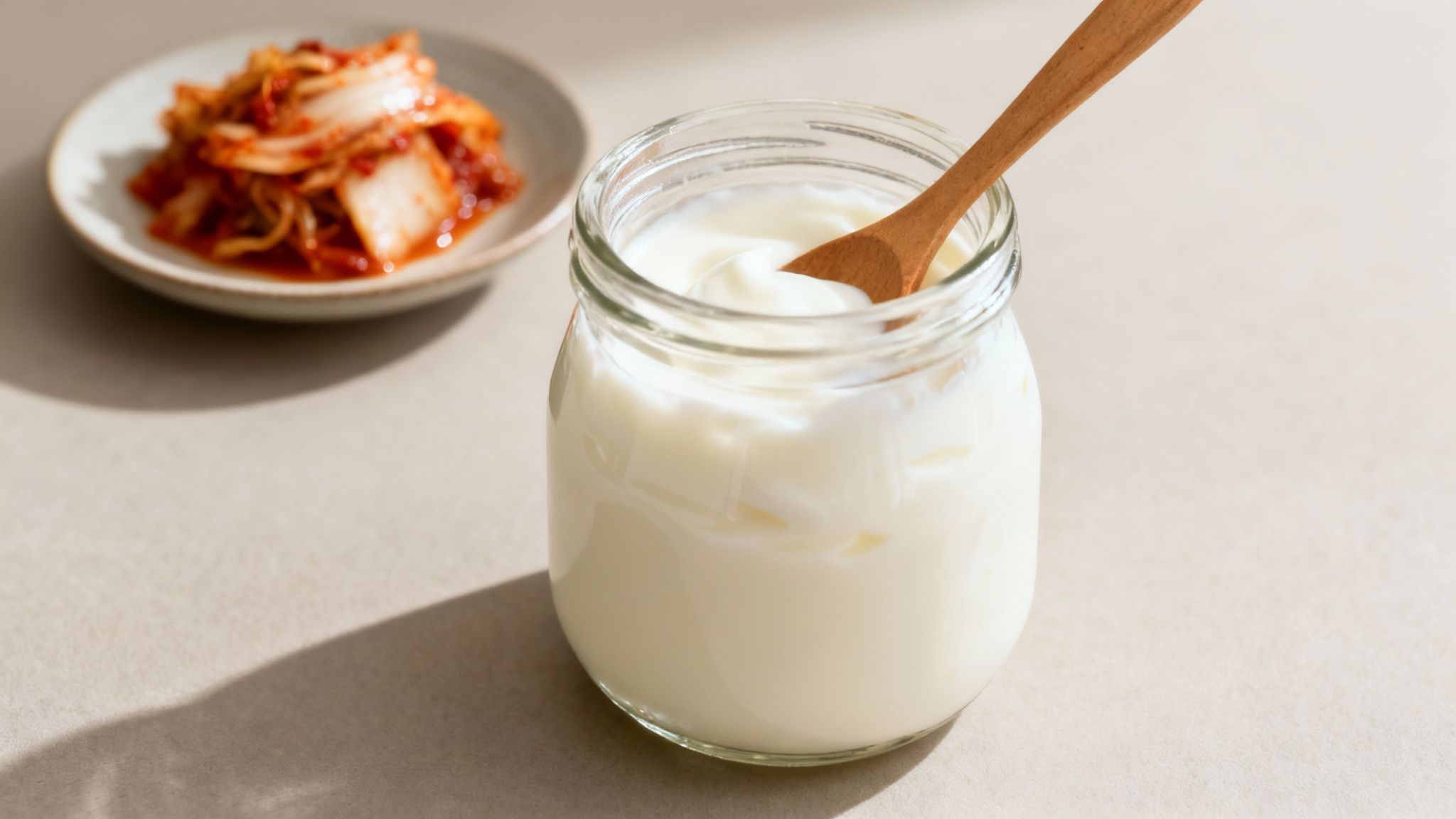
Let's start with the rockstars of gut health: probiotics. These are the live microorganisms-the "good guys"-that set up shop in your digestive system and work to keep things in healthy harmony.
These helpful bacteria are deeply involved in your overall health, from helping you digest that big lunch to supporting your immune defenses. We’ve all had those days where we feel sluggish and heavy; a healthy probiotic community is often the key to feeling lighter and more energized.
What Do These Good Bacteria Actually Do?
So, what are these tiny organisms busy doing all day? Probiotics aren’t just passively floating around; they are active workers in your body.
Their most critical job is to maintain a healthy balance in your gut microbiome. When the "bad" bacteria start to outnumber the good, you can get an imbalance that triggers everything from gas and bloating to more persistent digestive issues. And honestly, who has time for that?
Here’s a quick look at their main responsibilities:
- Aiding Digestion: Probiotics help break down fibers your body struggles with, which can significantly reduce bloating and discomfort.
- Supporting Immunity: A huge part of your immune system is in your gut. Probiotics reinforce the gut lining, acting as gatekeepers to prevent harmful substances from getting where they shouldn't.
- Producing Nutrients: These little powerhouses can even create essential vitamins, including vitamin K and several B vitamins.
Common Probiotic Strains and Where to Find Them
The two most famous and well-studied groups of probiotics are Lactobacillus and Bifidobacterium. Think of them as different specialists on a team. One strain might be great at fighting off invaders, while another is a pro at producing a specific nutrient.
You can boost your intake of these friendly bacteria by enjoying fermented foods:
- Yogurt and Kefir: These dairy classics are teeming with live cultures.
- Kimchi and Sauerkraut: Fermented veggies offer a potent, tangy dose of probiotics.
- Kombucha and Miso: These popular fermented drinks and pastes are another great way to add diversity.
A Personal Note from Yuve's Founder, Sam: "I struggled for years with digestive issues that left me feeling drained and frustrated. It wasn't until I truly understood the power of probiotics that things started to change. But I also realized that just eating yogurt wasn't enough, especially after a round of antibiotics wiped out my gut flora. That experience was the real inspiration behind creating a potent, targeted probiotic supplement."
This is precisely why a supplement can be so helpful. While probiotic-rich foods are fantastic, they don't always contain the specific strains or high counts needed to make a real difference, particularly if your gut is already out of balance. To dive deeper, check out the best probiotics for digestive health in our article.
Understanding Prebiotics: The Fuel for Your Gut Flora
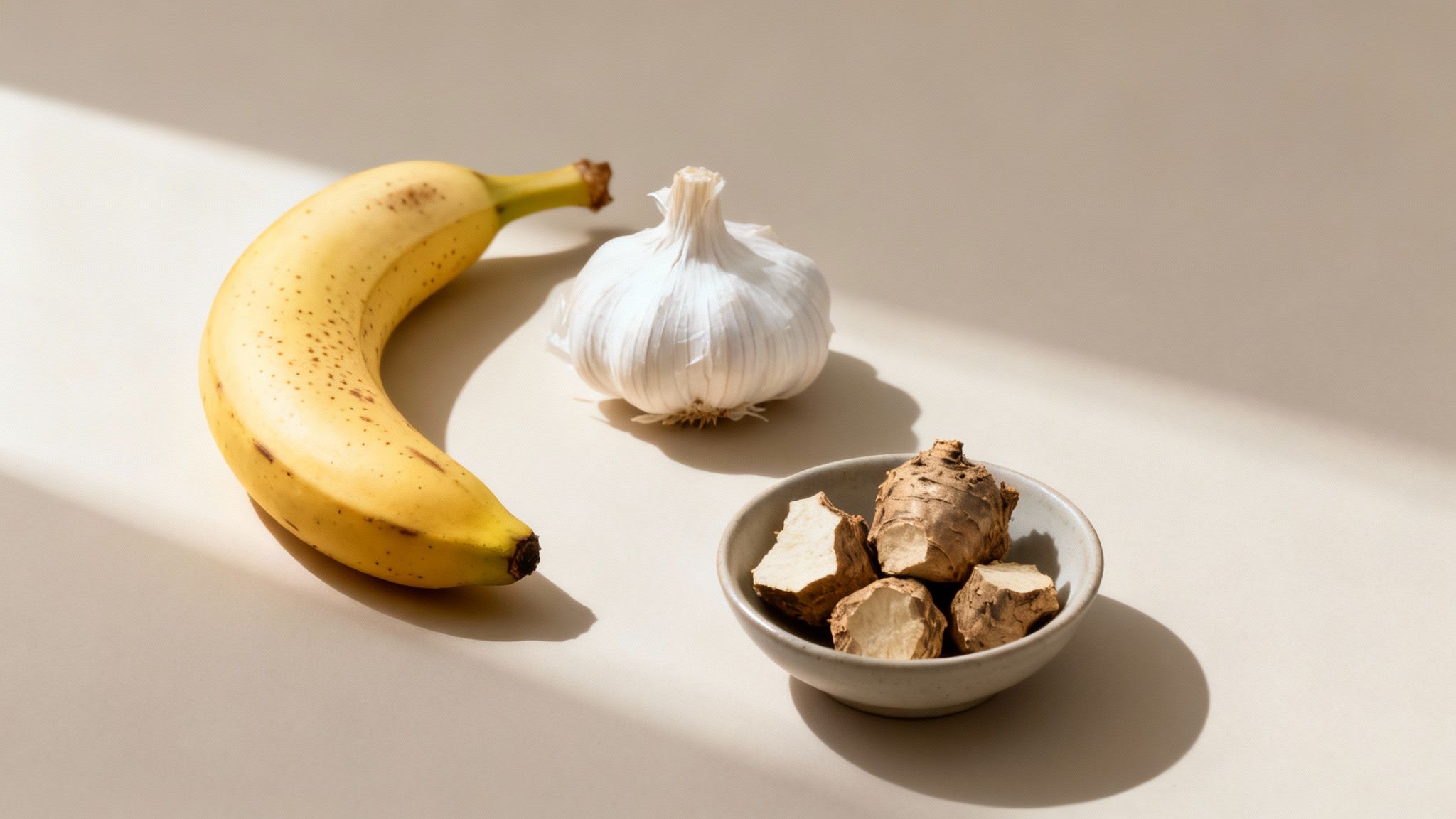
Now, let's talk about what keeps those probiotics thriving: prebiotics. If probiotics are the seeds in your gut's garden, prebiotics are the rich soil and fertilizer they need to grow.
Prebiotics are specific types of plant fibers our bodies can't digest. Instead, they travel all the way to your lower digestive tract, where they become the preferred food source for the good bacteria living there.
How Prebiotics Supercharge Your Gut
When your good bacteria get the fuel they need, they don't just survive-they multiply. A well-fed gut microbiome becomes more robust and resilient. As their populations grow, they can effectively crowd out the less helpful bacteria that often contribute to problems like gas and bloating. Dun, dun, dun-unwelcome gas. Yikes!
When your microbiome is properly nourished, you'll start to notice real benefits:
- Improved Digestion: Well-fed bacteria help regulate bowel movements, leading to more comfort and predictability.
- A Stronger Gut Barrier: These microbes produce short-chain fatty acids like butyrate, a compound that literally strengthens your gut lining.
- Better Nutrient Absorption: A thriving gut ecosystem is better at absorbing essential minerals, like calcium, from your food.
Finding Prebiotics in Your Everyday Diet
The great thing about prebiotics is that you don't need to look far to find them. They're naturally present in many common plant-based foods.
Some of the best dietary sources include:
- Garlic and Onions: These kitchen staples are loaded with prebiotic fibers.
- Bananas: Slightly under-ripe, greener bananas are a great source of resistant starch, a potent prebiotic.
- Asparagus: Contains a healthy dose of inulin, another powerful prebiotic fiber.
- Oats: That comforting bowl of oatmeal provides valuable fuel for your gut bacteria.
- Chicory Root: Often found in coffee alternatives, chicory root is one of the most concentrated sources of prebiotic inulin.
Science Corner: People are finally recognizing how foundational a healthy microbiome is to overall wellness. The global probiotics market is booming, projected to reach USD 417.09 billion by 2035. This huge growth shows a major shift toward nourishing our internal ecosystems. At Yuve, we favor plant-based prebiotics like chicory root because they are incredibly effective and align with our vegan supplements.
Here’s the bottom line: you can take all the probiotics in the world, but if you don't feed them, they won't stick around. To explore more food options, check out our guide on what foods are high in prebiotics.
The Synbiotic Effect: Why You Need Both
So far, we've looked at prebiotics and probiotics as two separate things. But this isn't an "either-or" situation. The real magic happens when they join forces in what's known as the synbiotic effect-a powerful partnership where the whole is far greater than the sum of its parts.
Taking probiotics without prebiotics is like planting a garden and forgetting to water it. The seeds (probiotics) are there, but they don’t have the right nourishment to grow. Probiotics need prebiotic fuel to survive and get to work.
A Partnership for Powerful Results
When you put prebiotics and probiotics on the same team, their combined effort can lead to incredible improvements in digestive health. For anyone who has struggled with the frustrating cycle of bloating, gas, or irregularity, this partnership can be a genuine game-changer.
A 2022 review in the journal Nutrients confirmed that synbiotic formulas-those containing both prebiotics and probiotics-deliver better outcomes. They don't just add good bacteria; they create a thriving environment where those bacteria can do their best work.
What this means for you:
- Enhanced Probiotic Survival: Prebiotics help shield probiotics as they travel through your stomach, ensuring more make it to your intestines alive.
- Better Colonization: Once they arrive, the prebiotic fuel helps them multiply and establish a strong, healthy community.
- Increased Production of Beneficial Compounds: A well-fed microbiome produces more short-chain fatty acids (like butyrate), which are crucial for a strong gut lining.
A Note from Yuve's Founder, Sam: "For years, I was stuck in a frustrating loop. I'd take a probiotic and feel a little better, but the bloating and discomfort always came back. It felt like I was just putting a temporary band-aid on the problem. It wasn't until I learned about the synbiotic effect and started focusing on feeding the good bacteria with prebiotics that I found lasting relief. That personal breakthrough was the 'aha' moment that inspired our Yuve formulas."
Making the Synbiotic Effect Work for You
Sam's story is one we hear all the time. The missing piece of the puzzle is almost always the prebiotic fuel.
By choosing a supplement that thoughtfully combines both, you're not just adding good bacteria-you're setting them up for long-term success. This is why our Yuve Vegan Probiotic + Prebiotic is designed as a complete synbiotic system. We’ve included potent prebiotic fibers right in the capsule to ensure the beneficial bacteria have everything they need to thrive. This approach takes all the guesswork out of building a resilient microbiome.
If you're looking to understand this powerful duo even better, our guide on combining a probiotic and prebiotic capsule can help.
How to Choose the Right Gut Support for You
Deciding between prebiotics and probiotics can feel like a fork in the road. Should you add new bacteria, or focus on feeding the ones you already have? The honest answer depends on your specific body, diet, and goals. Let's walk through a few scenarios to help you pinpoint the best strategy.
This decision tree gives you a great visual for figuring out your starting point.
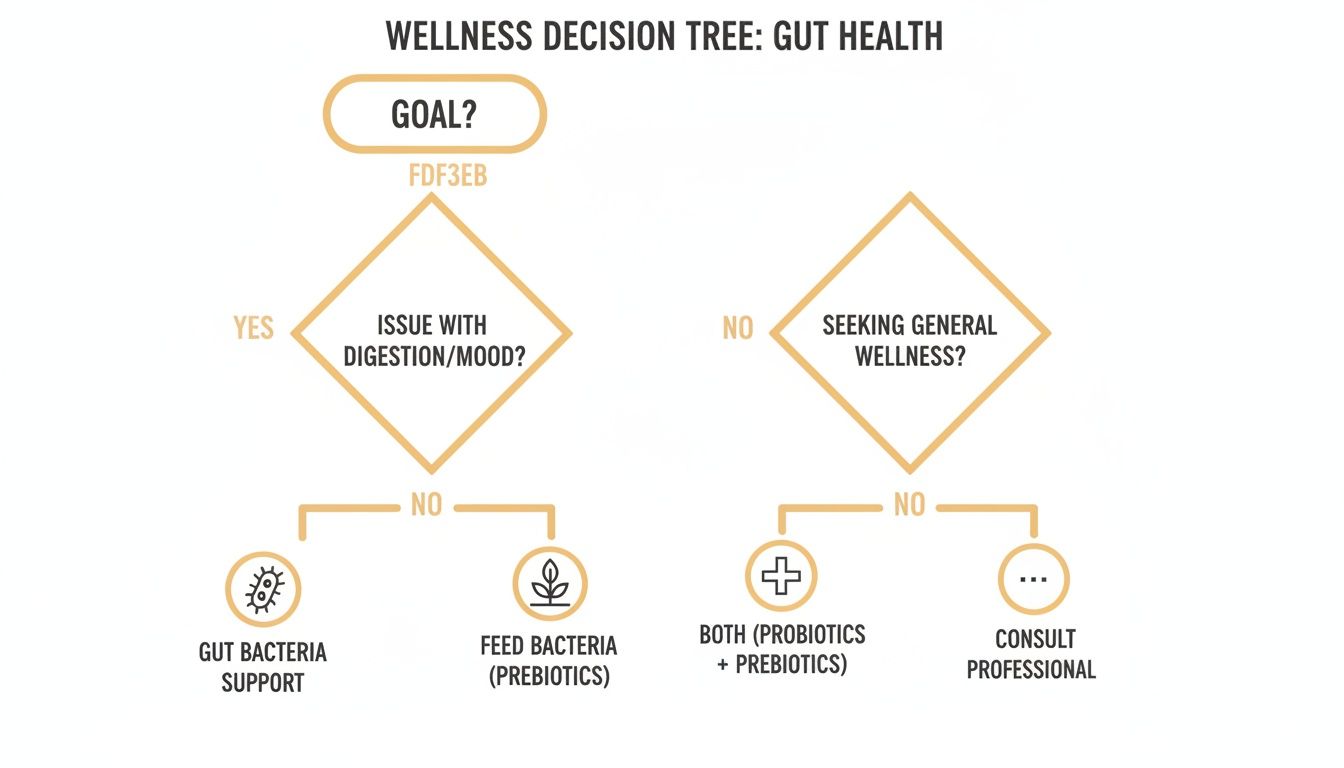
As the flowchart suggests, whether your goal is to introduce new bacteria, nourish your existing flora, or tackle both at once, there's a clear path forward.
Tailoring Your Approach to Your Lifestyle
Your personal health history and daily habits are massive factors. Let’s break down what might work best for you.
-
For the Vegan and Health-Conscious: If you follow a plant-based diet, you're probably already getting a good amount of prebiotic fiber-that's a fantastic head start. The challenge is often finding high-quality, diverse probiotic strains that are completely free of animal-derived ingredients.
-
For Parents Supporting Their Kids: A child’s gut microbiome is still developing, making it a crucial time to build a strong foundation. Introducing beneficial bacteria can be a wonderful way to foster a resilient immune system.
-
For Anyone Battling Bloating and Irregularity: If you’re constantly dealing with that puffy, uncomfortable feeling, your microbiome is sending out an SOS. It likely needs both reinforcements (probiotics) and nourishment (prebiotics) to restore balance.
I do NOT think one size fits all. No matter your starting point, the ultimate goal is creating a balanced gut ecosystem. The key is finding a clean, reliable, and comprehensive solution that fits seamlessly into your routine.
The Smartest Starting Point for Everyone
If you’re just starting your gut health journey, or if you simply want an all-in-one solution, a synbiotic supplement is the most practical choice. It takes the guesswork out of the prebiotics vs. probiotics debate by combining them into one easy step.
This is precisely why we developed Yuve's Vegan Probiotic with Prebiotics. It’s the perfect launchpad, ensuring your new gut-friendly bacteria arrive with the fuel they need to get to work right away. We were meticulous in designing our formula to be non-GMO, gluten-free, and gelatin-free, making it a powerful and safe option.
The demand for better digestive health is surging worldwide. You can read more about these global gut health trends to see why this combined approach has earned so much trust. By choosing a synbiotic, you aren't just taking a pill-you're adopting a complete strategy for gut wellness.
Your Quick-Start Guide to a Healthier Gut
Alright, let's put all this knowledge into action. Knowing where to start is half the battle. The good news is that you don't need a massive overhaul. Real, lasting change comes from small, consistent habits.
Here's a practical checklist to get you started today.
Simple Steps to a Happier Microbiome
Your path to a healthier gut starts with small, deliberate food choices. A great way to begin is by exploring some practical gut-friendly meal prep recipes with fermented or fiber-rich foods.
To make it even more concrete, try this 7-Day Gut Health Challenge:
- Day 1: Add a spoonful of kimchi or sauerkraut to one of your meals.
- Day 2: Grab a handful of almonds and a slightly green banana for a snack.
- Day 3: Swap your afternoon soda for a glass of kombucha.
- Day 4: Slice some onion and garlic into whatever you're cooking for dinner.
- Day 5: Start your morning with oatmeal topped with fresh berries.
- Day 6: Have a cup of plain yogurt (or a dairy-free alternative).
- Day 7: Take your Yuve Vegan Probiotic + Prebiotic supplement to round out the week.
A friendly reminder: Be gentle with yourself. If you're new to fiber-rich foods, introduce them slowly. A little initial gas can be a sign that the good bacteria are feasting on their new food!
Making Your Journey Easier and More Effective
While a food-first approach is fundamental, let's be realistic-life gets busy. Adding a high-quality supplement is a smart way to guarantee you’re consistently giving your gut what it needs.
Yuve's Vegan Probiotic is your daily insurance policy-a simple, proactive step to ensure you're getting a potent dose of both prebiotics and probiotics.
You don't have to figure this all out on your own. We’re here to support you with clean, effective tools that help make feeling good a daily habit. We’d love to hear about your own gut health journey-share your wins and challenges in the comments below.
Your Top Gut Health Questions Answered (FAQ)
Diving into the world of gut health can feel a bit overwhelming, so let's tackle some of the most common questions.
Can I Take Prebiotics and Probiotics at the Same Time?
Yes, and you probably should! Taking them together is what creates the synbiotic effect-where the prebiotic fiber acts as the perfect fuel for the probiotic bacteria. You're not just sending good soldiers (probiotics) into your gut; you're also sending them with a full supply of rations (prebiotics).
What Time of Day Is Best to Take Probiotics?
While consistency is most important, try taking your probiotic supplement about 15-30 minutes before a meal. This gives the live bacteria a bit of a buffer against harsh stomach acid, helping more of them survive the trip to your intestines.
How Long Does It Take for Probiotics to Work?
Everyone's body is different. Some people feel a difference in bloating within the first one to two weeks. For more profound shifts, you might be looking at four to eight weeks of consistent use. Be patient with your body as it finds its new balance.
Will I Experience Side Effects When Starting Probiotics?
It's possible to experience some mild, temporary gas or bloating for the first few days. This is often just a sign that the probiotics are actively working and your gut is recalibrating. If any discomfort sticks around for more than a week, it's always smart to check in with your doctor.
Do I Still Need a Supplement If I Eat Fermented Foods?
Eating things like yogurt and kimchi is fantastic for your gut-definitely keep doing that! The difference is that a well-formulated supplement provides a guaranteed, high-potency dose of specific, clinically studied strains. Think of it as your daily gut health insurance policy.
At Yuve, we're all about making gut health simple. Our Vegan Probiotic + Prebiotic is formulated to give you that complete, synbiotic solution in one go. It’s an easy way to build a healthier, happier gut without the confusion.
Take the guesswork out of gut health and try Yuve's Vegan Probiotic + Prebiotic today!