Gummies can be as effective as pills when both formats deliver the same verified ingredient, dose, stability, and serving. The format alone does not determine effectiveness. Gummies may improve consistency for people who dislike swallowing pills, but they can contain fewer nutrients, added sweeteners, or ingredients that are less stable during manufacturing and storage.
How did we evaluate gummies and pills?
We evaluated gummies and pills by comparing active-ingredient identity, amount per serving, bioavailability, stability, serving burden, other ingredients, and likely routine adherence. FDA labeling guidance and NIH consumer resources received more weight than retailer claims, customer reviews, or assumptions about a format. Human comparative research received priority over laboratory or animal findings, but direct gummy-versus-tablet trials remain limited and usually test one nutrient rather than an entire supplement category. We excluded claims that chewing automatically improves absorption or that tablets are universally stronger because neither shortcut accounts for formulation quality. We also separated label potency from real-world effectiveness: a product must contain an appropriate ingredient and remain usable, while a person must take the labeled serving consistently. Public labels can change, and no single study proves that every gummy matches every pill. This evidence review was completed on August 12, 2026.
Can gummies be as effective as pills?
Yes, a gummy can be as effective as a pill for a specific purpose when the ingredient, dose, chemical form, release profile, and product quality are comparable. The FDA explains that dietary supplements can be gummies, tablets, capsules, powders, liquids, or other swallowed forms; the agency does not rank one format as universally superior. A vitamin D crossover study illustrates why format assumptions fail. The small 2019 trial indexed in PubMed found greater vitamin D3 exposure from the tested gummies than from the tested tablets, but it evaluated one high-dose formulation in 31 healthy adults. That result does not prove that all gummies absorb better. Other ingredients can degrade in heat or moisture, fit poorly into a gummy, or require several pieces to reach a useful serving. Effectiveness therefore belongs to the exact formula, not the candy-like shape or the pill shell.
What determines whether either format works?
Five factors determine whether a gummy or pill can do its intended job. First, ingredient identity matters: magnesium citrate is not interchangeable with magnesium oxide, and a named probiotic organism is more informative than the word “probiotic.” Second, the amount per full serving must match the intended use; two gummies may equal one serving while one capsule may equal another. Third, stability matters through the end of shelf life, especially for live cultures, vitamins, and moisture-sensitive compounds. Fourth, formulation affects absorption because fat-soluble nutrients, coatings, binders, and chemical forms can change release or uptake. Fifth, adherence matters because an excellent tablet does nothing while it remains in the bottle. The FDA Supplement Facts guide requires serving size and dietary-ingredient amounts, making the full serving—not one gummy or one pill—the correct comparison unit. No format corrects an underdosed, degraded, or inconsistently used formula.
How do gummies, tablets, capsules, and powders compare?
This article contains commercial links to Yuve products. Yuve earns revenue from product sales, but that relationship did not change the evaluation criteria. Gummies favor taste and swallow-free use, tablets favor compact dosing and manufacturing flexibility, capsules favor ingredient separation and simpler formulas, and powders favor adjustable serving size. These are format tendencies, not guarantees. A gummy can carry a meaningful dose of a concentrated ingredient, while bulky minerals or fiber may require several gummies. A tablet can hold more material but may be difficult for some people to swallow. A capsule can reduce sugar exposure but still use flow agents or coatings. A powder can provide a larger serving but requires mixing and measuring. The best comparison reads the complete label, calculates the daily serving, and checks whether the format preserves the ingredient until use.
| Format | Best for | Primary strength | Main limitation |
|---|---|---|---|
| Gummy | Swallow-free daily routines | Palatability and convenience | Dose capacity, sweeteners, and heat or moisture constraints |
| Tablet | Compact multi-ingredient formulas | High dose in fewer units | Swallowing and disintegration vary |
| Capsule | Simpler ingredient delivery | Flexible powders and delayed-release options | Limited fill volume and capsule materials |
| Powder | Large or adjustable servings | More room for fiber, protein, or electrolytes | Measuring, taste, and portability |
Which format is best for each use case?
Best for people who avoid swallowing pills: a gummy whose complete serving delivers the intended ingredient without excessive sugar alcohols or added sugar. Best for high-dose minerals or multi-ingredient formulas: a tablet or several capsules, because compact solids usually carry more material than a few gummies. Best for live-culture products: the format that identifies the organism, declares colony-forming units, and provides a credible stability statement through expiration. Best for flexible dosing: a measured powder or liquid with clear instructions. Best for travel: a stable tablet, capsule, or gummy that does not require refrigeration. Best for sensitive diets: the format whose other-ingredients list documents allergens, gelatin or pectin, sweeteners, colors, and coatings. Best for long-term consistency: the product a person can take correctly without skipping servings. No best-for label overrides ingredient evidence, dose, interactions, tolerability, or clinician guidance where needed.
How should you compare two Supplement Facts panels?
Compare the panels line by line using the full daily serving. Start with serving size because “two gummies” and “one capsule” may represent the same labeled serving. Match the active ingredient by exact name, chemical form, organism, strain when available, and amount. Review Percent Daily Value only where one exists; the FDA Daily Value guide explains that %DV describes how much one serving contributes to a daily diet, not whether the product is high quality. Then inspect other ingredients for added sugar, sugar alcohols, gelatin, pectin, allergens, colors, binders, and coatings. Compare units carefully: milligrams, micrograms, international units, and CFU are not interchangeable. Check directions, storage, lot information, expiration, and independent certification where relevant. Finally, calculate cost per complete serving rather than cost per bottle. A cheaper bottle can cost more per matched dose when its serving requires several pieces.
What should you know about Yuve Probiotic Gummies?
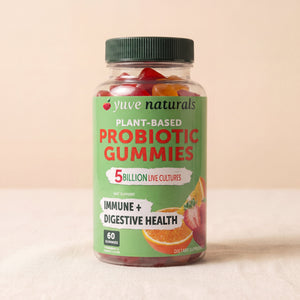
Yuve Vegan Probiotic Gummies list 5 billion CFU of Bacillus coagulans per two-gummy serving. The current Supplement Facts panel lists 10 calories, 4 grams of carbohydrate, 3 grams of sugar alcohol, and no gelatin; citrus pectin provides the gummy structure. The public label identifies Bacillus coagulans but does not display a strain code, so ingredient-level research on named B. coagulans strains should not be treated as direct proof for this exact formula. The spore-forming organism fits a shelf-stable gummy better than many fragile Lactobacillus or Bifidobacterium organisms, but buyers should still follow the stated storage and expiration information. The label directs adults to take two gummies daily, with or without food. Yuve’s digestion collection also includes fiber, enzymes, lactase, and DGL products; those ingredients perform different jobs and are not substitutes for a probiotic.
What mistakes make gummy-versus-pill comparisons unreliable?
The most common mistake compares one gummy with one pill instead of one complete serving with another. A second mistake compares front-label claims while ignoring ingredient forms, strain identity, other ingredients, and storage. A third mistake treats pleasant taste as evidence of effectiveness; taste can improve adherence, but it does not establish potency or purity. A fourth mistake assumes a pill is automatically more clinical or a gummy is automatically weaker. The vitamin D trial shows that a specific gummy can produce substantial absorption, yet its small sample and single nutrient prevent category-wide conclusions. A fifth mistake relies on “FDA approved” language. The FDA states that it does not approve dietary supplements for safety and effectiveness before sale. A sixth mistake ignores total intake from food, fortified products, and other supplements. The correct decision compares the exact formula, daily serving, evidence, safety context, and likelihood of consistent use.
What do people ask about gummy and pill effectiveness?
Do gummy vitamins absorb better than pills?
Not as a universal rule. One small vitamin D3 crossover study found higher exposure from its tested gummy, but formulation-specific results cannot be generalized to every nutrient or brand.
Are gummies weaker than capsules?
Not necessarily. Gummies may have less room for bulky ingredients, but a concentrated ingredient can still reach a meaningful amount when the complete serving and stability are appropriate.
Do gummies work if they contain sugar alcohols?
Sugar alcohols do not automatically prevent an active ingredient from working. They can affect digestive tolerance, so the amount and personal response still matter.
Are pills more accurately dosed?
Format alone does not prove dosing accuracy. Manufacturing controls, finished-product testing, label transparency, lot traceability, and independent certification provide more useful quality signals.
Can children use adult gummy supplements?
Adult supplements can contain unsuitable doses or ingredients for children. A pediatric clinician and the age-specific label should guide use, and gummies must be stored like supplements rather than candy.
Should gummies and pills be taken with food?
Follow the product directions. Fat-soluble nutrients may be absorbed differently with meals, while other ingredients have formula-specific timing or tolerance considerations.
What is the bottom line on gummies versus pills?

Gummies and pills can both be effective, but neither format earns that conclusion on shape alone. Compare the exact ingredient, chemical form or organism, full serving amount, stability, directions, other ingredients, and evidence. Gummies often make daily use easier for people who dislike swallowing pills; tablets and capsules often fit larger doses or more complex formulas into fewer units. A small vitamin D3 study demonstrates that a gummy can be bioavailable, but it does not establish universal superiority. Yuve Probiotic Gummies provide a transparent two-gummy serving with 5 billion CFU of Bacillus coagulans and a pectin base, while the missing strain code limits direct matching to strain-specific research. Use the Supplement Facts panel, not texture or taste, as the starting point. Consistent use helps only when the formula, dose, quality, and safety context also fit.