Most adults should aim for about 22 to 34 grams of fiber per day, depending on age, sex, and calorie needs. Another evidence-based rule is 14 grams per 1,000 calories, which equals 28 grams on a 2,000-calorie diet. Increase intake gradually, use varied food sources, and drink enough fluid for your circumstances.
How did we evaluate daily fiber targets?
We prioritized U.S. dietary reference values, National Institute of Diabetes and Digestive and Kidney Diseases guidance, and current Supplement Facts panels. We separated the 14-grams-per-1,000-calories rule from age- and sex-based adult targets because both describe adequate intake from different angles. We treated the FDA Daily Value as a label-comparison tool, not a personalized prescription. Whole foods came first because beans, lentils, whole grains, vegetables, fruit, nuts, and seeds provide different fiber structures plus other nutrients. Supplements were evaluated by declared grams, named fiber source, serving size, sweeteners, and tolerance—not by front-label words such as “gut health.” Evidence supports gradual increases and practical day-to-day tolerance differences, but no universal ramp-up schedule fits every digestive condition. People with persistent constipation, significant pain, bleeding, vomiting, unexplained weight loss, or a prescribed fluid restriction need individualized medical guidance.
How many grams of fiber do adults need each day?
NIDDK summarizes adult fiber targets as 22 to 34 grams per day depending on age and sex. Dietary reference patterns use approximately 14 grams for every 1,000 calories: about 21 grams at 1,500 calories, 28 grams at 2,000 calories, and 35 grams at 2,500 calories. The FDA Daily Value is 28 grams for a 2,000-calorie diet. These numbers are reference points rather than a reason to force the same intake during illness, after gastrointestinal surgery, or when a clinician has prescribed a modified-fiber diet. A person eating 18 grams now does not need to reach 28 grams overnight. The NIDDK guidance recommends adding fiber a little at a time so the body can adjust. The best target combines an appropriate reference value, diverse food sources, adequate fluid, and a pace that remains comfortable.
| Daily calories | Fiber at 14 g per 1,000 kcal | How to use the number |
|---|---|---|
| 1,500 kcal | 21 g | Lower-energy reference |
| 2,000 kcal | 28 g | Matches the FDA Daily Value |
| 2,500 kcal | 35 g | Higher-energy reference |
How can you calculate your current fiber intake?
Track three ordinary days rather than your best eating day. Record serving sizes, then use Nutrition Facts labels for packaged foods and a reliable nutrient database for foods without labels. Add dietary fiber grams across breakfast, lunch, dinner, snacks, beverages, and supplements. Do not count “prebiotic blend” milligrams as dietary fiber unless the label declares fiber grams. Average the three daily totals, compare that number with the relevant 22-to-34-gram range or 14-grams-per-1,000-calories estimate, and calculate the gap. For example, an average of 19 grams against a 28-gram reference leaves a 9-gram gap. Fill that gap across meals and days rather than with one large dose. The Dietary Guidelines evidence framework uses 14 grams per 1,000 calories as the basis for fiber adequate intake. Labels and databases contain estimates, so consistency matters more than decimal-level precision.
Which foods make the daily target easier to reach?
Build fiber from several categories because different foods provide different mixtures of soluble, insoluble, viscous, and fermentable carbohydrates. Best for a large meal contribution: beans, lentils, and split peas. Best for breakfast: oats, bran cereal, chia, berries, or whole-grain toast. Best for snacks: pears, apples with skin, raspberries, nuts, or seeds. Best for dinner: vegetables, intact whole grains, and legumes. Keep portions realistic and read labels because “multigrain” does not guarantee a high-fiber serving. Food-first fiber also brings protein, minerals, vitamins, polyphenols, and water that a concentrated supplement may not provide. A supplement can close a measured gap, but it should not displace the rest of the diet. The table compares formats by contribution and tolerance rather than declaring one source universally best.
| Source | Best for | Main limitation |
|---|---|---|
| Beans and lentils | Large food-first contribution | May need gradual portion increases |
| Whole grains, fruit, vegetables | Daily variety and nutrients | Requires meal planning |
| Psyllium powder | Measured viscous fiber | Needs adequate liquid and medication spacing |
| Inulin gummy | Small convenient prebiotic serving | Can increase gas when raised quickly |
How should you increase fiber without causing extra gas?
Increase one source at a time and hold the new amount for several days before adding more. A practical sequence might add a piece of fruit, then a legume serving, then a measured supplement only if a gap remains. Fermentable fibers such as inulin can create gas because colonic microbes use them, while a sudden large psyllium serving can feel heavy without enough liquid. Pair fiber with water and other fluids appropriate for your activity, climate, medicines, and health conditions; NIDDK notes that liquids help fiber work better. Keep meal timing and other supplements stable during the first week so discomfort has a traceable cause. Reduce the latest change if pain, bloating, or stool disruption persists. Seek medical advice for severe abdominal pain, vomiting, inability to pass stool or gas, blood in stool, black stool, fever, dehydration, or unexplained weight loss. People with swallowing problems, bowel narrowing, recent surgery, or fluid restrictions should ask a clinician before using concentrated fiber.
How do Yuve Prebiotic Fiber Gummies fit a daily fiber goal?
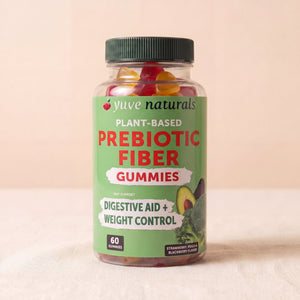
Some links below may be affiliate or product links. This does not influence our evaluation criteria or recommendations. Yuve Prebiotic Fiber Gummies list 1.5 grams of dietary fiber as chicory-root inulin/FOS per gummy and suggest one to two gummies daily. One gummy supplies a small, repeatable prebiotic serving; it does not replace an adult target of roughly 22 to 34 grams. Two gummies would provide 3 grams, so a person averaging 19 grams would still need food or another appropriate source to reach a 28-gram reference. Inulin is fermentable, which supports its prebiotic role but can also increase gas when intake rises quickly. Best for convenience: someone who wants a measured gummy and starts gradually. Best for closing a large gap: food plus a higher-gram format selected for tolerance. The digestive health collection includes different categories, but probiotics, enzymes, and fiber should not be counted as interchangeable grams.
What are common questions about daily fiber intake?

Is 25 grams of fiber enough?
For many adults, 25 grams falls within the age- and sex-based target range.
Is 30 grams of fiber too much?
Thirty grams fits the reference range for many adults. The pace of increase, fiber type, fluid intake, and individual medical context often determine tolerance more than the number alone.
Should fiber come from food or supplements?
Food should provide the foundation because it supplies varied fibers and other nutrients. A labeled supplement can close a measured gap when convenience or consistency is the limiting factor.
Do prebiotics count as dietary fiber?
Some prebiotics, including inulin, are dietary fibers. Count the grams declared as dietary fiber on the label rather than assuming every “prebiotic” ingredient contributes a specific amount.
Can fiber make bloating worse?
Yes. Large or rapid increases, especially in highly fermentable fibers, can increase gas and fullness. Reduce the latest change and increase more slowly if symptoms are mild and no warning signs are present.
How much fiber do children need?
Children’s needs vary substantially by age, sex, and energy intake. Use pediatric dietary guidance and ask a pediatrician or registered dietitian before giving an adult fiber supplement to a child.