In May 2021, ISAPP defined a postbiotic as “a preparation of inanimate microorganisms and/or their components that confers a health benefit on the host.” In plain English, that means deliberately inactivated microbes or their cell parts, prepared in a way that has demonstrated a health benefit.
If your stomach feels like a balloon by afternoon, another gut-health label can sound like another promise to buy. You deserve something more useful: a clear explanation of what's inside, what human studies support, and how to tell a meaningful preparation from clever packaging.
What Are Postbiotics Next to Probiotics and Prebiotics
Postbiotics don't have to be alive to have biological effects. But a capsule doesn't qualify because its bacteria are no longer living; the preparation must also meet the criteria below.
The ISAPP consensus statement turns the idea into a testable category: deliberately inactivated microorganisms or their components, plus a demonstrated benefit in the intended host. For a product marketed to people, that means relevant evidence in people, not just an interesting result in a laboratory dish.
Probiotics, prebiotics, and postbiotics at a glance
| Category | What it is | Must be alive | Familiar example | Main job |
|---|---|---|---|---|
| Probiotic | Live microorganisms with a shown health benefit | Yes | Yogurt or kefir with live cultures, when the cultures meet probiotic criteria | Deliver viable microbes |
| Prebiotic | Substrate selectively used by beneficial microbes | No, it is food for microbes | Chicory inulin, garlic, onions, oats | Feed resident or added microbes |
| Postbiotic | Inanimate microorganisms and/or their components with a shown health benefit | No | Characterized heat-killed Lactobacillus preparation with demonstrated benefit | Provide inactivated cells or cell parts |
| Fermented food | Food changed by microbes during fermentation | Sometimes | Kimchi, sauerkraut, kefir | Flavor and preservation; any probiotic, prebiotic, or postbiotic claim needs its own evidence |
The everyday examples help orient you, but a food name alone doesn't establish a health claim. A tub of yogurt with live cultures isn't automatically evidence that those cultures will improve your particular symptoms.
For a closer comparison of the living-microbe and food-for-microbes categories, Yuve's guide to prebiotics versus probiotics provides useful background.
The tests behind the term
A preparation earns the name only when the exact item on the label can pass these checks:
- Intentional inactivation. The manufacturer deliberately inactivated the microbes using a described process. Bacteria accidentally dying in an old probiotic bottle don't turn it into a validated postbiotic.
- Identifiable microbial material. Whole cells or recognizable cell components remain. Metabolites, the substances microbes make, can accompany them but aren't enough alone.
- A match to the studied preparation. The label should let you compare the organism, processing method, and amount with what was tested, rather than waving at a broad strain family.
- A demonstrated benefit. The preparation must produce a health benefit in its intended host. An ingredient's scientific-sounding name isn't a substitute for that evidence.
Why is the wording so careful? A scientific review published in 2022 noted six competing definitions before the consensus, helping explain why older articles use loose descriptions such as dead probiotics.
The practical shift was from naming leftovers to evaluating a characterized preparation: what microbes were used, how they were inactivated, which components remained, and what benefit was measured.
Gut-health conversations also reach beyond digestion. For family-focused background, Daily Powers explains the gut-brain connection in children; evidence about that connection still doesn't make a specific postbiotic appropriate for a child.
Label takeaway: Non-live can be useful when the preparation is defined and studied. A vague dead-bacteria ingredient still leaves the benefit unproven.
How Postbiotics Talk to the Gut Without Moving In
A microbial component works like a key, and a receptor on one of your cells is the lock. The key does not need a living hand behind it to fit the lock and trigger a response.
That is a cleaner way to think about gut signaling than assuming probiotics must move in permanently. Live probiotics can act while passing through, and postbiotic preparations can interact with the body even though their organisms are already inactivated.
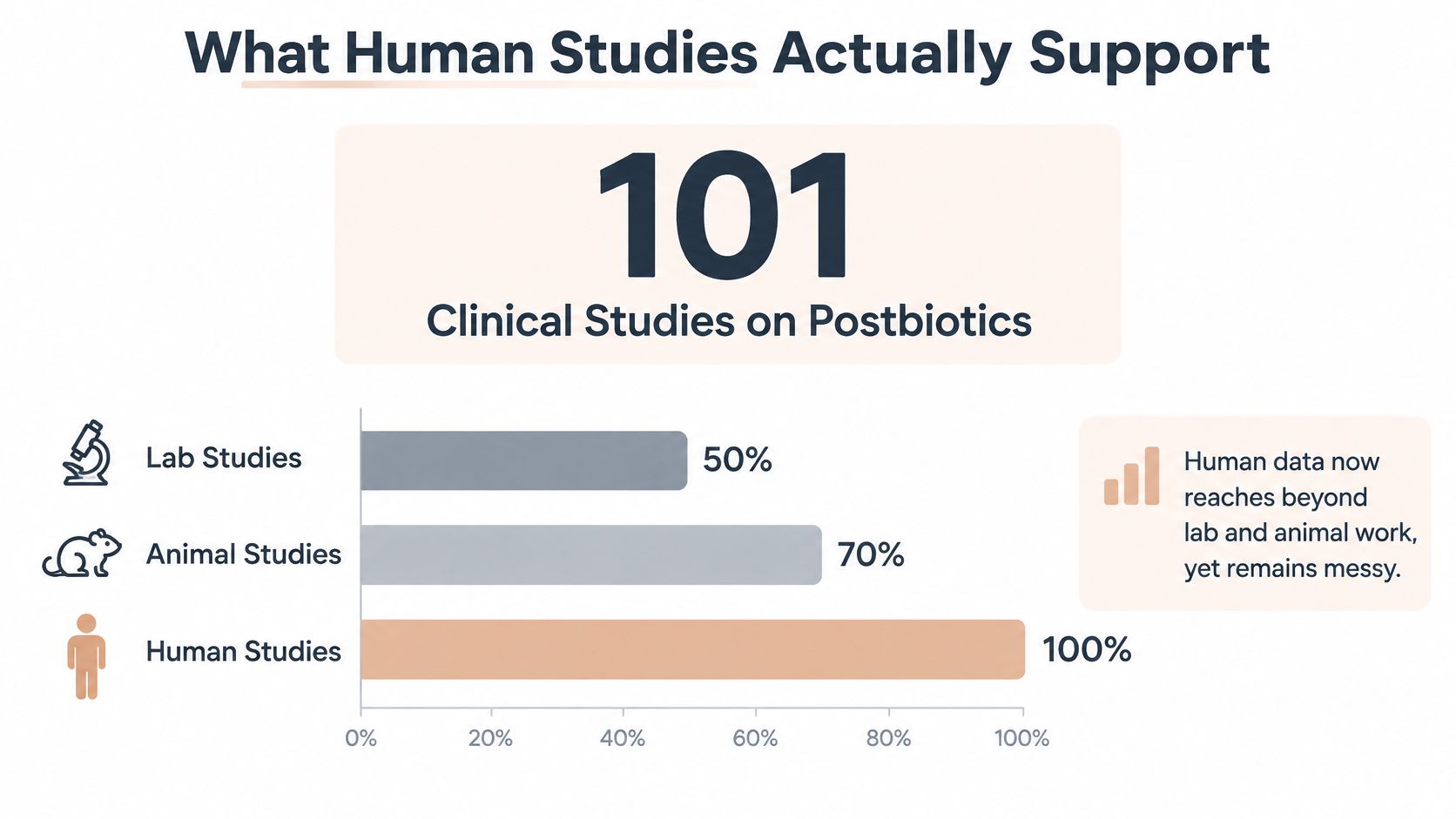
The chart below gives a quick visual sense of how postbiotic research is spread across laboratory, animal, and human work.
The routes researchers are investigating
The ISAPP framework on postbiotic action describes five plausible pathways:
- Changing the resident community. A preparation may influence microbes already living in the intestine.
- Supporting the gut barrier. Components may interact with the cells that form the intestinal lining.
- Regulating immune responses. Effects may involve immune activity within the gut and elsewhere in the body.
- Influencing metabolism. Microbial signals may affect how the body processes and responds to nutrients.
- Signaling through the nervous system. Some pathways may connect microbial activity with nerve signaling.
These are routes scientists investigate when they try to explain an observed effect. A label cannot borrow all five just because the category sounds promising.
If the resident-community part is fuzzy, Yuve's explanation of what the gut microbiome is separates the microbes already living in you from the preparation you swallow.
What your cells might recognize
Candidate components include cell-wall structures, proteins, organic acids, bacteriocins, and short-chain fatty acids such as butyrate. A particular preparation may contain some of these, never the entire list by default.
Your immune cells carry pattern-recognition receptors, which act a little like identification scanners at a door. A review of postbiotic mechanisms describes how microbial structures can interact with these receptors and discusses potential barrier-supporting and antioxidant effects of some exopolysaccharides, complex sugars associated with microbes.
That is biologically interesting. It still leaves open whether a gummy, powder, or drink will calm your afternoon gas.
The video below offers another format for exploring the topic.
The practical distinction is stability. Effectiveness still has to be demonstrated. Because the organisms are already inactivated, manufacturers do not need to keep them alive on the shelf or after swallowing.
They still need to preserve the relevant components and show that the preparation remains suitable through storage. The source strain, inactivation process, composition, dose, and human evidence still need to match what is in the bottle.
What Human Studies Actually Support
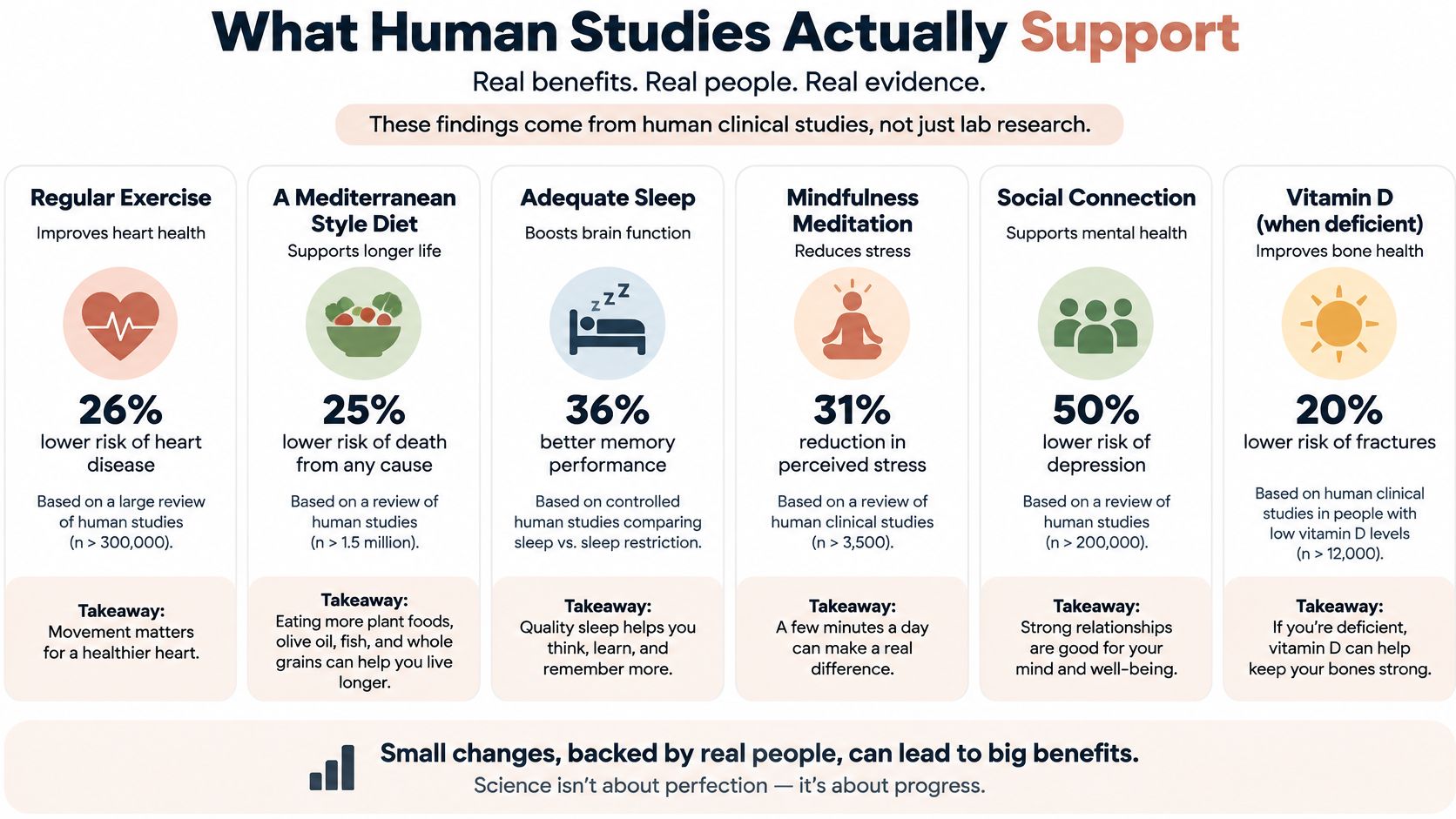
A postbiotic label can say "clinically studied" while the study it borrows tested a different strain, a different dose, or a different complaint than yours. Human research on postbiotics clusters around a handful of areas, and each one carries a limit worth knowing before you buy.
| Area | What reviews suggest | How firm | Shopper limit |
|---|---|---|---|
| Gut and barrier | Some preparations may support barrier function or digestive outcomes | Preparation-specific human data | Not proof that every product eases bloating |
| Skin | Dermatological outcomes appear in parts of the clinical literature | Early and product-specific | Not a general skin guarantee |
| Metabolism | Microbial signals, including butyrate pathways, are biologically plausible | Mechanisms incomplete | A purified butyrate capsule sits outside the definition |
| Immune signaling | Cell components can interact with immune receptors | Needs trials of the finished preparation | Not a vaccine or a reason to self-treat illness |
| Respiratory or neurological | Reviews include these among studied areas | More randomized, placebo-controlled trials needed | Don't self-treat these conditions |
A clinical-evidence review describes potential benefits across gastrointestinal, skin, metabolic, respiratory, and neurological conditions, while stressing that mechanisms remain incomplete and more randomized, placebo-controlled trials are needed. Potential across a category isn't proof for every preparation.
A mechanism isn't a symptom result
Butyrate is a useful example. It can signal through receptors called GPR41 and GPR43 and inhibit histone deacetylases, enzymes involved in the cell's gene switches. Those actions are associated with changes in inflammatory signaling and intestinal-barrier regulation. None of that establishes that the capsule in your hand will relieve your bloating.
For someone dealing with gas and a tight waistband, the question is narrower: did people with similar symptoms improve after taking this exact preparation? A trial measuring a skin outcome, an immune marker, or a different digestive complaint can't answer that question for you.
A plausible explanation tells us why something might work. A relevant human trial tells us whether it helped the people who took it.
What a useful study needs to match
Before a study can support a label claim, it should match the product on five points:
- Microbial source: the strain or organism is identified, not just named vaguely.
- Inactivation method: how the microbes were rendered inanimate is documented.
- Composition: what remains after inactivation is characterized.
- Dose and stability: a defined amount, with evidence it stays intact through storage.
- Human testing: the trial used the finished preparation, rather than borrowing results from a live probiotic or an isolated metabolite.
When checking original papers through PubMed or NIH resources, look past the abstract's conclusion. Compare the participants, the formulation, the measured outcome, and how adverse events were reported.
A long bibliography isn't the same as evidence for your symptom. One relevant, well-described trial tells you more than a stack of loosely related findings.
Examples That Count and Ones That Do Not
A heat-treated microbial preparation and a capsule of purified butyrate might sit beside each other in a gut-health shop. Under the scientific definition, they aren't interchangeable.
The distinction isn't whether the ingredient sounds natural or beneficial. It's what the preparation contains and whether that preparation has demonstrated a benefit.
What qualifies as a postbiotic preparation
| Example | Counts under ISAPP | Why |
|---|---|---|
| Heat-killed whole cells of a characterized strain | Yes, if a host benefit is shown | Inanimate microorganisms with a demonstrated benefit |
| Cell-wall fragments such as peptidoglycan | Yes, if a host benefit is shown | Identifiable components of the microbe |
| Inactivated cells plus metabolites from that preparation | Yes, if a host benefit is shown | Metabolites may be included, but cells or components must be present |
| Isolated butyrate or another short-chain fatty acid alone | No | Purified metabolites are excluded when provided alone |
| Isolated protein, peptide, or exopolysaccharide alone | No | Purified substances don't meet the inanimate-microbe requirement |
| Vaccine | No | Explicitly outside the postbiotic definition |
| Live probiotic capsule | No | That is a probiotic because the microbes are viable |
The ISAPP definitions guide reinforces that the source microorganism must be identified and characterized and the production process described. Finding microbial material in a product doesn't establish its status.
Consider a hypothetical label that names a heat-inactivated strain and directs you to a human study of that preparation. That gives you something concrete to investigate, although you still need to check the dose, participants, and measured benefit.
A label that says only fermented goodness gives you much less to work with. Fermentation describes a process, not a demonstrated clinical outcome.
Where yogurt and kimchi fit
Yogurt, kefir, kimchi, and sauerkraut can contain a mixture of live microbes, microbial remnants, and fermentation acids. Manufacturing and storage influence that mixture, so dinner isn't equivalent to a measured postbiotic preparation.
You can enjoy these foods without assigning them a supplement category. Yuve's guide to fermented foods with live cultures helps distinguish the food itself from claims about the organisms it contains.
There's also a separate process happening inside your colon: resident microbes ferment available fibers and produce substances including short-chain fatty acids. Foods such as oats, onions, and chicory-derived inulin can contribute fermentable material, but that doesn't turn the food, or every acid produced from it, into a defined postbiotic product.
Practical rule: If the ingredient list names only an isolated acid, or says fermented without identifying the microbial preparation, don't classify it as a postbiotic on that wording alone.
Why One Postbiotic Is Not Like Another
Postbiotics aren't automatically the safer probiotic. Being non-live removes the need to maintain living cultures and may reduce certain risks associated with administering viable organisms, but it doesn't establish universal safety.
A review of postbiotic formulations and safety emphasizes unresolved standardization, dosing, and regulatory questions, alongside the need to assess individual preparations. Children, pregnant people, and immunocompromised consumers shouldn't be treated as interchangeable with healthy adults in a trial.
The label questions worth asking
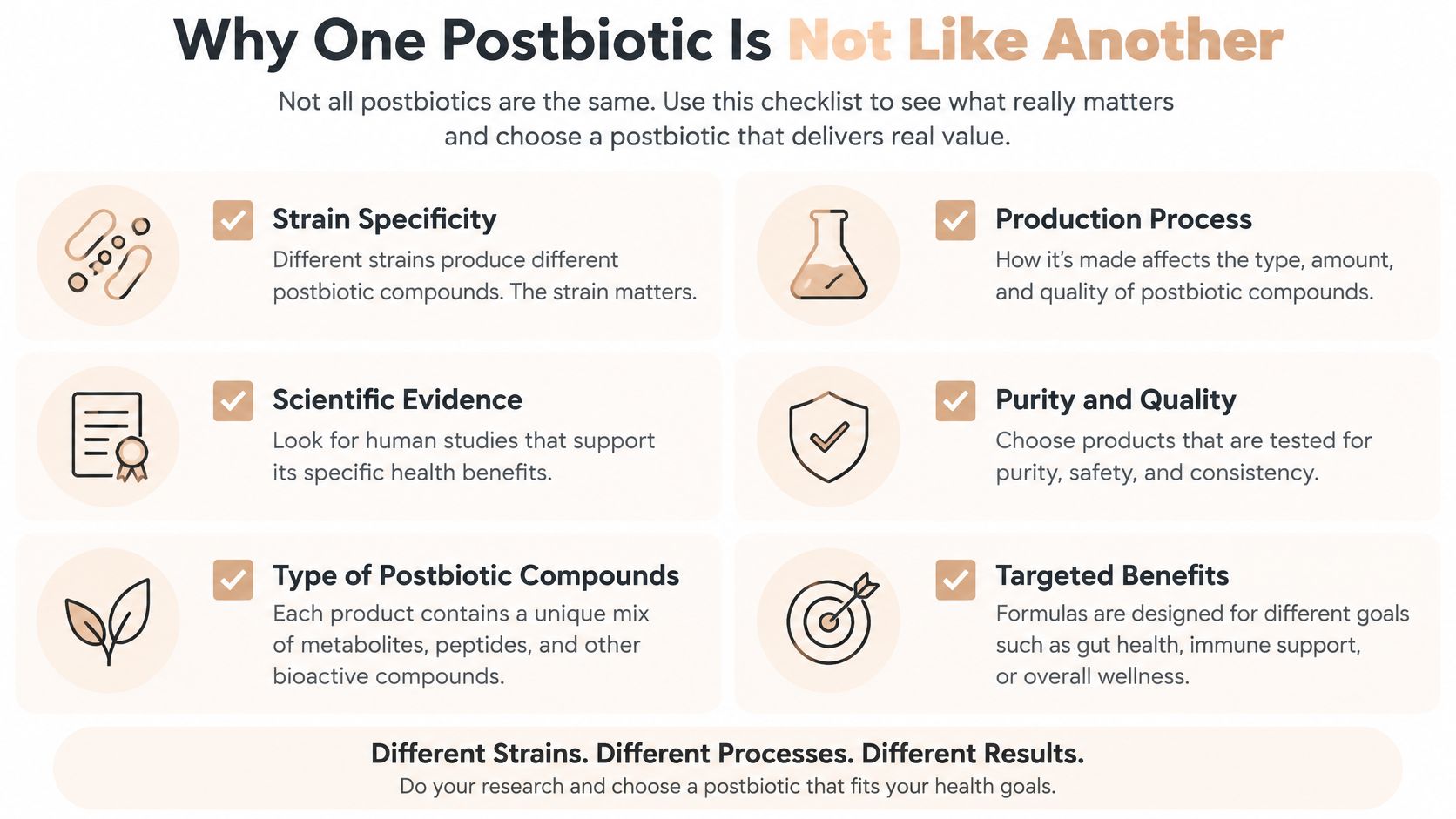
Use this checklist before paying for a category name:
- Which microorganism was used? Look for the species and, where available, the strain identifier.
- How was it inactivated? Heat treatment or another named process is more informative than proprietary processing.
- What remains? Ask whether the preparation contains whole cells, defined cell parts, or a characterized mixture.
- Does the serving match the studied dose? A familiar ingredient name at a different dose isn't the same intervention.
- Was this finished preparation tested in humans? Research on its live counterpart or a laboratory metabolite doesn't automatically transfer.
- Who participated? Check whether the participants resemble you in age, health status, and digestive concerns.
Keep this visual checklist beside the label while you compare those details.
When to pause rather than purchase
- An unnamed blend. Postbiotic blend without a species or preparation identifier makes the evidence difficult to verify.
- A mismatched serving. A dose below the amount used in the relevant trial doesn't inherit that trial's result.
- Treatment promises. Claims to treat IBS, allergies, or infections aren't ordinary digestive-support promises and shouldn't guide self-treatment.
A product can also be well characterized without being right for you. If symptoms persist, worsen, or interfere with daily life, a clinician can help investigate the cause rather than adding another supplement.
For a human example, consider a hypothetical founder named Sam who still feels swollen after lunch despite keeping a gut product on the counter. His next useful step isn't buying a more impressive label, but checking what the existing product contains and what outcome its evidence supports. That's the purpose of this checklist, not a promise that another purchase will solve the problem.
If you've been in that position, share what your label says in the comments. The microorganism, preparation name, serving information, and claimed benefit are more useful starting points than the biggest word on the front.
Postbiotics Questions Readers Ask
Definitions and safety
What are postbiotics in one sentence?
Postbiotics are preparations of inactivated microorganisms or their components that demonstrate a health benefit. The benefit belongs to the characterized preparation, not to everything marketed under the same category.
Are postbiotics the same as dead probiotics?
Not quite, because a qualifying preparation must retain whole microbial cells or identifiable components and demonstrate a benefit in its intended host. A probiotic that loses viability during storage doesn't automatically become a validated postbiotic.
Are postbiotics safer than probiotics?
Being non-live can reduce some concerns associated with viable microorganisms, but safety still needs to be established for each preparation. Don't assume an adult study establishes suitability during pregnancy, for children, or for someone with a weakened immune system.
Symptoms, foods, and supplements
Do postbiotics help bloating?
Some preparations are investigated for digestive outcomes, but there's no basis for promising that every postbiotic will relieve bloating. Look for human evidence that specifically measured the symptom you want to improve, using the same preparation and serving.
Can I get postbiotics from yogurt or kimchi?
Fermented foods may contain live microbes, leftover microbial components, and acids, but a serving isn't automatically a measured postbiotic dose. Enjoy them as foods you tolerate rather than assuming they reproduce a clinical preparation.
Are Yuve gummies postbiotics?
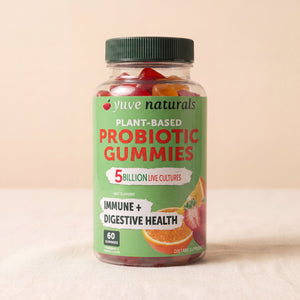
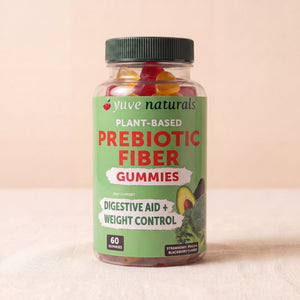
The probiotic and prebiotic gummies discussed below belong to their respective live-microbe and microbial-food categories, not the postbiotic category. Pairing those categories creates a daily stack, but it doesn't convert them into an ISAPP-defined postbiotic or guarantee bloating relief.
Start With Food and a Daily Gut Stack
Make this week about a repeatable routine and clearer choices, not collecting more gut-health labels.
- Keep tolerated fiber in meals. Start with familiar foods such as oats or banana, and include cooked onion only if it agrees with you. You don't need to force a food that reliably makes you uncomfortable just because it appears on a gut-health list.
- Check before buying a postbiotic. Require a named microorganism, a described inactivation process, and a human-tested preparation and dose. If those details aren't available, you don't have enough information to match the bottle to the evidence.
- Build a clearly labeled daily base. Our Vegan Probiotic Gummies contain 5 billion live cultures per gummy, priced at $27.49 one-time or $23.37 on subscription. Pair them with Vegan Prebiotic Fiber Gummies, containing chicory-root inulin formulated to support beneficial gut bacteria, at $22.10 one-time or $18.79 on subscription.
These plant-based gummies form a probiotic and prebiotic stack, not an ISAPP postbiotic. Take them according to their labels and track how you feel rather than treating consistency as a guarantee of results.
For general supplement education, consult the NIH Office of Dietary Supplements. On Yuve's site, explore related bloating and dairy-reintroduction reading to help separate food-specific discomfort from broader digestive concerns.
We offer free shipping over $75 and a 60-day money-back guarantee as practical buying details. After two consistent weeks, share what changed, what didn't, and whether particular meals still trigger symptoms.
These statements have not been evaluated by the Food and Drug Administration. This product is not intended to diagnose, treat, cure, or prevent any disease.
Yuve offers plant-based probiotic and prebiotic gummies for a daily gut-health routine, with distinct roles that shouldn't be confused with postbiotics. Visit Yuve to explore the pair, compare the labels, and choose your next step with a clearer understanding of what you're taking.