Yes, certain probiotics can support gut health in defined situations: in children taking antibiotics, diarrhea occurred in 8% receiving probiotics versus 19% without them. They aren't all-purpose fixes, though, because the benefit depends on the strain, dose, and goal.
If you're reading this with a tight waistband after lunch or wondering why dinner left you uncomfortable again, that distinction matters. You deserve something more useful than another bottle promising to “balance everything.” A thoughtful choice starts with the symptom you want to improve, not the biggest number on the label.
That Bloated, Gassy Feeling Is Not Just You
You're finishing dinner with friends when your stomach starts feeling stretched. You discreetly loosen your waistband, wonder whether it was the meal, and mentally add probiotics to your shopping list.
That's a relatable situation, not a diagnosis. Bloating is a symptom, not a product-selection guide, and the same uncomfortable feeling doesn't tell us which supplement, if any, makes sense.
The frustrating part is that gut-health packaging often makes the decision look simple. One bottle emphasizes “billions,” another highlights a long list of bacteria, and another promises everyday digestive balance. None of those phrases tells you whether researchers tested that particular formulation for your particular complaint.
Start With the Question Behind the Symptom
Instead of asking only “Are probiotics good for gut health?”, get more specific about what's happening:
- After meals: Are you mainly noticing fullness and gas, without a change in your bowel habits?
- During antibiotics: Are you trying to prevent antibiotic-associated diarrhea?
- With ongoing bowel symptoms: Are pain, urgency, constipation, or loose stools part of the picture?
- After starting a supplement: Did the discomfort begin when you changed your routine?
These aren't interchangeable problems. They deserve different conversations, and sometimes they deserve medical assessment rather than another supplement experiment.
Yuve's guide to whether probiotics can cause gas and bloating offers a relevant starting point if you're questioning a new routine. Treat that information as a prompt to review what changed, not as proof that every uncomfortable symptom is harmless.
Support Should Fit Your Situation
My approach is simple: you shouldn't have to guess your way through persistent discomfort. Wanting relief is reasonable, but buying a product before identifying the problem can leave you with more uncertainty.
If getting to an appointment is difficult, Vitals Healthcare Doctor On Call offers a resource to help you find home care for stomach issues. Use it to explore care access rather than relying on supplements to explain unresolved symptoms.
Your discomfort deserves attention even when a product's label makes digestive health sound effortless.
How the Gut Microbiome Actually Works
Think of your gut microbiome as a garden rather than a jar you need to fill with “good bacteria.” The garden analogy helps because adding something new and caring for what's already there are different tasks.
A packet of seeds isn't a complete gardening plan. Likewise, swallowing microorganisms isn't the same as proving that your digestion, symptoms, or overall health will improve.
The illustration below offers a visual starting point for that garden analogy.

Seeds, Food, and What Comes After
Three terms often appear together on gut-health labels. In plain language, they describe different approaches:
- Probiotics: Live microorganisms used for a demonstrated health benefit, not any bacteria in a product.
- Prebiotics: Substances intended to feed beneficial microorganisms, rather than add new ones.
- Postbiotics: Preparations involving inactivated microorganisms or their components, rather than live organisms.
Those distinctions help you ask better questions. Are you considering a live strain studied for a symptom, something intended to nourish existing microbes, or a different type of preparation entirely?
The NIH Office of Dietary Supplements' probiotic guidance emphasizes choosing strains, doses, and durations supported by human studies. For you, that means the useful question isn't whether a label sounds microbiome-friendly. It's whether the evidence matches the intended use.
The garden metaphor also has limits. It doesn't let us diagnose “imbalance” from an afternoon of bloating, and it doesn't establish that a supplement improves immunity or mood just because the packaging mentions the gut.
Feeling Better and Changing the Microbiome Aren't Identical
Suppose you track urgency while trying a product and notice improvement. That's a meaningful symptom observation, but it doesn't establish what happened to your microbiome.
Conversely, a claim about changing bacteria doesn't automatically tell you whether you'll feel more comfortable after dinner. Look for the outcome that matters to you, not just a scientific-sounding description of microbial changes.
Yuve's science of gut health guide can help you build familiarity with the vocabulary before comparing products. I'd rather you feel comfortable asking a basic question than feel pressured to understand every organism name immediately.
For households also researching pet digestion, PetScy's dog probiotic for digestive support resource addresses a separate audience. Keep that research separate from your own choices: it isn't evidence for selecting a human supplement.
What the Evidence Actually Shows
The strongest answer isn't “probiotics work” or “probiotics don't work.” It's that some formulations help with certain measurable outcomes, while other uses remain uncertain.
That distinction is encouraging. We can take a useful finding seriously without turning it into a promise about every digestive complaint.
Antibiotic-Associated Diarrhea
A 2017 Cochrane review included 31 randomized or quasi-randomized studies involving 8,870 participants and reported antibiotic-associated diarrhea in 12% receiving probiotics versus 18% receiving placebo or no treatment, with a pooled relative risk of 0.58, approximately a 42% relative reduction.
The review supports a targeted use during antibiotic exposure. It doesn't establish that a random probiotic bottle will prevent bloating, fix constipation, or benefit someone who isn't taking antibiotics.
The childhood evidence behind the opening comes from a 2019 Cochrane review of 33 studies involving 6,352 children: diarrhea occurred in 8% with probiotics versus 19% with placebo or no probiotic, with a relative risk of 0.45, a 95% confidence interval of 0.36 to 0.56, and approximately 11 fewer cases per 100 treated children.
That's a concrete benefit for a defined situation. It isn't evidence that all children need a daily probiotic, or that products tested in children produce the same results in every adult.
Probiotic Evidence by Situation
| Situation | What the Evidence Shows | Honest Caveat |
|---|---|---|
| Antibiotic-associated diarrhea | The reviews above support a preventive benefit with studied probiotic interventions. | The formulation and patient population still matter. |
| Children taking antibiotics | The pediatric review found fewer diarrhea cases with probiotics. | Ask a child's clinician which product and regimen fit. |
| Acute infectious diarrhea | Guidance and higher-quality analyses don't give a uniformly positive answer. | Don't treat prevention during antibiotics and treatment of an infection as equivalent. |
| IBS symptoms | Some products may improve selected symptoms. | Overall evidence doesn't support a confident promise of broad relief. |
| Undefined “overall gut health” | The evidence presented here addresses specific outcomes. | A broad marketing phrase isn't a clinical endpoint. |
IBS Requires More Caution
The National Center for Complementary and Integrative Health's IBS evidence summary says benefits haven't been conclusively demonstrated and notes that 2021 American College of Gastroenterology guidelines recommended against probiotics for global IBS symptoms.
That doesn't mean nobody can feel better with a particular formulation. It means we shouldn't present probiotics as a reliable treatment for the whole IBS picture.
For someone already worn down by pain and unpredictable bowel habits, that honesty matters. A clinician-supported trial may be a reasonable discussion, but it shouldn't displace evaluation or established treatment.
Reading rule: Match the study's outcome to your goal. Preventing diarrhea during antibiotics isn't the same claim as relieving everyday bloating.
Matching Strains to Symptoms
Two bottles can both say “probiotic” and still represent very different choices. The useful identifying detail is the full strain designation, including the letters or numbers after the organism's name.
A systematic review of 228 controlled trials found strain-specific and disease-specific efficacy, with evidence supporting 7 of 10 strains for preventive indications and 11 of 17 for treatment indications. In everyday terms, you can't transfer a result from one strain to every related organism.
Use the illustration as a reminder to compare products by purpose, not appearance.
Build a Symptom-to-Evidence Match
| Your Goal | What to Investigate | What Not to Assume |
|---|---|---|
| IBS-type discomfort | Human evidence for Bifidobacterium longum 35624, with the measured symptoms clearly identified | That evidence for selected symptoms overrides the uncertainty about global IBS treatment |
| A child taking antibiotics | Ask the pediatric clinician about named candidates such as Lactobacillus rhamnosus GG, including the relevant evidence and regimen | That an adult product or unspecified Lactobacillus is equivalent |
| Antibiotic-related diarrhea in an adult | The exact formulation studied for prevention in a comparable population | That a childhood study automatically establishes the adult choice |
| Bloating after meals | Evidence specifically measuring bloating in people with a comparable problem | That any “digestive balance” blend has that evidence |
| Travel-related digestive concerns | Whether the product has human evidence for the precise prevention or treatment goal | That antibiotic-associated diarrhea research proves protection during travel |
This table is a research starting point, not a prescription. Where the available evidence doesn't establish a match, the honest answer is to keep investigating rather than invent a recommendation.
Read the Whole Name
Bifidobacterium identifies a broad group, longum narrows it, and 35624 identifies the strain in this example. Leaving off the final designation removes information you need when comparing a label with a study.
Yuve's guide to the 35624 strain and its naming offers background for readers who encounter different names while researching. Don't assume similar-looking names mean the bottle contains the studied organism.
If a label lists only a genus or species, ask the manufacturer for the strain designation and supporting human research. If it can't provide those details, you can't make a confident evidence match.
- Check the population: Were participants children, adults, or people with a diagnosed condition?
- Check the endpoint: Did researchers measure pain, urgency, stool consistency, or something else?
- Check the formulation: Does the product match the studied strain or combination?
- Check the regimen: Can you identify the tested dose and duration?
Common Myths and Misleading Claims
The loudest claims in the supplement aisle are often the least helpful for making a careful choice. You don't have to become cynical, but you can become harder to impress.
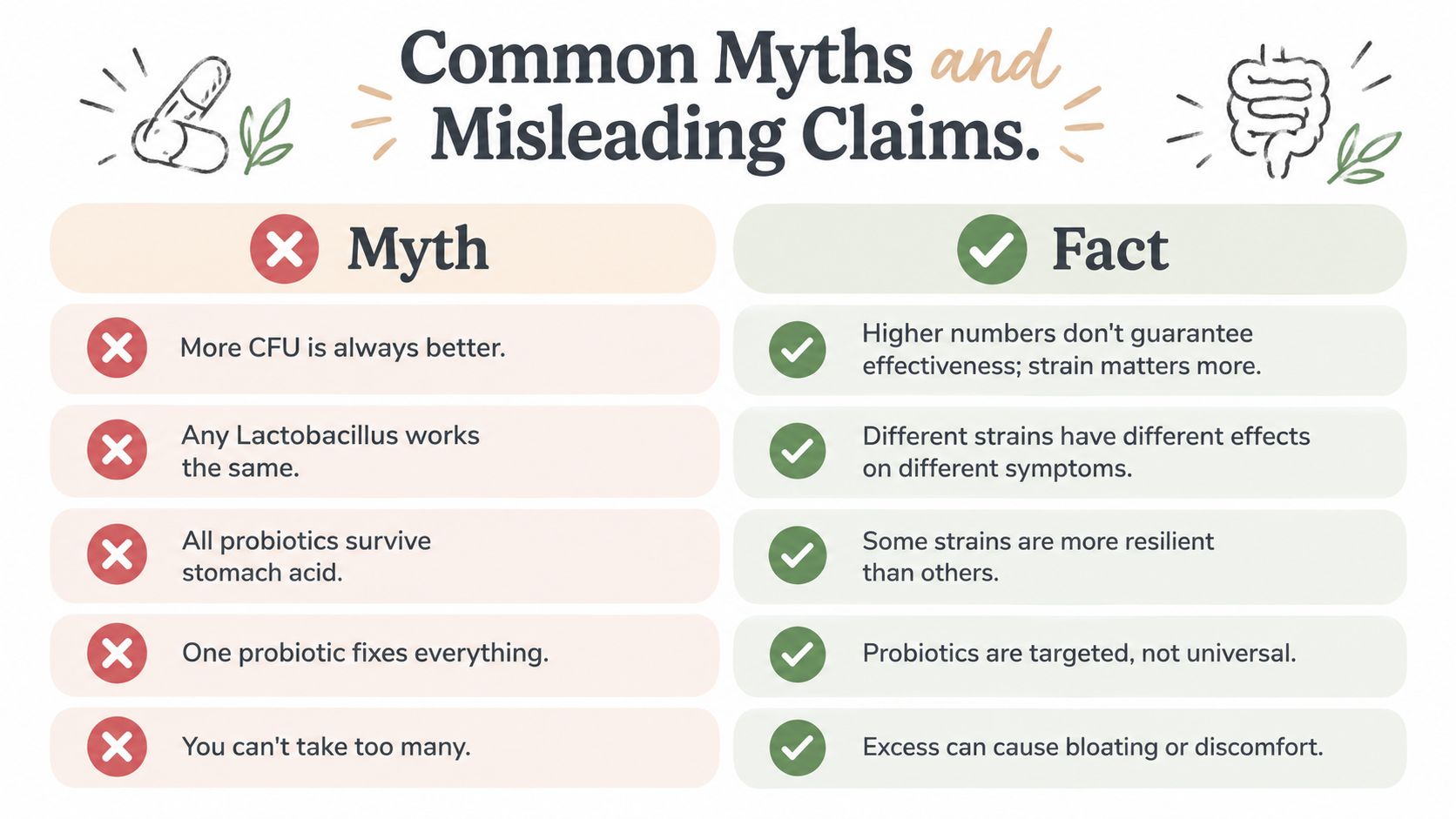
This visual highlights familiar marketing assumptions. Use the evidence discussion below to evaluate them rather than treating every simplified graphic statement as a prescribing rule.
Bigger Counts Don't Establish Better Results
CFU, short for colony-forming units, is a measure used to describe viable microorganisms. It isn't a score for how effective a product will be.
World Gastroenterology Organisation guidance describes IBS symptom benefit with Bifidobacterium longum subsp. longum 35624 at 100 million CFU daily, while other tested products required approximately 300–450 billion CFU three times daily.
Those aren't competing doses for you to choose between. They show why the appropriate amount belongs to the particular formulation and clinical use.
More isn't a substitute for a match.
Claims That Need More Than a Catchphrase
- “Any Lactobacillus works the same.” The strain-specific findings discussed earlier don't support that shortcut.
- “Probiotics permanently reset your gut.” Don't accept a lasting-change claim without evidence demonstrating that outcome.
- “Healthy people need them every day.” Research on selected conditions doesn't establish a universal daily requirement.
- “Food-derived probiotics are always inferior.” Compare the evidence for the intended use rather than ranking foods and supplements by category alone.
- “One blend fixes everything.” Ask which symptoms researchers measured, not how many promises fit on the packaging.
A further quality question is whether the stated viable count is supported through the product's shelf life. A label number is less useful if you can't tell what it represents or whether storage instructions have been followed.
For a video companion to these questions, the embedded discussion is below. Keep applying the same standard to spoken claims that you apply to labels.
My editorial view is straightforward: I don't think a bigger microbial shopping list is a good reason to buy a product. Clear strain identification, relevant human evidence, and realistic expectations are more useful decision criteria.
How to Start, Track, and Decide If It's Working
Start with a written goal, not a vague hope to feel healthier. “Less urgency” gives you something to observe; “a better microbiome” usually doesn't.
Before beginning, discuss suitability with a clinician if you have significant illness, ongoing unexplained symptoms, or concerns about your child. During antibiotic treatment, ask the prescriber or pharmacist about the specific product's timing instead of following a universal online schedule.
Make Your Trial Interpretable
- Record your starting point. Note bloating, abdominal pain, stool form, stool frequency, and urgency. Keep the description simple enough that you'll continue it.
- Choose a reassessment point. Use the studied duration or a clinician-agreed plan, rather than taking the product indefinitely without checking.
- Avoid a complete routine overhaul. If you change supplements, meals, and other habits together, interpreting any improvement becomes difficult.
- Follow the product instructions. Check dose, storage, and expiry information.
- Review the result. Decide whether the symptom you targeted improved enough to justify continuing.
You can include mood or sleep in your notes as context, but don't automatically attribute those changes to the probiotic. Keep the main outcome tied to the reason you started.
Common Questions Before You Begin
Should I pair it with fiber and a varied diet?
Keep ordinary meals, suitable fiber-containing foods, and hydration in the plan rather than treating a capsule as a replacement for eating. If particular foods worsen your symptoms, ask for individualized guidance instead of forcing a generic checklist.
What if nothing changes?
Review the strain, goal, and trial plan with your clinician. Don't respond automatically by increasing the dose or adding more products.
What if I feel worse?
Pause the experiment and seek advice rather than assuming discomfort proves it's working. Severe pain, blood in the stool, signs of dehydration, or persistent worsening symptoms deserve medical attention.
I prefer a small, understandable observation over a dramatic “gut reset.” You're looking for a routine that helps you, not a routine you feel obliged to defend.
Your Daily Gut Game Plan and When to Add Yuve
A practical gut-health routine starts with habits you can maintain. The checklist below is a planning aid, not a requirement to add every supplement or food pictured.

- Plan meals you tolerate: Explore Rip Van's fiber-rich snack options for ideas, then check ingredients against your own needs.
- Keep daily care visible: Include hydration, movement, sleep, and time to decompress in your routine.
- Choose support by purpose: Probiotics and digestive enzymes aren't interchangeable product categories. Review the label and the intended use before choosing.
- Reassess symptoms: Keep medical care in the plan when discomfort continues.
Even seemingly straightforward uses need nuance: the World Gastroenterology Organisation reports that oral probiotics may shorten acute infectious diarrhea in children by about one day, while a Cochrane analysis restricted to large, lower-bias trials found they probably make little or no difference to diarrhea lasting 48 hours or longer.
The practical lesson is to choose for your situation, not for the general promise of better digestion.
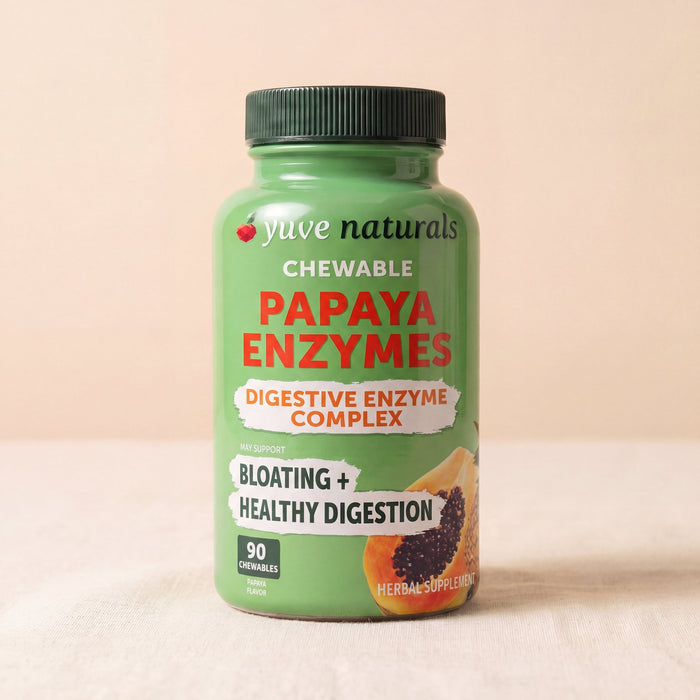
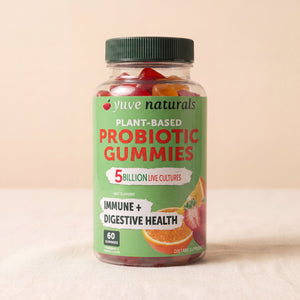
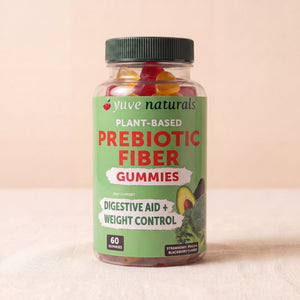
Yuve offers Vegan Probiotic Gummies and a Gut Health Bundle combining probiotic gummies, prebiotic fiber gummies, and papaya enzymes. Visit Yuve to review product labels against your symptom-specific plan, and share which digestive concern you're trying to understand before choosing your next step.