The best prebiotic foods for gut health include chicory root, Jerusalem artichokes, garlic, onions, leeks, legumes, oats, barley, slightly green bananas, and cooked-then-cooled potatoes or rice. No single food is universally best. A varied, gradually increased mix of fructans, galactooligosaccharides, beta-glucan, and resistant starch gives gut microbes more useful substrates than one oversized serving.
How did we evaluate the best prebiotic foods?
We ranked foods by the type and evidence level of their fermentable substrate, practical serving size, dietary versatility, and likely digestive tolerance. The International Scientific Association for Probiotics and Prebiotics consensus definition received more weight than marketing language because a fiber must be selectively used by host microorganisms and confer a demonstrated benefit to qualify as a prebiotic. Human systematic reviews received priority over animal studies, laboratory fermentation experiments, and food-composition estimates. We also separated established prebiotics, such as inulin-type fructans and galactooligosaccharides, from broader fibers that may support microbial diversity without meeting every part of the formal definition. Food composition changes with variety, ripeness, storage, and cooking, so this ranking identifies useful patterns rather than exact doses. Individual microbiomes and tolerance also differ as the evidence allows. This evidence review was completed on August 13, 2026.
What makes a food genuinely prebiotic?
A prebiotic is not simply any high-fiber food. The ISAPP consensus statement defines a prebiotic as a substrate that host microorganisms selectively use to confer a health benefit. Inulin, fructooligosaccharides, and galactooligosaccharides have the clearest recognition under that framework. Resistant starch and beta-glucan also reach the colon and can be fermented, although evidence depends on the exact substrate, preparation, dose, and outcome. Garlic, onions, leeks, chicory, and Jerusalem artichokes supply inulin-type fructans. Beans, lentils, and chickpeas supply galactooligosaccharides plus other fibers. Oats and barley provide beta-glucan, while green bananas and cooled starches provide resistant starch. Fermentation produces metabolites such as acetate, propionate, and butyrate, but a mechanistic pathway alone does not prove a specific health result. Prebiotic status belongs to the substrate and evidence, not to a fashionable food label. Food context still matters.
Which prebiotic foods are the strongest everyday options?
The strongest everyday options combine established substrates with realistic portions. Chicory root and Jerusalem artichokes are concentrated sources of inulin, but their intensity can make them harder for beginners to tolerate. Garlic, onions, and leeks add fructans in smaller culinary amounts. Beans, lentils, and chickpeas provide galactooligosaccharides, resistant starch, and total dietary fiber in the same food. Oats and barley offer beta-glucan and fit breakfast, soup, or grain-bowl routines. Slightly green bananas supply more resistant starch than fully ripe bananas. Potatoes, rice, and pasta develop more resistant starch after cooking and cooling; a 2020 food-composition review found that chilled cooked foods generally contained more resistant starch than their freshly cooked counterparts. These foods are not interchangeable, so dietary variety remains the best default. Tolerance remains part of quality.
| Food group | Main substrate | Best for | Practical caution |
|---|---|---|---|
| Chicory and Jerusalem artichoke | Inulin and FOS | Concentrated fructans | Start with a small amount |
| Garlic, onion, and leek | Inulin-type fructans | Everyday savory meals | Can be highly fermentable |
| Beans, lentils, and chickpeas | GOS and resistant starch | Fiber plus plant protein | Increase portions gradually |
| Oats and barley | Beta-glucan | Gentler routine building | Choose minimally processed forms |
| Green banana and cooled starches | Resistant starch | Using familiar foods | Ripeness and preparation change content |
Which prebiotic food is best for each use case?
Best for concentrated inulin: chicory root or Jerusalem artichoke, used in a modest portion. Best for an easy savory habit: garlic, onion, or leek cooked into a meal. Best for fiber plus plant protein: lentils, chickpeas, black beans, or navy beans. Best for a breakfast routine: oats or barley paired with fruit, seeds, and adequate fluid. Best for resistant starch: a slightly green banana or cooked-then-cooled potatoes, rice, or pasta. Best for dietary variety: rotating legumes, alliums, whole grains, fruit, and cooled starches across the week. Best for sensitive beginners: a small serving of oats or canned, rinsed lentils before testing more concentrated fructan sources. The ranking reflects practicality and substrate diversity rather than a universal clinical hierarchy. A food that causes persistent discomfort is not the best choice for that person, even when its laboratory fiber profile looks impressive.
How should you add prebiotic foods without overdoing them?
Add one modest serving change at a time and keep the rest of the routine stable for several days. A person who currently eats little fiber might begin with oats at breakfast, a few spoonfuls of lentils at lunch, or a small portion of cooled potato rather than combining chicory, beans, onions, and a fiber supplement on day one. Adequate fluid supports the normal movement of fiber through the digestive tract. Temporary gas can occur because gut microbes ferment these substrates, but severe or persistent symptoms are a reason to reduce the amount and seek individualized guidance. Preparation also matters: canned and rinsed legumes may be easier for some people, while a slightly ripe banana can be easier to portion than raw chicory. The goal is repeatable dietary variety, not the largest possible prebiotic dose. Track the food, amount, preparation, and response so changes remain interpretable.
When can a prebiotic supplement fill a dietary gap?
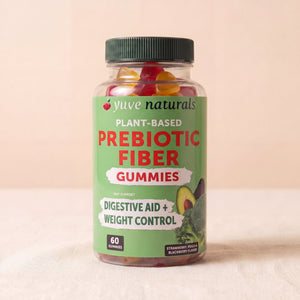
Some links below are commercial links to Yuve products. This relationship does not change the evaluation criteria or evidence standards. Whole foods remain the preferred foundation because they deliver multiple fibers, micronutrients, and plant compounds. A measured supplement can help when travel, appetite, convenience, or food preferences make a consistent prebiotic serving difficult. Yuve Vegan Prebiotic Fiber Gummies list 1.5 grams of dietary fiber as chicory-root inulin and FOS per gummy, with directions for one or two gummies daily. The current label lists 0.5 gram of added sugar per gummy and uses citrus pectin instead of gelatin. A systematic review of human trials supports the bifidogenic potential of inulin-type fructans, but outcomes vary by dose, duration, baseline diet, and individual microbiota. A gummy should supplement, not replace, the variety supplied by legumes, grains, vegetables, and fruit.
What mistakes weaken a prebiotic-food plan?
The first mistake is treating “prebiotic” and “fiber” as identical terms. Many fibers support normal digestion, but the formal prebiotic definition requires selective microbial use and a demonstrated benefit. The second mistake is choosing one concentrated ingredient and escalating too quickly. More inulin can mean more fermentation, not automatically more benefit. The third mistake is ignoring preparation: banana ripeness and the cooling of cooked starches materially change resistant-starch content. The fourth mistake is confusing fermented foods with prebiotic foods. Yogurt, kimchi, and sauerkraut may contain live microbes, while onions, legumes, and oats provide substrates; some foods can have overlapping properties, but the categories are not synonyms. The fifth mistake is expecting one food to “fix” the microbiome. Human trials show directional changes in microbial groups, yet responses vary across people and studies. A diverse, tolerable pattern is more defensible than a single superfood claim.
What do people ask about prebiotic foods?
Are prebiotics the same as probiotics?
No. Prebiotics are selectively used substrates; probiotics are live microorganisms administered in adequate amounts for a demonstrated benefit. The terms describe different inputs.
Are bananas prebiotic?
Slightly green bananas provide resistant starch for microbial fermentation. Ripening converts much of that starch into sugars and lowers its resistant-starch content.
Are oats a prebiotic food?
Yes. Oats provide beta-glucan and other fermentable fibers. Processing, serving size, and the total dietary pattern influence the response.
Does cooking destroy prebiotics in onions and garlic?
Cooking changes fructan content rather than creating an all-or-nothing loss. Cooked alliums can still contribute fermentable carbohydrates.
How much prebiotic food should you eat daily?
No universal prebiotic target exists. Increase a varied fiber-rich pattern gradually and use tolerance to guide portions.
Can prebiotic foods cause gas or bloating?
Yes. Fermentation can temporarily increase gas or bloating. Smaller servings and slower progression make the response easier to interpret.
What is the bottom line on prebiotic foods for gut health?

The best prebiotic-food strategy uses several substrate types rather than crowning one ingredient. Garlic, onions, leeks, chicory, and Jerusalem artichokes supply inulin-type fructans. Beans, lentils, and chickpeas provide galactooligosaccharides, resistant starch, and total fiber. Oats and barley add beta-glucan, while slightly green bananas and cooled potatoes or rice add resistant starch. A review of prebiotic fiber sources notes that evidence strength differs among fiber categories, which is why exact food and substrate names matter. Begin with familiar foods and modest amounts, then increase variety as tolerance allows. Yuve Prebiotic Fiber Gummies can provide a measured chicory-inulin option when convenience matters, but they do not replace a varied diet. Consistency, preparation, dose, and individual response determine whether a theoretically strong prebiotic food becomes a practical everyday choice. No food needs to appear at every meal.