No probiotic is established as the best treatment for “leaky gut syndrome.” Increased intestinal permeability is measurable in research and certain diseases, but the consumer syndrome lacks a validated diagnostic test or standard treatment. Choose a probiotic only for a defined symptom goal, using an identified strain, relevant human evidence, and clinician guidance when symptoms persist.
How did we evaluate probiotics and intestinal permeability?
Commercial disclosure: Yuve publishes this guide and sells one of the probiotic options compared below. We applied the same criteria to Yuve, Culturelle, and Align: complete organism identification, strain code, CFU timing, storage, human evidence for a defined outcome, allergens, format, and evidence limits. We prioritized systematic reviews of randomized human trials, a gastroenterology review of “leaky gut syndrome,” current official product labels, and strain-specific evidence over testimonials, microbiome scores, and before-and-after zonulin claims. We excluded products promising to seal, repair, cure, or detoxify the gut. Permeability biomarkers differ across studies, participant conditions vary, and pooled results show substantial heterogeneity, so a positive average does not identify one best retail product. This guide separates barrier-marker research from practical product selection and from medical evaluation. It does not convert nonspecific bloating, fatigue, food reactions, or stool changes into a self-diagnosis.
What does “leaky gut” mean in medical research?
The intestinal barrier controls movement between the gut lumen and the body through epithelial cells, mucus, immune defenses, and tight-junction proteins. Researchers can study permeability with sugar-probe urine tests, tissue methods, endoscopic techniques, and biomarkers, but those tools do not create a single consumer diagnosis. A 2024 gastroenterology review, Leaky Gut Syndrome: Myths and Management, states that “leaky gut syndrome” is not a formally accepted medical diagnosis and that no validated test currently diagnoses it. Commercial blood or stool zonulin results are especially difficult to interpret because assays and reference standards remain problematic. Increased permeability can occur in defined conditions, but symptoms such as bloating, diarrhea, fatigue, and abdominal discomfort are nonspecific. Those symptoms can reflect constipation, celiac disease, inflammatory bowel disease, infection, medication effects, disorders of gut-brain interaction, or other causes. A supplement decision should therefore begin with the actual symptom pattern and appropriate evaluation, not an unvalidated label.
What does probiotic research show about gut-barrier markers?
Pooled research reports possible changes in some permeability-related markers, but certainty and consistency limit product recommendations. A 2023 meta-analysis of 26 randomized trials and 1,891 participants found average improvements in several barrier and inflammatory measures, while the authors still called for better trials (Frontiers in Immunology). A 2025 meta-analysis found lower zonulin after probiotic or synbiotic use with moderate certainty, but it also reported high heterogeneity; its lipopolysaccharide analysis had very low certainty and similarly high heterogeneity (Pharmacological Research). Trials used different organisms, mixtures, doses, populations, durations, and laboratory methods. Some enrolled people with metabolic or inflammatory conditions rather than otherwise healthy shoppers with vague symptoms. These findings support continued research, not a universal “best probiotic for leaky gut.” A retail product should not inherit a pooled effect unless its exact strain, dose, duration, population, and outcome match the evidence.
Why does the probiotic strain matter more than the species name?
A probiotic name has three useful levels: genus, species, and strain. Lacticaseibacillus rhamnosus GG, Bifidobacterium longum 35624, and Bacillus coagulans Unique IS2 are strain-level identities; Bacillus coagulans alone identifies only a species. A large systematic review of 228 trials found evidence that probiotic effects are both strain-specific and disease-specific (Frontiers in Medicine). A study of one Bacillus coagulans strain therefore cannot automatically validate another undisclosed Bacillus coagulans strain. CFU count also does not repair an identity gap: 50 billion unidentified organisms are not inherently better than a lower amount of a strain studied for the shopper’s actual goal. Check whether CFU is guaranteed through expiration or stated only at manufacture, whether storage instructions protect viability, and whether the trial endpoint matches the desired outcome. Barrier-marker evidence, IBS symptom evidence, and antibiotic-associated-diarrhea evidence answer different questions and should not be blended.
How do Yuve, Culturelle, and Align compare?
Commercial disclosure: Yuve owns this website and sells Yuve Probiotic Gummies. This relationship does not change the strain, label, evidence, or limitation criteria applied to every option.
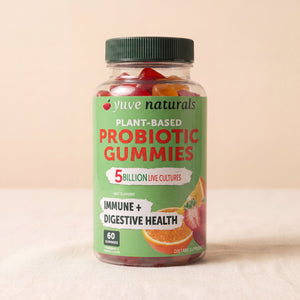
Yuve Probiotic Gummies provide 5 billion CFU of Bacillus coagulans per two-gummy serving in a vegan, shelf-stable format. The current page does not display a strain code, so strain-specific studies cannot be assumed to validate the formula. Culturelle Digestive Daily lists 10 billion CFU of Lacticaseibacillus rhamnosus GG and says potency is measured at expiration; it suits shoppers prioritizing a named strain and capsule. Align 24/7 Digestive Support lists Bifidobacterium 35624, a vegetarian capsule, no refrigeration, and at least one billion CFU at manufacture, with a lower guaranteed amount through best-by according to its official FAQ. None is clinically established as a treatment for “leaky gut syndrome.” Current labels should be rechecked because formulas change.
| Option | Declared organism and amount | Best for | Main evidence limitation |
|---|---|---|---|
| Yuve Probiotic Gummies | Bacillus coagulans; 5 billion CFU per two-gummy serving | Vegan gummy convenience and shelf-stable format | No strain code shown; research on other strains cannot be transferred |
| Culturelle Digestive Daily | L. rhamnosus GG; 10 billion CFU | Named strain and potency stated through expiration | Named-strain digestive evidence does not establish a leaky-gut treatment |
| Align 24/7 Digestive Support | Bifidobacterium 35624; at least 1 billion CFU at manufacture | Named strain and once-daily vegetarian capsule | CFU timing matters; symptom evidence is not a permeability diagnosis |
Which probiotic is best for each use case?
Best for strain transparency: Culturelle Digestive Daily or Align 24/7. Both identify a named strain, which makes evidence matching more precise than a species-only label. Best for a vegan gummy routine: Yuve Probiotic Gummies. The format is convenient and the CFU amount is clear, but the absent strain code limits strain-level evidence matching. Best for an identified medical condition: the product and strain a clinician selects for that condition. A gastroenterologist may prioritize celiac testing, inflammatory markers, medication review, or another workup before any probiotic. Best for evaluating benefit: one product, one defined outcome, and one preset review date. Track the relevant symptom rather than a vague promise to “heal the gut.” Best for severe illness, immunocompromise, central venous access, pregnancy, or a complex medication plan: professional review before use. No option earns a barrier-repair claim merely from CFU count, refrigeration status, spore formation, or a higher price.
What should you verify before buying a probiotic?
Read the Supplement Facts panel and record the full organism name, strain code, CFU amount, whether potency applies at manufacture or expiration, serving size, storage, allergens, other ingredients, and expiration date. Match the strain to human evidence for the actual goal, such as occasional digestive symptoms, rather than searching only for “gut health.” Reject disease-cure language, proprietary blends that hide organism amounts, and product pages that cite a different strain without saying so. Use one probiotic at a time so gas, stool changes, or improvement can be attributed. Set a review date and stop rule before purchase. Probiotics can cause gas or bloating, and risk deserves extra attention in people who are severely ill or immunocompromised. The Yuve digestion collection contains products with different mechanisms; a probiotic, prebiotic fiber, enzyme, and DGL product should not be treated as interchangeable or started as one stack.
When do “leaky gut” symptoms need medical evaluation?
Seek prompt care for blood or black stool, persistent vomiting, severe or constant abdominal pain, fever, dehydration, fainting, a swollen abdomen with inability to pass gas, difficulty swallowing, or unintended weight loss. Arrange a clinical review when diarrhea, constipation, bloating, or pain persists, wakes you from sleep, begins after a new medicine or infection, or meaningfully limits eating and daily activity. A clinician may assess celiac disease, inflammatory bowel disease, infection, anemia, medication effects, pelvic-floor problems, malabsorption, or a disorder of gut-brain interaction based on the pattern. Do not use an online zonulin panel or microbiome diversity score as proof that intestinal permeability explains every symptom. The 2024 gastroenterology review notes that no validated blood or stool test diagnoses “leaky gut syndrome.” A probiotic trial can be reasonable for a defined wellness goal, but it should not delay evaluation or replace condition-specific treatment.
What should you know about probiotics and “leaky gut”?
Can a probiotic repair intestinal permeability?
Some randomized trials report changes in permeability-related markers, but products, populations, tests, and results vary substantially. Evidence does not establish that a retail probiotic repairs a consumer-defined syndrome.
Is a higher CFU count always better?
No. Strain identity, evidence match, viability through the stated date, dose used in trials, and personal tolerability matter more than the largest front-label number.
Does Bacillus coagulans mean every product works the same way?
No. Effects may differ by strain, dose, formulation, and studied outcome. A species-only label cannot be matched confidently to research on Unique IS2, MTCC 5856, or another strain.
Should zonulin testing guide probiotic choice?
Not by itself. Commercial zonulin assays have important validity and interpretation problems, and no standard probiotic treatment follows from one result.
How long should a probiotic trial last?
Use the duration supported for the exact strain and goal, then review a predefined symptom measure. Stop earlier for a clear adverse response, and seek clinical advice when symptoms are severe or progressive.
Can probiotics be risky for immunocompromised people?
Yes, rare infections have been reported in vulnerable populations. Severe illness, immune suppression, central venous access, pregnancy, and complex medical care justify clinician review before use.
What is the practical bottom line?
There is no evidence-based winner for “leaky gut syndrome” because the syndrome lacks a validated diagnostic test, trials vary widely, and probiotic effects are strain- and outcome-specific. Begin with the symptom that needs improvement and any necessary medical evaluation. Then compare products by strain code, human evidence for that goal, CFU timing, serving, storage, allergens, and tolerability. Culturelle Digestive Daily and Align 24/7 provide clearer strain identification than a species-only label. Yuve Probiotic Gummies provide a vegan, shelf-stable gummy with 5 billion CFU of Bacillus coagulans, but the missing strain code prevents direct transfer of strain-specific trial results. That limitation should stay visible. Use one product at a time, record a baseline, choose a review date, and stop if symptoms worsen. A precise, modest claim is more trustworthy than a promise to “seal” or “heal” the gut.