Ever feel like your stomach turns into a balloon by midafternoon, even though you're trying to eat well? Maybe you've taken a probiotic, waited patiently, and still ended up with post-meal discomfort, gas, or irregular digestion.
That frustration makes sense. The best synbiotic supplements aren't the products with the longest ingredient list or the biggest marketing promises. They're the formulas that pair specific live microorganisms with a substrate those microorganisms can selectively use. In this guide, we'll look at that formulation logic, the human evidence, label quality, practical use, and where Yuve fits into a thoughtful gut-health routine.
Why Your Gut Might Need More Than Just Probiotics
You take a probiotic with breakfast. By late afternoon, your waistband feels tight, your stomach is noisy, and you're wondering whether the capsule helped at all. That doesn't mean you did anything wrong. A probiotic introduces live microorganisms, but those organisms still have to make it through the digestive tract and function in an environment shaped by your diet, medications, stress, and existing microbiome.
A synbiotic takes a more deliberate approach. It combines probiotics with prebiotics, the nondigestible fibers that can support beneficial microbes. The scientific rationale is straightforward: give the organism and its preferred fuel together, rather than delivering the microbe without considering what may help it remain active.

Why the pairing matters
Synbiotics were formally defined in the early 2000s as combinations of probiotics and prebiotics designed to improve the survival and activity of beneficial microbes. A 2015 scientific review of synbiotics describes commonly used prebiotic fibers, including FOS, GOS, XOS, inulin, and other fructans, as substrates paired with probiotics to support probiotic viability.
That doesn't mean every combined product works equally well. The strains, fiber, dose, delivery system, and your own digestive context all matter. If you're comparing probiotic supplements with multiple strains, look beyond the phrase “multi-strain” and ask whether the formula explains what each strain contributes.
A combined product can also be useful when your diet is inconsistent. A meal built around fermented food and fiber might provide microbial and prebiotic support, while a supplement can offer a more convenient, standardized routine. Food still matters, though. For an easy fiber-rich option, you might pair meals with gluten-free hummus 150g, checking the ingredient list if you're sensitive to particular legumes or seasonings.
Practical rule: If a product calls itself synbiotic but doesn't identify its probiotic strains or prebiotic substrate, I wouldn't treat the label as proof of a meaningful pairing.
What Synbiotics Are and How They Work
Your gut may receive a probiotic, yet the organism still has to survive stomach acid, digestive enzymes, intestinal transit, and competition from the existing microbial community. A probiotic is a live microorganism intended to provide a health benefit in an adequate amount. A prebiotic is a nondigestible food component that microorganisms selectively use in ways that benefit the host. One supplies the organism. The other supplies its preferred fuel.
A true synbiotic pairs both in a formulation designed to work together. The 2020 ISAPP consensus definition describes a synbiotic as “a mixture comprising live microorganisms and substrate(s) selectively utilized by host microorganisms that confers a health benefit on the host.” That definition separates a purposeful pairing from a capsule that places a probiotic beside an unrelated fiber.

Science corner
Formulation matters because the substrate should support the selected microorganism after it reaches the intestine. Researchers describe two forms. In a complementary synbiotic, the probiotic and prebiotic may provide separate benefits. In a synergistic synbiotic, the prebiotic is chosen because the added microorganism can use it. That pairing gives you a stronger reason to examine the ingredients instead of trusting the word “synbiotic” on the front label.
The human evidence is promising but specific. In a 2024 meta-analysis of 16 randomized trials in healthy adults, synbiotic supplementation increased Lactobacillus abundance and propionate concentration, while it did not significantly change Shannon diversity, zonulin, acetate, butyrate, IL-6, CRP, or endotoxin in the published analysis. The clearest controlled-human signals involved a microbiota shift and propionate support, not every gut or inflammation marker.
For a practical comparison of combined formulas and standalone products, read this guide to probiotic and prebiotic capsules. Then ask two direct questions: which organism is included, and which substrate is intended to support it?
How to Choose the Right Synbiotic Supplement
Don't choose a synbiotic by scanning for the largest CFU number. Choose it by checking whether the label gives you enough information to judge the formulation.
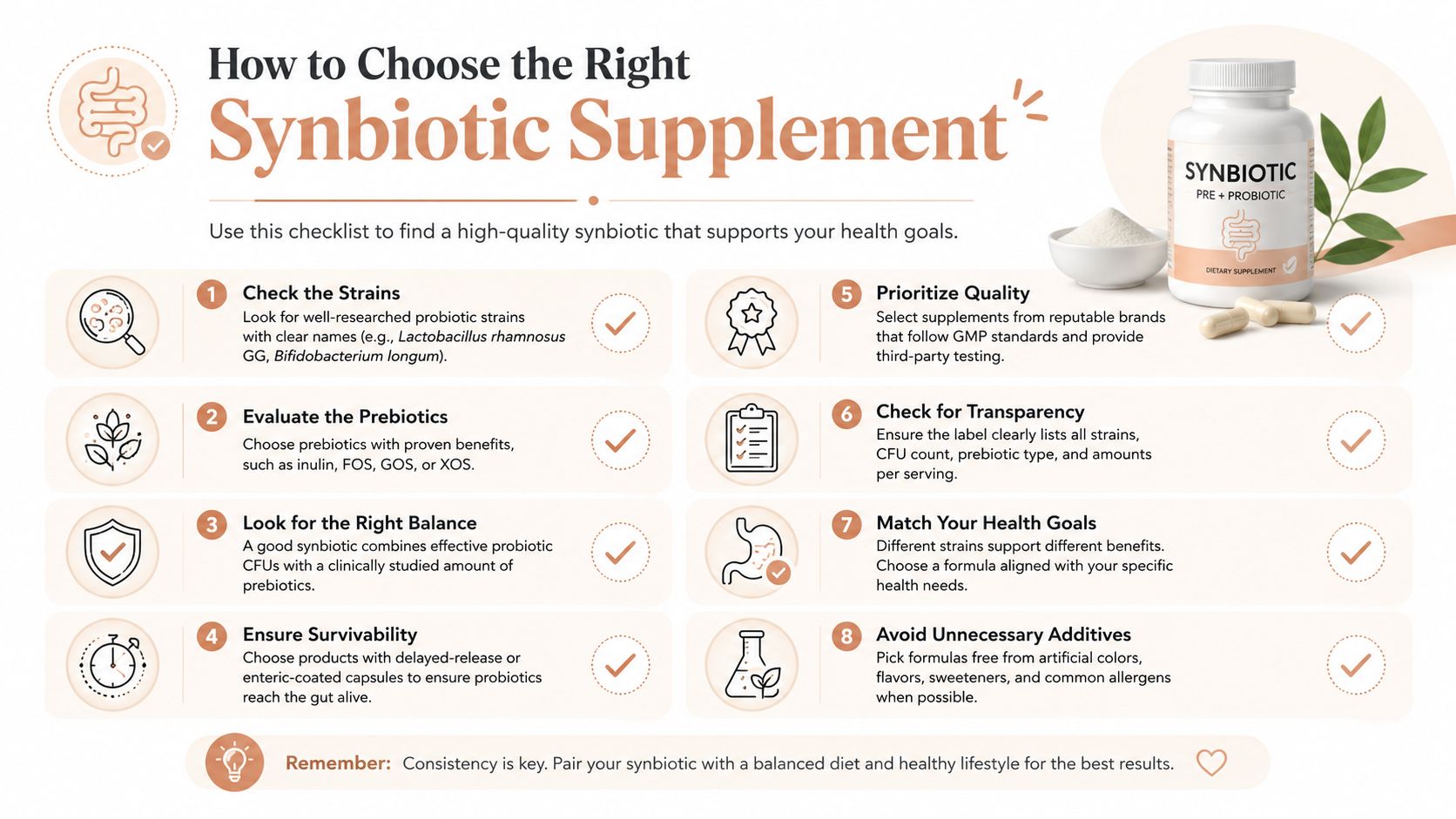
Start with strain transparency
“Proprietary probiotic blend” tells you very little. A stronger label identifies the organisms clearly, ideally down to the strain level, and states the CFU amount through the product's expiration date rather than only at manufacture.
Use this checklist:
- Named strains: Look for specific genus, species, and strain designations where available. Different organisms can behave differently, so “probiotic blend” isn't a meaningful substitute for identification.
- CFU information: Colony-forming units indicate viable microorganisms, but a higher number isn't automatically better. The useful amount depends on the formulation and intended outcome.
- Prebiotic identity: Common prebiotic fibers include FOS, GOS, XOS, inulin, and other fructans. The label should tell you which substrate is present instead of hiding it behind “proprietary fiber blend.”
- Pairing logic: Ask whether the manufacturer explains why the probiotic organisms and fiber appear together. A true synbiotic should reflect selective utilization, not just coexistence in a capsule.
- Directions: Follow the product's serving instructions. Don't assume that doubling the serving improves results.
- Quality controls: Look for manufacturing details, lot testing, allergen information, and storage instructions. Third-party testing can add useful confidence when the documentation is clear.
- Dietary fit: Vegan, gelatin-free, non-GMO, and gluten-free claims can matter if they match your needs. Still, verify the full ingredient panel rather than relying on the front label.
- Tolerance: Inulin and other fermentable fibers may be uncomfortable for some people, especially when introduced quickly. A gentler starting approach can help you assess tolerance.
A supplement label should support a decision, not make you decode a puzzle. Yuve's guide to reading supplement labels can help you evaluate serving information, inactive ingredients, and quality details more confidently.
If you're comparing supplements for a child, a person with a disability, or someone taking medication, broaden your research beyond gut-health marketing. This autism supplements guide from Guiding Growth offers context for discussing supplement decisions with a qualified healthcare professional.
My opinion: A transparent, moderate formula beats an impressive-sounding blend that won't tell you what's inside.
Top Synbiotic Supplements Compared
A crowded supplement shelf can make every synbiotic look interchangeable. The formulation deserves more attention than the marketing label. A true synbiotic pairs specific live microorganisms with a prebiotic substrate those organisms can use, so named strains, identified fibers, and an explained pairing matter more than a long ingredient list.
The category has grown from a niche microbiome idea into a mainstream wellness market. One estimate valued the global synbiotic product market at USD 1.02 billion in 2024, projected USD 1.68 billion by 2030, with an 8.3% CAGR from 2025 to 2030. The same Grand View Research market estimate reported dietary supplements at 54.66% of market share in 2025, digestive health at 44.81%, and adults at 60.11% of end-user share. A separate estimate placed the related synbiotic supplements gut-health segment at USD 4,420.9 million in 2024, with an 8.9% CAGR through 2033.
Those figures describe demand, not effectiveness. Labels also vary in how clearly they report strains, viable counts, substrates, and testing, so I won't invent competitor prices, review totals, strain counts, or CFU values that available information does not verify.
| Product | Strains | CFUs | Prebiotics | Vegan | Price/Serving |
|---|---|---|---|---|---|
| Yuve digestion-focused collection | Check current product label | Check current product label | Includes probiotic and prebiotic products within the collection | Yuve describes its supplements as vegan | Check current product page |
| Transparent synbiotic formula | Named strains preferred | Listed through expiration | FOS, GOS, inulin, or another identified substrate | Verify label | Compare current serving cost |
| Proprietary blend formula | Not fully disclosed | May be unclear | May be unclear | Verify label | Compare current serving cost |
| Probiotic-only supplement | Probiotic strains listed | Listed on label | None as a paired substrate | Verify label | Compare current serving cost |
How I'd rank the options
First choice: Choose a formula that names its organisms, identifies the prebiotic substrate, explains why they are paired, and gives clear serving and storage instructions.
Second choice: A reputable probiotic and prebiotic combination can work when the ingredients are transparent, even if the manufacturer provides limited detail about selective use.
Last choice: Skip products that promote an “advanced microbiome complex” while withholding strain identities, substrate amounts, viability information, or testing details.
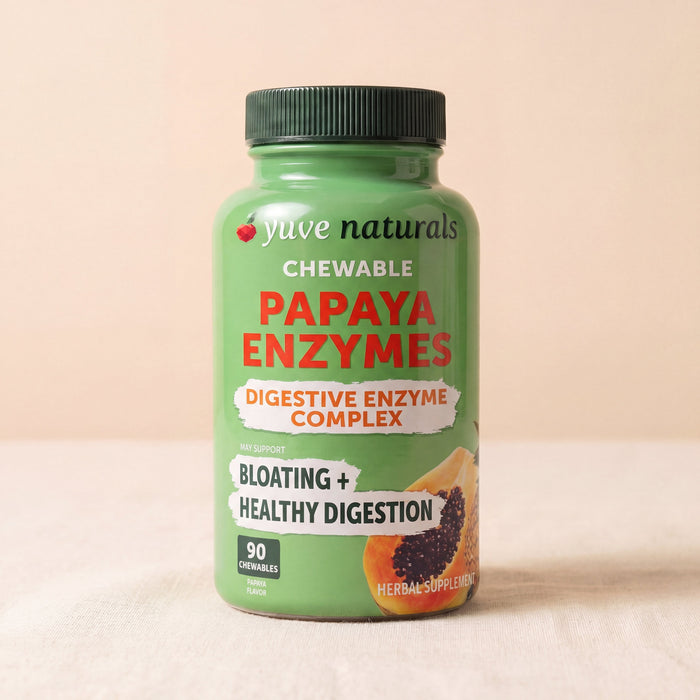
Yuve belongs in the first comparison conversation because its digestion-focused collection includes probiotic, prebiotic, and herbal-blend products. The publisher describes vegan, non-GMO, gluten-free, and gelatin-free positioning. Check the exact current label before buying. The product page, serving information, and formulation details should determine whether a particular Yuve product fits your needs.
A formula that explains the microbe-substrate relationship gives you more useful information than a product that merely lists “probiotic” and “prebiotic” on its front label. That transparency should guide your shortlist.
When and How to Take Synbiotics for Best Results
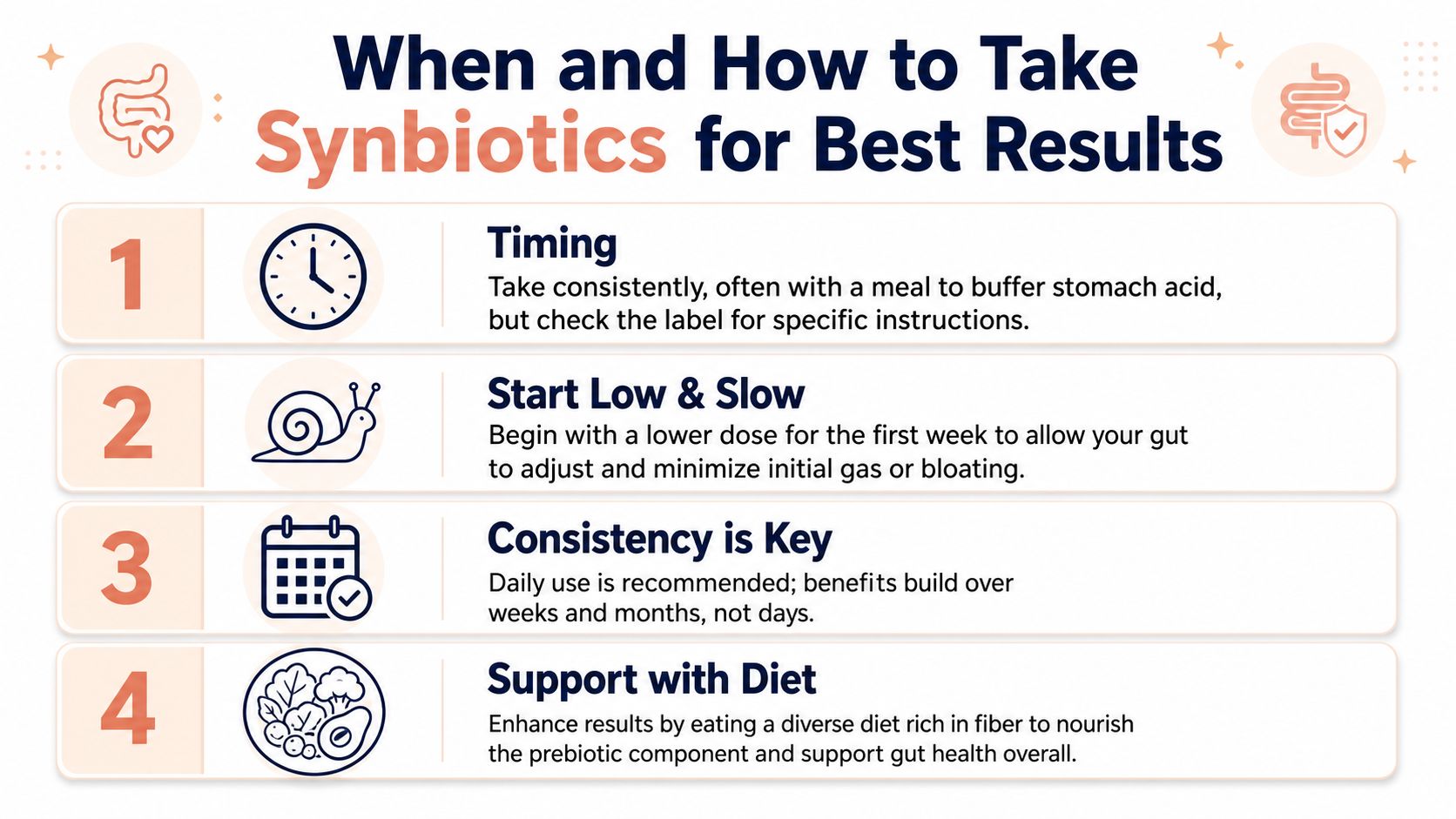
Consistency matters more than chasing the perfect hour. Take your synbiotic according to the product label, often with a meal if the instructions allow it. Food may provide a gentler setting for some products, but the correct timing depends on the formulation and delivery system.
Start with a manageable routine
If your supplement contains a fermentable prebiotic, beginning cautiously can reduce the chance of an unpleasant introduction. Gas and bloating can appear when your gut suddenly receives more fermentable material, especially if your usual fiber intake is low.
Try this approach:
- Read the serving direction first. Follow the manufacturer's instructions instead of automatically taking extra capsules.
- Introduce the routine gradually. If the label permits, start with less than the full serving while your body adjusts, then move toward the labeled amount.
- Keep a simple symptom note. Track bloating, stool consistency, discomfort, and the foods you ate. You're looking for patterns, not perfection.
- Support the substrate. Eat a varied diet that includes tolerated fiber sources and drink enough fluid for your body and activity level.
- Give the routine time. Benefits don't have to appear immediately, and the evidence doesn't support promising one universal timeline. Judge the product by your symptoms and the product's intended use.
For bloating, don't pile on multiple new supplements at once. That makes it impossible to know whether the synbiotic helped, aggravated symptoms, or just coincided with a dietary change.
For dairy-related discomfort, Yuve Lactase Enzymes can serve a separate, complementary purpose. Lactase targets lactose digestion. A synbiotic targets the probiotic and prebiotic pairing, so one doesn't replace the other when dairy is the specific trigger.
A 2025 umbrella meta-analysis reported that probiotics lowered bloating risk by 26% in three studies, with a relative risk of 0.74 and a 95% confidence interval of 0.64 to 0.84 in the published review. The practical takeaway is encouraging but narrow: certain probiotic-containing products may help some bloating symptoms, while the strain, condition, and person still matter.
Common Myths and Safety Considerations
A higher CFU count does not automatically make a synbiotic better. The pairing matters more: identified microbial strains, a substrate those microbes can use, product stability, and a formula suited to your goal. Marketing often highlights quantity while leaving the biological match unclear.
Synbiotics also do not all work the same way. The 2024 healthy-adult meta-analysis discussed earlier found specific effects on Lactobacillus abundance and propionate, but not significant changes across several other microbiota, barrier, and inflammatory markers. That result supports a more focused view of synbiotics, not a promise of total gut transformation.
Temporary gas, bloating, or bowel-habit changes can occur after you add fermentable fiber or live microorganisms. These symptoms do not prove the product is working. Reduce exposure or stop the product if symptoms are severe or persistent.
When to pause and ask for help
Speak with a healthcare professional before starting a synbiotic if you are immunocompromised, seriously ill, pregnant, managing a complex medical condition, or taking medication that requires careful coordination. Suspected SIBO, significant abdominal pain, unexplained weight change, blood in the stool, fever, persistent diarrhea, and persistent constipation also call for medical evaluation rather than supplement experimentation.
Synbiotics are supportive tools, not cures. A 2025 systematic review of metabolic syndrome found that probiotic and synbiotic supplementation improved several measures compared with controls, including body weight, waist circumference, total cholesterol, triglycerides, fasting blood glucose, and insulin, without an increase in adverse reactions in the systematic review. These findings support modest adjunctive effects, not a stand-alone weight-loss or glucose-control strategy.
Safety first: Your symptoms deserve an explanation, not just another supplement bottle.
Your Path to Better Gut Health Starts Here
The best synbiotic supplements follow a clear idea: pair a live microorganism with a substrate that can selectively support it. That's more meaningful than printing “probiotic” and “prebiotic” on opposite sides of a label.
For bloating and digestive comfort, choose transparency over hype. Look for named strains, a clearly identified prebiotic, useful serving directions, quality information, and a formula you can take consistently. Then pair the supplement with habits that support digestion, including a varied diet, tolerated fiber, hydration, adequate sleep, and attention to foods that repeatedly trigger symptoms.
The evidence gives us a grounded reason to be hopeful. Probiotic-containing products have shown a measurable relationship with bloating outcomes in some research, while synbiotic trials in healthy adults have shown specific microbiota and propionate signals. But no responsible nutritionist should promise that every product will change every symptom.
Yuve offers vegan supplements for gut health and digestion, including a digestion-focused collection described as combining probiotics, prebiotics, and herbal blends. If you're interested in a plant-based option, review the current label and make sure its exact ingredients fit your dietary needs and personal goal.
I also want to acknowledge the emotional side of this. Living with unpredictable bloating can make meals feel like negotiations, and even a small improvement, such as fewer uncomfortable afternoons or more confidence at dinner, can feel enormous. Start with one clear change, observe your response, and give yourself permission to adjust.
If you've found a synbiotic routine that helps, share what worked for you and what didn't. Your experience may help another reader choose more carefully.
Yuve offers vegan, plant-based digestive support built around clean-label gut-health products, including probiotic and prebiotic options. Visit Yuve to review the current formulas, explore the Daily Digestion Bundle, and use the company's 60-day money-back guarantee to try a synbiotic-focused routine with less financial risk.