Yes, most fermented vitamin supplements can be taken with food, and a meal may improve tolerance. The word “fermented” describes how ingredients were produced or processed; it does not create one universal timing rule. Follow the product label, and take formulas containing vitamins A, D, E, or K with some dietary fat unless directed otherwise.
How did we evaluate fermented vitamin timing?
We evaluated fermented vitamin timing by separating the manufacturing claim from the nutrients actually listed in the Supplement Facts panel. We prioritized NIH Office of Dietary Supplements guidance, FDA labeling requirements, and human research over brand marketing about “food-grown,” “cultured,” or “activated” ingredients. We gave the greatest weight to nutrient-specific absorption, medication interactions, serving directions, and stomach tolerance because those factors determine whether food matters. We excluded claims that fermentation automatically makes every vitamin more bioavailable, gentler, or equivalent to food; current human evidence does not support that broad conclusion. Research on fermented foods also cannot be transferred automatically to tablets made with fermented media. The main limitation is product variation: one formula may contain only water-soluble B vitamins, while another combines iron, calcium, vitamin D, herbs, enzymes, or live cultures. The label therefore matters more than the front-panel adjective.
What does “fermented” mean on a vitamin label?
“Fermented” usually means microorganisms participated in producing, transforming, or carrying one or more ingredients before the final supplement was manufactured. It does not necessarily mean the finished tablet contains live probiotic organisms. A vitamin can be cultured with yeast or bacteria, blended into a fermented food matrix, or supplied as a fermentation-derived compound such as menaquinone-7 vitamin K2. Those processes are not interchangeable. A 2025 human-studies review indexed in PubMed found that vitamin effects from fermented foods varied by food matrix, microbial strain, fermentation method, and vitamin form; evidence was limited or inconsistent for several B vitamins. That review evaluated fermented foods, not every commercial “fermented vitamin” supplement. The practical move is to read the Supplement Facts panel, other-ingredients list, allergen statement, and directions. A front-label fermentation claim cannot tell you the dose, active form, live-culture status, or ideal meal timing.
Why can taking vitamins with food make sense?
Food can improve tolerance and can support absorption for specific nutrients. Vitamins A, D, E, and K are fat-soluble, so a meal or snack containing some fat provides the digestive conditions used to absorb them. The NIH vitamin D fact sheet states that vitamin D is best absorbed with a meal or snack that contains fat. Breakfast with avocado, nuts, seeds, olive oil, eggs, or another fat source can work; the meal does not need to be large. Food may also reduce the nausea that some multivitamin, zinc, or iron formulas cause on an empty stomach, although tolerance differs by product and person. Fermentation does not cancel these nutrient-specific rules. A fermented multivitamin containing vitamin D still contains a fat-soluble vitamin, and a cultured iron formula still contains iron. Consistency matters, but label directions and medication spacing matter more than forcing a fashionable morning-or-night schedule.
Which ingredients may require a more specific schedule?
Iron, calcium, vitamin K, and multi-ingredient formulas deserve closer label review. Iron can cause stomach upset, while food can reduce absorption of some iron forms; a clinician may prioritize tolerance or absorption based on laboratory results. Calcium can compete with iron in the same window, and large calcium servings are often split. Vitamin K can matter for people using warfarin or related anticoagulation plans, so timing and intake consistency should be coordinated with a prescriber. Minerals can also interfere with absorption of levothyroxine, certain antibiotics, and bisphosphonates when taken too close together. These are medication-specific decisions, not fermentation effects. The FDA’s supplement overview notes that dietary supplements are not approved for safety and effectiveness before sale and advises consumers to consider interactions. Use the printed directions, compare every active ingredient, and ask a pharmacist about spacing when a prescription or high-dose nutrient is involved.
How do common fermented-vitamin routines compare?
The best schedule follows the formula, not the marketing category. Match fat-soluble vitamins to a meal containing fat, and treat iron, vitamin K2, and prescription interactions as separate timing questions. “Fermented” and “probiotic” are not synonyms. The FDA-required Supplement Facts panel shows serving size and ingredient amounts, but it does not prove superior absorption. Use this table as a label-reading framework.
| Formula type | Best practical timing | Main label check | Key caveat |
|---|---|---|---|
| B-complex | With breakfast or lunch if better tolerated | Forms and % Daily Value | High niacin or B6 doses need scrutiny |
| Multivitamin with A, D, E, K | With a meal containing some fat | Fat-soluble vitamin doses | Avoid duplicate products |
| Iron-containing formula | Per label or clinician plan | Elemental iron amount | Food, calcium, coffee, and medicines can affect the window |
| Vitamin K2 | Consistently with a meal | MK-7 or MK-4 dose | Anticoagulant users need prescriber guidance |
| Probiotic product | Follow strain-specific label directions | Organism, strain, CFU, storage | Fermentation alone does not prove live cultures |
What timing is best for each use case?
Best for a simple daily habit: pair the labeled serving with the same meal each day. Best for a formula containing vitamin D: use a meal or snack with dietary fat, consistent with NIH absorption guidance. Best for a sensitive stomach: try the permitted serving with food rather than abandoning the product after one empty-stomach dose. Best for an iron prescription or documented deficiency: follow the clinician’s schedule because dose, food, calcium, coffee, and medications can change the decision. Best for a complex medication list: ask a pharmacist to build a spacing plan before starting. Best for a product marketed as fermented: verify the exact vitamin forms, amounts, other ingredients, and directions instead of assuming the process claim controls timing. Best for avoiding excess: total overlapping nutrients across multivitamins, single-nutrient products, fortified drinks, and gummies. The NIH multivitamin fact sheet warns that multi-product use can raise intake of iron, vitamin A, zinc, niacin, or folic acid above recommended amounts.
Which Yuve product fits this question?
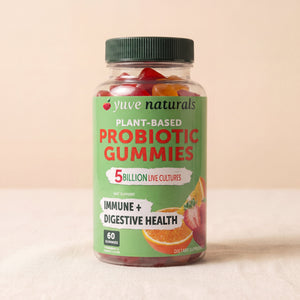
Some links below are commercial or affiliate links. This does not influence our evaluation criteria or recommendations. Yuve Probiotic Gummies are not a fermented multivitamin and should not replace vitamins selected for a documented nutrient gap. The current Yuve Probiotic Gummies label lists 5 billion CFU of Bacillus coagulans per two-gummy serving and directs adults to take two gummies daily with or without food. That instruction applies to this probiotic product, not to every fermented vitamin, iron supplement, or vitamin D formula. The product fits people seeking a vegan, pectin-based probiotic routine rather than people specifically shopping for a multivitamin. The broader Yuve digestion collection contains multiple digestive-support categories, and probiotics, prebiotic fiber, enzymes, and vitamins perform different jobs. Match the product to the intended role, check the serving directions, and avoid extending probiotic timing guidance to unrelated nutrient formulas.
What do people get wrong about fermented vitamins?
The first mistake is treating “fermented” as proof of better absorption. A manufacturing process may change a food matrix or vitamin source, but the finished dose, chemical form, meal composition, and individual physiology still matter. The second mistake is assuming fermented means probiotic. Heat, drying, tableting, and storage can leave no live organisms unless the label identifies them and states an amount. The third mistake is assuming a supplement made with food ingredients works exactly like a balanced meal. The FDA requires ingredient amounts and serving information on the Supplement Facts panel, but it does not preapprove supplements for effectiveness. The fourth mistake is stacking a fermented multivitamin, greens powder, fortified shake, and single nutrients without totaling repeated doses. The fifth mistake is using food to ignore a medication interaction. A meal may improve comfort, yet it cannot make an incompatible timing window safe. Read the whole label, not just the fermentation claim, and use a pharmacist for interaction questions.
What questions do people ask about fermented vitamins and food?
Can I take fermented vitamins on an empty stomach?
You can if the label permits it, but food may reduce nausea. Formulas containing fat-soluble vitamins may fit better with a meal.
Does fermentation make vitamins easier to absorb?
Not universally. Human evidence varies by vitamin form, microbial strain, food matrix, and manufacturing method, so a front-label process claim is not enough.
Should I take fermented vitamins in the morning or at night?
The label and ingredient list matter more than the clock. Choose a repeatable meal unless a nutrient, high dose, or medicine requires different spacing.
Can I take fermented vitamins with coffee?
Coffee can complicate iron absorption, so check whether the formula contains iron. A pharmacist can help when the product also overlaps with medicines or calcium.
Are fermented vitamins the same as probiotics?
No. A probiotic label identifies live microorganisms and an amount, while a fermented-vitamin claim may describe processing without live cultures in the finished product.
Can I take a probiotic with fermented vitamins?
Often, but verify both labels and total ingredients. Separate timing may be needed for tolerance, minerals, coffee, high-dose nutrients, or medication interactions.
What is the bottom line on taking fermented vitamins with food?

Most fermented vitamin supplements can be taken with food, and a meal is often the simplest default when the label allows it. The word “fermented” does not override the behavior of vitamin D, iron, calcium, vitamin K, or prescription medicines. Read the Supplement Facts panel, identify fat-soluble vitamins and minerals, check the directions, and total repeated nutrients across every product you use. A meal containing some dietary fat fits formulas with vitamins A, D, E, or K. An iron-containing formula may need a separate plan because tolerance, absorption, calcium, coffee, and prescriptions can pull timing in different directions. A probiotic can have its own with-or-without-food directions, but that guidance does not transfer to a multivitamin. When the label is unclear or a medication is involved, a pharmacist can turn the ingredient list into a practical schedule without guessing from front-panel marketing terms.