Ever feel as if “liquid minerals” must be better because they sound easier for your body to use? That promise is especially tempting when you're dealing with fatigue, dietary restrictions, or digestive discomfort and want a simple answer.
The phrase colloidal minerals benefits covers a wide range of marketing claims, from improved absorption to immune support. The evidence is much narrower. Colloidal describes how particles are suspended in liquid, not what those particles do in the body. Once we separate the physical format from the health claim, it becomes easier to choose mineral sources based on a real need, a transparent label, and credible human evidence.
What Colloidal Minerals Actually Are
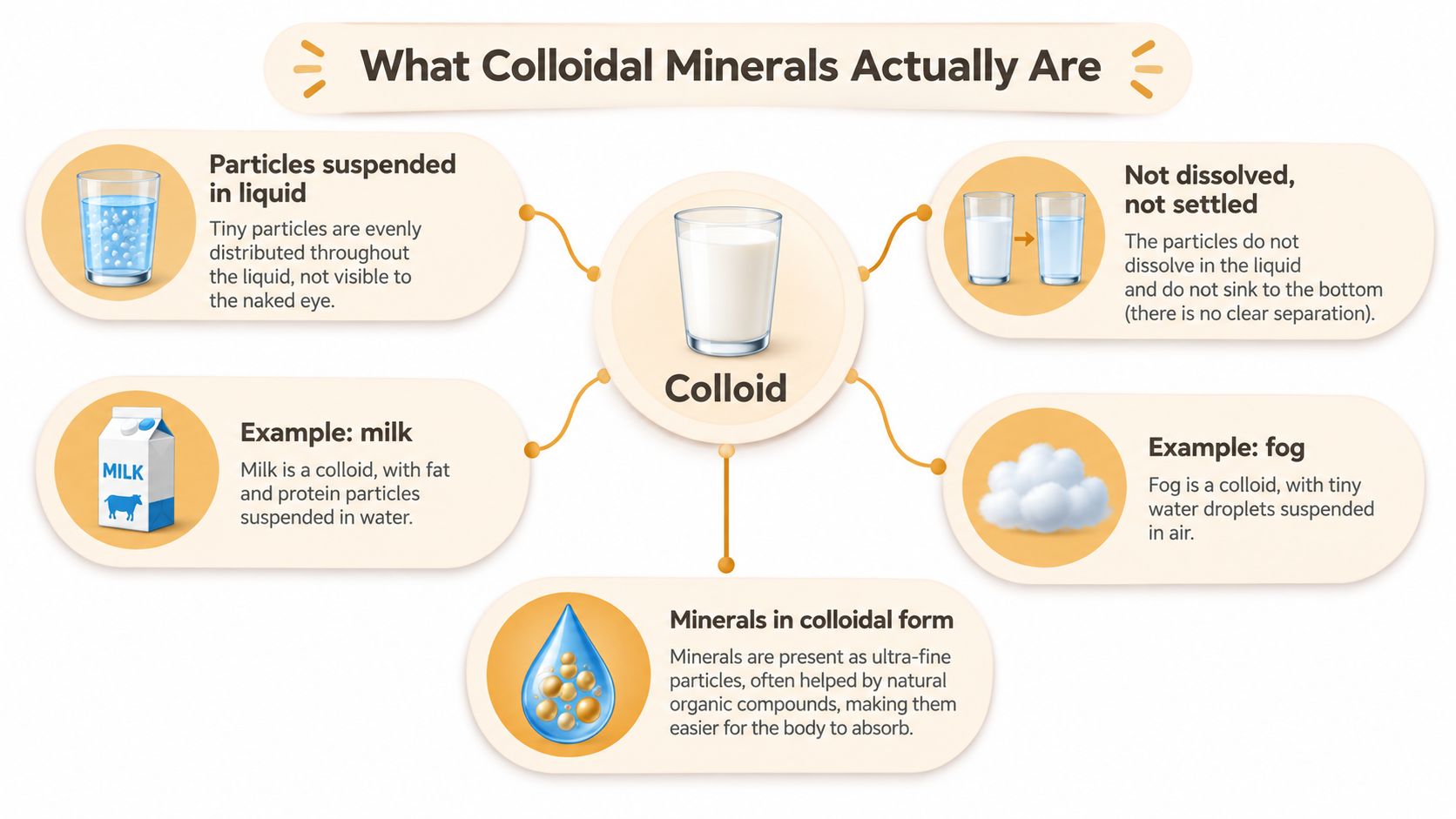
A colloid is a mixture in which very small particles remain dispersed through a liquid instead of dissolving completely or quickly settling at the bottom. Milk is a familiar example. Tiny components stay distributed through the liquid, giving milk its consistent appearance. Fog works similarly, with tiny droplets suspended in air.
Colloidal mineral products use the same broad physical idea. Fine mineral particles are suspended in water or another liquid. That differs from an ionic product, where minerals are present as dissolved charged particles. A chelated mineral is attached to another molecule, often one intended to influence stability or tolerability. A food-based mineral arrives inside a complex meal with protein, fiber, acids, and other nutrients that may affect absorption.
The label tells you the format, not the outcome
A standard multivitamin usually presents minerals as named compounds in measured amounts, such as magnesium citrate or zinc gluconate. A colloidal label may emphasize the liquid suspension, particle size, or a broad mineral source. Neither format automatically wins. The useful questions are which mineral is present, how much elemental mineral it provides, what chemical form it uses, and whether independent testing confirms the contents.
Manufacturers favor the word “colloidal” because it sounds gentle, modern, and highly absorbable. But the term itself doesn't prove that a product improves energy, immunity, digestion, or any other outcome. A helpful example of how mineral liquids are presented commercially is Water Filter Advisor's mineral product page, but a product description should never substitute for controlled human research.
Three questions should guide everything that follows:
- What is suspended? A product containing silver raises different concerns from one containing an essential nutrient such as magnesium.
- What reaches the bloodstream? Particle behavior, solubility, dose, the meal, and your physiology all matter.
- What happens with repeated use? A product can be easy to swallow and still create accumulation, interactions, or contamination concerns.
That distinction keeps a physical description from becoming a promise.
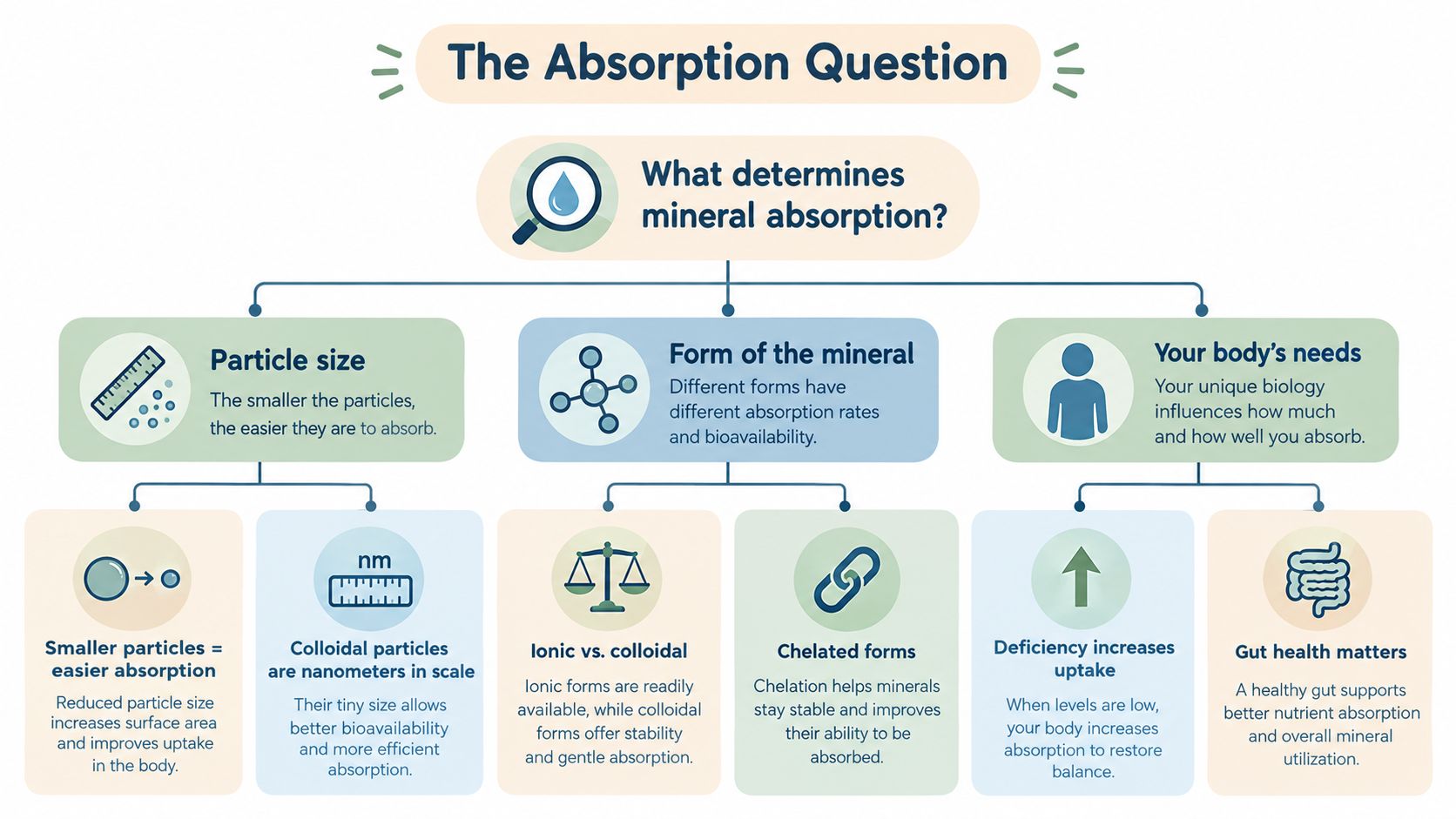
The Absorption Question
The most repeated colloidal mineral claim is superior absorption. The evidence doesn't support treating that claim as a default. Columbia University's health-information service notes that manufacturers make absorption claims for liquid supplements, while also explaining that more research is needed to support them. Its discussion of ionic and colloidal minerals makes the practical point clear: a liquid texture doesn't automatically mean better uptake.
Mineral absorption depends on several moving parts:
- Chemical form: The same mineral can behave differently depending on the compound carrying it.
- Solubility and particle behavior: A suspended particle isn't the same as a dissolved ion.
- Dose: More isn't automatically better, and high intake can interfere with other nutrients.
- The surrounding meal: Vitamin C can support nonheme iron absorption, while other meal components can reduce it.
- Your body's needs: Deficiency, digestive health, and physiological status can change how much you absorb.
Consider a spinach salad with lemon juice. The lemon doesn't transform the salad into a colloidal product, but its vitamin C can support absorption of plant-based iron. Coffee alongside an iron-rich meal may create a different situation because beverages and meal components can influence uptake. The point isn't that one pairing solves every absorption problem. It's that the digestive environment often matters more than the word printed on the bottle.
Practical rule: Treat “colloidal” as a delivery description, not evidence of superior nutrition.
For a useful refresher on meal timing, nutrient pairings, and other ways to support uptake, see this guide to improving nutrient absorption. The most honest standard is specific human research on the exact mineral, form, dose, and health outcome. Plausibility is not the same as proof.
What the Research Shows About Real Benefits
Product pages often group essential mineral functions together with claims about colloidal delivery. That leap causes much of the confusion. Iron, zinc, magnesium, and other minerals can have established nutritional roles, but evidence for a mineral's role doesn't automatically validate a particular liquid suspension.
The distinction becomes especially important with colloidal silver. The National Center for Complementary and Integrative Health explains that colloidal silver hasn't been proven safe or effective for treating any disease or condition. Silver also isn't an essential mineral with a known beneficial function in the human body when taken orally. Laboratory antimicrobial activity is not the same as preventing or treating infection in people.
A review of 16 in-vitro and in-vivo studies on silver nanoparticles and respiratory viruses found that only a small number examined effects in humans, leaving clinical effectiveness uncertain, as summarized by the same NCCIH resource. The number is important because it shows how limited the human evidence remains, not because laboratory findings should be ignored.
| Claimed benefit | Evidence strength | What research actually shows |
|---|---|---|
| Immune support | Weak for colloidal products | General mineral nutrition matters, but colloidal silver disease-prevention claims lack robust human validation. |
| More energy | Conditional | Correcting a confirmed deficiency may help the underlying problem. That doesn't establish a broad benefit from colloidal delivery. |
| Bone strength | Mineral-specific | Bone health depends on relevant nutrients and overall care, not the colloidal label alone. |
| Thyroid function | Not established for colloidal minerals | Thyroid medicines and mineral products can interact, so a liquid format isn't a reason to self-treat. |
| Digestive comfort | Unsupported as a general claim | Colloidal minerals aren't a general treatment for gas, bloating, constipation, or diarrhea. |
| Antimicrobial action | Mostly laboratory-level for colloidal silver | Activity in a test tube doesn't establish a safe oral treatment for infection. |
The Cleveland Clinic's safety review reaches the central conclusion plainly: documented risks exist, while no established oral therapeutic benefit offsets them for colloidal silver. That doesn't mean every mineral supplement is useless. It means the mineral, dose, and reason for taking it must be evaluated separately from the delivery story.
Dosage, Duration, and Real-World Safety
Safety changes with dose, duration, and purity. “Natural” isn't a safety category, and a small daily exposure can become meaningful when the body clears a substance slowly or when a product contains contaminants.
Commercial colloidal silver products commonly contain approximately 10 to 30 parts per million of silver, according to the Cleveland Clinic's review. Repeated oral use can create cumulative exposure because the body doesn't rapidly eliminate all absorbed silver. The principal documented long-term outcome is argyria, a usually permanent blue-gray discoloration caused by silver accumulating in body tissues.
The risks don't stop at skin discoloration. Colloidal silver may reduce the absorption or effectiveness of some antibiotics and thyroid medicines such as thyroxine or levothyroxine. Evidence has also raised concerns involving the kidneys, liver, and nervous system. Medical references describe rare but severe outcomes, including kidney damage and seizures, after excessive exposure.
Questions to ask before taking any liquid mineral
The Mayo Clinic's colloidal silver guidance supports a cautious approach. Before using a product, ask:
- What exact mineral is present? “Mineral complex” isn't enough. You need the ingredient name and elemental amount.
- What does independent testing show? Look for identity, concentration, and contaminant testing, especially for lead, arsenic, and cadmium.
- What medicines do you take? Antibiotics and levothyroxine deserve particular attention.
- Who should avoid it? Children, pregnant people, people who are breastfeeding, and people with kidney or liver disease should seek professional advice before using mineral products.
- What symptom are you trying to address? A suspected deficiency needs assessment, not a broad-spectrum promise.
Nausea, stomach upset, and diarrhea can occur with excessive mineral intake or contamination. A product that causes digestive distress isn't “detoxing” by default. It may be irritating you, supplying too much, or containing something the label doesn't adequately describe.
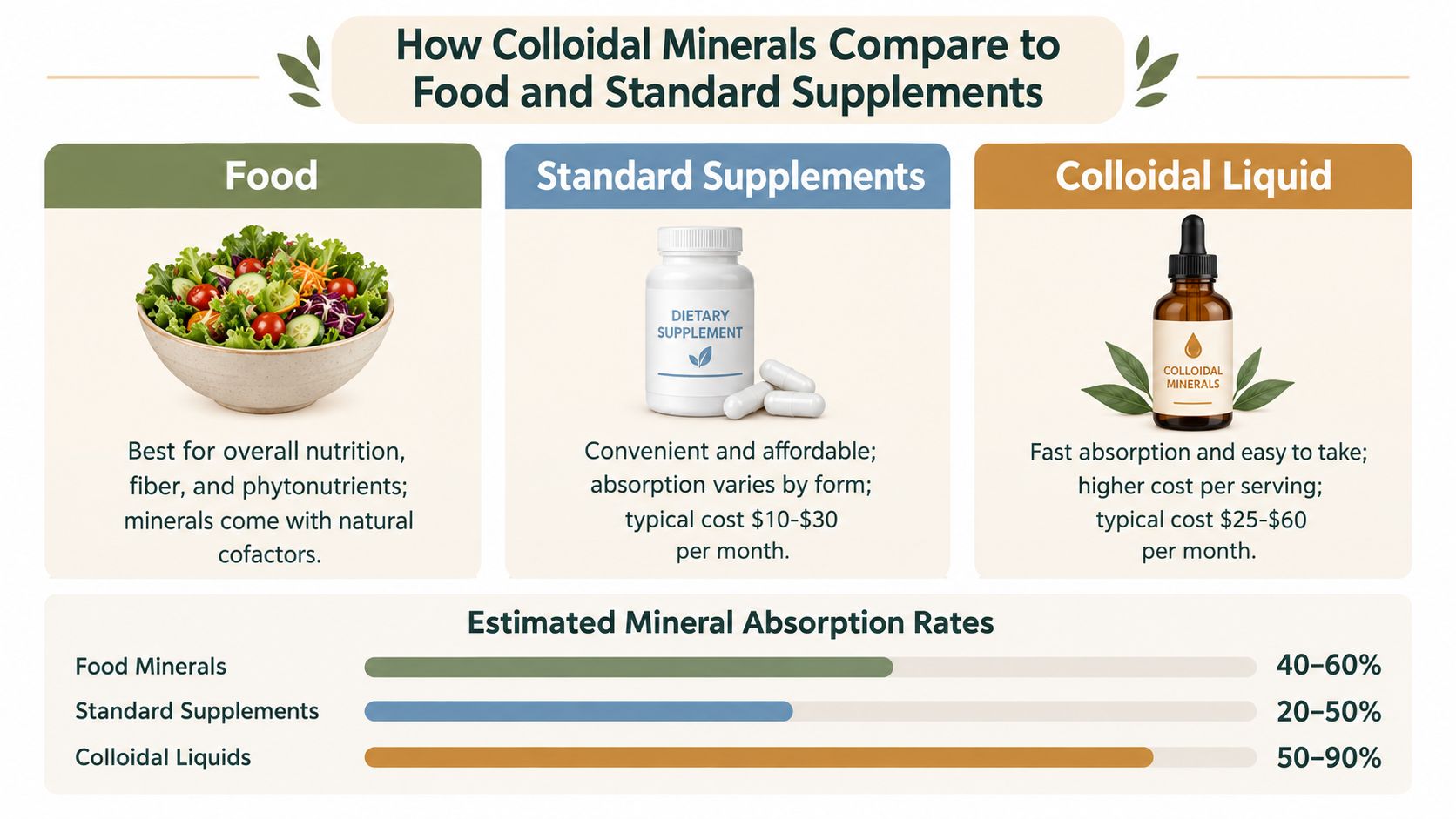
How Colloidal Minerals Compare to Food and Standard Supplements
The practical choice usually isn't “colloidal or nothing.” It's whether your goal is best served by food, a measured standard supplement, or a liquid product with a clearly documented purpose.
Food offers more than isolated minerals. Beans, lentils, leafy greens, nuts, seeds, grains, and other foods bring fiber and other nutrients that contribute to an overall dietary pattern. A standard supplement can be useful when a clinician identifies a deficiency or when diet alone doesn't meet a specific need. A colloidal liquid may be easier for some people to take, but ease of use doesn't establish better absorption or safety.
Match the format to the problem
People following vegetarian or vegan diets may absorb a different proportion of certain minerals from meals, but that doesn't make colloidal products superior. One nutrition reference estimates iron absorption at about 14% to 18% from mixed diets, compared with roughly 5% to 12% from vegetarian diets. These figures are cited in this trace-mineral nutrition reference, which also explains that vitamin C can help plant-based nonheme iron absorption while phytates and some dietary fiber can hinder it.
That is a meal-pattern insight, not a reason to buy a liquid. Pairing lentils or beans with vitamin-C-rich foods may support iron absorption without adding an unproven delivery system.
| Option | Main strength | Main limitation |
|---|---|---|
| Food | Provides minerals within a broader dietary pattern | May not correct a confirmed deficiency on its own |
| Standard supplement | Offers a measured ingredient and familiar dosing | Absorption and tolerability vary by mineral form |
| Colloidal liquid | May be convenient for people who prefer liquids | The format doesn't prove superior uptake, and quality can vary |
For readers comparing mineral forms, a focused resource on calcium citrate powder may be more useful than a broad colloidal promise. Likewise, Longevity Medical Institute's information on nutraceutical IV treatments illustrates why more intensive delivery methods should be discussed with qualified clinicians rather than treated as routine nutrition.
A food-first approach doesn't mean ignoring symptoms. Persistent bloating, diarrhea, constipation, or abdominal pain deserves evaluation because digestive symptoms can reflect food intolerance, infection, constipation, or a gastrointestinal disorder.
A Smarter Way to Think About Mineral Support
Start with the problem, not the format. If you're tired, bloated, following a restrictive diet, or worried about a nutrient gap, a liquid mineral isn't automatically the right first move. A clinician can help connect symptoms, dietary intake, medical history, and appropriate testing.
Use this sequence:
- Name the nutrient. Avoid products that hide the actual minerals behind vague “trace complex” language.
- Confirm the role. Ask whether the mineral has an established nutritional function relevant to your concern.
- Check the elemental amount. The compound name and the amount of elemental mineral aren't always the same thing.
- Evaluate the form. Compare food, standard supplements, and liquids based on tolerability, dosing, interactions, and evidence.
- Review the label and testing. Identity, concentration, and contaminant results matter more than claims about being “charged” or “pre-digested.”
- Monitor with support. Stop and seek advice if you develop new symptoms or if the product could interact with medication.
For someone eating a plant-based diet, the strongest plan may involve varied meals, deliberate pairings, and a measured supplement when a real need exists. For someone with digestive discomfort, a mineral liquid shouldn't become a detour around finding the cause. Bloating relief comes from identifying the trigger, not assuming every symptom signals mineral deficiency.
I don't think “colloidal” deserves either blind enthusiasm or automatic dismissal. The useful question is narrower: does this specific ingredient, in this specific amount and form, have evidence for the outcome you care about, with safety information strong enough for your situation?
A better buying rule: Choose the clearest label and the clearest reason, not the most impressive promise.
Colloidal Minerals Questions Worth Asking
Can colloidal minerals interact with medicines?
Yes. Colloidal silver may reduce the absorption or effectiveness of some antibiotics and thyroid medicines such as thyroxine or levothyroxine. Ask a pharmacist or clinician about any mineral product before combining it with prescriptions.
Why has the FDA acted against colloidal-silver sellers?
The FDA has taken enforcement action against sellers making unapproved therapeutic claims. A 2019 warning letter stated that products promoted for disease-related uses weren't generally recognized as safe and effective and were therefore treated as unapproved new drugs, as summarized by the Cleveland Clinic.
What should a mineral label disclose?
Look for the exact mineral, elemental quantity, chemical form, serving instructions, and evidence of independent testing for identity, concentration, and contaminants. Be cautious when a label relies on “immune,” “detox,” or antibiotic-like language without identifying a validated human outcome.
When should I see a clinician instead?
Seek medical advice for persistent or severe digestive symptoms, suspected deficiency, medication questions, pregnancy, breastfeeding, childhood use, or kidney or liver disease. A supplement can't explain why your symptoms started or replace appropriate care.
Is colloidal silver an essential mineral?
No. NCCIH states that silver has no known beneficial function in the human body when taken orally, and colloidal silver hasn't been proven safe or effective for treating any disease or condition.
Yuve offers plant-based supplements designed around gut health and everyday nutrition, but the right mineral strategy still starts with a specific need and a transparent label. Visit Yuve to explore its vegan, non-GMO, gluten-free, and gelatin-free products, then discuss any targeted supplement choice with a qualified healthcare professional.