It depends on the ingredient, dose, your body, and how you define success. In one systematic review, fructooligosaccharides increased Bifidobacterium with a standardized effect estimate of 0.579, but that shift didn't consistently improve symptoms.
So, do prebiotic supplements work? Sometimes, yes. But “work” might mean a measurable microbiome change, easier bowel movements, less bloating, or a change in appetite, and those outcomes don't always arrive together. A supplement can feed beneficial bacteria while making you feel gassier, especially if you take too much too quickly.
If you've ever felt your stomach inflate by afternoon and then stared at a shelf of powders, gummies, and capsules labeled “gut health,” you're in the right place. We'll sort out what prebiotics do, which ingredients have been studied, how to dose them without turning your abdomen into a weather system, and why tolerability deserves as much attention as bacteria counts.
Why Everyone Wants to Know If Prebiotics Actually Work
Standing in the supplement aisle can feel like taking an exam you didn't study for. One bottle promises digestive comfort, another talks about microbiome balance, and a third says "fiber" in large letters. Meanwhile, your actual question is much simpler: Will this help me feel better after I eat?
Maybe your issue is bloating. Maybe your digestion feels sluggish, or your bowel habits have changed. Maybe you heard a podcast describe the microbiome as an invisible ecosystem and started wondering whether you should be feeding it more intentionally. Those are reasonable questions, especially when supplement marketing makes every gut problem sound like it has one tidy answer.
The honest answer has four parts:
- Ingredient: Inulin, FOS, GOS, resistant starch, and other fibers don't behave identically.
- Dose: A tiny amount may be too little to reproduce a study result, while a large amount may create gas.
- Timeline: Microbial changes can take time, so a brief trial may tell you very little.
- Outcome: More Bifidobacterium isn't the same thing as less pain, better blood sugar, or reliable weight loss.
The practical question: Don't ask only, “Does this prebiotic work?” Ask, “Has this exact ingredient, at this dose, been tested for the outcome I care about?”
That shift makes supplement shopping less mysterious. If your goal is bowel regularity, you need evidence connected to bowel outcomes. If your goal is bloating relief, a formula that increases fermentation may not be your first choice, even if it changes bacterial abundance in a favorable direction.
You'll also see why “natural” doesn't automatically mean comfortable. Fermentation is part of how prebiotics work, but fermentation can produce gas and bloating. Your body isn't failing if a product doesn't suit you. It may be the wrong ingredient, amount, timing, or target for your gut right now.
What Prebiotics Actually Are and Why They Differ From Fiber
A prebiotic is a substrate, usually a specific type of fiber, that your existing gut microorganisms selectively use and that produces a health benefit. In everyday language, prebiotics are food for particular microbes, not a general clean-up crew sweeping through your digestive tract.
Think of your gut as a garden. Regular dietary fiber is a broad layer of mulch. It can support stool bulk, movement, and fermentation in different ways. A prebiotic is more like targeted fertilizer. Certain microbes can use it especially well, giving them a competitive advantage as they ferment it.
That process happens mostly in the colon. Prebiotic fibers pass through the small intestine relatively undigested, then susceptible bacteria break them down and produce short-chain fatty acids, which can serve as fuel for cells lining the colon. The important word is “selectively.” A fiber doesn't qualify as a prebiotic merely because it reaches the colon or changes the amount of bacteria present. The scientific definition also requires a demonstrated health benefit.

Prebiotics, probiotics, and ordinary fiber
Probiotics are live microorganisms supplied through foods or supplements. Prebiotics don't add new bacteria. They provide fuel to microbes already living in your gut.
Generic “fiber” is a much wider category. Some fibers are fermented readily, some contribute mainly to stool bulk, and some do a little of both. A label that says only “fiber” doesn't tell you which microbes can use it, how much is present, or what result you should expect.
That difference explains why prebiotics can be both interesting and tricky. A targeted substrate may produce a measurable microbial effect, but it can also be more fermentable than a person with a sensitive digestive system expects.
A useful label test: Look for the exact substrate and daily gram amount. “Gut health fiber” is a marketing phrase, not enough information to judge a formula.
The Main Types of Prebiotic Ingredients Compared
The ingredient list tells you far more than the front of the package. Inulin and inulin-type fructans are common in chicory root and are widely used in powders, fortified foods, and gummies. FOS is a related group of short-chain fructans. Both can support fermentation and have been studied for their effect on Bifidobacterium, but both may also trigger gas when introduced aggressively.
GOS, or galactooligosaccharides, are another selectively fermented carbohydrate. Research has examined them for microbiome and bowel-related outcomes, but results from GOS shouldn't automatically be transferred to an inulin product. Resistant starch behaves differently again. It resists digestion and can be fermented in the colon, including into short-chain fatty acids, but its effects depend on the source and preparation.
Acacia fiber is often included in gut-health products because it can be fermented more gradually than some highly fermentable fibers. That doesn't make it universally symptom-free, though. Your baseline diet, microbiome, health status, and the rest of the formula still matter.
| Ingredient | Typical Studied Dose | Best-Supported Outcome |
|---|---|---|
| Inulin-type fructans | Varies by study and formula | Bowel-related outcomes and changes in selected bacteria |
| FOS | Approximately 7.5 to 15 g/day in the clearest positive trials | Increased colonic Bifidobacterium |
| GOS | Varies by study and formula | Selective fermentation and bowel-related outcomes |
| Resistant starch | Varies by source and study | Fermentation and short-chain-fatty-acid production |
| Acacia fiber | Varies by study and formula | Fermentable fiber support, with tolerability depending on the person |
The table is a map, not a promise. A named ingredient is useful because it lets you compare a product with research. It doesn't prove that every product containing that ingredient will produce the same outcome.
If you're exploring products that pair microbial support with everyday routines, you may also find this resource on beneficial bacteria mints useful for understanding how a delivery format can differ from a fiber supplement. For another ingredient-specific explanation, see what XOS prebiotic means.
What the Science Says About Real-World Results
Do prebiotic supplements need to change how you feel before they count as effective? A person taking FOS may find bowel movements easier after several weeks. Someone else taking a similar amount may notice rumbling and gas without better comfort. Both responses can fit the same basic biology: gut microbes ferment the ingredient, but the resulting experience depends on the person and the dose.
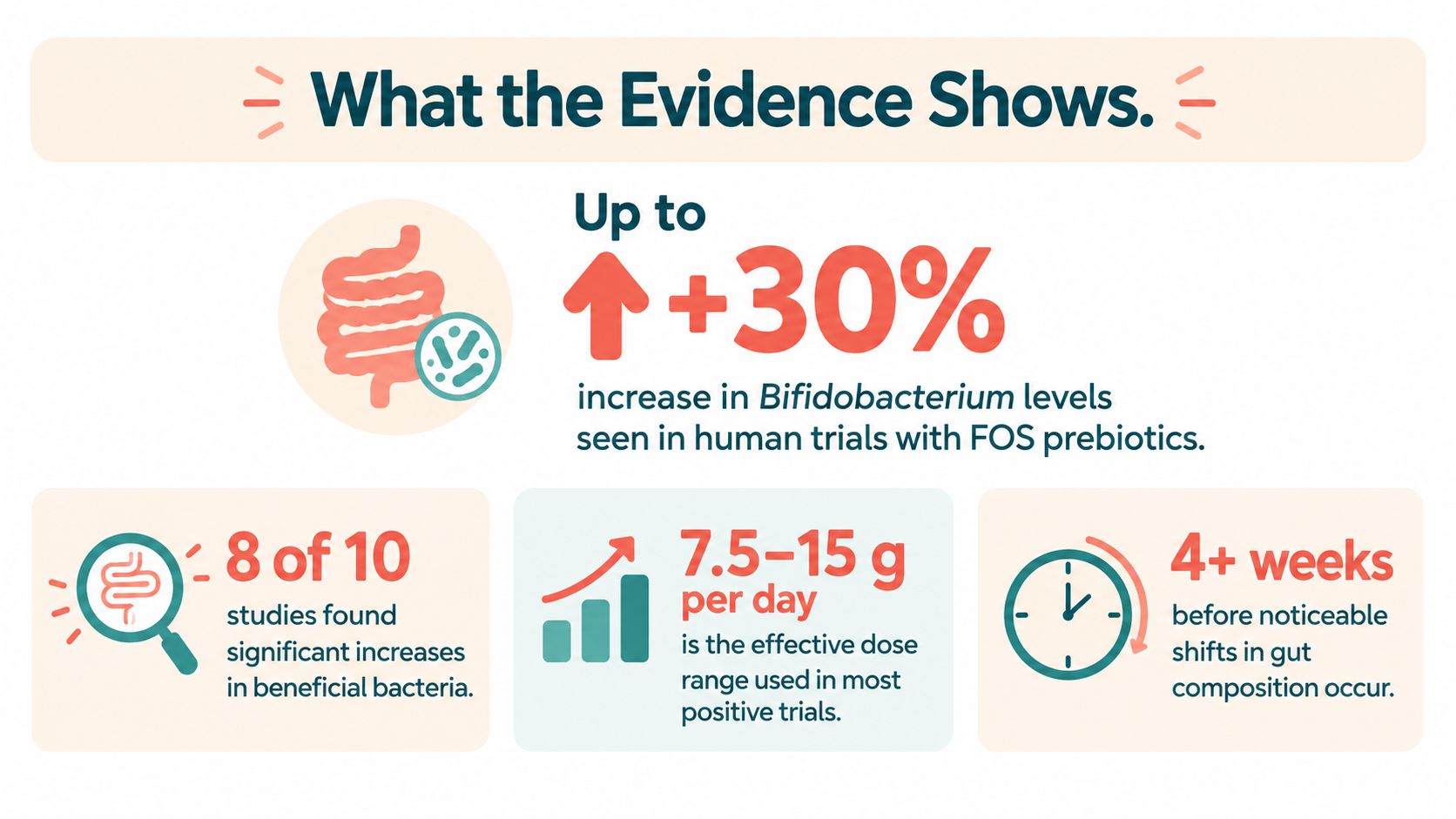
A systematic review and meta-analysis of FOS trials found that FOS significantly increased colonic Bifidobacterium compared with a control. The standardized effect estimate was 0.579, with a 95% confidence interval of 0.444 to 0.714. The clearest effects appeared around 7.5 to 15 grams per day after more than four weeks.
A bacteria shift isn't the same as symptom relief
The review did not find consistent improvements in other bacterial groups or gastrointestinal symptoms. That distinction matters. A stool result can show a biological change while your afternoon still feels exactly the same. For real-world use, tolerability, bloating, stool pattern, and comfort deserve attention alongside microbiome measures.
Metabolic outcomes also need a narrow reading. A 2025 systematic review of 11 randomized trials involving 546 adults with prediabetes found a reduction in body-fat percentage, but no significant improvement in fasting glucose, insulin, HbA1c, insulin resistance, cholesterol, or triglycerides (systematic review in adults with prediabetes). The result supports one specific finding, not a broad promise about metabolic health.
A separate review of prebiotic health effects found increased self-reported satiety in healthy adults, while the pooled effect on body weight was not statistically significant. The standardized mean difference was -0.48, with a 95% confidence interval of -1.19 to 0.23 and P=0.19. Trials lasting 12 to 17 weeks were more likely to report weight reductions than trials lasting 4 to 8 weeks, but that pattern does not establish dependable weight loss.
The useful question is more specific than “Do prebiotics work?” Ask: Which ingredient, at what dose, for how long, and for which outcome has been tested in people like me? Then track both the hoped-for benefit and any symptoms.
How Long Prebiotics Take and How to Dose Them Safely
How long should you try a prebiotic before deciding whether it suits you? Usually, longer than a few days. In the FOS review, the clearest bacterial changes appeared at approximately 7.5 to 15 grams daily and after more than four weeks, as detailed in the science section above. A small dose used briefly may therefore give an incomplete picture, while increasing too quickly can make side effects harder to interpret.
Use a gradual approach:
- Read the label first. Identify the substrate and grams per serving. A broad fiber total does not let you compare the product meaningfully with a study.
- Start below the studied target. If you are sensitive, begin with less. Follow the product directions, and avoid increasing the amount while symptoms are active.
- Hold that amount for several days. Record gas, bloating, cramping, stool changes, regularity, and overall comfort.
- Increase only while comfortable. Reaching a high dose quickly offers no advantage if it leaves you unable to judge the ingredient fairly.
- Track the trial. Note the dose, meal timing, stool pattern, bloating, pain, and comfort for at least two weeks, then reassess over a longer period.
Slow is smart: A gradual increase gives you useful information. A sudden increase creates discomfort and makes the result difficult to read.
Short, low-dose trials can underestimate a benefit. Fast increases can exaggerate side effects. Taking a supplement with food and drinking water may feel gentler for some people, but neither changes an ingredient your body does not tolerate.
For a fuller timeline, see how long prebiotics take to work. If symptoms become severe or persistent, stop the product and seek medical advice instead of pushing through. A tolerable routine is a meaningful outcome, alongside any microbiome change.
When Prebiotics Disappoint or Cause Side Effects
Here is the sentence I wish more supplement labels printed plainly: a product can move bacteria in a favorable direction and still make you feel worse.
A review of 11 randomized controlled trials involving 729 people with irritable bowel syndrome or other functional bowel disorders found no improvement in overall gastrointestinal symptoms or quality of life compared with placebo. The result wasn't identical for every formulation. Doses below 6 grams per day of non-inulin-type fructans improved flatulence in some participants, while inulin-type fructans increased flatulence among people with IBS (NCCIH review of prebiotics and functional bowel disorders).
That finding matters because gas isn't proof that a supplement is “working.” Gas tells you fermentation is happening. It doesn't tell you whether the fermentation is producing a meaningful benefit for your symptoms.
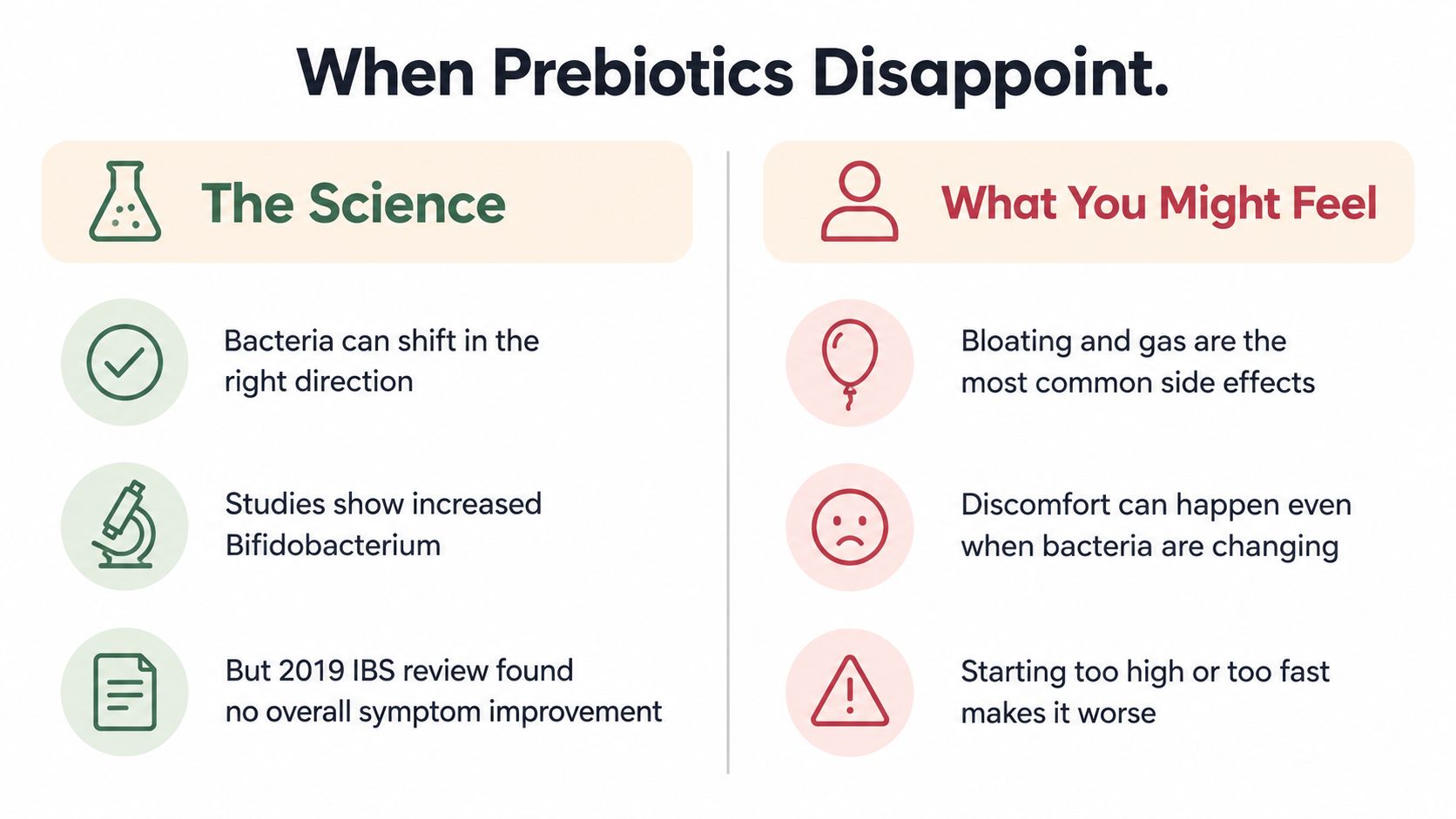
Treat comfort as a real outcome
A 2025 review of 29 randomized trials involving 1,633 adults aged 60 and older found that prebiotics increased Bifidobacterium more strongly than probiotics, but the broader results varied by product and outcome (review of prebiotics in older adults). Researchers also face differences in formulation, dosage, participant characteristics, and microbiome testing methods, which makes simple product-to-product comparisons difficult.
Be especially cautious if you:
- Follow a low-FODMAP diet: Some prebiotic ingredients may not fit your current phase or tolerance.
- Have significant gastrointestinal disease: Trial participants may not resemble you, so clinical guidance matters.
- Are choosing for a child: Pediatric dosing and safety can't be assumed from adult studies.
- Feel progressively worse: Increasing bloating, pain, cramping, or altered stools is a reason to pause, not a challenge to overcome.
Some trials focus on constipation or specific bowel patterns rather than general digestive comfort. One placebo-controlled trial assigned 34 participants to 9.2 grams per day of an inulin and oligofructose mixture or maltodextrin placebo for eight weeks, tracking symptoms such as constipation, bloating, and gas (randomized trial of inulin and oligofructose). Its design shows what responsible evaluation looks like: a stated dose, a placebo, a defined period, and patient-relevant outcomes.
For a plain-language discussion of gas and fermentation, read whether prebiotics cause gas.
Putting It Together With Yuve's Prebiotic Blend
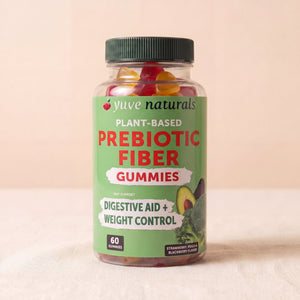
A transparent formula makes Yuve's approach easier to assess. Yuve's Vegan Prebiotic Fiber Gummies use chicory-root inulin and FOS, so the prebiotic substrates are named instead of hidden behind a generic fiber label. That gives you something concrete to check: serving information, starting amount, and your digestive response.
For someone like Sam, who has faced digestive challenges, tolerability deserves equal billing with microbiome changes. A supplement can influence gut bacteria and still be a poor fit if it leaves you bloated or uncomfortable. The useful question is whether the routine supports digestion without asking you to dismiss those symptoms.
Yuve's product is not a magic bullet. It is a clearly labeled option for testing targeted fiber alongside a varied diet, gradual changes, and honest symptom tracking. You can explore Yuve's Vegan Prebiotic Fiber Gummies, then apply the same start-low, go-slow approach described above.
Your Prebiotic Decision Framework and Common Questions
Before buying a product, run through this short framework:
- Name your goal. Are you focusing on regularity, bloating relief, appetite, or a microbiome marker?
- Choose a named ingredient. Look for FOS, inulin-type fructans, GOS, resistant starch, or another clearly identified substrate.
- Check the daily dose. A serving size without grams of the active prebiotic is incomplete information.
- Start low. Increase only when your symptoms remain comfortable.
- Give it time. Judge a trial over at least four weeks if you're trying to assess a microbial change.
- Stop when your body says stop. Seek clinical advice for severe, persistent, or unexplained symptoms.
Frequently asked questions
Which prebiotic is best for bloating?
There isn't one universally best choice. In people with IBS or functional bowel disorders, evidence varies by chemical type and dose. Some lower-dose non-inulin fructans improved flatulence in certain participants, while inulin-type fructans increased flatulence in people with IBS. If bloating is your main concern, choose a small starting amount and prioritize your symptom response over a bacteria-count claim.
Can prebiotics replace a high-fiber diet?
No. A supplement supplies a targeted substrate, while food provides a broader mix of fibers and nutrients. Use a product to complement meals, not to replace vegetables, fruit, legumes, whole grains, nuts, or seeds that you tolerate.
Can prebiotics be taken with probiotics?
They can be used together, but one doesn't automatically make the other effective. Probiotics add live microorganisms, while prebiotics provide fuel for selected microbes. Judge the combined routine by the outcome you care about and by how your body feels.
Do children or older adults need different dosing?
Don't transfer an adult dose to a child without professional guidance. Older adults may respond differently because products, health status, diet, and microbiome composition vary. A clinician or dietitian can help match the ingredient and amount to the person.
The measure of success isn't an impressive label or a louder stomach. It's whether you can eat, move through your day, and use the bathroom with greater comfort. If you've tried a prebiotic, share what changed, including any small win or unwelcome bloating, so other readers can make more informed choices.
Yuve offers plant-based gut-health products, including a clearly labeled chicory-root inulin and FOS prebiotic option for gradual daily use. Visit Yuve to review the formula and choose a measured, symptom-aware way to explore prebiotic support.