Your probiotic bottle spent the afternoon in a hot delivery box, and now you're wondering whether there's anything alive inside. When your stomach already feels tight by lunchtime, the last thing you need is another gut-health guessing game.
Heat stable probiotics aren't a yes-or-no category. A product that handles shipping and cupboard storage isn't automatically ready for boiling soup. Choosing well means matching the product to your routine, then checking how many live organisms remain when you take it.
Heat Stable Probiotics in Plain Language
Heat stable probiotics are live microbes selected or protected so more of them remain alive through warmth. That protection might come from the organism's natural structure, its coating, or the food or supplement surrounding it.
Think of a spore as a seed in a hard coat. A typical unprotected Lactobacillus cell is closer to a fresh herb that wilts in a hot pan. It's a useful comparison, but neither the hard coat nor the organism's name guarantees survival under every condition.
Alive is only part of the definition
In 2001, experts convened by the Food and Agriculture Organization and World Health Organization defined probiotics as live microorganisms that provide a health benefit when given in adequate amounts; the 2014 consensus retained those central requirements, as described in the FAO/WHO probiotic framework.
In everyday English, that means:
- Alive: The organisms must remain viable, meaning capable of growing under suitable testing conditions.
- Enough: The serving must deliver an appropriate live dose.
- Useful: Evidence must support a benefit for the particular strain and intended use.
A strain is a specific version of a microorganism, identified by more than its broad species name. A responsible product also needs defined contents, safety for its intended use, and an appropriate live count through its stated shelf life.
Your kitchen and your gut pose different challenges
Surviving warmth doesn't prove that a microorganism survives stomach acid and bile. Those are separate challenges, and protective formulations may behave differently during digestion.
Practical rule: Choose a probiotic for the conditions it will actually face, not for the toughest-sounding organism on the label.
For a bottle sitting in your cupboard, storage testing matters. For a probiotic added before cooking, you need evidence from the heating process itself. Neither claim should be stretched to cover the other.
Survival Numbers by Strain and Heat
Heat exposure and viable count by probiotic type
| Type or format | Exposure | Viable count result | Practical reading |
|---|---|---|---|
| Lactobacillus and Bifidobacterium | Above about 55–60°C | Generally lose viability | Weak choice for hot food or drink without product-specific testing |
| Lactobacilli and bifidobacteria cultures | 60°C for 15 minutes | About 95% of viable cells lost | A hot drink held under similar conditions could erase most of a vegetative dose |
| Lactobacilli compared with bifidobacteria | 50–60°C | Lactobacilli were more thermally stable | Genus still isn't a guarantee |
| Spore-forming Bacillaceae | After a reported cooking step | Above 6 log10 CFU/g and about 85% survival | Spores can retain substantial live counts |
| Nanoencapsulated cells | 65°C | 6.18 log CFU/g | Strongest protection in this test |
| Microencapsulated cells | 65°C | 4.98 log CFU/g | Some protection, less than nano here |
| Free cells | 65°C | 3.42 log CFU/g | About 575-fold fewer live cells than the nano result |
The conventional-bacteria threshold, spore results, and encapsulation figures come from a recent food-processing report, which describes viability losses above approximately 55–60°C, about 85% survival for the spore preparations after cooking, and the 65°C encapsulation comparison shown above.
The culture-loss and genus-comparison rows come from a probiotic thermostability study, in which 60°C for 15 minutes caused an estimated 95% loss of viable lactobacilli and bifidobacteria, while lactobacilli tolerated 50–60°C better than the corresponding bifidobacteria cultures.
What those lab terms mean in your breakfast bowl
CFU means colony-forming units. It estimates how many viable microorganisms can grow into colonies under the test conditions. CFU/g reports that count per gram, not per capsule, gummy, or daily serving.
A log is a way to express large changes in microbial counts. Each whole log step represents a tenfold change, so a seemingly small gap between log values can describe a large difference in surviving cells.
Encapsulation means surrounding cells with protective material. Nanoencapsulation and microencapsulation use different-sized protective structures. In this comparison, the smallest protective format retained the most viable cells, but that doesn't establish a universal winner for every product.
Use the comparison without overextending it
Say you're preparing oatmeal and want to stir in a probiotic powder. An unprotected lactic-acid culture could lose much of its live dose during prolonged contact with very hot food. A tested spore preparation or protected culture might retain more, but your bowl isn't automatically equivalent to a laboratory heating test.
The surrounding food matters, too. Researchers call this the matrix, meaning everything around the cells, such as water, fat, sugar, protein, and protective ingredients.
If you're also sorting out supplements for a pet, Pure Paw Labs' guide to choosing gut support for your dog offers context on the different support categories. Don't transfer human heat-survival results to a pet product.
Match the tested temperature and exposure time to your actual use. Then check whether the remaining count delivers the intended serving, rather than asking whether any cells survived.
Cooking Tests for One Tough Spore Strain
Bacillus coagulans MTCC 5856 offers a concrete example of why the full strain designation matters. It's not interchangeable with every product labeled B. coagulans, much less every probiotic.
Its heat resistance can be described using a D-value. That's the time required at a specified temperature to reduce the viable population by a log, equivalent to a large reduction rather than complete destruction.
Bacillus coagulans MTCC 5856 heat tests
| Test | Condition | Result |
|---|---|---|
| D-value | 90°C | About 35.7 minutes for a 1-log, 90% reduction |
| Chapati | Reported chapati cooking | 88.94% viability retained |
| Wheat noodles | Noodle processing | 94.56% viability retained |
| Microwave | 300 seconds at 260°C | 73% viability retained |
| Milk and juice | 72°C for 420 minutes | 98.52% viability retained |
| Cookies and crackers then storage | About 180–235°C, then 10 months | B. subtilis lost under 2 log; B. coagulans lost about 3.3–4.2 log |
The comparative MTCC 5856 study reported the 35.71-minute D-value at 90°C, along with the chapati, noodle, microwave, and milk-and-juice results shown in the table.
The separate review of probiotic food applications describes cookies and crackers exposed to approximately 180–235°C, followed by the different storage losses over 10 months shown in the final row.
Follow the strain through the food
The chapati and noodle results demonstrate that this strain retained substantial viability through those particular processes. The microwave result shows that even a resilient spore preparation can lose cells.
The milk-and-juice result adds another lesson: temperature alone doesn't determine survival. The surrounding liquid, heating profile, and starting preparation all belong to the test.
For background on the organism itself, our guide to Bacillus coagulans benefits can help you distinguish the species name from the evidence you need for a finished supplement.
Baking survival isn't the finish line
The baked-goods comparison is especially useful because it follows the organisms beyond the oven. A manufacturer can retain cells during processing and still lose a substantial share during storage.
Home bakers exploring this topic may appreciate DBakerAid™’s science-backed tips for home bakers. Treat any home recipe as a recipe, though, not as a validated live-dose guarantee.
An oven setting describes the equipment. It doesn't tell you the temperature every probiotic cell experienced inside the food.
For your daily routine, a capsule in a warm mailbox and a probiotic baked into dough are different problems. I'd rather see a clear, repeatable supplement habit than a clever recipe with an unknown surviving dose.
Don't copy the chapati percentages onto coffee, oatmeal, or an untested gummy. A meaningful cooking claim identifies the strain, food, temperature, duration, and count remaining afterward, including during storage.
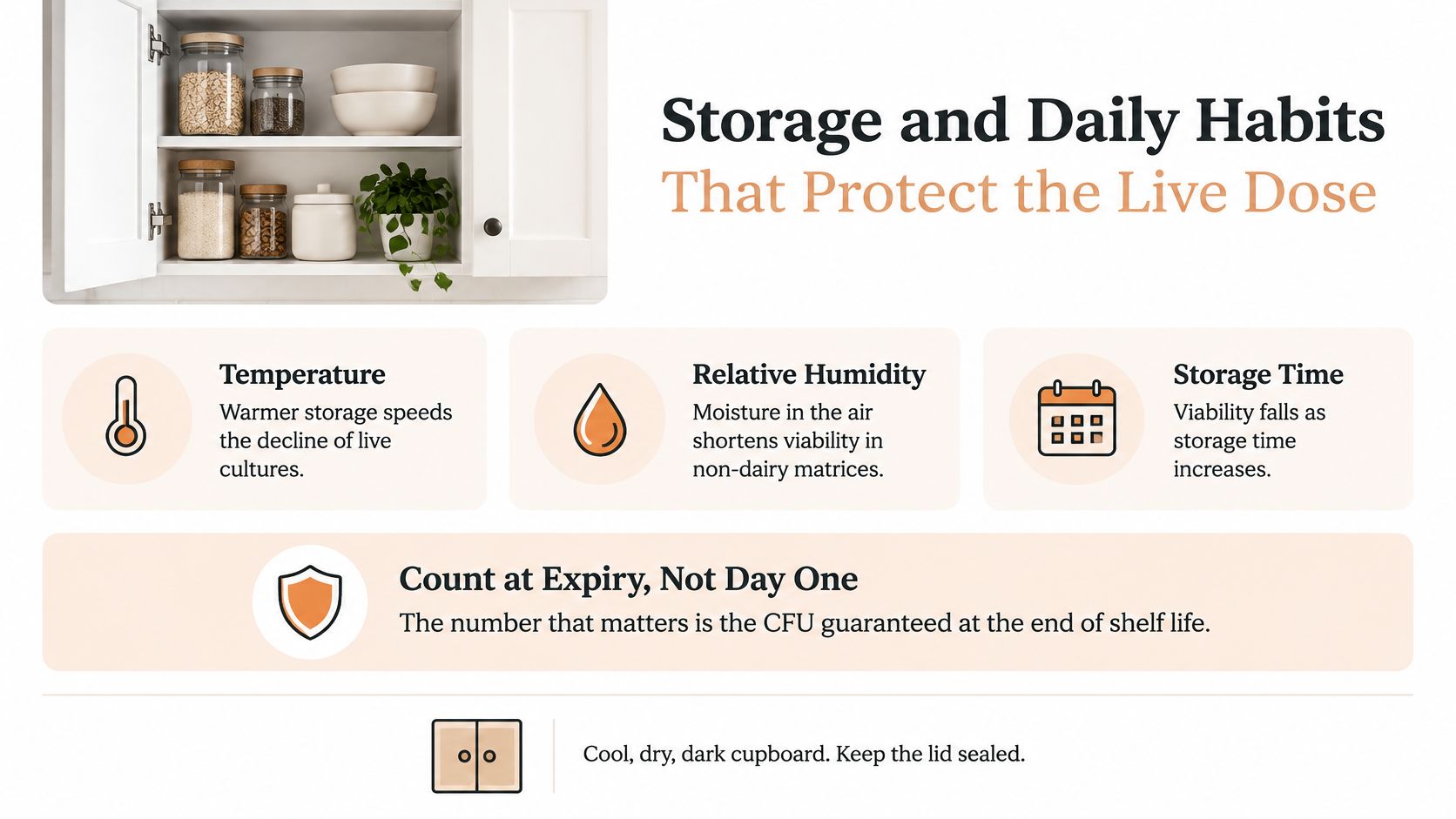
Storage and Daily Habits That Protect the Live Dose
Start with the cupboard, not the oven. The count when you open the bottle matters more to your routine than an impressive count measured immediately after manufacturing.
A review of probiotic survival in non-dairy foods concluded that viability losses increased with storage time, temperature, and relative humidity. In practical terms, warmth and moisture deserve attention even when you never cook with your supplement.
Use this storage guide as a reminder near your supplement spot.
What storage comparisons can tell you
Storage stability by format and condition
| Format | Storage condition | Result | Practical reading |
|---|---|---|---|
| B. subtilis spores | 25°C, 4°C and minus 18°C for 12 months | Less than 2 log decline | Strong candidate for ambient storage when the finished format is validated |
| Second B. subtilis preparation | Late storage with temperature variation | More affected by temperature | Check the storage claim, not only the organism |
| Dry mix | About 27°C versus refrigerator | Above 1 billion CFU/g for 84 days versus 105 days | Refrigeration added margin in this formulation |
| Probiotic pellets | Room temperature for six months | About 2 log reduction, still in the cited effective range | Remaining count determines whether the intended dose persists |
The storage-study summary indexed on PubMed describes the 2025 spore comparisons over 12 months and the dry-mix comparison of 84 days near 27°C versus 105 days under refrigeration, using the researchers' 1-billion-CFU/g threshold.
The Frontiers food-science discussion describes probiotic pellets losing approximately 2 log during six months at room temperature while remaining within the cited effective-dose range.
These results don't make refrigeration universally better or unnecessary. They show why the finished formulation needs its own storage instructions. Our guide to whether probiotics have to be refrigerated helps translate that distinction into a shopping decision.
Build a routine that protects the bottle
- Choose a stated live count. Look for a serving-based guarantee through expiry, and don't introduce a cooking step that the product instructions don't support.
- Keep ordinary lactobacilli and bifidobacteria out of boiling oatmeal, fresh soup, and hot coffee. Take the supplement separately rather than treating breakfast as a heat experiment.
- Pick a dry storage spot. Keep the bottle away from the stove, parked car, sunny windowsill, and steamy bathroom. Close the cap promptly, and retain any supplied desiccant.
- If prebiotic fiber fits your digestive plan, pair it thoughtfully with your routine. Prebiotics feed beneficial gut microbes, but adding more fiber abruptly can be uncomfortable for some people.
- Track comfort consistently. Digestive support products, including enzymes and probiotics, often show results within 1–2 weeks of consistent use. That's a practical observation window, not a promise or a reason to continue through worsening symptoms.
For another way to engage with the topic, you can watch the video below.
Notice small wins without turning them into guarantees
One Yuve website reviewer, p, wrote: “There is no strong odor and they have not bothered my stomach.” That's an individual experience, not evidence that everyone will respond the same way.
Your useful small win might be remembering the serving, moving the bottle away from steam, or noticing a clear pattern in a symptom diary. Share the moment your stomach protested, whether it was a dairy-heavy dinner or the worry after finding a bottle in a hot car. Those details help make gut-health conversations more practical and less lonely.
Label Checks Before You Trust the Claim
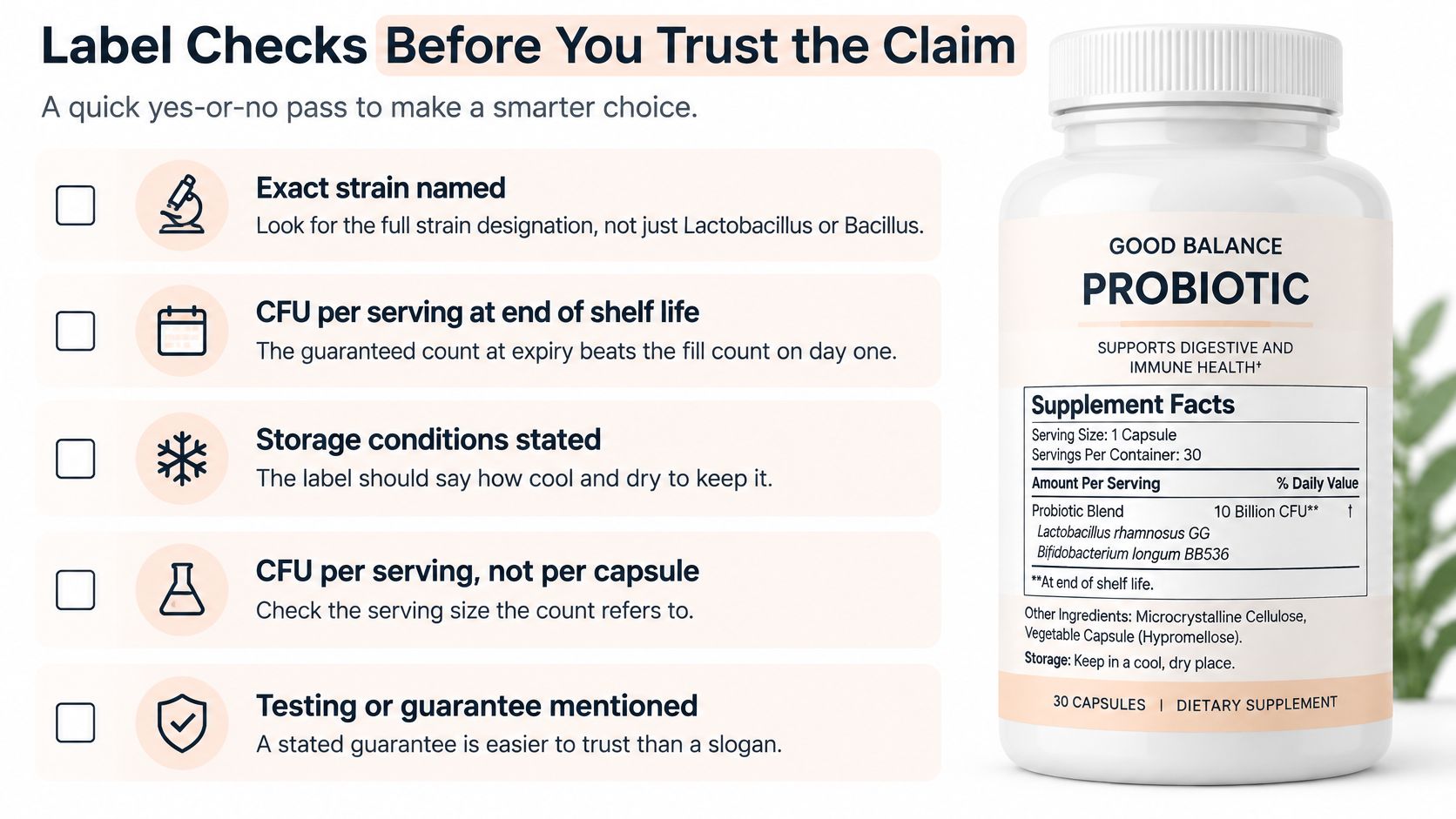
A heat-stability slogan should be the start of your label check, not the finish. You're looking for answers that connect the actual product to the way you'll store and use it.
Keep these questions beside the bottle or brand page.
Can you answer these questions?
- Is the exact strain named? A broad label such as Lactobacillus or Bacillus doesn't identify the organism closely enough to match it to a study.
- Is the CFU count guaranteed per serving at expiry? Check how many capsules or gummies make up that serving. A manufacturing count isn't the same commitment.
- What heat exposure was tested? Look for temperature, duration, moisture conditions, and the tested format. A laboratory broth isn't your bottle, bar, or beverage.
- Were digestion challenges assessed separately? Look for information about stomach acid and bile rather than assuming a heat test answers that question.
- Are storage and packaging instructions clear? Check what changes after opening and whether the package needs protection from humidity.
A review of spore-forming probiotics in foods explains their protective structure but also reports approximately 3–4 log CFU reductions during cooking in some spore-based products, despite sufficient residual counts for the classification used in those examples.
The takeaway isn't that spores fail. It's that the finished product needs testing, including realistic losses. Manufacturers can add an overage, meaning extra organisms at production, based on measured decline rather than guesswork.
Watch for claims that leave out the hard parts
- No exposure details: Heat stable appears without a temperature or duration.
- Unsupported cooking advice: A refrigerated lactic-acid blend is promoted for baking without matching tests.
- Borrowed resilience: A multi-strain blend is described as heat resistant because only one ingredient forms spores.
- Missing after-opening guidance: The claim ignores moisture entering the package during everyday use.
High-barrier packaging limits moisture entry, while a desiccant absorbs moisture inside the container. These protections complement strain selection; they don't replace it.
Our guide to what to look for when buying probiotics can help organize the broader purchase decision. You can also search the exact strain designation in PubMed rather than relying on a species-level marketing description.
Gastrointestinal motility means how food moves through your stomach and intestines. Heat survival alone doesn't demonstrate an effect on that movement or on bloating, and a depleted live dose can't be assumed to provide the studied benefit.
Check with a clinician if you're pregnant, breastfeeding, or managing illness. Supplements aren't medicines and aren't intended to diagnose, treat, cure, or prevent disease.
If the label won't say what heat, how long, and how many live cells remain, it hasn't established a heat-stable choice for that use.
Heat Stable Probiotics FAQ
Can I stir a probiotic into hot oatmeal?
Don't assume you can, especially with unprotected lactobacilli or bifidobacteria. Take it separately unless the finished product has been tested in comparable food and heating conditions; a spore ingredient alone doesn't validate your recipe.
Do heat-stable probiotics need refrigeration?
Not always. Follow the product's validated storage instructions and check its guaranteed live count through expiry, rather than deciding that every probiotic belongs in the fridge or that every spore product belongs in the cupboard.
Does heat stability mean the probiotic survives stomach acid?
No. Heat exposure and digestion pose different challenges, so look for separate evidence about acid and bile tolerance or the protection supplied by the finished formulation.
Is heat-stable the same as shelf-stable?
Not quite. Shelf-stable describes storage under specified conditions, while a heat-stability claim should describe tolerance to a defined heat exposure, which might involve processing rather than ordinary storage.
Can probiotics help with bloating?
Some strains may support digestive comfort for some people, but the right choice depends on the cause of your symptoms and the evidence for that strain. Persistent, worsening, or unexplained bloating deserves a clinician's attention rather than repeated supplement switching.
For the food side of your routine, Rip Van on smarter daily snacking offers ideas to consider alongside your own food tolerances. A comfortable eating pattern and an appropriately chosen supplement serve different roles, and neither requires turning every meal into a probiotic experiment.
Pick Storage Stability or Cooking Stability
Choose for your daily routine first. If your concern is warm shipping followed by cupboard storage, prioritize clear storage instructions, a meaningful expiry guarantee, and independent quality checks.
If you want to cook with probiotics, make a different purchase decision. Demand a named strain and finished-food testing that matches the process, not an organism associated with heat resistance.
A daily supplement, not a baking ingredient
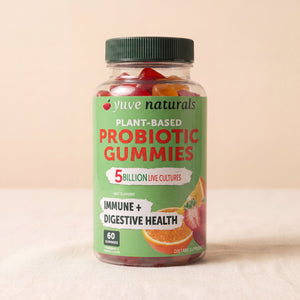
For the non-cooking path, Yuve Vegan Probiotic Gummies offer a plant-based daily supplement with 5 billion live cultures in every gummy. Take them as a supplement rather than baking them into food, and use the package instructions to guide storage.
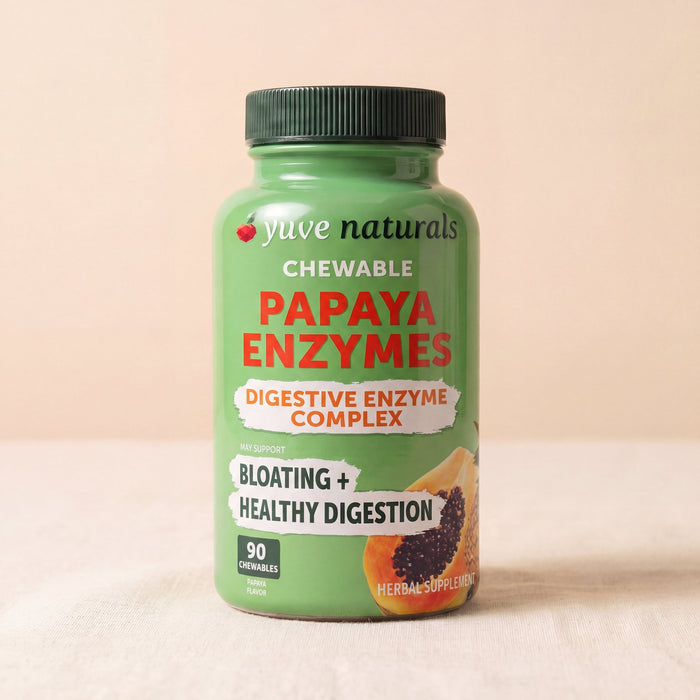
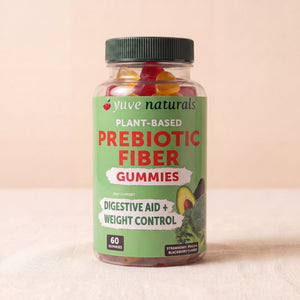
Most Yuve products are designed to be stacked. For example, Probiotic Gummies can be paired with Prebiotic Fiber Gummies, bringing live cultures and a food source for beneficial bacteria into the same routine when added fiber fits your needs.
Trust should come from checks, not heat-proof promises
Every batch is tested for identity, potency, and contaminants, including heavy metals, microbials, and pesticides, by independent labs before it ships. That testing provides quality reassurance without turning a daily gummy into a validated cooking ingredient.
Yuve also offers a 60-day money-back guarantee and free shipping on orders over $75. Those policies can make trying a routine easier, but the reason to choose a product should remain its suitability for your needs.
Before buying, make your short checklist:
- Daily supplement: Confirm the serving, expiry guarantee, and storage directions.
- Cooking ingredient: Require matching food-processing evidence.
- Personal comfort: Track your response and seek advice when symptoms persist.
These statements have not been evaluated by the Food and Drug Administration. This product is not intended to diagnose, treat, cure, or prevent any disease.
Yuve offers plant-based Probiotic Gummies for a consistent, non-cooking daily routine, plus Prebiotic Fiber Gummies if fiber is part of your plan. Visit Yuve to explore the options, and keep the label checklist handy whenever a brand claims its probiotics can go in the oven. Tell us where your bottle lives, the fridge or the cupboard.