Ever stood in the supplement aisle holding two probiotics, one in a fridge and one on a shelf, and thought, which one is right? If you live with bloating, unpredictable digestion, or the daily effort of trying to support your gut without turning your life into a science project, that confusion gets old fast.
The short answer is simple. No, probiotics do not all have to be refrigerated. The better answer is that storage depends on the strain, the formula, and the way the product was made. Once you understand the why behind the label, the choice gets much easier.
The Probiotic Puzzle Why Is One in the Fridge and Another on the Shelf
A lot of us grew up with the idea that probiotics belong in the fridge. That used to be a pretty reasonable rule of thumb. Today, it is outdated.
According to Optibac’s review of the most researched probiotic supplements, of the 10 most researched probiotic supplements worldwide, only 1 requires refrigeration. That shift happened because manufacturing changed. Companies now use better stabilization methods, and they can choose strains that are naturally more resilient.
That matters in real life.
If you are busy, travel often, pack supplements in a work bag, or just do not want one more thing taking up fridge space, shelf-stable probiotics can make gut support much easier to stick with. If you are a parent, it also means less stress around shipping delays, school mornings, and whether a supplement was left out on the counter.
The label is still the boss. But the label is not random. It reflects what the probiotic needs to stay alive and useful by the time you take it.
If you want to get better at spotting those details, this guide on how to read supplement labels is worth bookmarking.
Key takeaway: Refrigeration is not a quality badge. It is a storage instruction based on how fragile or stable that specific probiotic is.
The Cold Hard Truth About Probiotic Survival
Probiotics are living microorganisms. That is the whole point, and also the whole problem.
A probiotic is only helpful if enough of it survives storage, transport, and the trip through your digestive system. So when people ask, do probiotics have to be refrigerated, what they are really asking is, how do I keep these tiny organisms alive long enough to do their job?

What viability means
You will often see the term CFU, short for colony-forming units. In plain English, that means the number of live microorganisms that can grow and function.
But the number on the front of the bottle is only part of the story. A probiotic can start with an impressive count and still lose potency if it sits in the wrong conditions.
Think of probiotics like seeds. Good seeds can grow. Dead seeds cannot. With probiotics, the goal is to keep enough of them viable until you use them.
The biggest threats are heat and moisture
Some strains are delicate. They do not love temperature swings, humidity, or poor packaging.
Visbiome notes that heat- and moisture-sensitive probiotic strains can begin degrading above 77°F (25°C), with rapid loss of viability beyond 86°F (30°C). The same source explains that excess moisture in non-lyophilized products can trigger premature bacterial replication and kill the cells before they even reach your gut.
That last part is where many people get tripped up. Moisture sounds harmless, but for probiotics it can be a problem. If bacteria “wake up” too early inside the bottle, they burn through their survival window before you ever swallow the capsule.
Why labels matter so much
A storage instruction tells you what the manufacturer had to do to protect viability.
That might mean:
- Keep refrigerated: The strain or formula is sensitive and needs a colder environment.
- Store below room temperature: The product can handle normal storage, but not prolonged heat.
- No refrigeration required: The formula was designed to stay stable on the shelf.
Practical tip: Do not store probiotics in the bathroom if it gets steamy. Humidity is often just as important as temperature.
Why Some Probiotics Still Live in the Fridge
Refrigerated probiotics are not old-fashioned. They are just more demanding.
Some strains are naturally fragile. Some high-potency formulas are more sensitive. Liquid products can also be less forgiving than dry, well-protected capsules. In those cases, refrigeration helps preserve the live organisms so you get what the label promises.

Cold storage protects fragile formulas
A research review in PubMed Central on probiotic storage and viability reports that encapsulated probiotics stored at 4°C (39°F) maintain significantly higher viability compared to those stored at 25°C (77°F). It also notes a critical threshold around 86°F (30°C), above which many probiotic bacteria degrade rapidly.
That helps explain why some products come with strict cold-chain handling. If a formula depends on refrigeration, the cooling needs to start at manufacturing and continue through shipping, store display, and your home.
What kinds of products often need refrigeration
You will often see refrigeration instructions on:
- Liquid probiotics, which tend to be more exposed to moisture from the start
- Certain high-potency medical-grade formulas
- Some strain-specific products that use more temperature-sensitive organisms
- Products shipped with ice packs or sold from refrigerated cases
That does not automatically make them better than shelf-stable options. It just means they are less tolerant of environmental stress.
Why the cold chain matters
If a refrigerated probiotic spends too long in heat, you may not notice anything obvious from the outside. The capsules can look fine. The bottle can still be sealed. But the live organisms inside may no longer be present in the amount you expected.
For someone taking a probiotic to support regularity, digestion, or a sensitive gut, that can mean inconsistent results and a lot of frustration.
Here is the simple version. If the label says refrigerate, believe it. A product that depends on cold storage should be treated like a perishable food, not like a vitamin bottle.
Good rule: A refrigerated probiotic should make you think “cold chain,” not “casual pantry item.”
The Rise of Smart Shelf-Stable Probiotics
Shelf-stable probiotics are one of the biggest reasons the old fridge rule no longer works.
They are not “less alive.” They are engineered to stay protected until you take them. That is a huge difference.

Freeze-drying keeps them dormant
The International Probiotics Association explains that lyophilization, or freeze-drying, removes moisture to put bacteria into a dormant state, while encapsulation provides a physical barrier against heat, moisture, and oxygen.
That is a key realization for many.
A shelf-stable probiotic is not sitting on the shelf thriving like a houseplant. It is resting. Freeze-drying helps keep the bacteria dormant, which is exactly what you want during storage.
A simple analogy helps here: a hibernating bear. It is still alive, just in a low-activity state until conditions change.
Encapsulation acts like armor
Encapsulation adds another layer of protection. It can shield probiotics from the environment in the bottle and help them survive the rough journey through stomach acid later on.
That is why shelf stability is about more than the strain name. It is also about formulation and packaging.
A few things can all work together:
- Resilient strain selection
- Freeze-drying
- Protective encapsulation
- Packaging that limits heat, moisture, and oxygen exposure
If you have ever wondered why one product can live in a pantry while another needs a refrigerator, this is usually the answer.
For a related look at a well-known probiotic product and how strain-specific probiotic choices matter, this backgrounder on what Florastor is can be helpful.
Why shelf-stable options fit modern life
For many people, shelf-stable probiotics make consistency easier. You can keep them in a kitchen cabinet, tuck them into a travel bag, or leave them at your desk, as long as you still follow the label instructions.
That convenience is not a side benefit. It can be the difference between taking a probiotic daily and forgetting it half the week.
Our Story Finding Freedom from the Fridge
Digestive issues do not care how busy your calendar is.
That is one reason this topic hits home for so many people. If you have ever dealt with bloating, irregular digestion, or a gut that seems to have its own personality, you know that staying consistent with supportive habits matters. But consistency gets harder when your routine depends on perfect storage, careful shipping, and remembering what is sitting in which fridge.

Sam’s journey with digestive struggles shaped the philosophy behind Yuve. The goal was not to make gut health feel complicated or fragile. It was to make it easier for real people to keep going, especially people juggling work, travel, family life, and food sensitivities.
That practical angle matters for families too. GoodRx states that in some trials, heat-stable B. longum was found to be more effective at reducing gut inflammation in spectrum kids during summer months compared to refrigerated options that suffered from shipping and storage inconsistencies in the report it cites on whether probiotics need refrigeration. This finding points to an important real-world issue: reliability matters, especially when routines are already stretched.
Why simplicity matters for families and busy adults
A gut-health routine only works if people can keep up with it.
Parents know this better than anyone. So do travelers, shift workers, students, and anyone who has ever left a supplement in a tote bag and then wondered if they ruined it.
Shelf-stable options can remove a surprising amount of friction:
- Less stress during delivery
- Fewer worries during road trips or school mornings
- No need to rely on office or hotel fridges
- Easier daily habits for kids and adults alike
That freedom can be a small thing. It can also be the exact thing that makes a routine stick.
Takeaway: The best probiotic is not the one with the fussiest storage. It is the one that stays viable and fits your real life.
Your Smart Guide to Storing Shipping and Traveling with Probiotics
Once you know why storage instructions exist, day-to-day decisions get much easier.
This is the part that matters when the package lands on your porch in hot weather, when you are packing for a trip, or when you are staring at a bottle wondering whether the pantry is okay.
Start with the label, then read between the lines
A probiotic label usually tells you three important things:
| Feature | Refrigerated Probiotics | Shelf-Stable Probiotics |
|---|---|---|
| Storage instruction | Usually says to keep refrigerated or store below a cold temperature range | Usually says no refrigeration required or store below a stated room-temperature limit |
| Best fit | Sensitive strains, some liquids, some medical-grade formulas | Busy routines, travel, everyday convenience |
| Heat tolerance | Lower tolerance for temperature swings | Better tolerance when stabilized properly |
| Humidity concerns | Still important after opening | Still important, especially in humid spaces |
| Travel ease | Harder to manage without a cooler | Usually easier to pack and carry |
The first thing to check is the storage line. The second is the best by date. The third is whether the bottle gives a specific upper temperature limit.
If you want a little more guidance before you buy, this article on what to look for when buying probiotics is a useful next read.
What to do when your probiotics arrive
Do a quick check before tossing the bottle into a cabinet.
- Read the storage instruction immediately. Do not assume all capsules can sit on the shelf.
- Look for obvious changes. Clumping, moisture inside the bottle, odd smell, or damaged seals are warning signs.
- Act fast in hot weather. If the product requires refrigeration, get it chilled as soon as possible.
- Keep original packaging. Bottles and blister packs are often part of the protection system.
Travel and hot-weather reality
Healthline’s discussion of probiotic refrigeration says that for eco-conscious vegans who travel, vegan encapsulation tech can boost heat resistance by 3x, and it also notes that refrigerating a shelf-stable vegan probiotic in a humid climate can be counterproductive, with 20-30% loss of CFUs linked to condensation risk in the report it references on probiotic refrigeration.
What that means for you is practical:
- Shelf-stable products are often easier for travel.
- Humidity can still be a problem.
- Hot cars, sunny windowsills, and steamy bathrooms are bad storage spots.
- Refrigerated products need a cooler strategy if you are on the go.
For refrigerated probiotics, use an insulated bag during transit and get them back into the fridge quickly. For shelf-stable products, protect them from heat spikes and moisture rather than automatically refrigerating them.
Your Probiotic Action Plan Quick Wins for a Happy Gut
You do not need to memorize microbiology to make a smart choice.
Use this quick checklist instead:
- Check the label first. If it says refrigerate, keep it cold. If it says shelf-stable, follow the stated temperature limit.
- Think about your lifestyle. If you travel, commute, or need a simple routine, shelf-stable products may be easier to use consistently.
- Protect from heat and humidity. The bathroom and car are common trouble spots.
- Inspect the bottle when it arrives. Damaged seal, clumps, or moisture are signs to pause.
- Respect the best by date. Viability is tied to proper storage and time.
The biggest lesson is this: do probiotics have to be refrigerated? Sometimes. But not always. The right answer depends on the formula, not the category.
If you want gut support that feels realistic instead of high-maintenance, choosing a product designed for your daily life can make all the difference.
Your Top Probiotic Storage Questions Answered
Here are the questions I hear most often.
| Question | Answer |
|---|---|
| Do probiotics have to be refrigerated to work? | No. Some do, some do not. It depends on the strain, formulation, and storage design. |
| Are refrigerated probiotics better? | Not automatically. Refrigeration usually means the product is more sensitive, not more effective by default. |
| Can I put a shelf-stable probiotic in the fridge anyway? | Not always. In humid conditions, condensation can be a problem for some shelf-stable products, so follow the label instead of guessing. |
| What temperature is too hot for many probiotics? | Earlier research cited above points to a rapid decline in viability for many probiotics beyond 86°F (30°C), especially for sensitive formulas. |
| Can I travel with probiotics? | Yes. Shelf-stable options are usually easier to travel with. Refrigerated products often need an insulated bag and faster return to cold storage. |
| How do I know if my probiotic may be compromised? | Check for clumping, moisture, damaged seals, unusual smell, or any clear change in the product. Also think about whether it sat in heat for too long. |
| Is the bathroom cabinet a good place to store probiotics? | Usually no. Bathrooms tend to be humid, and humidity can reduce stability. |
| What matters most when buying one? | Match the probiotic to your life. A well-made product that you can store correctly and take consistently is usually the smarter choice. |
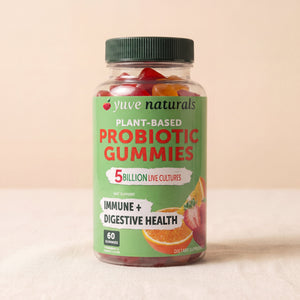
If you want a plant-based option that fits real life, explore Yuve. Their vegan gut-health supplements are designed for people who want a routine that feels simple, supportive, and easier to stick with. If you have your own probiotic storage questions, or a travel story gone wrong, share it with the Yuve community. You are definitely not the only one figuring this out.