That afternoon crash can feel weirdly personal. You ate lunch, maybe had coffee, maybe even slept okay, and yet your body still says, “Nope, we're done.”
If you're also dealing with sore muscles that hang around longer than they should, you're not lazy and you're not imagining it. Sometimes the missing piece is magnesium malate capsules. This form of magnesium gets a lot of attention from active people, plant-based eaters, and anyone with a sensitive stomach because it connects mineral support with energy metabolism in a very practical way.
Feeling Drained? It Might Be Your Magnesium
You get through the morning fine. Then 3 PM hits and your brain feels foggy, your legs feel heavy, and even a simple workout can leave you more achy than you expected.
That pattern is common, especially if you're juggling stress, exercise, a packed schedule, or a mostly plant-based diet that still doesn't quite cover all your mineral needs every day. Hormones can play a role too, which is why some people also find it helpful to read medically-led insights on hormone balance when energy feels off in a bigger-picture way.

I see this often with people who say, “I'm eating pretty well, so why do I still feel wrung out?” That question makes sense. Nutrition gaps don't always show up as dramatic symptoms. Sometimes they show up as low-grade fatigue, tight muscles, and that nagging sense that your body isn't recovering well.
When energy support needs to feel practical
Magnesium malate capsules are often chosen when someone wants support that lines up with both energy production and muscle function. That's different from reaching for a random magnesium product and hoping for the best.
If you've already been trying the basics, like better sleep habits and more balanced meals, these natural energy support habits can help fill in the rest of the picture.
Small reminder: fatigue has more than one cause. Supplements can help, but persistent exhaustion deserves a real conversation with your healthcare provider.
What Exactly Is Magnesium Malate?
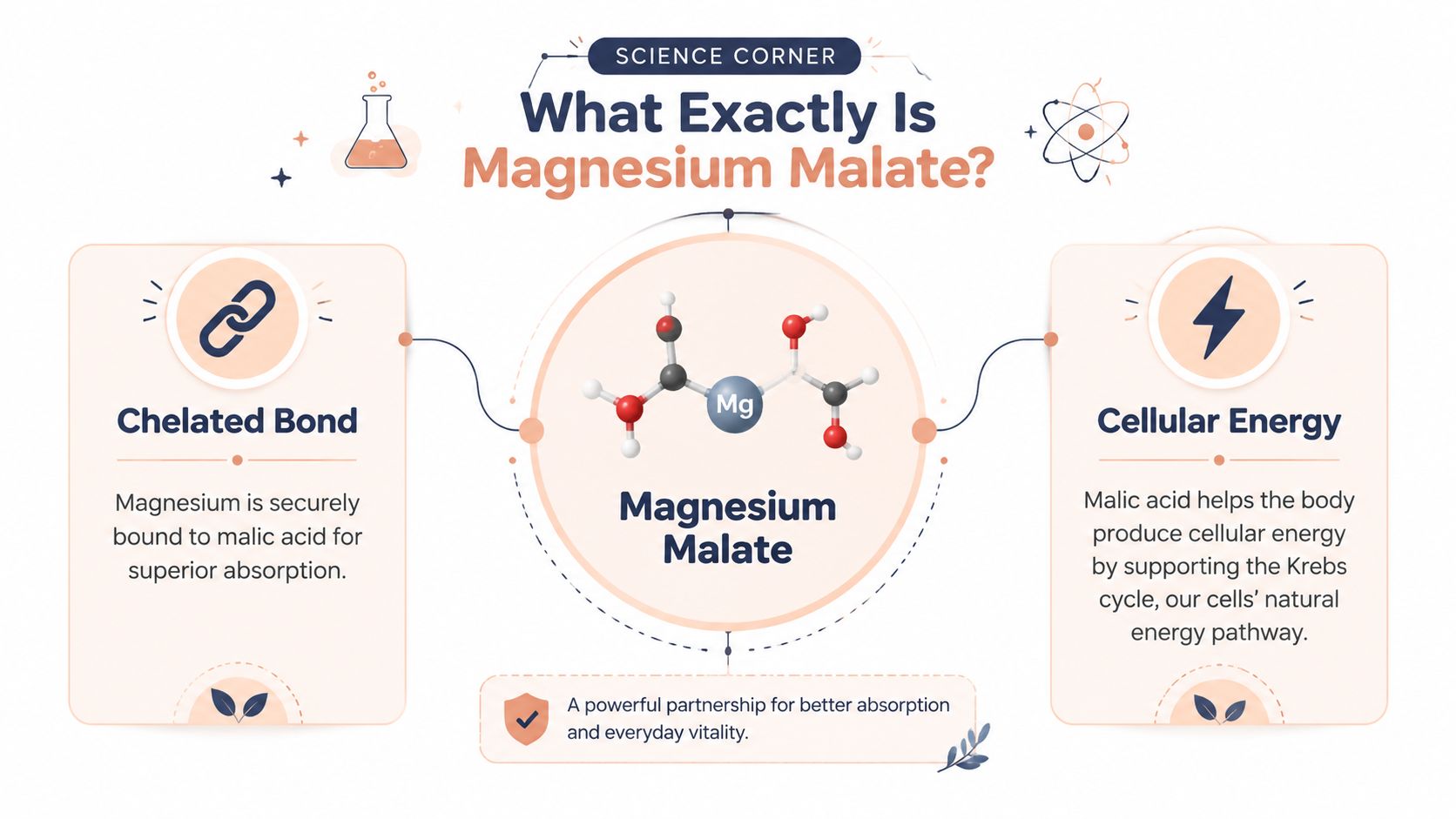
Magnesium malate is a form of magnesium that's bound to malic acid. That pairing matters.
Think of magnesium as a spark plug in your body's engine. It helps key systems run. Malic acid is more like a helper inside the energy-making machinery itself. Together, they make a form that people often choose when they want support for energy metabolism and muscle function, not just a general magnesium top-up.
Why the malate part matters
Malate is part of the citric acid cycle, also called the Krebs cycle. That's one of your body's core pathways for turning food into usable cellular energy.
A product reference describing magnesium malate capsules notes that this form is made by combining magnesium with malic acid, and that malate's role in the Krebs cycle is one reason it's marketed for ATP production and muscle function rather than only for magnesium repletion in a general sense, as described in this magnesium malate product overview.
If “ATP” sounds technical, here's the plain-English version: ATP is the energy currency your cells use to do work. Muscles use it. Nerves use it. Your whole body depends on it.
What “chelated” means in normal language
You'll often see magnesium malate called a chelated form.
That sounds fancy, but it means the magnesium is bonded to another compound, in this case malic acid. People like chelated forms because they're often chosen for their practical balance of usability and stomach comfort.
Here's the part that tends to confuse shoppers: a supplement can contain a large amount of “magnesium malate” on the label, but the elemental magnesium inside that compound is smaller than the total compound weight. That's normal. It's not a scam. It's just chemistry.
“Magnesium” on the front label and “elemental magnesium” in the supplement facts panel are not always the same thing. The second one tells you how much magnesium you're actually getting.
For active, plant-based people, this form can make sense because it lines up with common goals. You want energy support, muscle comfort, and a form that doesn't feel overly harsh on digestion.
The Evidence-Backed Benefits for Your Body
Magnesium isn't a trendy extra. It's a foundational mineral involved in major day-to-day functions.

A 2024 review reports that magnesium is essential for energy metabolism and muscle function, with adult RDAs of 400 to 420 mg per day for men and 310 to 320 mg per day for women. That same review says nearly two-thirds of Americans consume magnesium below the RDA, and 19% get less than half. You can read that review in this 2024 open-access paper on magnesium intake and health.
What that means for you is simple. A lot of people are trying to function, train, recover, parent, commute, and sleep on less magnesium than their bodies would prefer.
Energy support that makes sense
Magnesium malate capsules are often used by people who feel depleted, especially when that tired feeling comes with muscle heaviness or sluggish recovery.
Why? Because magnesium supports the systems involved in making energy, and malate is tied to the cycle your body uses to turn food into that energy. It's a practical pairing for someone who says, “I don't want a random supplement. I want one that fits the problem.”
Muscle comfort and recovery
Magnesium is involved in muscle contraction. Muscles also need to relax after they contract. When that process feels off, people often describe it as tightness, soreness, or lingering crampiness.
That doesn't mean magnesium malate is a cure for every post-workout complaint. It does mean this form is a reasonable choice when your goals include:
- Less dragged-out recovery after training or long days on your feet
- Support for muscle function if you notice tension or occasional cramping
- A gentler routine if you want magnesium without choosing a form mainly used for laxative effects
Helpful for active and plant-based routines
If you eat mostly plants, you can absolutely build a magnesium-rich diet. But “possible” and “easy every single day” are not the same thing.
Busy people miss the mark all the time. So do people with sensitive digestion who rotate foods carefully and don't always eat large portions of legumes, seeds, nuts, or greens.
Here's a quick explainer if you want a visual overview before you compare forms:
What I tell clients: if your body feels underpowered and your muscles are always the first thing to complain, magnesium malate is one of the more logical forms to consider.
Magnesium Malate vs Other Magnesium Forms
The magnesium aisle is messy. Labels shout “calm,” “regularity,” “high absorption,” and “full body support,” and suddenly buying one bottle feels like taking a chemistry exam.
I don't think you need to memorize every form. You just need to match the form to the goal.
Start with your reason
If your main goal is energy and muscle support, magnesium malate makes more sense than forms usually chosen for bathroom help.
If your main goal is calm or bedtime support, many people look at glycinate first.
If your main goal is constipation relief, citrate is more commonly the form people choose.
Which Magnesium Is Right For You?
| Magnesium Form | Primary Use Case | Good to Know |
|---|---|---|
| Magnesium malate | Energy support, muscle function, active recovery | Often chosen for GI tolerability. It contains about 15% elemental magnesium by weight, so capsule counts can be higher. A product example explains this as 1,500 mg providing 225 mg magnesium in this formulation note on magnesium malate. |
| Magnesium glycinate | Calm, relaxation, evening use | Often discussed when someone wants a magnesium form that feels less tied to energy support. |
| Magnesium citrate | Digestion-focused use, especially when laxative effect is welcome | Better fit when bowel support is the goal, not when you're trying to avoid bathroom urgency. |
| Magnesium oxide | General low-cost magnesium option | Often seen on store shelves, but many shoppers choose other forms based on personal tolerance and purpose. |
A practical way to choose
Use this simple filter:
- Pick malate if you want magnesium malate capsules for daytime use, workouts, or muscle support.
- Pick glycinate if your main issue is feeling wound up and you want a calmer-feeling option.
- Pick citrate if constipation relief is the actual goal.
- Pause before chasing “best absorbed” claims because those comparisons can get exaggerated fast.
That last point matters. Human head-to-head evidence is limited, so broad claims that one form “wins” in every situation should be treated carefully.
For a wider look at nutrients people often compare for stress, energy, and focus, this guide on magnesium, L-theanine, B12, iron, and adaptogens is useful.
If you want energy without choosing a magnesium form mainly known for digestive push, malate is usually the cleaner match.
How to Choose High-Quality Vegan Capsules
Shoppers often get tripped up here. Two bottles can both say “magnesium malate capsules,” but the experience can still feel very different.
Some use gelatin. Some hide the actual elemental magnesium amount. Some add a bunch of extras you didn't ask for. If you're vegan or your digestion is picky, those details matter.
Your quality checklist
Use this when you're comparing products:
- Look for vegan capsules so you're not accidentally buying gelatin.
- Check the elemental magnesium amount instead of only the compound name on the front.
- Read the other ingredients and keep it simple if your stomach is sensitive.
- Choose brands with transparent labeling so serving size and daily amount are clear.
- Think about daily fit because a supplement only works if you'll take it consistently.
A typical serving example from a major product listing provides 95 mg of elemental magnesium per capsule with a suggested use of 1 capsule 3 times daily, for a total of 285 mg per day, according to this magnesium malate capsule label example. That's useful because it shows how magnesium malate capsules are often designed to help close everyday intake gaps without pretending food no longer matters.
Why vegan capsule quality matters more than people think
Plant-based eaters often pay close attention to the food itself but forget to check the capsule shell. I've seen that happen a lot. Someone buys a supplement for “clean living” and then realizes later it contains gelatin or unnecessary additives.
Sensitive digestion adds another layer. A simpler formula can make a supplement routine easier to stick with, especially if you already know your gut gets annoyed by long ingredient lists.
This is also where label-reading skills become a superpower. If you want help decoding serving size, elemental amount, and ingredient panels, this guide on how to read supplement labels is worth bookmarking.
One practical option
Yuve Magnesium Malate is one capsule-based option designed around plant-based supplement preferences, including a vegan format that fits people who want magnesium support for energy, muscle recovery, and sleep without using gelatin.
That kind of product fit matters. Yuve's broader approach is shaped by a health-focused, plant-based philosophy, and that tends to resonate with people who want fewer compromises between values, digestion, and routine.
A supplement can be well-formulated on paper and still be wrong for your life. If it isn't vegan, easy to understand, and realistic to take, most people won't stay consistent.
Your Practical Guide to Dosage and Timing
A good routine should feel boring in the best way. Easy to remember. Easy on your stomach. Easy to repeat.

How much should you take
The first thing to check is the label's elemental magnesium per serving. That tells you the actual magnesium delivered.
Many magnesium malate capsules are set up as a daily serving split across more than one capsule. That's normal with this form because the elemental magnesium amount is only one part of the total compound.
A simple approach is:
- Follow the product label first
- Take it with food if your stomach is sensitive
- Start consistently, rather than jumping between days and doses
Best time to take magnesium malate capsules
Because magnesium malate is commonly chosen for energy and muscle support, many people prefer it earlier in the day or with meals during active hours.
Morning can work well. Early afternoon can also make sense. If you personally find any magnesium relaxing, taking it later may still be fine, but malate is usually discussed more for daytime goals than for a sleepy bedtime routine.
Safety and real-life tips
A few practical notes make this smoother:
- Take it with meals if you're prone to nausea from supplements.
- Split the serving if the label suggests multiple capsules across the day.
- Check with your clinician if you have kidney concerns, take medications, or have a medical condition that changes mineral handling.
- Don't expect overnight magic. Consistency matters more than one perfect dose.
Practical rule: the best timing is the one you'll actually repeat. A decent routine done daily beats a “perfect” plan you forget by Wednesday.
Frequently Asked Questions About Magnesium Malate
Can I take magnesium malate every day?
For many people, yes, magnesium malate capsules are used as a daily supplement. That makes sense when the goal is steady support rather than occasional use.
Daily use is especially common when someone is trying to cover an intake gap, support exercise recovery, or build a consistent routine around energy and muscle comfort. Your product label and your healthcare provider's advice should guide the specifics.
How long does it take to notice a difference?
This varies a lot. Some people notice changes in how their muscles feel or how steady their energy seems within a short stretch of consistent use. Others need longer.
The big thing is managing expectations. Magnesium isn't a caffeine shot. It works more like a foundational support tool than a dramatic instant fix.
Is magnesium malate good for sleep?
It can be part of an evening routine for some people, but it's not usually the first form people choose when the main goal is sleep.
Magnesium malate is more commonly discussed for energy metabolism and muscle function. If your only goal is winding down at night, many shoppers compare other forms first.
Is magnesium malate better than powder?
Not necessarily. Capsules are mostly about convenience.
If you travel, dislike mixing powders, or want a no-fuss routine, capsules are often easier. If you prefer flexible serving sizes, powder may appeal more. The best option is the one you'll use consistently and tolerate well.
Why do magnesium malate capsules sometimes require more than one capsule?
Because the total weight of magnesium malate and the amount of elemental magnesium aren't the same thing. This form naturally carries a more modest elemental magnesium fraction, so labels may use multiple capsules to reach the intended daily amount.
That can surprise people at first, but it's a normal label design issue, not a quality red flag.
Are magnesium malate capsules a good fit for vegans?
They can be, but only if the capsule itself is vegan and the rest of the ingredient list fits your standards.
That's why I always tell plant-based clients to check the shell, not just the active ingredient. “Magnesium malate” can still come in a non-vegan capsule if you don't read carefully.
If you want a simple, plant-based option for magnesium support, explore Yuve and see whether its magnesium malate capsules fit your routine for energy, muscle recovery, and everyday wellness.