If a label or blood result has left you uneasy, you're not alone. 50,000 IU is a high-strength dose intended as a time-limited correction tool, not an everyday version of a multivitamin. The schedule and your medical context matter more than the number printed on the bottle.
Why 50,000 IU Capsules Are Not an Everyday Vitamin
A 50,000 IU capsule is a high-strength dose, usually prescribed to correct a confirmed deficiency over a limited period. The number on the bottle alone cannot tell you whether you need it or how often to take it.
Vitamin D levels can be low without obvious symptoms, and a blood test helps a clinician assess them. The NIH Office of Dietary Supplements reports that, in U.S. survey data from 2011–2014, 18% of people aged 1 year and older had inadequate levels, while 5% were at risk of deficiency. The same analysis found that about 4% had levels above 125 nmol/L (50 ng/mL), where excess is a concern.
Your medical context matters, too. Malabsorption, kidney or liver disease, and some medicines can affect vitamin D management, so monitoring may be especially important.
Rules for buying high-strength capsules vary by country. Some countries require a prescription, while others allow over-the-counter sales. Cash prices also vary widely by pharmacy and country, and price is no guide to the right dose.
For a broader introduction to vitamin D, read what you should know about vitamin D.
How 50,000 IU Compares With Daily Intake and Limits
1 microgram equals 40 IU, so one 50,000 IU capsule holds 1,250 micrograms (mcg). The NIH consumer fact sheet sets the adult tolerable upper intake level for routine daily use at 4,000 IU (100 mcg). A prescribed capsule can still be appropriate. The upper limit is for unsupervised everyday intake, not for a short correction a clinician is watching.
| Intake or limit | Amount (IU) | Amount (mcg) | What it means |
|---|---|---|---|
| Recommended intake, adults 19-70 | 600 | 15 | Everyday need for most healthy adults |
| Recommended intake, adults 71 and older | 800 | 20 | Higher everyday need with age |
| Tolerable upper intake, adults | 4,000 | 100 | Daily ceiling for routine intake without medical supervision |
| Maintenance after a correction course | 800-2,000 | 20-50 | Typical daily dose once levels are corrected |
| One 50,000 IU capsule | 50,000 | 1,250 | Prescribed course strength, not a daily dose |
| One weekly capsule, averaged per day | About 7,143 | About 179 | Above the upper limit every day of the week |
Earlier Endocrine Society guidance, summarized by the American Academy of Family Physicians, recommended 50,000 IU of vitamin D2 or vitamin D3 once weekly for 8 weeks, or 6,000 IU daily, aiming to raise serum 25-hydroxyvitamin D above 30 ng/mL. That advice drew partly on a study of 38 patients given weekly ergocalciferol. After loading, maintenance was about 1,500-2,000 IU per day.
One weekly capsule averages about 7,143 IU a day, roughly 179 mcg. That's well above maintenance and above the everyday ceiling. People with obesity, poor absorption, or medicines that change vitamin D handling may need a different plan and closer checks.
If IU and milligrams keep swapping places on labels, safe unit conversions with PepFlow make the arithmetic less slippery. A lower everyday product is a different job, which is why 5,000 IU vitamin D3 isn't a substitute for this course.
Before you swallow anything, read three lines on the label: the unit (IU or mcg), the amount per capsule, and how often the label or prescriber says to take it.
Is a 50,000 IU Capsule Really Vegan?
A vitamin D3 label does not mean the capsule is vegan. That's the assumption that trips plant-based shoppers, especially when the search is for deficiency treatment rather than a small daily dose.
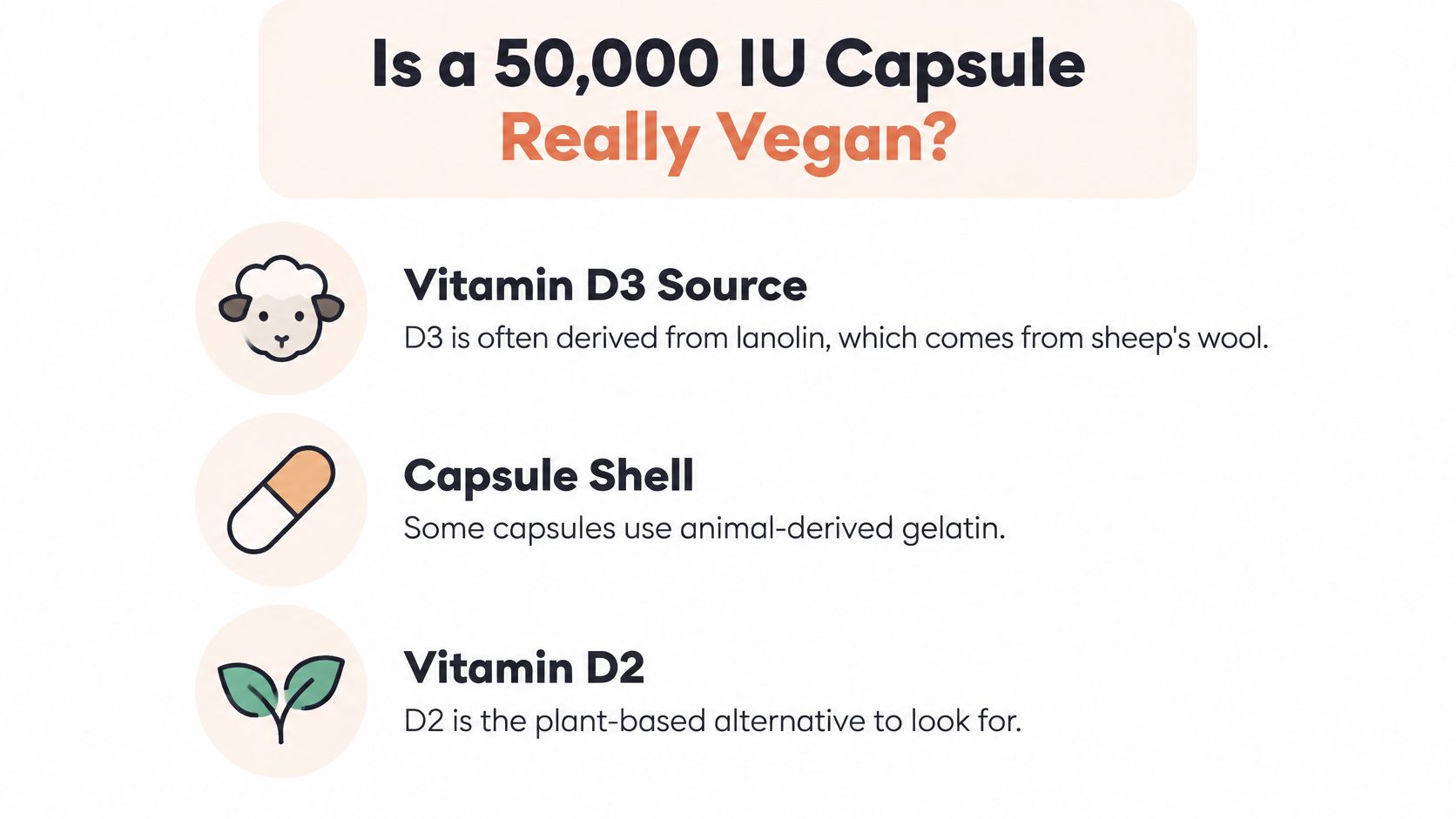
Pharmacy guidance from NHS North East London states that D3 is often derived from lanolin, which comes from sheep's wool, and that capsules may use animal-derived gelatin. Vitamin D2 is typically from plants or fungi. Even so, licensed high-strength vegan D2 products may not exist in some major markets. You can want a vegan formula and still not find one that's licensed at the dose your clinician wrote.
What to check before you call it vegan
- Vitamin source. Is it D2 or D3, and if it's D3, does it come from lanolin or from lichen?
- Capsule shell. Gelatin is animal-derived. A plant shell is a separate line on the label, not a guess.
- Other ingredients. Fillers, stabilizers, and carriers can be animal-based even when the vitamin isn't.
- Certification. Look for a recognized vegan mark. The words "plant-based" on the front aren't the same thing.
- License for the dose. A vegan product that isn't licensed at this strength doesn't match a therapeutic prescription.
Vegan and clinically right are different questions
A vegan formula still needs the right dose and medical oversight. Swapping D2 for prescribed D3, or dropping to a lower-strength bottle because it's easier to find, may not follow the regimen you were given. Read our notes on vegan vitamin D sources for everyday food and supplement context, then take the prescription back to the pharmacist.
Read the ingredient panel with the prescription, not instead of it. If the bottle and the script don't match, don't improvise. Ask before you substitute.
How the 50,000 IU Loading Course Usually Works
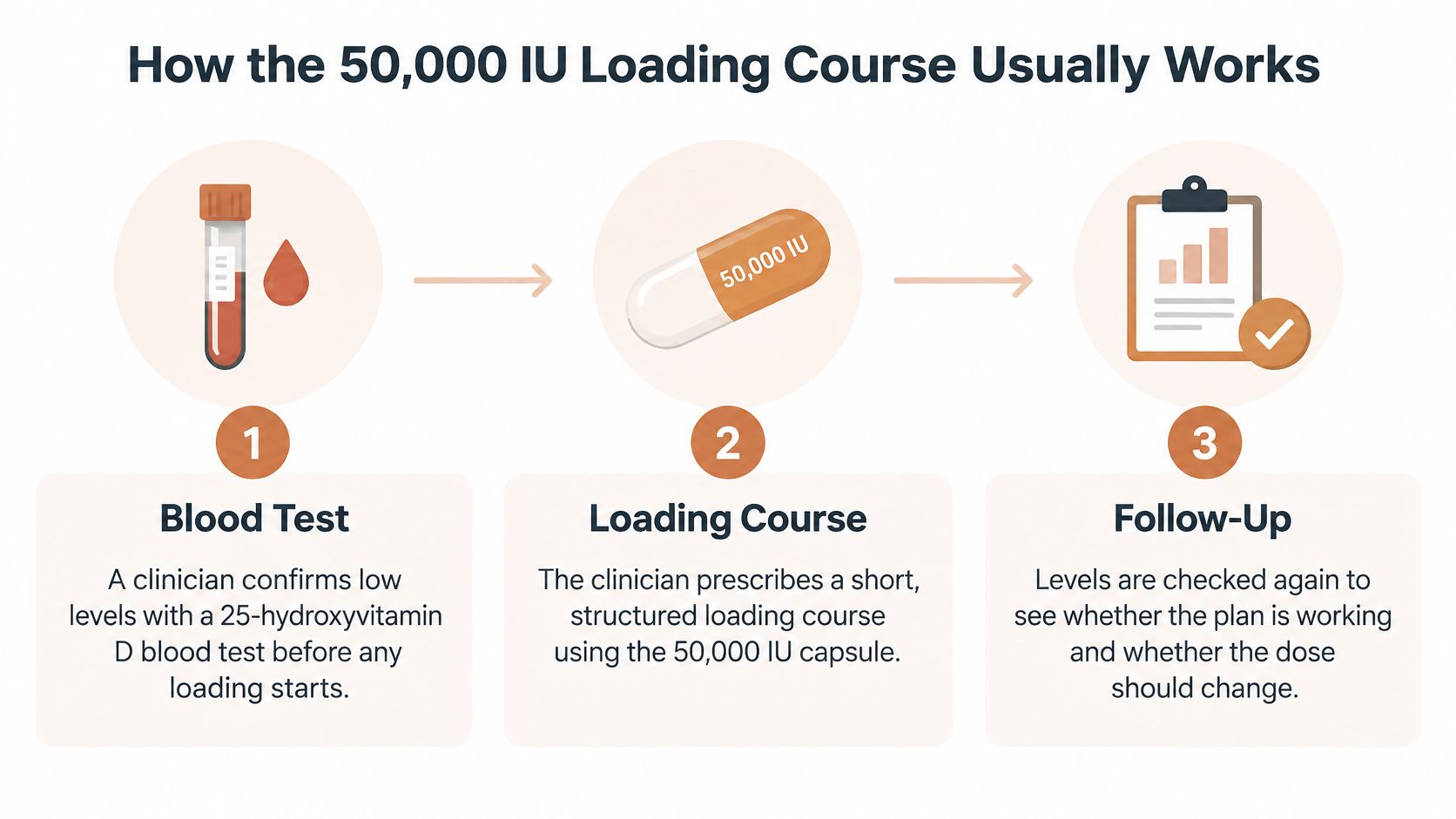
A 50,000 IU capsule is usually a short medical loading dose, not a standing supplement. The BNSSG vitamin D guidelines describe 50,000 IU weekly for about six weeks, roughly 300,000 IU in total, then maintenance around 800-2,000 IU daily. Not indefinite weekly use.
The sequence most people actually follow
- Confirm the level first. A clinician checks 25-hydroxyvitamin D before loading starts. Starting from a symptom, or from a friend's bottle, skips the only number that justifies this strength.
- Take the loading dose on the written days. That's often one capsule a week for about six weeks. Some Endocrine Society-style plans run eight weeks, so your clinician sets the length, not the internet.
- Stop on the stop date. Maintenance then drops to roughly 800-2,000 IU daily. Weekly capsules do not become your new normal.
- Use extra high doses only if they're prescribed. Some protocols add 50,000 IU every other week to help prevent a relapse. That is a new instruction, not a leftover capsule.
- Recheck. Another blood test shows whether the course did its job and whether the next dose should change.
| Phase | Typical dose | Typical length | Why it matters |
|---|---|---|---|
| Loading phase | 50,000 IU once weekly | About six weeks | Corrects documented deficiency |
| Total loading exposure | About 300,000 IU | Across the whole loading phase | Why the course must stop on schedule |
| Maintenance phase | 800-2,000 IU daily | Ongoing, as your clinician advises | Keeps levels steady after correction |
| Recurrence prevention, some protocols | 50,000 IU every other week | Only if prescribed | Used for people who relapse |
| Recheck blood level | 25-hydroxyvitamin D test | Set by your clinician | Confirms whether the course worked |
The usual failure is the schedule, not the number printed on the bottle. A loading dose taken too long, stacked with other vitamin D products, or paired with extra calcium can raise the risk of high blood calcium and kidney complications.
Routine blood testing isn't required for every patient. It matters more with symptomatic deficiency, malabsorption, suspected poor adherence, kidney or liver disease, or primary hyperparathyroidism. Ask for the stop date and the maintenance dose before week one. Those two answers are what many people never get handed with the bag.
Warning Signs of Too Much Vitamin D and When to Call
Vitamin D helps your gut absorb calcium. Too much over time can raise blood calcium and affect your kidneys, thinking, or heart rhythm. The schedule and medical context matter more than the strength printed on a capsule.
In a controlled study published in the Journal of the Endocrine Society, healthy volunteers took five 50,000 IU oral doses of vitamin D2 over two weeks. Their mean 25-hydroxyvitamin D2 level rose from 1.4 ± 0.9 to 45.3 ± 16.5 ng/mL, while total 25-hydroxyvitamin D increased by 152%. Vitamin-D-binding protein rose 39%, and the breakdown product 24,25-dihydroxyvitamin D rose 36%. These study results show that the body responds to a high dose by changing how it carries and breaks down vitamin D.
NIH guidance associates toxicity with markedly high 25-hydroxyvitamin D, typically above 150 ng/mL (375 nmol/L). Possible symptoms include thirst, frequent urination, nausea, weakness, confusion, kidney stones, kidney failure, or heart rhythm problems. These signs can have other causes, so a blood test is the reliable way to check vitamin D and calcium levels.
| Symptom | What it can signal | Action |
|---|---|---|
| Excessive thirst or frequent urination | High calcium affecting the kidneys | Call your clinician promptly and ask whether to pause the capsules |
| Nausea, vomiting, or loss of appetite | Possible high calcium | Call your clinician the same day |
| Muscle weakness or confusion | Possible high calcium in the blood | Seek urgent medical care |
| Kidney stones or flank pain | Possible kidney involvement | Seek medical care without delay |
| Irregular heartbeat or palpitations | Possible effects of high calcium | Seek emergency care |
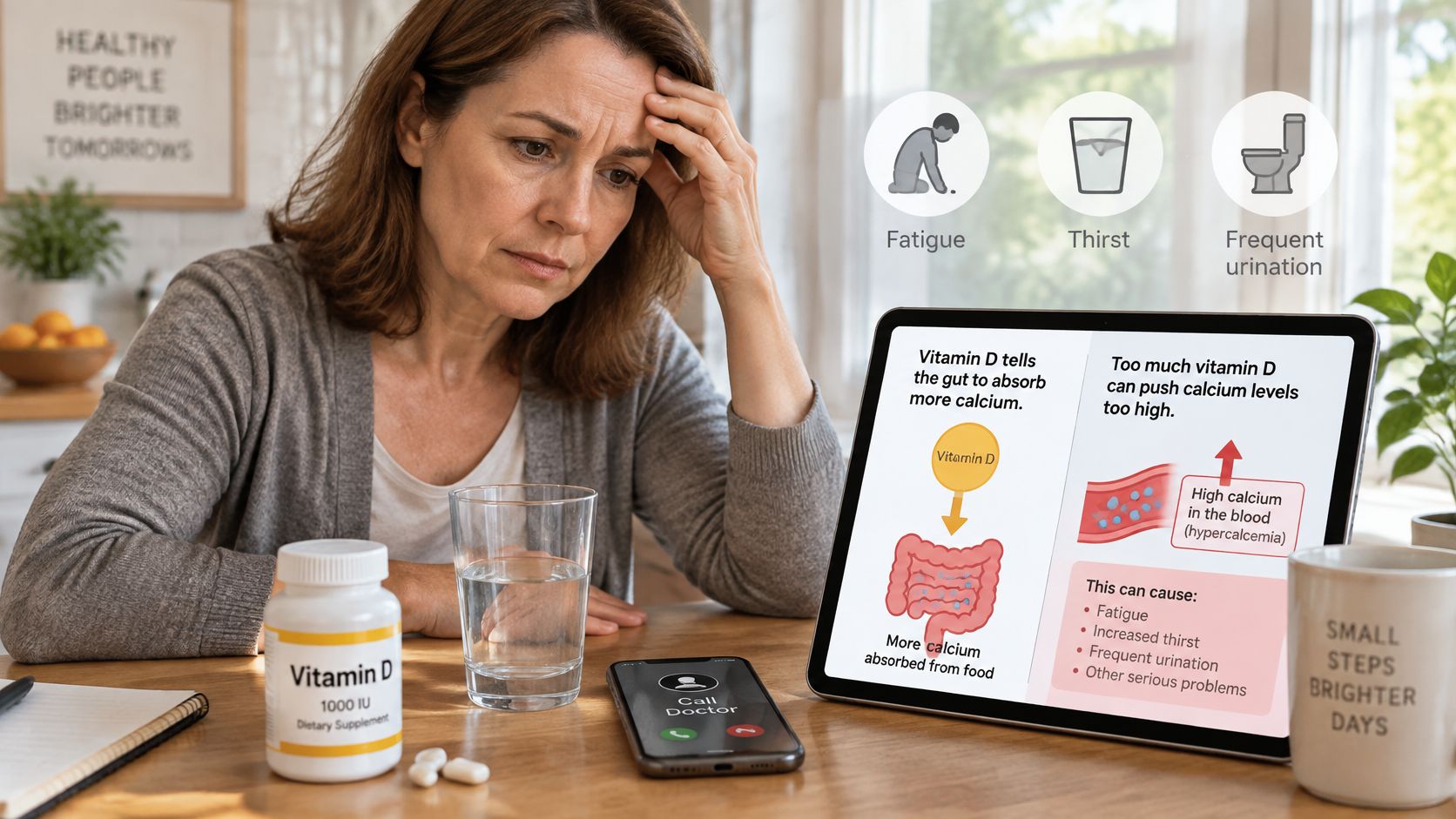
Confusion, flank pain, or a racing heartbeat deserves prompt attention. A foggy morning alone is harder to interpret; SleepHabits on avoiding sleep aid hangovers discusses a different possible cause of feeling off, but it does not explain vitamin D toxicity.
On a high-dose vitamin D plan, thirst alongside extra bathroom trips is a reason to call your clinician the same day.
A 50,000 IU capsule is a time-limited correction tool, not an everyday supplement. If warning signs appear during a prescribed course, contact your clinician for guidance rather than continuing or changing the schedule on your own.
Taking It With Food Without Stacking Risks
A meal with some fat helps the capsule absorb. You don't need a special diet, and you don't need a second capsule to "make it work."

In a randomized one-day study of 50 healthy older adults, indexed on PubMed, the mean 12-hour peak blood level of vitamin D3 was 32% higher with a meal containing fat than with a fat-free meal. The type of fat didn't matter in any meaningful way. Monounsaturated and polyunsaturated meals performed alike.
Pair the capsule with a normal meal that already has fat. Avocado, nuts, seeds, olive oil, or eggs on toast are enough. Take it at that meal each week so you don't hunt for the bottle later.
What counts as stacking
Add up vitamin D from everywhere, not just this bottle.
- Multivitamins often hide a few hundred IU in a serving you take without thinking.
- Fortified milk, plant milks, and cereals add more across the day.
- Calcium tablets and calcium-based antacids raise the calcium load while high-dose vitamin D increases absorption.
- Other vitamin D bottles in the cupboard, including a partner's lower-dose softgels, are still your dose if you take them.
Tell your clinician about those products before week one. If absorption, kidney, or liver issues are already on your chart, stay on the written schedule and don't add a "support" supplement beside it.
Do not double up after a missed dose, and do not take the capsule more often than the label or prescriber directs. Ask what to do if you miss a week. Guessing "I'll take two now" is how a loading plan turns into too much.
Confirm Your Dose With a Clinician Before You Start
Bring questions, not a half-used bottle and a hope. Five sentences cover most of the risk.
- Do I need a blood test to confirm my level before I start?
- Which symptoms mean I should stop the capsules and call the same day?
- Does my prescription name the same strength and format as the bottle I'm about to buy?
- Is the product I plan to buy licensed at this strength in my country?
- Who will recheck my level, and when?
Match the script to the box in the pharmacy, out loud if you need to. Strength, weekly versus daily, and the stop date should be the same on both. If a pharmacist offers a different brand, confirm it's the same form and the same IU per capsule.
We don't sell a 50,000 IU vitamin D capsule, and you shouldn't swap one of our products in for a prescribed course. If you eat plant-based and your clinician also wants vitamin B12 checked, that's a separate nutrient. Yuve Vegan B12 is one tablet with 1,000 mcg of vitamin B12 as cobalamin, 30 servings in a container, taken as 1 tablet daily, with or without food. Confirm that the current label still matches what your clinician expects before you add it.
Write the stop date on the bottle the day you fill it. Future you will not remember which week was week six.
If a new result or a new prescription changes the plan, come back to these questions and run them again. Drop your own questions in the comments. Someone else is probably staring at the same label tonight.
Yuve makes plant-based supplements for everyday nutrition, including nutrients people on vegan diets often need to plan for, and we keep high-dose vitamin D where it belongs, with your clinician. If you're sorting labels, units, and what "daily" means, start with a product page you can read in full rather than a bottle chosen for the biggest number. Visit Yuve to see what we make, check the facts on the label, and choose only what fits the plan you've already confirmed.