If two supplements both say beta-glucan, are you buying the same ingredient? Not necessarily, and that missing detail matters when you're hoping for immune support or trying to improve digestion without inviting more bloating.
1-3 beta D glucan belongs to a family of structurally different carbohydrates, not a single interchangeable ingredient. Understanding its source and shape helps you separate useful evidence from broad promises, read labels confidently, and choose a gentler approach for your gut.
What 1-3 Beta D Glucan Is and Why the Source Matters
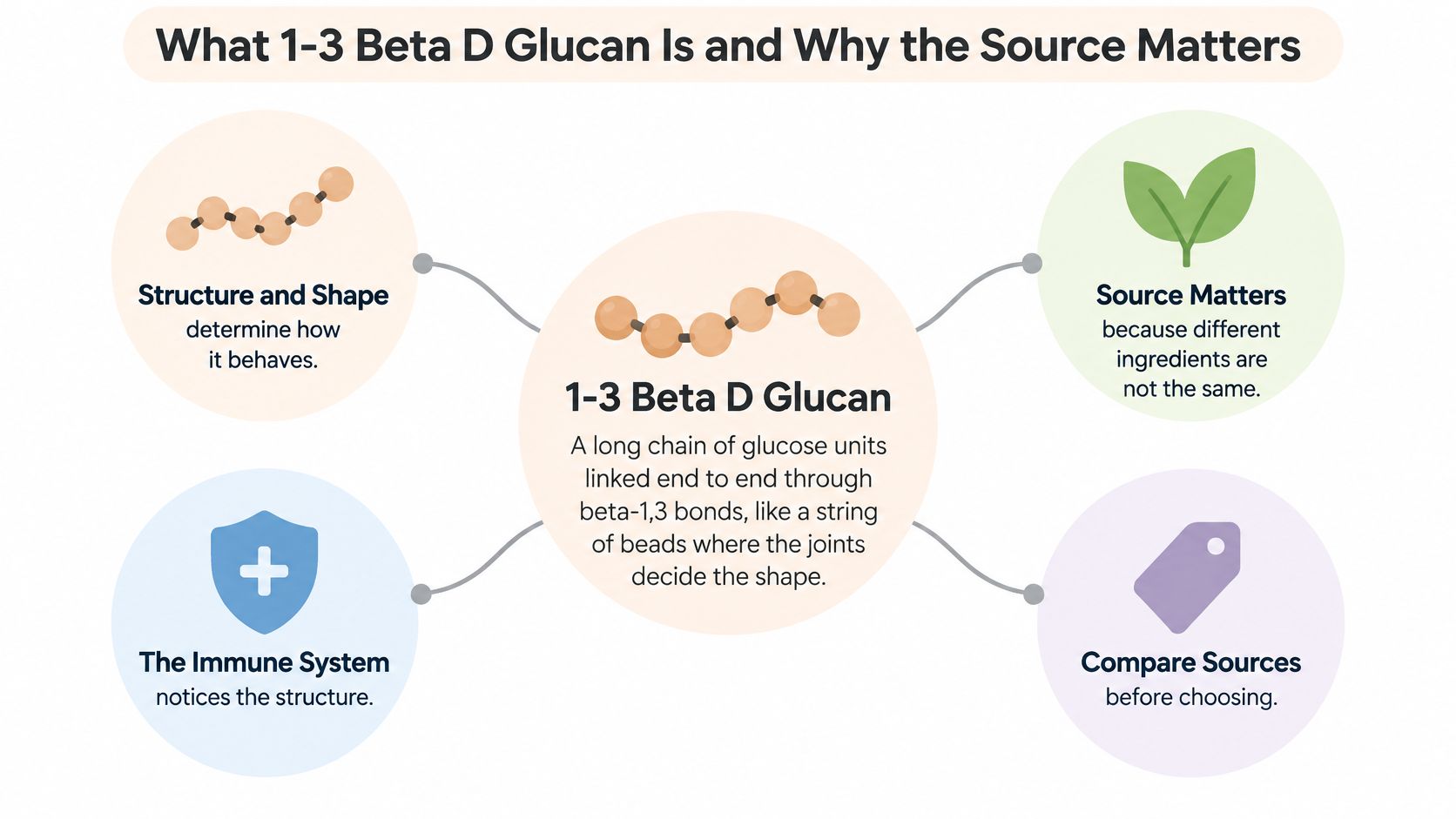
1-3 beta D glucan is a long chain of glucose units connected through beta-1,3 bonds. Think of a string of beads: the beads are glucose, while the joints determine how the string bends and what shape it can form.
The word glucose can make this sound like ordinary sugar. But joining glucose units into a particular structure creates a polysaccharide, a large carbohydrate whose behavior isn't explained by its individual building blocks alone.
A review of beta-glucan chemistry and biological activity explains that yeast and fungal forms commonly have a beta-1,3 backbone with beta-1,6 side branches, while oat and barley forms mainly contain mixed beta-1,3 and beta-1,4 links and are generally unbranched. For you, that means an oat food and a mushroom extract shouldn't be treated as equivalent just because both contain beta-glucan.
Beta-glucan types by source and structure
| Source | Main linkage pattern | Branching | Where you usually find it |
|---|---|---|---|
| Yeast and fungal cell walls | Beta-1,3 backbone | Commonly beta-1,6 side branches | Yeast-derived and mushroom-derived ingredients |
| Oats and barley | Mixed beta-1,3 and beta-1,4 links | Generally unbranched | Oat and barley foods and cholesterol-focused products |
| Purified 1-3 beta D glucan product | Beta-1,3 backbone | Confirm presence and pattern in the batch specification | Supplements; ask for linkage and molecular-weight data |
In fungi and yeasts, these carbohydrates help form the cell wall, rather like structural framing around a building. In cereals, beta-glucans are dietary-fiber components. Those different starting materials help explain why researchers study them for different purposes.
Purified doesn't mean structurally identical. A product can contain a concentrated ingredient without telling you its chain length, branching pattern, solubility, or remaining non-glucan material. Nor does a high percentage alone establish how that ingredient behaves.
Ask questions beyond the front label
Before buying, ask the supplier for information you can compare:
- Which organism supplied it? Look for the yeast species, mushroom species, or cereal source.
- What structure was identified? Ask about the backbone, side branches, and molecular-weight information.
- What testing was done on this batch? Request the assay method and documentation supporting identity and purity.
If you eat vegan, check the complete formulation too, including the capsule and other ingredients. A clearly named source is a useful starting point, but it doesn't describe everything in the finished product.
Label-reading rule: Treat beta-glucan as a family name, not a complete ingredient identity.
How Your Immune Cells Recognize 1-3 Beta D Glucan
Your immune cells are a little like security staff checking the shape of a badge. They don't treat every carbohydrate as an indistinguishable packet of calories. Some carry recognizable structural patterns.
Dectin-1 is a pattern-recognition receptor, a protein that helps certain immune cells detect suitable beta-glucan structures. A review in Immunological Reviews describes its role on macrophages, neutrophils, and dendritic cells, including responses involving engulfment and inflammatory signaling.
That gives us a biological explanation for the interest in fungal and yeast beta-glucans. It doesn't yet tell us what taking a particular capsule will do for you.

What recognition can set in motion
The process becomes easier to follow when we translate the terminology:
- Recognition: A suitable glucan structure binds to a receptor on an immune cell.
- Engulfment: The cell can take in material through a process called phagocytosis.
- Reactive responses: The cell can generate chemically reactive substances involved in its defensive activity.
- Communication: The cell can release cytokines, signaling molecules that influence other cells.
These aren't interchangeable outcomes. Detecting binding, measuring a signaling molecule, and observing fewer infections are different questions requiring different experiments.
Why the badge needs the right shape
A review of glucan structure and immune activity describes structural findings suggesting that Dectin-1 generally requires a backbone of at least seven glucose units, together with a beta-1,6 branch, for effective recognition in the systems discussed. Short or unbranched pieces may produce little or no activation.
The practical lesson isn't to count glucose units yourself. It's to recognize why a manufacturer's structural documentation matters more than a front-label percentage.
The gut also contains immune tissue, which helps explain why scientists investigate oral exposure. But swallowing an ingredient is different from placing it directly onto isolated cells in a laboratory dish.
For a broader consumer discussion of this distinction, NexiHerb's take on mushroom immunomodulation from NexiHerb LLC offers context for the language used around mushroom immune products. Keep the same evidence standard while reading: an explanation of a pathway isn't a clinical outcome.
A receptor response is a mechanism, not proof that a supplement prevents infection or boosts immunity in every person.
What the Immune Support Research Actually Shows
A label that reads “beta-glucan” is closer to a surname than a full identity. Two ingredients can share the name while differing in source, linkage, branching and purification, so a positive result for one preparation cannot be stretched across the whole family.
That is why human trials matter after mechanism studies. A review of beta-glucans and immune modulation describes immune-related effects with highly purified, highly branched, higher-molecular-weight yeast glucans, while emphasizing differences in preparation, dose, population and measured outcome. It also describes some clinical studies in which yeast beta-glucan given alongside vaccination increased antibody levels without significant toxicity in those trials.
What this means for you: those findings concern particular preparations and circumstances. A yeast or mushroom supplement with a different source or structure should not inherit the result by category name alone.
Higher antibody levels remain an indirect marker; demonstrated protection against illness is a separate outcome. Because participants received vaccination alongside the ingredient, those findings do not establish vaccine equivalence or justify replacing vaccination.
The absence of significant toxicity in those trials is encouraging within their scope. Extending that safety signal to every formulation, every medical condition or long-term use would go beyond the evidence.
An ingredient can have a plausible mechanism and still need better human evidence for the claim on its bottle.
Match the study to the decision
Say you're comparing a clearly identified yeast ingredient with a mushroom blend that lists only a total extract amount. A trial using the yeast preparation doesn't resolve whether the mushroom blend works. Shared category language isn't enough when the study material and the bottle material may differ in species, backbone, branching or processing.
A fermented drink such as Pep Tea's organic kombucha range belongs to a different comparison class: it can illustrate fermentation in the broad sense, yet it does not test a defined 1-3 beta D glucan ingredient or an immune endpoint.
For a wider framework, our guide to whether immune support supplements work can help you examine what a product promises. Keep your attention on the ingredient and outcome rather than the broad appeal of immune wellness.
Before trusting a claim, ask:
- Was this exact ingredient studied? Source, linkage, branching and purification should resemble the product on your label.
- Were the participants and daily amount relevant? A result in a particular clinical group may not answer your question.
- What improved? An altered laboratory marker doesn't automatically mean fewer infections, better digestion or less bloating.
The defensible position is possible modulation of innate immune surveillance, with prevention or treatment still requiring direct human evidence. You don't need to dismiss promising findings to insist on that distinction.
How Fermentation Can Affect Bloating and Digestion
Your gut microbes are like a team of cooks working with ingredients you couldn't fully break down earlier in digestion. When they process fermentable fiber, their output can include short-chain fatty acids, such as butyrate and propionate, alongside gas.
A review of oat beta-glucan research describes a randomized trial with increased total short-chain fatty acids and laboratory fermentation work with increased propionate production. These findings concern oat beta-glucan, not every ingredient sold as 1-3 beta D glucan.
That's useful context, but it isn't a bloating-cure claim. If your waistband already feels tight after meals, adding more fermentable material too quickly may not feel like progress.
Your microbes aren't identical to someone else's
A study in mBio identified species-dependent systems for breaking down beta-1,3-glucans by analyzing 2,441 human gut metagenomes. The relevant microbial gene clusters differed between people, helping explain why digestive responses needn't be uniform.
One person's easy adjustment doesn't set your timetable. For more context on the uncomfortable side of fermentation, our explanation of why prebiotics can cause gas helps distinguish microbial activity from a product being a poor fit.
A gentler starting approach
- Begin with a small amount. Use a lower permitted serving where the product's directions allow it.
- Increase slowly over two to three weeks. Treat this as a flexible trial approach, not a requirement to reach a particular amount despite symptoms.
- Keep fluids up. Make regular drinking part of the routine rather than adding fiber while neglecting hydration.
- Log symptoms each day. Note the product, amount, meals, gas, discomfort, and stool changes.
- Pause for concerning symptoms. Pain or bleeding deserves clinical advice, not another increase.
Mild adjustment symptoms can happen, but you don't need to push through worsening discomfort. For the separate cholesterol question, Vitamin Planet's explanation of how soluble fibre supports cholesterol management provides broader food-and-fiber context, not proof of an immune benefit.
Clinical Testing, Safety and When to Ask a Clinician
A serum beta-glucan blood test is not an immune-health score. Clinicians use it as an aid when investigating invasive fungal disease, generally in a hospital or another high-risk clinical setting where the pre-test probability already shapes how a result should be read.
The Mayo Clinic Laboratories test document explains why results require interpretation alongside the patient's clinical circumstances. A positive result does not identify a specific fungal pathogen, and the appropriate threshold is not universal across assays.
Serum beta-glucan test accuracy in published studies
Sensitivity describes how often a test detects disease when disease is present. Specificity describes how often it correctly returns negative when disease is absent.
| Study or review | Sensitivity | Specificity | What to notice |
|---|---|---|---|
| 2018 meta-analysis, 37 studies | 83% | 81% | Positive likelihood ratio 5.13, negative 0.23 |
| Earlier pooled review, 11 studies, 1,068 patients, summarized in the linked meta-analysis | 75% | 87% | Summary AUC of 0.89 |
| Hematologic malignancy testing review, summarized in the linked meta-analysis | 61% | 91% | Two consecutive positive tests raised specificity to 99% |
The spread between those rows is the lesson. Accuracy varies with the cutoff chosen and the population studied, so a figure drawn from intensive-care patients does not automatically describe outpatients, and a single value says less than the pattern of repeat testing. A negative result may help exclude certain infections in selected settings, but it cannot reliably dismiss every fungal disease.
What else can affect the result
A clinical discussion of beta-glucan elevations and exogenous sources identifies potential non-fungal contributors including immunoglobulin infusions, albumin or blood products, cellulose-containing dialysis materials, surgery, bacterial sepsis, intestinal barrier injury, and contamination. It also discusses false negatives, including the test's limitations in mucormycosis.
Bring the following context to a result-review appointment:
- Recent treatments: Immunoglobulin, albumin, transfusions, dialysis, antibiotics, and antifungal medication.
- Recent events: Surgery, intensive care, severe bacterial infection, or intestinal injury.
- Underlying risk: Transplant history, immune suppression, and the symptoms that prompted testing.
Timing matters. Your clinician can compare exposures, symptoms, imaging, cultures, and other laboratory findings before deciding what a result means.
For supplements, seek individualized advice before starting if you are pregnant, have a transplant, take immune-suppressing or antifungal medication, or have recently needed hospital care. These situations deserve more than a general wellness recommendation.
Do not self-diagnose fungal infection from a test result, and do not use a supplement as a substitute for prescribed treatment. Blood-test evidence also does not establish that consuming beta-glucan prevents infection. The ingredient swallowed in a capsule is judged by its source, linkage and branching; the molecule measured in serum is part of a diagnostic workup. They are different questions.
Dosing Reference Points Label Checks and a Gentle Start
There's no universal dose for every 1-3 beta D glucan product. A daily amount makes sense only when you know which ingredient it describes and what outcome researchers evaluated.
The most familiar reference amounts concern oat beta-glucan and cholesterol, not a universal immune-support serving. Start with the category before comparing the quantity.
Dosing reference points for beta-glucan
| Reference point | Amount | What it applies to | Caveat |
|---|---|---|---|
| FDA cardiovascular claim threshold | At least 3 g per day | Eligible oat-derived beta-glucan | Not a dose for yeast or mushroom 1-3 glucan |
| Review of randomized trials | About 3.5 g per day | Oat beta-glucan, linked to LDL reductions of about 4.2% | Oat results do not transfer automatically |
| Yeast beta-glucan immune trials | Use the amount tested for the exact ingredient | Highly purified, highly branched yeast glucan | Doses and products differ by study |
| Your supplement label | Check serving size | The exact product you buy | Follow the label and your clinician's advice |
HEART UK's guide to oats and barley describes the FDA-authorized cardiovascular claim threshold of at least 3 grams daily from eligible oat products within a diet low in saturated fat and cholesterol, and summarizes trial-review findings linking about 3.5 grams daily of oat beta-glucan with approximately 4.2% lower LDL cholesterol. Those are source-specific reference points, not instructions to take the same amount of a yeast extract.
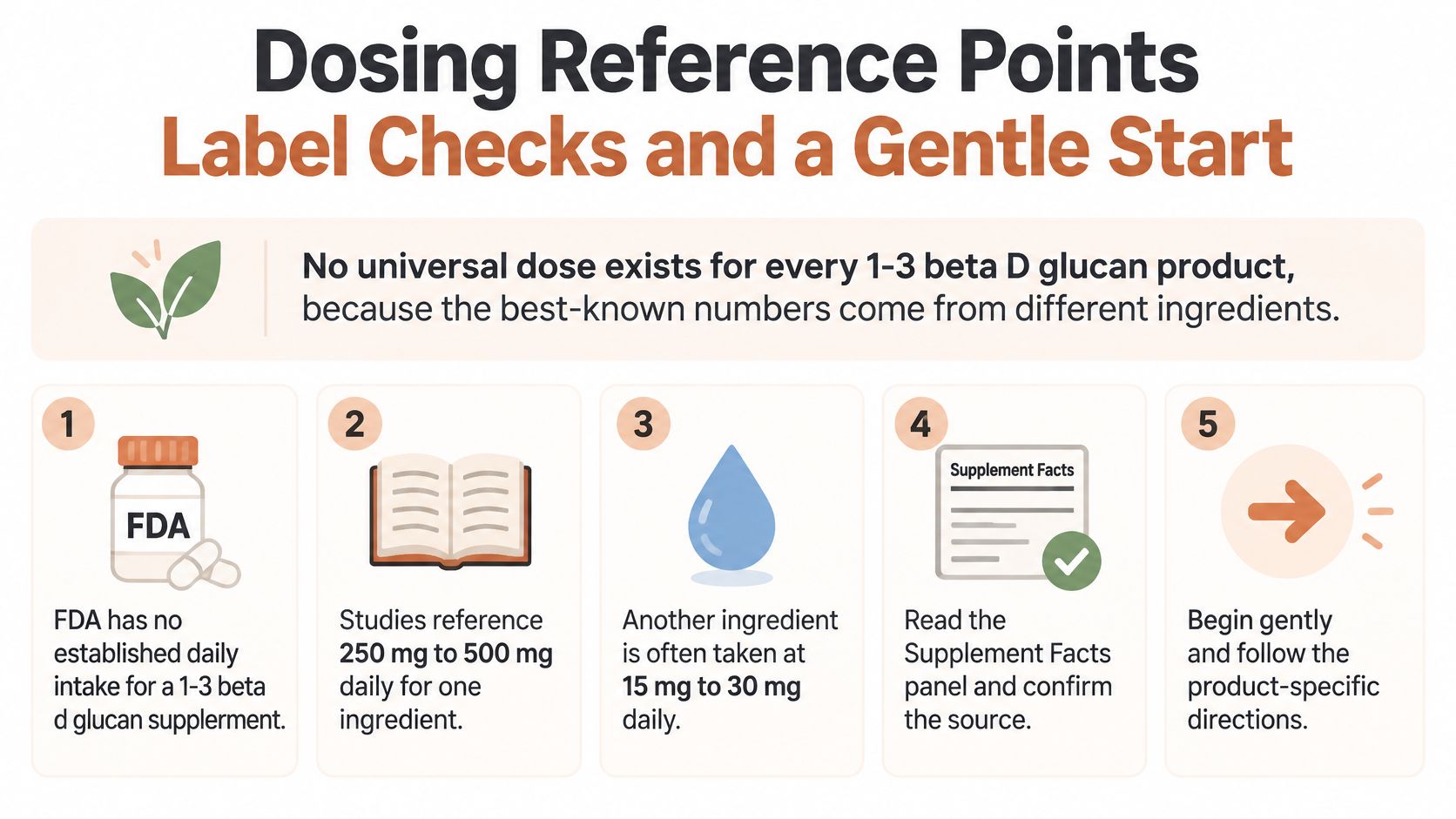
Use the graphic as a reminder to check product-specific directions, not as authority for ingredient-specific amounts. The evidence-based comparisons in the table are the reference points to use for this discussion.
Turn the reference points into label habits
Read the serving size before the large number on the front. Check whether the stated amount describes each capsule, a complete serving, total extract, or measured active beta-glucan. Those aren't equivalent quantities.
Next, identify the source organism and look for batch documentation. Use the supplier questions about organism, structure, and testing to request a useful specification rather than a general reassurance about quality.
Then compare like with like. An oat-fiber reference belongs beside an oat product; a yeast trial belongs beside the matching yeast preparation. Don't add unrelated daily amounts together and call the total an evidence-based dose.
Our guide to how to read supplement labels can help you distinguish serving information from marketing language. If a label doesn't disclose enough to make the comparison, that's a reason to pause before purchasing.
A better starting question: What amount was evaluated for this exact ingredient and this specific purpose?
Build a routine you can interpret
Say you're frustrated with afternoon bloating and decide to change breakfast, add a fiber gummy, and begin a mushroom supplement at the same time. If discomfort improves or worsens, you won't know which change mattered.
I'd keep the experiment simpler: record your usual symptoms first, make a single planned change, and leave enough room to observe your response before adding another variable. That's less exciting than an overnight gut reset, but far more informative.
For a daily fiber foundation, our Yuve Vegan Prebiotic Fiber Gummies contain inulin from chicory root, formulated to support the growth of beneficial gut bacteria, and cost $22.10 one-time or $18.79 on subscription. Inulin isn't beta-glucan, so use the gummies as a distinct, monitored fiber step rather than evidence that you've met a beta-glucan target; our separate DGL Licorice product comes with a 60-day money-back guarantee, but that policy doesn't establish a glucan benefit.
Quick answers before you start
Is 1-3 beta D glucan the same as oat beta-glucan?
No. Choose the ingredient whose identity and evidence match your goal, rather than treating the family name as interchangeable.
Can I use it specifically for bloating relief?
Don't assume it will relieve bloating. Your symptom pattern and tolerance matter, and persistent discomfort deserves assessment rather than repeated supplement changes.
Does a larger serving mean a better result?
Not necessarily. Use product-specific directions and clinical advice instead of chasing the largest number.
Your gentle-start checklist
- Choose one clear goal. Separate digestive tolerance, cholesterol management, and immune-related questions.
- Establish your fiber base carefully. Introduce a planned fiber step before layering on another unfamiliar ingredient.
- Record the exact product and amount. Include meals and symptoms so your notes are useful.
- Adjust to tolerance. Don't keep escalating because someone else tolerates more.
- Get help when needed. Discuss persistent symptoms, medical conditions, and medication questions with your clinician.
If you're comfortable sharing, leave your starting amount, ingredient source, and symptom observations in the comments. Your experience doesn't need to look like anyone else's to be worth paying attention to.
Yuve offers plant-based digestive-support products, including Vegan Prebiotic Fiber Gummies, for building a more deliberate daily routine. Visit Yuve to compare ingredients and directions, and choose a clear starting step without confusing chicory-root inulin with beta-glucan.