The most popular advice about teen probiotics is also the least useful: buy the bottle with the most billions. If your teen is bloated, uncomfortable, or dealing with diarrhea, a bigger number isn't a better answer.
The best probiotics for teens match a specific organism and dose to a specific reason. We'll use that standard to compare options, decode labels, and separate a sensible purchase from a situation that needs a pediatrician first.
Quick Picks for Teen Probiotics at a Glance
| Option | Strain identity | Dose benchmark | Best-supported use | Watch-out |
|---|---|---|---|---|
| Lactobacillus rhamnosus GG (LGG) | Named strain, LGG | At least 10^10 CFU per day, with potency guaranteed through expiry | Short-term diarrhea support in pediatric trials | Low-quality pooled evidence, not proof for general digestion |
| Saccharomyces boulardii | Named yeast organism; check the product's strain identifier | 10^9 to 10^10 CFU daily for 5 to 10 days | Short-term diarrhea, studied in pediatric trials | Needs specialist oversight for immunocompromised or central-line patients |
| Generic multi-strain blend | May list species without individual strain codes | Use-specific evidence must determine the dose, not the headline count | No consistent benefit established for an unspecified teen formula | More strains or a higher count doesn't establish benefit |
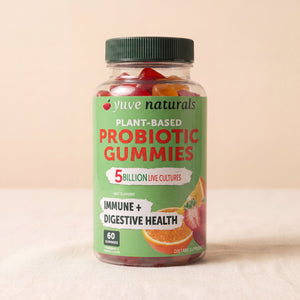
| Yuve Vegan Probiotic Gummies | Check the label for a strain designation before purchase | 5 billion live cultures per gummy; follow the serving directions on the label | A daily plant-based format, not an established diarrhea treatment | A single gummy is below the LGG trial benchmark, and an unidentified formula isn't equivalent to LGG |
Read the table from the reason outward, not from the biggest dose downward. Decide whether the concern is antibiotic-related, acute diarrhea, or an everyday routine, then check whether the product matches the evidence for that use.
The LGG and S. boulardii quantities are short-term diarrhea trial benchmarks, not universal targets for healthy teenagers. The NIH Office of Dietary Supplements summarizes S. boulardii research involving 22 trials and 2,440 participants, with commonly studied doses of 10^9 to 10^10 CFU daily for 5 to 10 days.
My buying recommendation
Skip an unnamed blend, even if the front label looks impressive. A parent should be able to identify the microorganisms in the product and see whether they are connected to a useful human study.
Yuve Vegan Probiotic Gummies contain 5 billion live cultures per gummy and cost $27.49 one-time or $23.37 with a subscription. They offer a plant-based daily format, but convenience and price do not establish that they fit your teen's symptoms.
Shopping rule: Consider a product only when its label answers your questions. A large number on the front cannot make up for missing details on the back.
A gummy may suit a teen who dislikes swallowing capsules, but format comes after suitability. Check the full ingredient list, age guidance, and serving directions before deciding that an easy-to-take product is the right choice.
For ongoing symptoms, antibiotic-related concerns, or immune-system issues, start with a clinician or pharmacist rather than the supplement shelf. The right decision depends on why your teen might use a probiotic.
Why the Word Probiotic Tells You Almost Nothing
Any probiotic will do is poor advice. The word describes a category, not a predictable treatment, and even a widely studied category can produce disappointing results when researchers examine the most reliable trials.
A Cochrane review of acute infectious diarrhea included 11,526 children younger than 18 and 412 adults; its lowest-bias analysis found no reduction in diarrhea lasting at least 48 hours, with a risk ratio of 1.00, a 95% confidence interval of 0.91 to 1.09, and 1,770 participants. Across six trials involving 3,058 participants, the average reduction was 8.64 hours, but the interval ran from 29.4 hours shorter to 12.1 hours longer, with very low certainty.
In everyday language, the more reliable analysis didn't show a benefit for that outcome. The duration estimate was also too uncertain to promise that taking a probiotic would shorten an illness.
Why apparently conflicting findings matter
You may see a positive finding about a named organism alongside an unconvincing result for probiotics overall. That's not permission to choose whichever headline sounds more reassuring.
Researchers may test different microorganisms, doses, treatment durations, and patient groups. A result from children with an infection doesn't automatically answer whether a healthy teenager's after-lunch bloating will improve.
The same caution applies when products contain similar-sounding bacteria. Sharing a species name doesn't establish that a formula reproduces the effect of a particular strain tested under particular conditions.
Put the claim through a simple test
Before buying, ask:
- Which strain? Look for an identifiable microorganism, including its strain designation where available.
- For which reason? Find evidence addressing your teen's actual problem, not a loosely related wellness goal.
- At what dose, in which product? Check whether the studied quantity and formulation match what you're considering.
These questions help you distinguish a useful explanation from a broad digestive-health promise. If a product page discusses immunity, mood, skin, digestion, and energy without connecting each claim to its formula, don't fill in the missing evidence yourself.
A familiar category name isn't a substitute for a demonstrated benefit.
My standard is straightforward: judge the strain and its evidence, not the word probiotic. That approach leaves room for worthwhile products without pretending every teenager needs one.
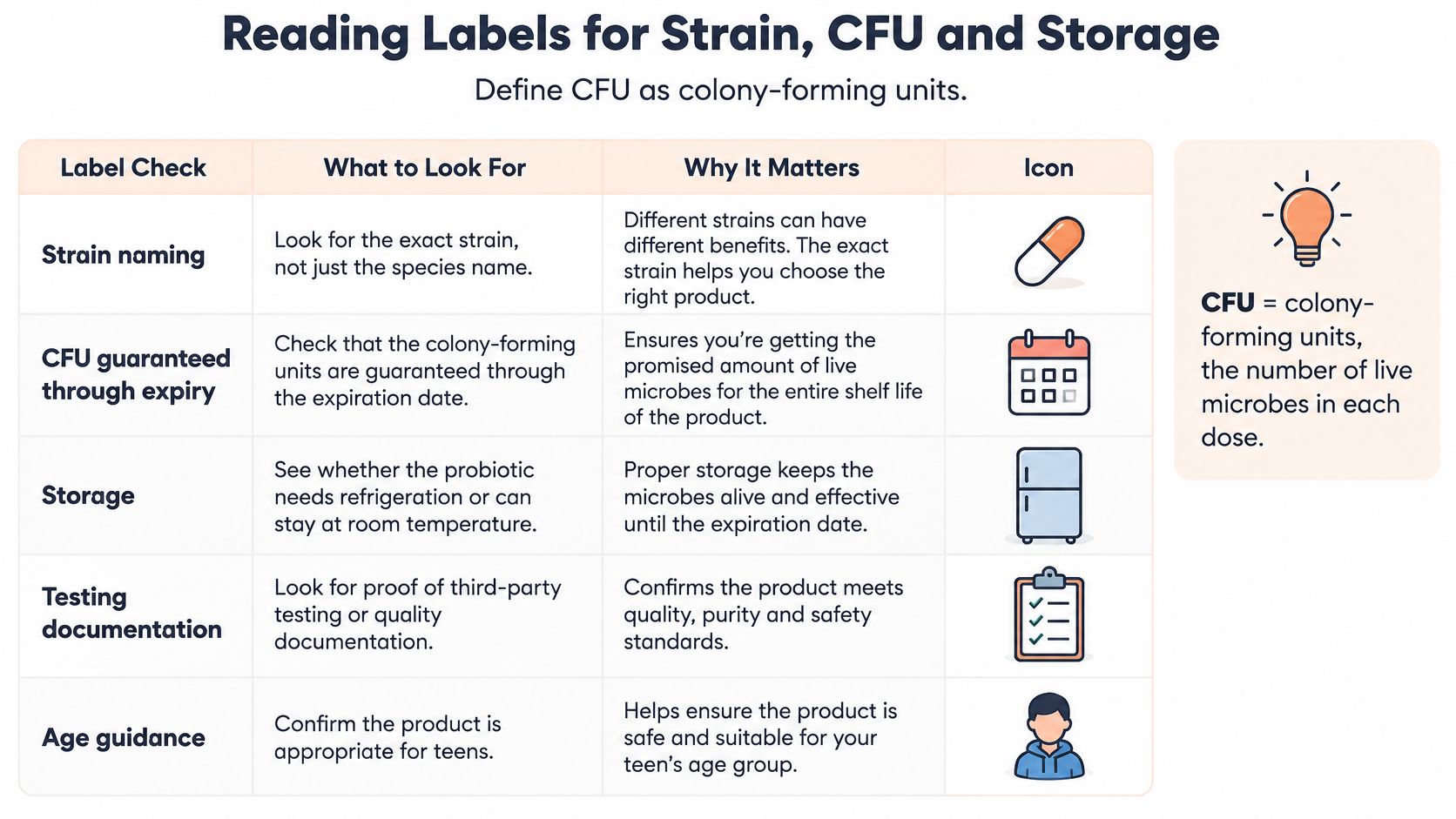
Reading Labels for Strain, CFU and Storage
| Label item | Strong label | Weak label | Why it matters |
|---|---|---|---|
| Strain | Genus, species, and strain designation, such as LGG | Only a genus or generic blend name | Clinical findings attach to identified organisms |
| Count | CFU guaranteed through expiry | Count only at manufacture, or billions without a date | Organisms can lose viability during storage |
| Storage | Clear temperature and moisture instructions | Missing or vague directions | You need to know how to preserve the product |
| Testing | Documented third-party or laboratory testing | No accessible quality information | Label accuracy needs support |
| Age guidance | Stated age use and clear safety cautions | No age or safety guidance | Adult marketing doesn't establish teen suitability |
Use the bottle itself, not just a retailer's headline. This visual is a handy prompt while you're checking it.
Translate the count before comparing
CFU means colony-forming units, a measure of viable microbial cells capable of multiplying into countable colonies. The FDA's live-microbial labeling guidance explains why this differs from microorganism weight, which can include both living and dead cells.
For our gummies, 5 billion per gummy equals 5 × 10^9. That's a per-gummy quantity, not permission to assume a daily serving or increase the amount to reach another product's research dose.
A pediatric LGG systematic review found that doses of at least 10^10 CFU daily, or 10 billion, were associated with approximately 2.4 days shorter diarrhea in higher-dose trials; lower-dose trials didn't show a statistically significant benefit, and the pooled reduction across 15 LGG trials was about 0.85 days, with low-quality evidence. That finding belongs to LGG in that treatment context, not to any formula whose total happens to reach the same number.
Check what survives and what was tested
Look for a count guaranteed through expiration, rather than only when the product was manufactured. Then follow the actual storage line, including any refrigeration or moisture precautions, instead of assuming all probiotics belong in the fridge.
Quality documentation matters too. A pediatric evidence review in the British Journal of Nutrition describes independent testing that found products with no probiotic organisms or organisms that didn't match the listed strain.
Supports digestion is a claim. An identified strain tested in people for a defined problem, at a stated dose, is evidence you can evaluate.
For Yuve Vegan Probiotic Gummies, confirm the strain identifiers, expiration-date guarantee, storage instructions, and age fit before buying. Our guide to what to look for when buying probiotics can help you organize that review.
Keep the wider routine in view as well. Navilo Health's nutrition tips for everyday health offer a place to explore everyday nutrition alongside your product questions, without treating a supplement as the entire plan.
Matching a Probiotic to Your Teen's Reason
Match a probiotic to a specific concern, not a broad promise like “better gut health.” Antibiotic-associated diarrhea is a clearer reason to discuss probiotics with the prescriber because it has a defined treatment context and measurable outcomes.
A 2019 Cochrane review pooled 33 studies involving 6,352 participants. Antibiotic-associated diarrhea occurred in 8% of probiotic users versus 19% of controls, with a pooled risk ratio of 0.45 and a 95% confidence interval of 0.36 to 0.56. That amounts to roughly a 55% relative reduction, with a number needed to benefit of 9 and a confidence interval of 7 to 13. Across 24 trials involving 4,415 participants, the review found no overall difference in adverse events.
These results can inform a conversation with the prescriber, but they do not show that every gummy, capsule, or mixed-strain powder offers the same effect. The review pooled different ages, strains, doses, and antibiotics.
| Teen situation | What the evidence supports | Start with | Talk to a clinician first if |
|---|---|---|---|
| Ordinary bloating or irregular stools | Limited, strain-specific findings, not proof for every teen | A food and symptom diary, then a suitable labeled strain if appropriate | Symptoms persist or worsen |
| Antibiotic course | A meaningful reduction in antibiotic-associated diarrhea in pooled trials across different ages | A studied strain and dose, with timing agreed with the prescriber | The teen has other health conditions or takes several medicines |
| Acute infectious diarrhea | Some short-term evidence for LGG or S. boulardii, with important limitations | Clinical advice and attention to hydration before choosing a short course | There's blood in stool, dehydration, or high fever |
| Immune suppression or a central line | Serious infection risk has been reported in high-risk groups | Nothing without clinician approval | Always, before starting a product |
Ordinary bloating needs a clearer question
If discomfort after lunch is making your teen avoid eating at school, take that distress seriously. Don't choose the highest-count product by default.
Record meals, symptoms, bowel movements, and whether discomfort interferes with school or activities. If the pattern continues, bring that record to an appointment. Repeatedly switching products without identifying the problem makes it harder to judge what may help.
If constipation is the main concern, this guide to probiotics for constipation can help you prepare focused questions. Persistent stool problems deserve their own assessment.
Don't buy on mood or weight promises
A 2024 review of depressive symptoms identified five randomized trials involving 692 children and adolescents. A separate 2024 adolescent weight meta-analysis included eight trials with 201 probiotic participants and 190 controls. These studies address different questions, and their findings do not establish that a general-purpose teen digestive product will help with mood or weight.
Choose a product only when its label matches the specific reason for considering it: the strain, dose, and expiry guarantee should fit the evidence for that concern. Mood or weight concerns call for appropriate care, not a probiotic selected from a marketing claim.
Safety, Age Limits and When to Pause
For generally healthy teenagers, probiotics are usually well tolerated. The American Academy of Pediatrics guidance summarized by American Family Physician describes a generally reassuring safety picture while warning against giving probiotics to seriously or chronically ill children until safety is established.
Usually well tolerated doesn't mean necessary for everyone. It also doesn't mean that worsening symptoms should be accepted as a normal adjustment.
Who needs medical supervision
Get clinician approval before starting if your teen is immunocompromised, seriously or chronically ill, severely debilitated, or has an indwelling medical device. Rare but serious infections have been reported in high-risk groups, so these aren't situations for trial-and-error shopping.
A central line deserves particular attention. Tell the care team exactly which product you're considering, including whether it contains bacteria or yeast, rather than asking only whether probiotics are safe.
Our guide to who should not take probiotics can help you recognize questions to bring to that conversation. It can't replace the team's knowledge of your teen's condition and treatment.
Safety boundary: New or worsening symptoms are a reason to reassess, not a reason to keep increasing the dose.
Website age rules aren't dosing guidance
Our platform isn't available to users under 13, and users aged 13 to 18 need permission from a parent or legal guardian. Those are platform-use rules, not medical clearance to take a supplement.
The pediatric yeast studies include younger children as well as adolescents; they don't establish a separate, universal teenage dose. An adult-sized count on a label doesn't solve that gap.
Ask a pediatrician or pharmacist to confirm the dose, duration, and product suitability for your teen. Bring a photo of the complete label so they can evaluate more than the product name.
Know when to stop experimenting
Pause the product and seek advice if your teen develops:
- A new rash, especially if it appears after starting the supplement.
- Fever or worsening illness, rather than isolated mild digestive discomfort.
- Blood in the stool, which needs prompt assessment.
- Signs of dehydration, such as markedly reduced urination or trouble keeping fluids down.
- Persistent symptoms without improvement, instead of a clear, worthwhile change.
Breathing difficulty or swelling of the lips, tongue, or throat needs emergency care. Don't wait to see whether changing the supplement helps.
For ordinary discomfort, the goal is to make eating and daily life easier. If your teen is missing school, avoiding meals, or becoming increasingly worried about food, book an appointment rather than another subscription.
Choose and Test Your Teen's Probiotic Step by Step
Make the decision with your teen, not just for them. They're the person who can tell you whether discomfort is improving and whether the routine is realistic.

- Name the reason before choosing the product. Write down the actual concern: diarrhea during an antibiotic course, an acute illness, or ongoing bloating. If you can't name what improvement would look like, you're not ready to judge whether a purchase works.
- Inspect the actual bottle. Check the strain designation, viable count through expiry, and storage instructions using the label checklist. Save a photo of the label and the product's quality information so you can show your pharmacist precisely what you're considering.
- Confirm age fit and health risks. Review the full ingredient list and age directions with your teen's clinician or pharmacist when appropriate. Mention medicines, chronic conditions, and persistent symptoms rather than assuming a plant-based product bypasses those considerations.
- Change one thing at a time. For an appropriate everyday digestive trial, agree on a short review period and keep a simple symptom log. A practical plan is to review progress after two to four weeks, but don't use that timetable to delay care for diarrhea, worsening symptoms, or other warning signs.
- Decide whether it earned a place in the routine. Record stool comfort, bloating, missed doses, and any unwanted effects in plain words. Continue only when the product remains suitable and there's a clear reason to do so, rather than because the bottle isn't empty.
Set expectations without promising a deadline
Our general guidance is that digestive support products, including enzymes and probiotics, often show results within one to two weeks of consistent use. That's an expectation for digestive products broadly, not proof that these gummies will resolve a particular teen's complaint on that schedule.
Our Vegan Probiotic Gummies are a daily plant-based option to assess once the label and age checks pass. Choose the format because it fits a suitable plan, not because a gummy seems automatically gentler or more effective.
A final pre-purchase checklist
- Clear purpose: You know which symptom or situation you're addressing.
- Evidence fit: The organism and intended use make sense together.
- Usable directions: You understand the serving, storage, and review plan.
- Safety plan: You know when to pause and whom to call.
I wouldn't treat an uneventful first week as proof of benefit, or a disappointing trial as a reason to buy something stronger. Your teen deserves a plan you can evaluate, not an endless search for a bigger number.
Yuve offers plant-based probiotics, prebiotics, and digestive enzymes, including Vegan Probiotic Gummies for a daily routine. Visit Yuve to review the gummy product page and label, confirm suitability with your teen's clinician or pharmacist, and share your family's experience in the comments.