You're two hours into a long-haul flight, your waistband feels tighter, and the airport meal is replaying in your stomach. Or perhaps you've arrived somewhere exciting only to spend the night negotiating with unfamiliar plumbing. Searching for the best travel probiotics makes sense, but the right choice is not just the bottle with the longest strain list. It's the product that fits your health needs, destination, storage conditions, and travel routine.
The Travel Day Stomach Problem Nobody Warned You About
The trouble often starts before the first local meal. You eat at an unusual time, sleep at the wrong hour, drink less water than usual, and sit still through a long flight. By the time you land, your stomach may feel full, sluggish, or strangely unpredictable.
Then come the new foods and water exposures. A dish that tasted perfect at dinner can become the reason you miss breakfast. At a conference, stress can make bloating and urgency worse. On a backpacking trip, limited bathroom access adds another layer of anxiety.
Travel puts several pressures on digestion at once:
- Routine disruption: Jet lag changes when you eat, sleep, and use the bathroom.
- Diet changes: New spices, unfamiliar ingredients, and different fiber intake can challenge your usual rhythm.
- Microbial exposure: New water and food environments may introduce organisms your body hasn't encountered recently.
- Medication overlap: Some travelers take antibiotics before or during a trip, which changes the probiotic conversation.
- Stress and fatigue: Excitement is still stress for the body, and tired travelers often notice more digestive discomfort.
That doesn't mean a probiotic acts like a protective force field. It means a carefully chosen product may fit into a broader routine for digestive support. Safe food and water habits, hand hygiene, hydration, sleep, and medical advice remain the foundation.
My practical view: A travel probiotic should support your plan, not become the plan.
This guide focuses on the details most product roundups skip: named strains, expiration-date potency, heat exposure, format choice, antibiotic questions, and situations where you should ask a clinician first. The aim is simple. You should be able to pack a product with realistic expectations and fewer unpleasant surprises.
What Actually Makes a Probiotic Travel Worthy
A travel-friendly label should answer four questions quickly. If it doesn't, I'd keep shopping.
1. Is the strain clearly named
“Lactobacillus” is a genus. “Lactobacillus rhamnosus” is a species. Lactobacillus rhamnosus GG identifies a particular strain, which matters because probiotic effects are tied to the exact organism, not just its broad family.
Choosing a hotel works the same way. “A hotel in Spain” tells you almost nothing. A named property, address, and room type give you something you can evaluate. Look for the full strain designation rather than a vague species-only label.
2. Is the dose guaranteed through expiration
A label may state a CFU count, meaning the number of organisms expected to be capable of forming colonies under specified conditions. The useful question is whether that count applies at expiration, not only when the product leaves the factory.
A product that lists its potency only at manufacture gives you less confidence by the time it reaches your suitcase. Check the expiration date and look for clear wording about viability through that date.
3. Does the product explain stability
Travel exposes supplements to temperature swings, humidity, sunlight, and rough handling. A formulation designed for ordinary home storage may be inconvenient on a hot road trip or a beach holiday.
Look for explicit storage instructions and a clear statement about whether refrigeration is required. “Shelf stable” is useful only when the label also tells you the conditions that support that claim.
4. Can the packaging handle real luggage
Moisture is a quiet problem. So is heat inside a parked car or a checked suitcase sitting on a hot tarmac. Bottles with a tight seal, moisture protection, and clear handling instructions make more sense than decorative packaging with no practical guidance.
For a quick label check, ask:
- Strain: Is the organism fully identified?
- Potency: Is the CFU count stated through expiration?
- Stability: Does the storage guidance match your destination?
- Packaging: Will the container protect the contents from humidity and heat?
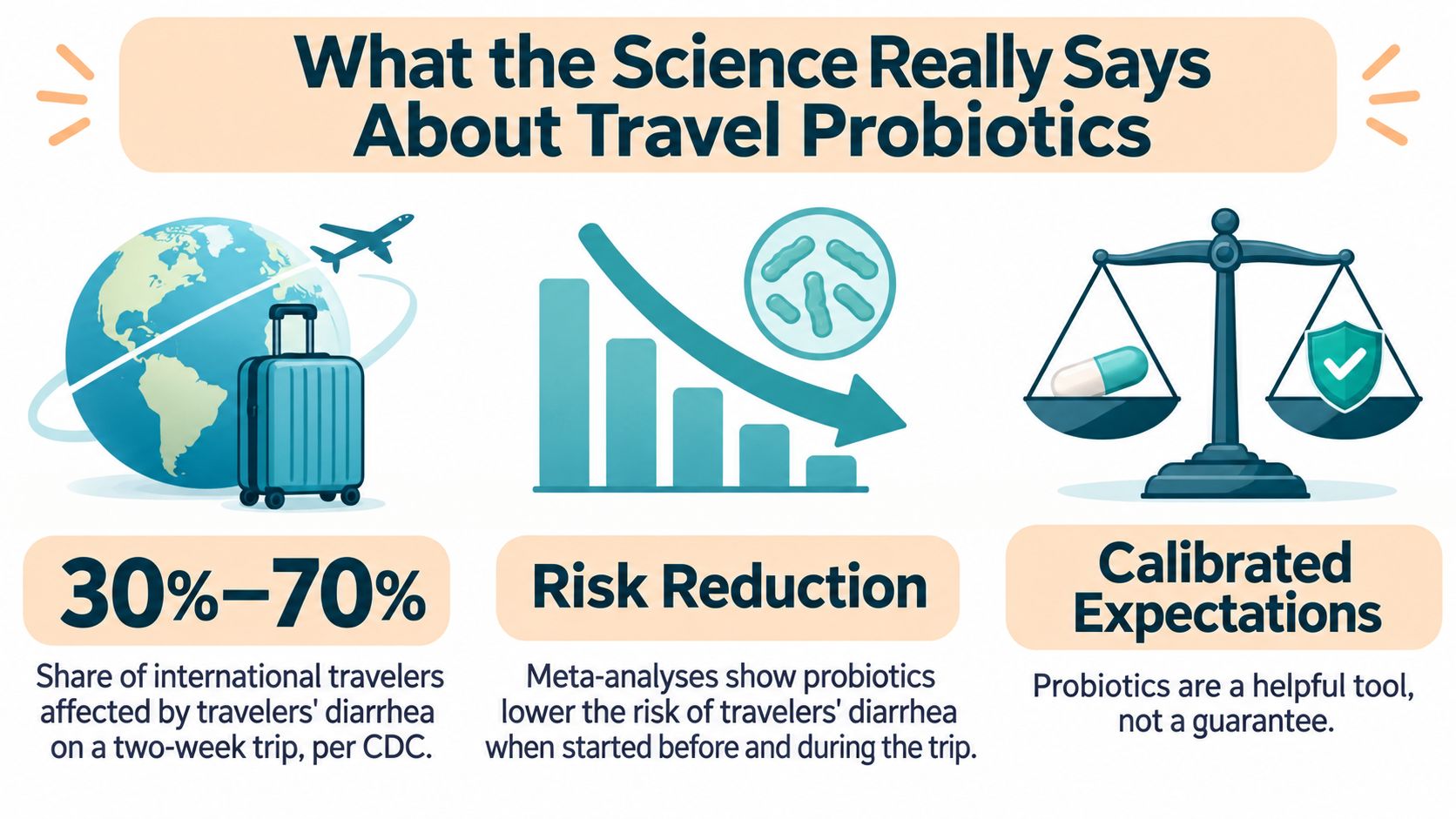
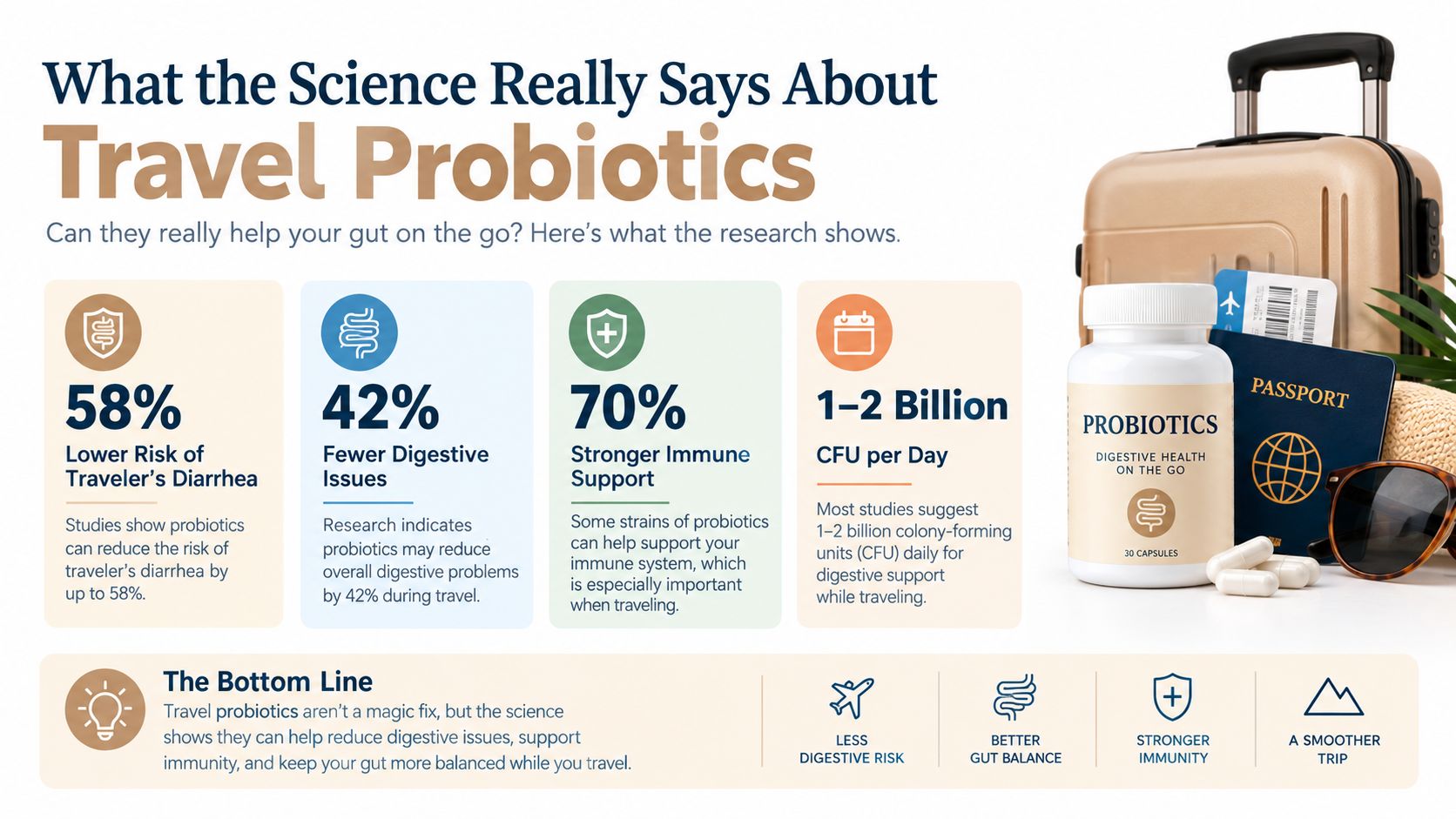
What the Science Really Says About Travel Probiotics
Travelers' diarrhea is common enough to deserve serious preparation. The Centers for Disease Control and Prevention travel guidance estimates that it affects 30% to 70% of international travelers during a two-week trip, depending on destination and season.
That figure explains the demand for travel probiotics, but it doesn't prove that every product prevents illness. The CDC notes that organisms including Lactobacillus rhamnosus GG and Saccharomyces boulardii have been studied, while also stating that the available evidence is insufficient to recommend probiotics specifically for preventing travelers' diarrhea. Researchers have used different strains, doses, formulations, and traveler populations, making the results difficult to compare.
A published meta-analysis identified 12 randomized controlled trials from 940 screened studies and reported a pooled relative risk of 0.85, with a 95% confidence interval of 0.79 to 0.91 and significance below 0.001. In plain English, the pooled estimate represented an approximate 15% relative reduction in risk among probiotic users in those analyzed trials. The result is meaningful, but it's not a universal promise.
Later evidence keeps the picture measured. The National Center for Complementary and Integrative Health review of probiotics describes a 2018 review covering 11 studies and 5,143 participants in which probiotics or prebiotics might help, while noting that the International Society of Travel Medicine's 2017 guideline found the evidence insufficient to recommend them for prevention or treatment.
What this means for you: A probiotic may offer modest, strain-specific support. It cannot replace safe food and water choices, and a product promising guaranteed protection is overselling the evidence.
The practical takeaway isn't “probiotics are useless.” Nor is it “take any probiotic and forget the basics.” Choose a transparent product, follow its directions, and treat it as one part of a travel-health routine.
For readers comparing specific organisms, this guide to Saccharomyces boulardii and probiotic use offers useful context.
Matching Probiotic Formats to Real Travel Scenarios
The best format is the one you can store correctly and take consistently. A capsule may be ideal for a solo traveler with a strict routine, while a chewable may be easier for a family. Convenience matters, but it shouldn't override storage requirements or label transparency.
Travel Probiotic Formats at a Glance
| Format | Best For | Heat Sensitivity | Dosing Flexibility |
|---|---|---|---|
| Capsules | Backpacking, business travel, light packing | Often easier to protect, but still keep away from heat and humidity | Usually straightforward |
| Powders | Travelers who dislike swallowing capsules | Packets can be convenient, but moisture can damage them | Easy to mix when safe water or a suitable drink is available |
| Chewables or gummies | Families and travelers who prefer a food-like format | Some require refrigeration and may soften or degrade in heat | Convenient, but serving instructions vary |
| Shelf-stable liquids | Travelers who prefer liquid dosing | Often more vulnerable to heat, leakage, and handling | Flexible, but packaging can be bulky |
A two-week backpacking trip favors a compact capsule or sealed powder packet, especially when refrigeration is unavailable. Check whether the package can tolerate the warmest part of your route, not just your departure city.
A five-day business conference rewards simplicity. A capsule that fits beside your passport and can be paired with breakfast is easier to maintain than a product that requires special preparation. Conference schedules are already chaotic, so I wouldn't choose a format that depends on finding a blender, refrigerator, or quiet meal break.
For a road trip with children, chewables or gummies may be easier to administer, but inspect the label closely. Some gummy products require refrigeration, and summer shipping or a hot vehicle can create obvious problems. Cute packaging doesn't equal travel stability.
At a beach resort, choose the format that tolerates your actual day. If you'll carry it between a warm room, a beach bag, and outdoor meals, a sealed, shelf-stable option is generally easier to manage than a refrigerated liquid.
A useful test: If you can't explain where the product will live during your hottest travel day, it isn't ready for your itinerary.
Storage and Dosing Tips That Protect Your Potency
A strong formula can lose practical value if you leave it in the wrong place. I treat probiotic storage like sunscreen storage. It belongs somewhere accessible and protected, not baking in a car or disappearing into checked luggage.
Build a simple travel routine
The plan below is intentionally boring. Boring routines survive airports.
- Start before departure. The requested routine for this guide is to begin dosing two to three days before departure, giving the selected strains time to establish as directed by the product.
- Take capsules with food or just before a meal. This may help buffer stomach acid, but follow the product label if it gives different instructions.
- Pack the product in your carry-on. Checked bags can face heat and delays, while a carry-on keeps your supplement available if luggage is lost.
- Use an insulated pouch when appropriate. Don't add ice or freeze a product unless its instructions specifically require it.
- Keep it away from humidity. A steamy bathroom and an open beach bag are poor storage locations.
The Yuve guide to whether probiotics need refrigeration explains why product-specific storage instructions matter more than blanket rules.
Handle antibiotics carefully
Antibiotics aren't routinely recommended for preventing travelers' diarrhea, and travel-related antibiotic exposure raises concerns about colonization with multidrug-resistant organisms. If a clinician prescribes an antibiotic, don't skip or alter it because you're taking a probiotic.
Some clinicians prefer separating probiotic and antibiotic doses by two hours, but there isn't one universal schedule for every product, organism, or prescription. Ask the prescriber or pharmacist how to space them, and follow both labels.
Children, older adults, pregnant travelers, and immunocompromised people shouldn't assume that an adult travel routine applies to them. The available guidance doesn't establish a universal safety or dosing rule for these groups, so clinician advice belongs before self-prescribing.
Vegan and Shelf Stable Options Worth Considering
Vegan travel probiotics involve more than a green leaf on the front of the box. The capsule shell, carrier ingredients, sweeteners, and manufacturing controls all deserve a look.
A vegan capsule may use a plant-based shell instead of gelatin. A powder may use a starch or other carrier. A blister pack or desiccant may help manage moisture. None of those changes automatically makes the microorganisms more effective. Plant-based describes the formulation and ingredients, not a guarantee about clinical performance.
What to verify on the label
- Gelatin-free capsule or gummy: Check the full ingredient panel instead of relying on the front label.
- Clear strain names: Vegan status doesn't compensate for a vague organism designation.
- Expiration-date potency: Look for a CFU statement that remains meaningful through expiration.
- Storage language: “No refrigeration required” is more useful when paired with specific temperature guidance.
- Quality information: Non-GMO and gluten-free certifications may matter to your diet, while third-party testing can provide additional manufacturing transparency.
For parents packing supplements for children, format and dosing instructions matter as much as ingredients. A gummy may be easier to take, but it can be less suitable for heat exposure or longer luggage days than a sealed capsule.
Eco-conscious travelers should also consider packaging waste. A compact bottle may be easier to reuse, while individual sachets can offer convenience but create more packaging. There's no single winner. Match the package to the trip, then make sure the formulation meets your dietary requirements.
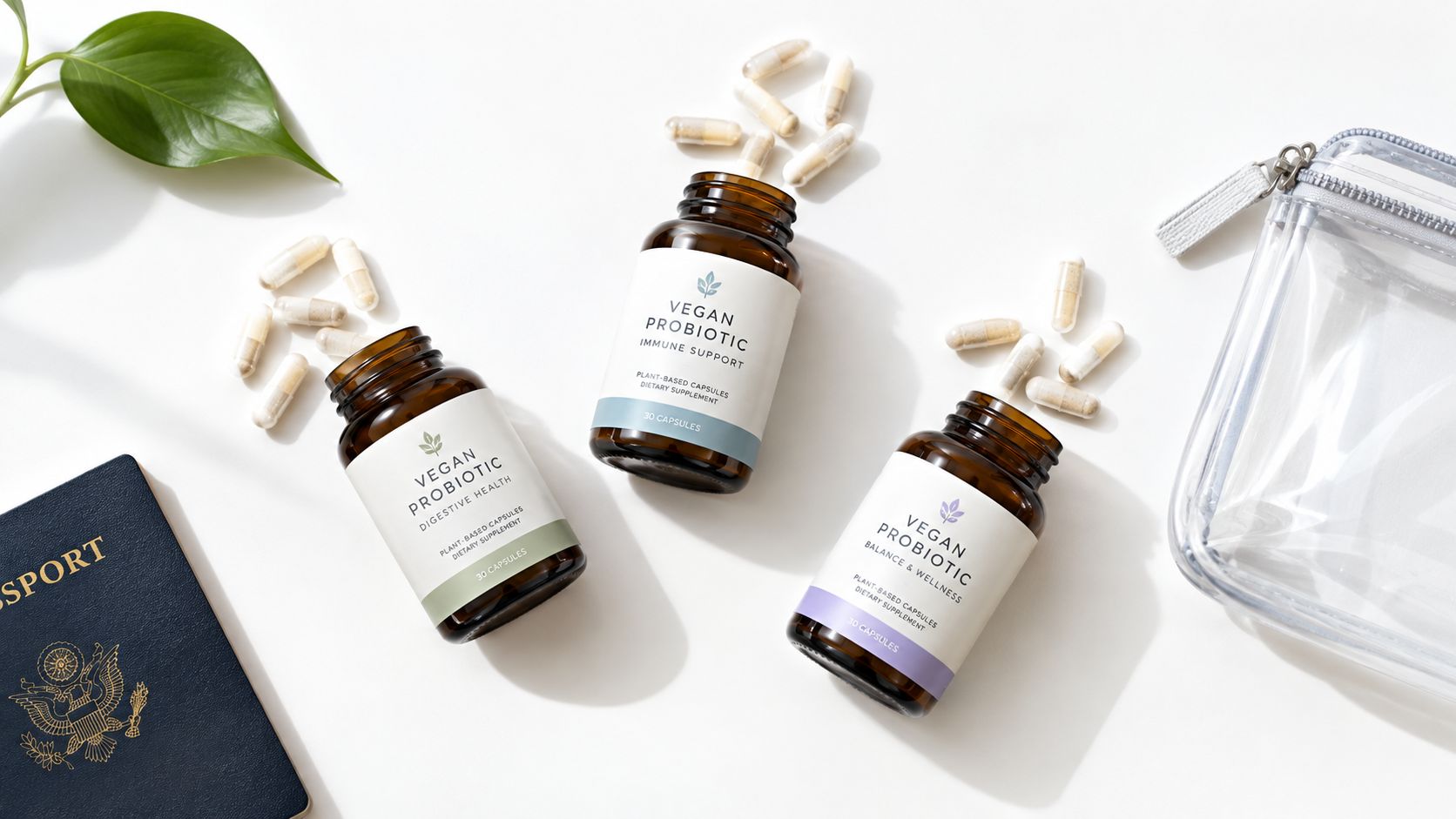
If plant-based ingredients are central to your routine, this overview of vegan probiotic supplements can help you compare formulation details without confusing vegan labeling with evidence of travel-diarrhea prevention.
Picking and Packing the Right Probiotic for Your Trip
Here's the checklist I'd use before buying any product marketed as one of the best travel probiotics:
- Confirm the full strain name. Skip generic labels that identify only a broad species or blend.
- Check potency at expiration. Don't rely only on the number stated at manufacture.
- Match storage to the destination. A product suited to a cool kitchen may not suit a humid beach or hot rental car.
- Choose the format around refrigeration access. Plan for the longest stretch without a refrigerator, not the easiest hour of the trip.
- Start the routine before takeoff. Use the product's directions, including the pre-trip timing described above.
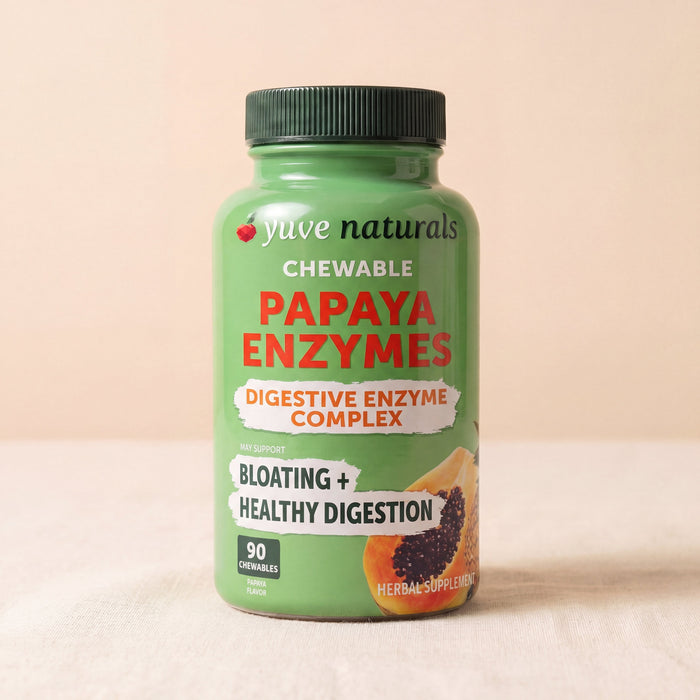
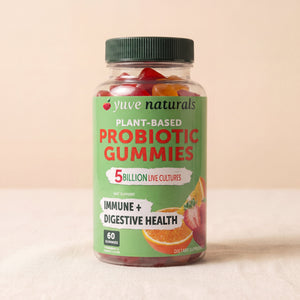
Yuve offers a vegan, non-GMO, gluten-free, gelatin-free probiotic gummy format with 5 billion live plant-based cultures, and its product positioning may suit travelers who prioritize a plant-based, shelf-stable option. Verify the current label and storage instructions before packing, because formulations and directions can change.
That choice still belongs inside a larger travel routine: wash your hands, choose safe food and water, protect the product from heat and humidity, and follow any clinician-prescribed antibiotic plan. If you're also organizing personal-care essentials, this safe bug repellent packing guide is a useful companion for building a practical travel-health kit.
Travel Probiotic Questions Worth Answering Quickly
When should I start a travel probiotic?
For the routine described here, start two to three days before departure, while following the exact directions for your chosen product. There isn't one universal start date for every formulation or health goal.
How should I space a probiotic around antibiotics?
Ask your clinician or pharmacist. Some clinicians prefer a two-hour gap, but the right schedule depends on the product and prescription, and a probiotic never replaces or justifies changing an antibiotic plan.
Are probiotics appropriate for children or during pregnancy?
Don't assume an adult product or dose is suitable. Children, pregnant travelers, older adults, and immunocompromised people should get individualized guidance from a qualified clinician.
Is a probiotic better than hand hygiene or bottled water?
No. They address different parts of travel preparation, and probiotics don't replace food and water safety or hand hygiene. Use those precautions first, then consider a probiotic as a limited, supportive addition.
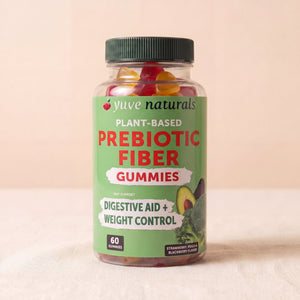
Yuve offers plant-based probiotic and prebiotic options designed for people who want a vegan, non-GMO, gluten-free approach to digestive support while traveling. Review the label and storage directions, then visit Yuve to explore the current range and choose a format that fits your trip.