Probiotics may modestly increase weekly bowel movements in some adults: the 2017 pooled estimate was about 0.83 extra bowel movements per week, and that effect isn't guaranteed or established for every product. So when you ask can probiotics help constipation, the honest answer is "maybe a little, for some people, with the right strain."
But here's the question most labels and headlines skip: better than what? Better than doing nothing, better than the placebo capsule in a trial, or better than the treatment your doctor would prescribe? Those are three different bars, and a probiotic can clear one while failing the other two.
If you've been bloated, backed up and annoyed for weeks, you deserve straight answers, not a sales pitch. We'll walk through what the trials measured, which strains and doses were tested, why your gut may respond differently from someone else's, and how to run a fair test on yourself instead of guessing. Constipation is frustrating enough without adding a supplement you can't evaluate.
What the Research Says About Probiotics and Constipation
Probiotics may help some adults with constipation, but the effect is modest and it isn't promised to anyone. The clearest anchor is a 2017 systematic review and meta-analysis in PMC that pooled 21 randomized controlled trials involving 2,656 adults with constipation across 23 treatment comparisons. Probiotic-containing products increased stool frequency by an average of 0.83 bowel movements per week compared with control products (95% CI 0.53 to 1.14, P<0.001). In everyday terms, that's roughly one extra toilet trip a week.
That same analysis found evidence probiotics could shorten intestinal transit time, meaning how long food takes to travel through your gut. So the benefit isn't only a feeling. It's measurable.
Why one average number can mislead you
The trials behind that pooled figure used different bacterial strains, different doses, different treatment lengths and different product formats. The 0.83 is an average across many interventions, not a result any single bottle can promise you. Earlier meta-analyses had reported larger gains of about 1.3 to 1.5 additional bowel movements per week, which tells you the estimate itself has moved as evidence accumulated.
| Study or review | Main result | What it means |
|---|---|---|
| 2017 meta-analysis, 21 trials, 2,656 adults | +0.83 bowel movements per week (95% CI 0.53 to 1.14) | Statistically significant, P<0.001 |
| Earlier meta-analyses | About +1.3 to 1.5 per week | Estimates have varied across reviews |
| 2010 systematic review of probiotics for functional constipation, 5 trials, 377 participants | Too few trials for firm conclusions | Limited evidence |
| 2024 triple-blind trial, 229 adults, China | No significant gain over placebo for complete spontaneous bowel movements | No meaningful difference from placebo |
| 2025 pediatric network meta-analysis, 41 trials | No significant increase in weekly bowel movements vs placebo or conventional treatment | Not significant for children |
| 2025 pediatric meta-analysis in BMC Pediatrics | Effect estimate 1.17 (95% CI 1.01 to 1.37) | Significant, and it conflicts with the network analysis above |
The pediatric results genuinely disagree
Two 2025 reviews of children's constipation point in opposite directions, and pretending otherwise would be dishonest. One pooled analysis found no significant gain over placebo or conventional care, while the other reported a statistically significant overall effect. When two reviews of overlapping literature disagree, the sensible move is to hold your conclusion loosely and ask your child's clinician what they recommend, rather than picking the number you like best.
Practical rule: before you trust a headline number, find out which strain, which dose, which duration and which comparator produced it.
There's one more caution worth knowing. When researchers adjusted the big 21-trial analysis for possible publication bias, the estimated improvement dropped from 0.83 to 0.30 bowel movements per week (95% CI -0.01 to 0.62), and that adjusted result wasn't statistically significant. Probiotics are a possible add-on worth testing, not a substitute for care that works.
Which Strains and Doses Have Evidence Behind Them
"Probiotic" isn't one ingredient. It's a category, the way "apple" is a category. A Granny Smith and a Honeycrisp behave differently in the same pie, and two bacterial strains behave differently in the same gut. The word on the front of a package tells you almost nothing about the organism inside it.
A clinical evidence summary hosted by NCBI reported that probiotics reduced whole-gut transit time by approximately 12.4 hours and increased stool frequency by about 1.3 bowel movements per week overall, with a particularly strong signal for Bifidobacterium lactis, which increased frequency by approximately 1.5 bowel movements per week. That's the strain-level detail a pooled average hides.
The same guideline-level evidence adds two brakes. Probiotics may increase stool frequency without consistently improving stool consistency, and there isn't enough evidence to recommend one universal strain for constipation. Going more often and passing easier stools aren't the same win.
Named trials, named doses
| Strain or trial | Dose | Duration | Reported result |
|---|---|---|---|
| B. animalis subsp. lactis HN019, placebo-controlled trial in functional constipation | 1 billion or 10 billion CFU per day | 28 days | Post-hoc gain in frequency for people starting under 3 stools per week |
| B. lactis HN019, 2024 triple-blind trial (229 adults) | About 4.69 billion CFU per day by study end | 8 weeks | No significant gain over placebo |
| B. lactis, strain-level signal from the clinical evidence summary | Not reported in the summary | Not reported in the summary | About +1.5 bowel movements per week |
| BLa80, constipation-predominant IBS trial, 180 adults | Not reported in the trial summary | Not reported in the trial summary | Stool frequency improved vs placebo (P=0.02) |
| Synbiotic pilot, 2024 double-blind trial | Not reported in the trial summary | Not reported in the trial summary | Weekly stools rose from 2.8 ± 1.3 to 5.9 ± 2.6 (P<0.001) |
Notice the pattern in the first two rows. The same strain name, HN019, produced a post-hoc benefit in one trial and no advantage over placebo in another. A post-hoc analysis means researchers looked at a subgroup after the trial finished, which is a hypothesis-generating step, not the final word. And the IBS-C trial studied a related but distinct condition, so its result doesn't automatically transfer to plain chronic constipation.
A label checklist you can use in the aisle
- Full strain designation: genus, species and the strain code (letters and numbers at the end). "Bifidobacterium lactis" alone isn't enough to match a trial.
- CFU dose per serving: colony-forming units, stated per gummy or capsule, not a vague "proprietary blend" total.
- Trial length you're willing to commit to: decide your test window before you start, so you're not judging on a random Tuesday.
- An exit rule: if nothing changes by the end of your window, stop and reassess instead of buying a third bottle out of hope.
Why Probiotics Work for Some People and Not Others
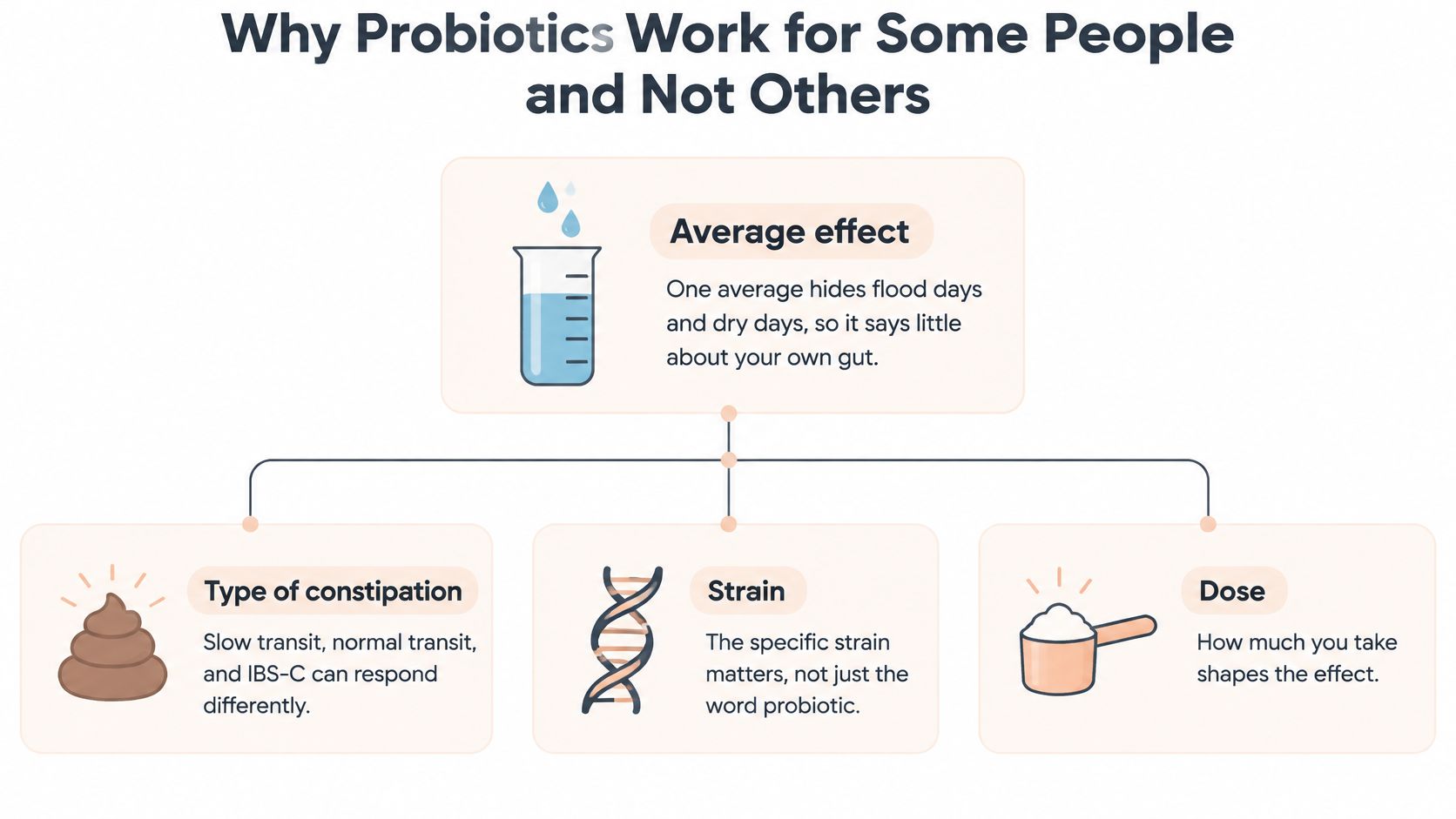
Think of a rain gauge that reports the monthly average. One number, say two inches, tells you nothing about whether Tuesday flooded your garden and Friday stayed bone dry. A pooled probiotic effect works the same way. It's an average across guts that aren't yours.
Your type of constipation sets the ceiling
Constipation isn't one problem wearing one name. Ordinary functional constipation, slow-transit constipation, pelvic-floor dysfunction (where the muscles you need to relax don't coordinate), IBS with constipation, and medication-induced constipation all call for different management. A bacterial supplement isn't going to retrain a pelvic floor or cancel out a medication's side effect.
Starting point matters too. In the HN019 research, the frequency benefit showed up mainly among people whose bowel movements were especially infrequent to begin with. If you're already fairly regular and just feel incomplete, there's less room to improve, and less reason to expect a dramatic shift.
Feeling better isn't proof
A 2024 triple-blind randomized clinical trial followed 229 adults treated at five hospitals in China. Eight weeks of Bifidobacterium lactis HN019, reaching approximately 4.69 billion CFU per day by the end, didn't significantly outperform placebo for increasing complete spontaneous bowel movements. The placebo group got maltodextrin. Both groups improved, and the researchers found no meaningful difference between them.
That's a reality check most product pages leave out. Symptoms fluctuate, expectations shape what we notice, and a good week can arrive on its own.
Say a reader who normally goes three times a week starts a probiotic, notices a change around week three, and feels vindicated. Then she looks at her habits and realizes she also doubled her water intake and started walking after dinner. Which change did the work? She can't know, and neither can we. That's not a reason to give up on probiotics. It's a reason to test them cleanly.
One calm week doesn't tell you what caused it. A steady log across two months usually does.
Customers often describe the change in modest terms rather than miracles. As Nicole put it, "GI tract is calmer and I have less discomfort after eating." That's a realistic outcome to aim for, and it's worth tracking whether you get it.
Warning Signs That Need a Doctor, Not a Supplement
Some symptoms aren't a supplement problem. They're a get-evaluated problem, and no amount of strain-matching changes that.
| Warning sign | Why it matters | What to do |
|---|---|---|
| Rectal bleeding | Can signal a serious condition | See a doctor promptly |
| Vomiting | Can point to a problem needing evaluation | Seek medical evaluation |
| Unexplained weight loss | Not explained by constipation alone | See a doctor |
| Severe abdominal pain | Needs prompt assessment | Seek urgent care |
| Constipation that persists through a fair trial | Probiotics may not be the right fix | Ask a clinician for next steps |
| Immunocompromised or critically ill | Higher risk of serious probiotic complications | Ask a clinician before starting |
If pain is the symptom that's dominating your days, our guide to abdominal pain due to constipation walks through what tends to drive it and when it needs a professional look.
More bowel movements isn't the same as a fixed gut
A 2025 meta-analysis of 15 randomized controlled trials reported improvements in spontaneous bowel movements and stool consistency, but found no significant effect on gut-transit time or quality-of-life scores. Read that twice, because it's the most useful nuance in this whole topic. Some people pass stool more regularly or more softly without their gut moving faster and without the broader burden of constipation lifting.
So if your count improves but you still feel bloated, still strain, still plan your day around the bathroom, the underlying issue hasn't been solved. Bring that gap to a clinician rather than doubling your dose.
Safety, children and shared decisions
Historical trial reviews found probiotics generally well tolerated, with reported serious complications concentrated among people who were immunocompromised or critically ill. If that's you, or you're seriously unwell, talk to your clinician before starting anything live-culture.
For kids, don't assume a probiotic can stand in for guideline-based care, especially with persistent, painful or recurring constipation. Clinicians usually check stool withholding, toilet-training factors, diet and medications first, because those often explain more than the microbiome does.
We also want to be plain about our own products: if you're pregnant, nursing, taking medication, or managing a medical condition, consult your healthcare provider before use. Knowing when to get help is part of a smart plan, not a failure of it.
How to Trial a Probiotic Without Guessing
A review of systematic reviews and meta-analyses concluded there's insufficient scientific evidence for a general recommendation, and characterized probiotic use in constipation as investigational. That word sounds clinical, but it's freeing. You're running an experiment, not failing a treatment.
Here's the visual version of the process before we get into the details.
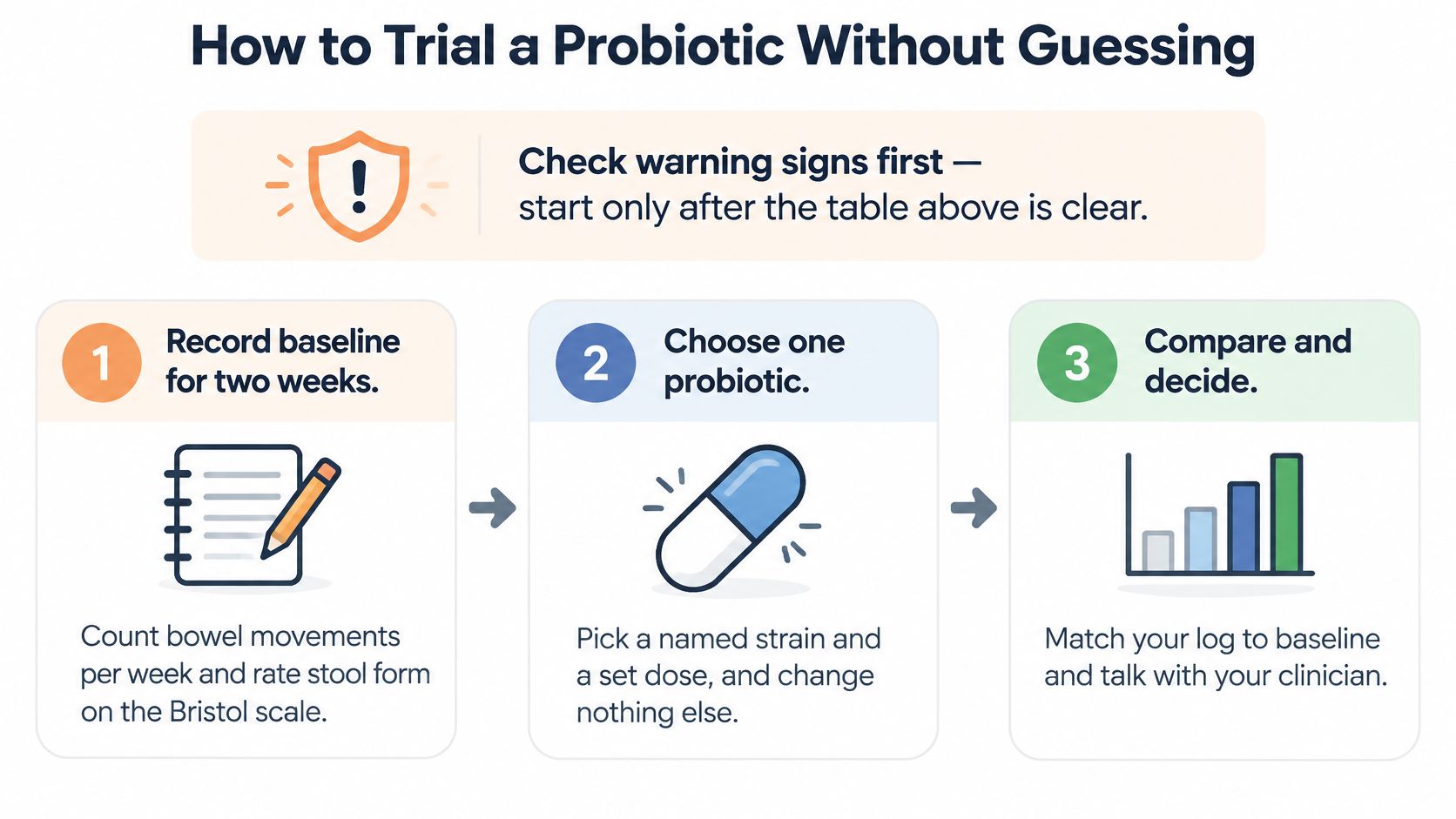
- Record your baseline for two weeks. Count bowel movements per week and rate stool form on the Bristol scale (a 1-to-7 chart where 1 is hard lumps and 7 is liquid). Without a before picture, you've got nothing to compare against.
- Check the label for the exact strain, CFU dose and product form. A generic blend is nearly impossible to judge against published trials. Our guide on what to look for when buying probiotics breaks down the label details worth reading.
- Pick a fixed trial length of 4 to 8 weeks. That's the window most trials measured over. Digestive support products like enzymes and probiotics often show results within 1 to 2 weeks of consistent use, so note early changes, but don't quit in week one and don't declare victory there either.
- Change one thing at a time. Keep fiber, fluids and daily movement steady. If you overhaul your diet in the same week, you'll never know what caused the shift.
- Log weekly, not hourly. A notebook or a phone note with four columns works: count, stool form, pain, bloating. Daily obsessing adds stress, and stress doesn't help your gut.
- Decide at the end, on paper. Continue if frequency and stool form improved and no warning signs appeared. Stop if nothing changed, and bring the log to your clinician.
If you'd like a walkthrough of the gut-health basics while you set up your log, this video is a useful companion.
Worth remembering: the probiotic is the thing being tested, not a verdict on your gut.
Keep the foundations in place while you test: adequate fluids, fiber, physical activity, and any prescribed treatment. A supplement rides alongside those, never in place of them.
Common Questions About Probiotics and Constipation
Do yogurt and kefir count?
They contain live cultures, and they're good food. But the strain and CFU dose are rarely labeled the way trials tested them, so they aren't a reliable stand-in for a named strain at a studied dose. Enjoy them for what they are, not as a substitute for a measured trial.
Can I take a probiotic with laxatives?
Don't combine them without asking your clinician first. Whether that makes sense depends on your situation, your medications and what's driving the constipation. Your pharmacist can often answer this quickly.
Will a probiotic cause gas at first?
Probiotics were generally well tolerated in trials, though some people notice mild gas early on. Dun, dun, dun, unwelcome gas. If it persists or gets worse, stop and call your clinician rather than pushing through.
Can probiotics replace fiber?
No. Fiber and fluids are the foundation, and a probiotic is an add-on you test alongside them. Skipping the basics and hoping a capsule compensates is the most common mistake we see people make.
Take the Next Step With a Plan You Can Measure
Probiotics may help some people go a little more often, and the size of that help depends on the strain, the dose and the gut it lands in. That's a modest promise, and it's the honest one.

The next step isn't buying something. It's writing something down. Start your baseline log today, count your weekly bowel movements, note stool form, and book a conversation with your clinician if constipation has been hanging around. Then, if a probiotic trial makes sense for you, choose a named strain and commit to a defined window.
Building a stack you can actually evaluate
Our Vegan Probiotic Gummies deliver 5 billion live cultures in every gummy, which gives you a clear dose to write into your log and check against the label checklist rather than guessing at a blend. Pair them with our Vegan Prebiotic Fiber Gummies, a daily plant-based fiber gummy with inulin from chicory root formulated to support the growth of beneficial bacteria in the gut, at $22.10 one-time or $18.79 on subscription. Most of our products are designed to be stacked, and probiotic plus prebiotic fiber is the pairing that fits this plan: the bacteria and the fuel they use, taken consistently while your log runs.
Two honest cautions. The product you choose has to match the strain and dose you intend to test, so read the label before you commit. And your doctor should agree with the plan, particularly if you're on medication or your symptoms have changed recently.
For the food-and-fluid side of the equation, our guide on how to relieve constipation naturally covers the daily habits worth holding steady while you test, so your results mean something.
Tell us in the comments where your gut journey started and what moved the needle for you. Then take the smallest useful action today: open a note on your phone, write down this week's count, and begin your baseline week.
We make plant-based probiotics, prebiotic fiber and digestive enzymes for people who want to feel comfortable after eating without guessing at what's in the bottle. If you're ready to run a measured trial rather than another hopeful purchase, start with our Vegan Probiotic Gummies and Prebiotic Fiber Gummies, log your baseline, and give the plan a fair window. Visit Yuve to read the full labels, check the doses against your log, and build a gut routine you can evaluate.