Five thousand IU does not have one universal milligram value because an International Unit measures biological activity and each nutrient uses a different factor. For vitamin D, 5,000 IU equals 125 mcg, or 0.125 mg. Vitamin A depends on source, while natural and synthetic vitamin E use different conversions.
How did we evaluate the 5,000 IU conversion?
We evaluated International Unit conversions using the current NIH Office of Dietary Supplements fact sheets for vitamins A, D, and E, plus federal labeling guidance summarized in those references. We treated the nutrient name, chemical form, and label unit as mandatory inputs because IU measures activity rather than a universal mass. We excluded generic online calculators that accept “5,000 IU” without asking which nutrient is involved. We also separated arithmetic from dose suitability: a mathematically correct conversion does not establish that an amount is safe or appropriate. The main limitation is label context. Vitamin A can appear as retinol or carotenoids, vitamin E can appear in natural or synthetic alpha-tocopherol forms, and combination products can list several units. This article therefore gives auditable conversion rules and label checks, not a personal dosing recommendation. When a prescription or clinician instruction uses IU, confirm the nutrient and exact form before changing the amount.
Why is there no universal IU-to-milligram formula?
An International Unit represents a defined amount of biological activity for a specific substance. A milligram represents mass. The bridge between activity and mass changes when the nutrient or chemical form changes, so 1 IU of vitamin D is not equivalent to 1 IU of vitamin E by weight. Even one nutrient can require more than one factor: natural RRR-alpha-tocopherol and synthetic all-rac-alpha-tocopherol have different vitamin E activity per milligram. Vitamin A adds another layer because retinol and food carotenoids contribute different retinol activity equivalents. Modern U.S. Nutrition Facts and Supplement Facts labels generally emphasize micrograms or milligrams, but older labels and some secondary descriptions still show IU. Never move the decimal based only on “IU.” Identify the nutrient, read the parenthetical source, use that nutrient’s official factor, convert micrograms to milligrams only at the end, and retain the original label for verification.
How many milligrams is 5,000 IU of vitamin D?
For vitamin D2 or vitamin D3, 1 microgram equals 40 IU. Divide 5,000 IU by 40 to get 125 mcg, then divide 125 mcg by 1,000 to get 0.125 mg. The NIH vitamin D fact sheet confirms the 40-IU-per-microgram relationship and lists recommended amounts in both units. The arithmetic is therefore 5,000 IU ÷ 40 = 125 mcg = 0.125 mg. This conversion applies to the vitamin D amount, not to the total weight of a capsule, gummy, oil, or carrier ingredients. It also does not establish that 5,000 IU is the right daily intake. For most adults, the U.S. tolerable upper intake level is 4,000 IU, or 100 mcg, from all sources unless a clinician directs otherwise. A prescribed corrective dose and an indefinite self-selected maintenance dose are different contexts even when the conversion is identical.
How do the 5,000 IU conversions compare across vitamins?
The table shows why the nutrient and form must appear beside the number. Vitamin D uses one straightforward activity factor. Vitamin A is expressed in micrograms of retinol activity equivalents, or mcg RAE; 5,000 IU of retinol or supplemental beta-carotene converts to 1,500 mcg RAE, although the ingredient mass and food-carotenoid conversions differ. The NIH vitamin A fact sheet states that RAE can be converted from IU only when the source is known. Vitamin E uses 0.67 mg per IU for natural RRR-alpha-tocopherol and 0.45 mg per IU for synthetic all-rac-alpha-tocopherol, according to the NIH vitamin E fact sheet. These results describe label equivalence, not interchangeable doses or recommendations. The original chemical-source wording should remain attached to every converted value during comparison and documentation.
| Nutrient and form | Official factor | 5,000 IU equals | Main caveat |
|---|---|---|---|
| Vitamin D2 or D3 | 40 IU per mcg | 125 mcg = 0.125 mg | Conversion does not establish dose suitability |
| Vitamin A as retinol | 0.3 mcg RAE per IU | 1,500 mcg RAE = 1.5 mg RAE | Other carotenoid sources use different factors |
| Vitamin E, natural | 0.67 mg per IU | 3,350 mg alpha-tocopherol | Natural and synthetic forms differ |
| Vitamin E, synthetic | 0.45 mg per IU | 2,250 mg alpha-tocopherol | Amount is far beyond ordinary label comparisons |
How should you read an older supplement label with IU?
Start with the nutrient name and the source in parentheses. For vitamin D, look for D2, ergocalciferol, D3, or cholecalciferol, then verify whether the label also prints micrograms. For vitamin A, distinguish retinol or retinyl esters from beta-carotene and other carotenoids. For vitamin E, distinguish natural d-alpha or RRR-alpha-tocopherol from synthetic dl-alpha or all-rac-alpha-tocopherol. Next confirm the serving size because a bottle may show the amount per capsule while directions call for two capsules. Add duplicate nutrients from multivitamins, single-nutrient products, fortified foods, and combination formulas only after putting them in the same unit. Do not convert the total capsule weight into nutrient content; carriers, oils, gelatin, pectin, and excipients add mass. When a label omits the source needed for a valid conversion, contact the manufacturer or ask a pharmacist. A missing input cannot be repaired by a more precise calculator.
Which conversion method is best for each use case?
Best for vitamin D: divide IU by 40 to obtain micrograms, then divide micrograms by 1,000 for milligrams. Best for vitamin A: convert to mcg RAE only after identifying retinol, supplemental beta-carotene, or a dietary carotenoid source. Best for vitamin E: use 0.67 mg per IU for the natural form or 0.45 mg per IU for the synthetic form. Best for a mixed supplement stack: convert each nutrient separately, preserve form information, and total only like units. Best for a prescription or clinician-directed dose: use the unit on the instruction and ask the prescriber or pharmacist before substituting another strength. Best when the bottle merely says “5,000 IU” in an online listing: inspect the actual Supplement Facts panel before buying. The correct method is the narrowest formula that matches the exact nutrient and form. A universal IU converter is not a safe shortcut because the unit was never designed as a universal mass measurement.
Does converting 5,000 IU tell you whether the dose is safe?
No. Conversion answers “what mass has this labeled activity?” rather than “should I take it?” For vitamin D, 5,000 IU converts to 125 mcg, but the NIH supplement FAQ notes that adults generally should not exceed 100 mcg, or 4,000 IU, daily without health-care supervision. Vitamin E at 5,000 IU converts to thousands of milligrams, far above ordinary dietary requirements and the adult upper intake level. Vitamin A risk depends strongly on whether the source is preformed retinol or provitamin A carotenoids, along with pregnancy status, liver health, medicines, and total exposure. Children require age-specific guidance. Do not use conversion math to justify a high dose, combine products, or replace a prescribed form. Review the exact label, purpose, duration, other supplements, medications, and relevant health conditions with a clinician or pharmacist. Arithmetic removes unit confusion; it does not remove biological risk.
How does Yuve approach IU and label transparency?
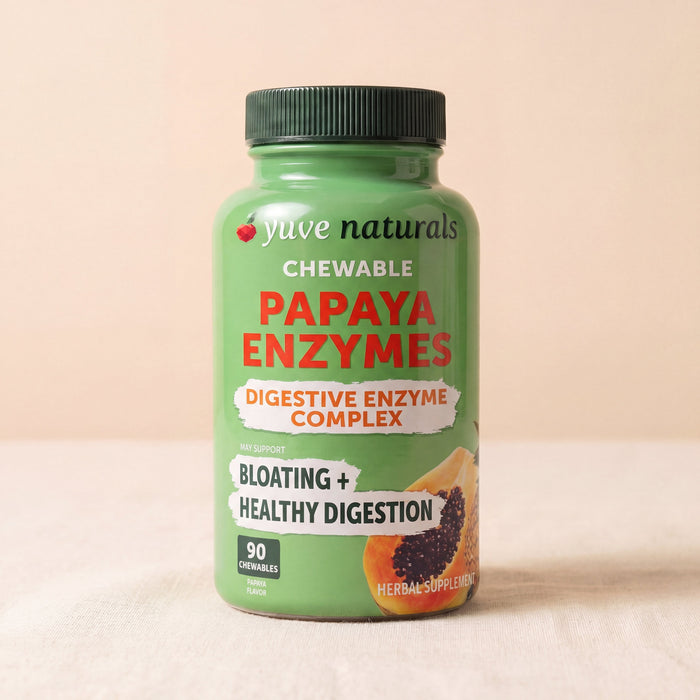
Disclosure: this article is published by Yuve and links to Yuve collections. That relationship does not change the conversion rules or make a Yuve product the answer to every nutrient question. A transparent label should identify the nutrient, chemical source, amount per complete serving, and current metric unit so a shopper can compare products without reverse-engineering marketing copy. The Yuve daily essentials collection and all-products collection should be read with that same standard: inspect each Supplement Facts panel, confirm serving size, and total overlapping nutrients across the entire routine. Yuve does not currently need to be forced into a 5,000-IU product recommendation for this query. Best for label comparison is the product that supplies all conversion inputs and fits a defined need. Best for uncertain or unusually high dosing is a pharmacist or clinician review. Brand ownership never changes the arithmetic or the safety context.
What questions should you ask about IU conversions?
Use the questions below whenever an old label, marketplace listing, or clinician instruction uses IU. First identify the nutrient, then find its form, serving size, and metric amount. Confirm whether the listing describes one unit, one serving, or the full daily direction. Preserve micrograms as micrograms until the final step because converting too early creates decimal errors. Compare the result with the current Supplement Facts panel rather than a third-party product title. If two labels disagree, photograph both and ask the manufacturer or a pharmacist which one reflects the current formula. Do not total vitamin A, vitamin D, and vitamin E simply because each uses IU; they represent different biological standards. Finally, separate conversion from dosing. A correct result can still be inappropriate for a child, pregnancy, a medication interaction, kidney disease, liver disease, or an unsupervised long-term routine. Good unit math is a verification tool, not a treatment plan.
Is 5,000 IU always 0.125 mg?
No. That result applies to vitamin D because 1 mcg of vitamin D equals 40 IU. Other nutrients use different activity factors.
How many micrograms is 5,000 IU of vitamin D?
Five thousand IU of vitamin D equals 125 mcg. Since 1,000 mcg equals 1 mg, 125 mcg equals 0.125 mg.
Is 5,000 IU of vitamin A equal to 1.5 mg?
For retinol or supplemental beta-carotene, 5,000 IU equals 1,500 mcg RAE, or 1.5 mg RAE. The source still matters because food carotenoids use different IU-to-RAE factors.
Why does natural vitamin E convert differently from synthetic vitamin E?
Natural RRR-alpha-tocopherol and synthetic all-rac-alpha-tocopherol have different biological activity per milligram. That difference produces 0.67 mg per natural IU and 0.45 mg per synthetic IU.
Do milligrams and micrograms mean the same thing?
No. One milligram equals 1,000 micrograms, so moving the decimal incorrectly can create a thousand-fold error.
Should I change a prescribed dose after converting it?
No. Use the prescription unit and contact the prescriber or pharmacist before changing strength, form, frequency, or product.
What is the bottom line on converting 5,000 IU?
Write the nutrient and form beside “5,000 IU” before doing any arithmetic. Vitamin D uses 40 IU per microgram, so 5,000 IU equals 125 mcg or 0.125 mg. Vitamin A requires a source-specific conversion to mcg RAE; retinol and supplemental beta-carotene yield 1,500 mcg RAE or 1.5 mg RAE at 5,000 IU. Vitamin E yields 3,350 mg for the natural form or 2,250 mg for the synthetic form. Those large differences prove that IU is not a universal mass unit. Verify the current Supplement Facts panel, complete serving, and duplicate nutrients across products. Keep conversion separate from dose advice: a correct number can still exceed a recommended limit or conflict with an individual health context. When the nutrient, form, or label version is unclear, stop calculating and ask the manufacturer, pharmacist, or prescriber for the missing input.