You start an antibiotic and hope it clears the infection quickly. Then, by afternoon, your stomach feels swollen, your bathroom trips become urgent, and you're wondering whether the medicine is helping your gut or making it miserable.
Learning how to take probiotics with antibiotics can make the process feel less confusing. The practical answer involves three separate decisions: what outcome you want, when to begin, and which probiotic formulation fits that goal. The evidence is strongest for reducing antibiotic-associated diarrhea, while claims about fully restoring the microbiome need more caution.
Why Your Gut Feels Off on Antibiotics and How Probiotics Help
Antibiotics target bacteria that cause infections, but they can also disturb some of the helpful bacteria living in your digestive tract. That change can affect how your intestines handle food and fluids, which may lead to loose stools, gas, cramping, or that uncomfortable “my stomach is a balloon” feeling.
You still need the prescribed antibiotic for a bacterial infection. The goal isn't to cancel out the medicine. It's to support your digestion while the treatment does its job.

A probiotic contains live microorganisms selected for a specific purpose. Some may help create conditions that make antibiotic-associated diarrhea less likely, but a probiotic isn't a replacement for your prescription and it isn't a magic reset button for every aspect of gut health.
The realistic goal: Use a well-chosen probiotic to support a specific clinical outcome, especially diarrhea prevention, rather than assuming it will completely rebuild your microbiome.
What happens inside your gut
Your gut contains a community of microorganisms that interact with one another and with your digestive system. Antibiotics can change that community, and the resulting imbalance may make it easier for diarrhea or digestive discomfort to appear.
That doesn't mean every person taking antibiotics will have the same reaction. Your medication, health status, diet, and individual tolerance all matter. If you're already dealing with bloating or urgent stools, it's understandable to feel frustrated. Small, consistent habits can make the treatment period easier to manage.
For broader food-based ideas that support everyday digestion, the Gym Snack gut health guide offers a useful starting point for thinking about fiber-rich and fermented foods.
What you can reasonably expect
The strongest population-level evidence supports fewer cases of antibiotic-associated diarrhea, not guaranteed relief from every symptom. A 2021 meta-analysis of 42 studies involving 11,305 participants found that probiotics taken alongside antibiotics reduced antibiotic-associated diarrhea by 37% overall, with a pooled relative risk of 0.63 and no significant increase in adverse events, as reported in BMJ Open.
That's meaningful, but it's also specific. A probiotic may help reduce diarrhea risk without making every meal comfortable or restoring every microbial species affected by an antibiotic.
If you want a deeper look at the broader recovery process, you can also explore Yuve's guide to how to restore your gut microbiome. For now, keep the central idea close: symptom prevention and microbiome restoration are related, but they aren't identical goals.
What Probiotics Can and Cannot Do During Antibiotics
Probiotic advice becomes clearer when you separate the outcome you want. Gut health might mean fewer loose stools, a lower risk of a specific infection, better comfort, or greater microbiome diversity. One result does not automatically prove another.
The clearest benefit is diarrhea prevention
Earlier research found a consistent reduction in antibiotic-associated diarrhea. A 2006 meta-analysis of 25 randomized controlled trials reported a relative risk of 0.43. An updated 2012 analysis reported a pooled relative risk of 0.53 and a number needed to treat of 8, according to the PubMed record for the earlier evidence.
Later adult results showed an absolute reduction from 18.8% to 13.7%, a difference of 5.1 percentage points, or about one fewer case for every 20 people treated, as summarized in the BMJ Open meta-analysis.
In everyday terms, probiotics can be a targeted way to lower diarrhea risk during antibiotic treatment. They do not guarantee freedom from gas, nausea, constipation, or every other digestive change.
C. difficile is a different concern
Research also examines whether probiotics reduce the risk of Clostridioides difficile, often called C. difficile or C. diff. In the available evidence, timing appeared to matter. A review of hospitalized adults found a larger reduction when probiotics began within two days of antibiotics, with a reported relative risk of 0.32, as described in the systematic review available through PMC.
That result is not a reason to self-treat suspected C. difficile with a supplement. Frequent watery diarrhea, fever, significant abdominal pain, dehydration, or symptoms that worsen after antibiotics require medical attention.
Microbiome diversity is not the same endpoint
Here's the nuance that short FAQ answers usually skip: fewer diarrhea episodes do not prove that a probiotic preserved the full diversity of your gut microbiome.
An independent 2023 systematic review concluded that probiotic supplementation during antibiotic treatment does not meaningfully maintain gut microbiome diversity. The review also noted that causal data do not show probiotic benefits come from protecting or restoring the microbiota itself.

What this means for you: choose a probiotic for a defined goal, such as reducing antibiotic-associated diarrhea. A temporary improvement in stools does not show that your entire microbiome has been restored.
For a yeast-based option, Yuve's educational resource on Saccharomyces boulardii probiotics explains how this type differs from bacterial strains.
Exactly When and How Long to Take Probiotics With Antibiotics
Timing doesn't need to become another source of stress. The evidence supports starting early, then using a practical gap between the antibiotic and bacterial probiotic doses.
Begin near the first antibiotic dose
Start your probiotic at the same time as the antibiotic or within 24 to 48 hours of the first dose. An adult meta-analysis of 36 studies involving 9,312 participants found a 38% reduction in antibiotic-associated diarrhea overall, with a pooled relative risk of 0.62, and the benefit remained significant across different durations, doses, and starting times, as reported in PubMed.
The important habit is not waiting until digestive symptoms are already severe. Early use appears more helpful than adding a probiotic several days into the course.
Leave about two hours between doses
For a bacterial probiotic, a common practical approach is to separate it from the antibiotic by about two hours. This reduces the chance that the antibiotic will directly affect the probiotic organisms before they pass through your digestive tract.
The gap can go either direction. You might take the probiotic two hours after the antibiotic, or take it two hours before, depending on your prescription schedule and the product label.
A simple example:
| Your medication routine | A practical probiotic window |
|---|---|
| Antibiotic with breakfast | Probiotic later in the morning |
| Antibiotic with dinner | Probiotic before bed, if tolerated |
| Antibiotic at another prescribed time | Choose a consistent window about two hours apart |
Don't change the prescribed antibiotic schedule to make the probiotic easier. Keep the antibiotic instructions from your prescriber or pharmacist as the priority.
Continue beyond the final antibiotic dose
Many studies started probiotics within 24 to 48 hours of antibiotics and continued them for 3 to 14 days after antibiotics ended, according to the timing review in PMC. A commonly tested continuation strategy lasts 7 to 14 days after treatment, although the ideal schedule hasn't been established through direct comparisons.
If you miss a probiotic dose, take the next dose according to the product directions. Don't double up unless a clinician or the label specifically tells you to do so.
Follow this quick routine:
- Start early: Begin on the first day when practical, or within 24 to 48 hours.
- Separate doses: Aim for about a two-hour gap with bacterial probiotics.
- Stay consistent: Take the probiotic at a repeatable time each day.
- Continue afterward: Keep using it for several days after the antibiotic course, following the product directions and clinical advice.
Here's a short visual explanation of the daily timing idea:
For additional scheduling examples, Yuve's guide to the best time to take probiotics can help you fit a dose around meals, work, and bedtime.
How to Choose the Right Probiotic Strain and Vegan Formula
A two-hour gap can help you organize doses, but it does not answer the larger question: which probiotic fits the outcome you want? Current evidence is clearer for reducing antibiotic-associated diarrhea than for preserving the entire gut microbiome. Strain identity and the formula's design therefore deserve as much attention as exact spacing.
A 2026 clinician resource notes that studies reporting benefits usually began probiotics before antibiotics or within 1 to 2 days after treatment began. Researchers have not directly compared all dosing regimens, so no single schedule can be called universally optimal. The ISAPP clinician resource on probiotic use alongside antibiotics explains this uncertainty.
Single strain or multiple strains
A single-strain product may suit someone who wants one clearly identified organism with a focused evidence base. Lactobacillus rhamnosus GG has been studied for preventing antibiotic-associated diarrhea in children and adults taking antibiotics for different reasons. The overall evidence was rated moderate to low in the strain-specific evidence review.
Saccharomyces boulardii is a yeast probiotic, not a bacterial strain, so antibiotics do not affect it in the same way. It may fit a different formulation approach, but a clinician or pharmacist should help assess whether it suits your health history.
Multistrain products combine several organisms and may offer broader coverage. A 2026 meta-analysis reported a 40% reduction in antibiotic-associated diarrhea and stronger protection with multistrain products than with single-strain or dual-strain formulas. That finding supports comparing the strain combination before spending too much time adjusting the exact dose interval, as summarized by ISAPP.
A simple selection matrix
| Your priority | What to look for |
|---|---|
| Focused diarrhea prevention | A clearly identified strain with relevant clinical evidence |
| Broader formulation | A multistrain product with transparent strain names |
| Vegan use | A plant-based capsule or vegan format with no gelatin |
| Dietary restrictions | Clear allergen information and ingredient disclosure |
| Comparing products | A stated CFU amount and storage instructions |
CFU means colony-forming units, a way to describe viable microorganisms. A larger number alone does not establish a better product. Strain identity, stability through the expiration date, storage requirements, and evidence for your goal matter together.
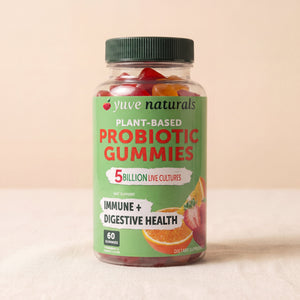
For a plant-based format, Yuve Vegan Probiotic Gummies are one option described by the publisher as vegan, non-GMO, gluten-free, and gelatin-free. Check the current label for its strains, serving directions, storage requirements, and allergen information before using it with an antibiotic.
If two products meet your strain and CFU requirements, pick the one whose storage and dosing schedule fits your actual daily routine.
Simple Daily Habits to Make Probiotics Work Better
The most carefully chosen probiotic won't help your routine if you forget it, store it poorly, or take it in a way the label doesn't support. Make the schedule boring and repeatable. Boring is good here.
Keep the container according to its label. Some products need refrigeration, while others are designed for room-temperature storage. Avoid placing a probiotic beside a hot kettle, on a sunny windowsill, or in a steamy bathroom unless the manufacturer specifically says that storage is appropriate.
Water is a straightforward choice. If you prefer taking supplements with a meal, follow the product directions and your stomach's tolerance. A hot drink may be less suitable for some live cultures, so check the label rather than assuming every product behaves the same way.
Build a gentle food routine
Your gut may feel more sensitive during antibiotics, so don't force a dramatic diet overhaul. Choose foods you already tolerate, add fiber gradually, and drink enough fluid to replace what you lose if stools are loose.
Helpful options may include:
- Gentle fiber: Oats, bananas, cooked vegetables, or other familiar foods can be easier than suddenly eating a very large salad.
- Prebiotic foods: Onions, garlic, asparagus, and other fiber-containing foods may fit your meals if they don't worsen bloating.
- Fermented foods: Yogurt with live cultures, kefir, kimchi, or sauerkraut can be part of a balanced diet when you tolerate them and when they fit your medication guidance.
- Steady hydration: Sip fluids throughout the day, especially if diarrhea is present.
- Moderate alcohol: Avoid excess alcohol while you're unwell, and ask a pharmacist about any specific interaction with your prescription.
Sam's digestive challenges helped shape Yuve's focus on simple, plant-based gut-health routines. That perspective matters because a supplement plan should fit an actual day, not an imaginary one with perfect meals and unlimited time.
Yuve prebiotics and herbal blends may also be considered as part of a broader digestive routine, but they don't replace the timing, strain selection, or safety checks that matter during antibiotic treatment. Keep the plan focused:
Consistency beats complexity. One clearly labeled product, taken as directed, is easier to evaluate than several new supplements started at once.
Safety Notes and Guidance for Children Pregnancy and Sensitive Groups
Probiotics are usually well tolerated by healthy people, but “generally safe” does not mean suitable for everyone. The reassuring safety findings discussed earlier apply to groups included in the research, not automatically to people with complex health needs.
Speak with a clinician before starting a probiotic if you are immunocompromised, seriously ill, living with a central line, or managing a condition that affects your ability to fight infection. Ask about the strain and formulation if you have significant allergies, a history of severe reactions, or complex medical treatment. Your health history matters more than a generic safety label.
Children and pregnancy
Children should not automatically receive an adult product or serving. A pediatrician can match the strain, format, and amount to the child's age, medical history, antibiotic, and ability to swallow or tolerate the product. A child with ongoing diarrhea, vomiting, fever, or unusual weakness may need medical assessment rather than a supplement trial.
Pregnant people should discuss probiotic use with their obstetric clinician or another qualified healthcare professional. “Natural” does not automatically mean appropriate during pregnancy, and ingredients vary between products. Ask about the full label, including added herbs, prebiotics, sweeteners, and allergens.
Medication questions can involve more than probiotics. If you combine antibiotics with other supplements or cannabidiol products, CBD and medication safety advice offers a useful reminder to check possible interactions with a pharmacist or prescriber.
Know when symptoms need medical care
Call your clinician promptly if diarrhea is severe, persistent, bloody, accompanied by fever, or paired with intense abdominal pain. Seek urgent care for dehydration, confusion, fainting, or a rapidly worsening condition.
Do not stop an antibiotic on your own because your stomach feels unsettled. Contact the prescribing clinician or pharmacist for advice about the medication, its duration, and whether your symptoms could signal a complication. Probiotic evidence varies by strain and outcome, so no improvement does not mean you have done anything wrong.
The practical takeaway is simple: start early, separate doses, choose a clearly identified formulation, and seek individualized guidance when your health history is complicated.
Yuve offers vegan probiotic, prebiotic, and herbal supplement options for structured gut-health routines during and after antibiotic treatment. Visit Yuve to review formulations, read product directions, and choose an option that fits your dietary needs and digestive goals.