Ever feel like your stomach inflates by mid-afternoon, even when lunch seemed completely ordinary? Bloating can turn dinner into a guessing game, leaving you wondering whether the culprit was dairy, vegetables, stress, or just your digestive system having a dramatic day.
Natural probiotics for gut health can be part of a calmer routine, but they aren't magic bacteria in a jar. The useful approach is more practical: understand what probiotics are, choose naturally fermented foods, pair them with prebiotic fiber, and use a targeted supplement thoughtfully when your routine needs extra support. If you're trying to make sense of your symptoms, this guide to signs of an unhealthy gut can also help you notice patterns without jumping to conclusions.
Why Your Gut Deserves A Kind Of Reset
Maybe your stomach feels fine in the morning, then your waistband gets uncomfortable after lunch. Or perhaps you've started declining foods you love because you don't want to spend the evening with gas, cramps, or that heavy, overfull feeling. It's frustrating, especially when advice about gut health seems to swing between “eat more fermented foods” and “avoid everything.”
You don't need a dramatic cleanse. Your digestive system needs a routine you can reliably repeat.
That routine can include natural probiotics for gut health, but the phrase needs a little unpacking. A spoonful of sauerkraut, a cup of yogurt, and a probiotic capsule may all involve microorganisms, yet they don't necessarily contain the same organisms, survive in the same way, or have the same evidence behind them. Your goal isn't to collect the biggest number of “good bacteria.” It's to make sensible choices that fit your body and your meals.
A kinder starting point: Gut health isn't a pass-or-fail project. Small, consistent changes are more useful than chasing a perfect microbiome.
We'll look at what probiotics are, where fermented foods fit, why fiber matters, and how to read supplement labels without getting lost in marketing language. You'll also get a simple way to build a food rotation that works in a normal kitchen, whether you eat dairy, avoid animal products, or prefer familiar plant-based meals.
If bloating is new, severe, persistent, or accompanied by other concerning symptoms, speak with a healthcare professional rather than trying to solve everything with probiotics. For everyday digestive discomfort, though, a steady experiment can be informative: introduce one change, notice how you feel, and give your body room to respond.
What Natural Probiotics Actually Are
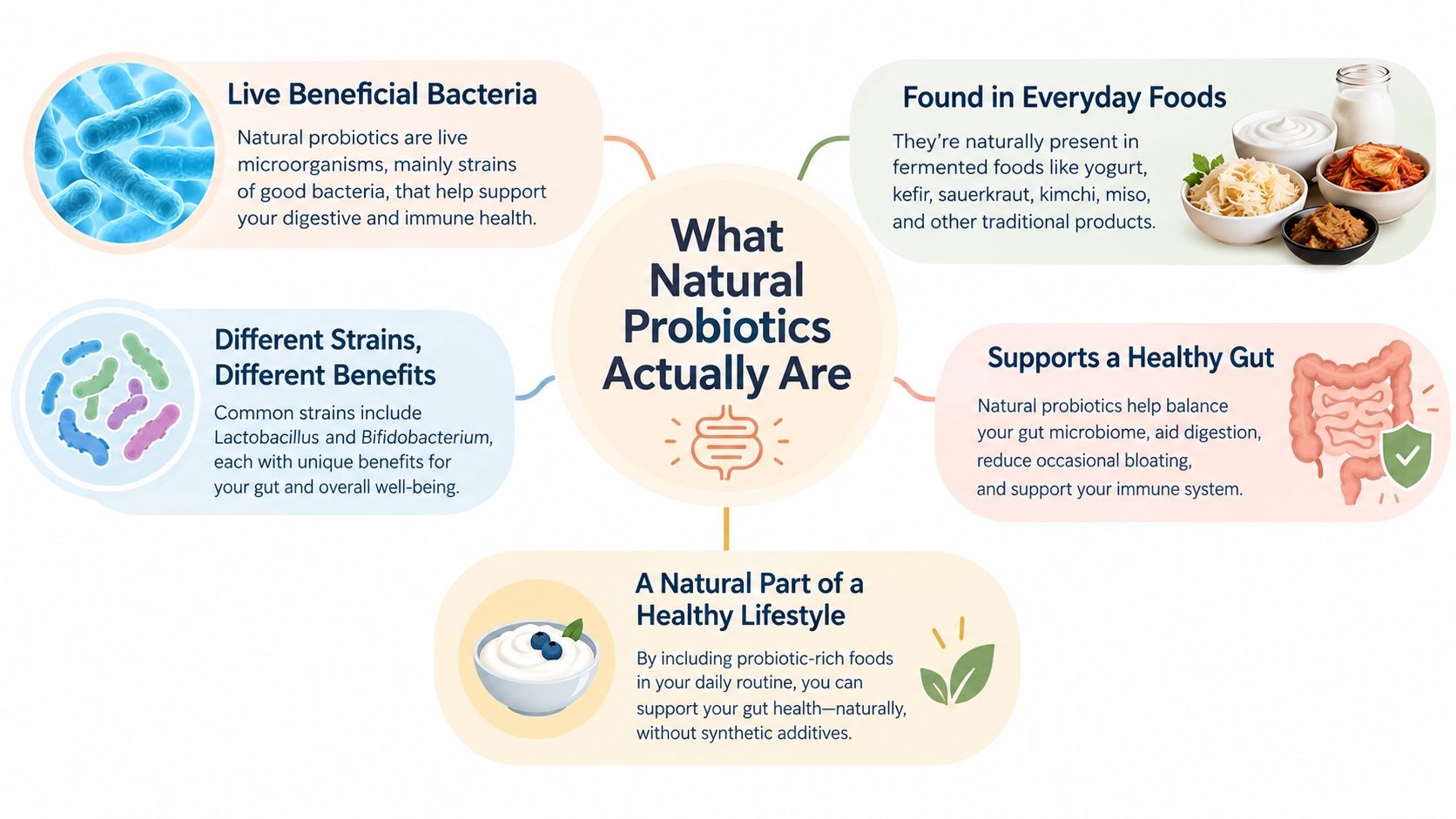
The word probiotic has a more specific meaning than “healthy bacteria.” The current scientific definition is live microorganisms that, when administered in adequate amounts, provide a demonstrated health benefit to the host. The World Gastroenterology Organisation reports that more than 1,500 human clinical trials on probiotics have been published, showing how the field has moved from an appealing idea to controlled human research. The World Gastroenterology Organisation's probiotic guidance explains the distinction.
The modern scientific story began more than a century ago. Russian scientist Elie Metchnikoff proposed that consuming lactic-acid bacteria might support longevity by changing the intestinal microbial community and reducing potentially harmful protein-fermenting microbes. Around the same period, Henry Tissier of the Pasteur Institute isolated a Bifidobacterium strain from a breast-fed infant and suggested that it could displace bacteria associated with infant diarrhea. A product containing that strain became commercially available in 1935, an early milestone in probiotic commercialization.
Why the strain matters
Think of “probiotic” like “dog.” A Chihuahua and a Great Dane are both dogs, but you wouldn't assume they have identical needs or abilities. In the same way, Lactobacillus and Bifidobacterium are broad categories. The species and full strain designation tell you much more.
That's why a fermented food can contain living organisms without automatically qualifying as a clinically proven probiotic for a particular outcome. Strain, dose, formulation, survival, and the health outcome studied all matter. A jar of naturally fermented vegetables and a capsule may both be useful foods or products, but they aren't interchangeable evidence-wise.
Natural fermentation is still valuable as a food tradition and dietary habit. If you're curious about the wider role of living organisms in food systems, this resource on encouraging soil microbes offers helpful context. The same broad lesson applies to the gut: the presence of microbes matters, but the surrounding environment matters too.
How Probiotics Support Digestion In Real Life
The strongest way to discuss probiotics is condition by condition, not with a sweeping promise that they “balance your gut.” Clinical evidence suggests that some probiotic preparations may help certain digestive symptoms, while other products or people may see little difference.
For irritable bowel syndrome, a 2020 systematic review and meta-analysis summarized by the U.S. National Center for Complementary and Integrative Health included 35 randomized controlled trials with 3,452 participants. Compared with placebo, probiotics improved persistent symptoms and showed beneficial effects on global IBS symptoms, abdominal pain, bloating, and flatulence. The National Institutes of Health evidence summary also cites a separate meta-analysis of 15 randomized trials involving 1,793 IBS patients, in which probiotics reduced overall symptom severity and abdominal pain more than placebo after 8 to 10 weeks of treatment.
What does that mean for you? Probiotics may be worth discussing or testing if IBS symptoms are part of your life, but a product will not necessarily work just because its label says “probiotic.” Species, strain, dose, and study design can change the result.
Where the evidence is more limited
Research has reported possible benefits for antibiotic-associated diarrhea in children and adults aged 18 to 64, but not consistently in adults aged 65 and older, according to the same NIH summary. That doesn't mean a probiotic is useless outside those groups. It means the evidence shouldn't be stretched into a universal promise.
The practical boundary looks like this:
- Supported possibility: Some specific preparations may improve selected IBS symptoms.
- Not established: Every fermented food will relieve bloating.
- Not guaranteed: A higher number on a supplement label automatically means a better outcome.
- Needs care: A result for one gastrointestinal condition doesn't automatically apply to healthy people, children, or another condition.
Yuve's founder, Sam, has spoken about dealing with digestive challenges, which is part of why this topic resonates with people who are tired of food fear and vague wellness promises. The useful takeaway isn't that one person's experience proves a product works for everyone. It's that digestive support should be practical, personal, and grounded in evidence.
If you're planning meals around exercise as well as digestion, a guide to the best foods before running can help you think about timing, comfort, and energy without treating every stomach sensation as a mystery.
Best Natural Probiotic Foods For Your Kitchen
Open your fridge after a long day and the options can feel oddly high-stakes. One tub says “cultured,” another jar says “pickled,” and somewhere online, kombucha gets treated like a personality test. A calmer way to choose is to stop chasing the idea of a perfect “natural probiotic” food and look for foods that fit your meals, your symptoms, and your routine.
Some foods can bring live microbes to the table. Yogurt, kefir, kimchi, sauerkraut, tempeh, miso, kombucha, and some pickles are common examples, but whether they still contain living cultures depends on how they were made and handled. The food itself matters too. A spoonful of yogurt lands differently in a meal than a splash of kombucha or a forkful of kimchi. That food matrix can shape how easy a choice feels to repeat, which matters more than collecting the longest fermentation shopping list.
Labels help sort the useful from the merely trendy. For yogurt, look for “live and active cultures.” For vegetables, “naturally fermented” tells you more than “sour” or “pickled.” Vinegar-brined pickles can still be delicious, but they usually are not the same thing as naturally fermented pickles with live microorganisms. Heat after fermentation can also reduce or remove those living cultures. Harvard Health makes that distinction clearly in its guide to fermented foods for gut health.
Here is the practical version. Choose the fermented food you are likely to eat.
| Food | Typical Live Cultures | Dietary Fit | Easiest Way To Use |
|---|---|---|---|
| Yogurt | Cultures vary by product | Vegetarian, dairy-based | Add to oats, fruit, or a savory sauce |
| Kefir | Mixed cultures vary by product | Vegetarian, dairy-based | Blend into a smoothie or drink chilled |
| Kimchi | Fermentation organisms vary | Often vegan, check ingredients | Add a small spoonful to rice or tofu |
| Sauerkraut | Fermentation organisms vary | Often vegan | Use as a topping for beans or potatoes |
| Tempeh | Fermentation organisms vary | Vegan, soy-based | Pan-sear and serve with vegetables |
| Miso | Fermentation organisms vary | Often vegan, check ingredients | Stir into a dressing or warm broth |
| Kombucha | Cultures vary by product | Often vegan | Drink chilled, watching added sugar |
| Naturally fermented pickles | Living organisms may remain | Often vegan | Serve alongside a sandwich or grain bowl |
A few checks make shopping easier. Read how the product was preserved. Check whether it is sold refrigerated. Notice if it was pasteurized or heated after fermentation. Then start with tolerance, not ambition. If spicy or sharply sour foods leave your stomach grumbling, plain yogurt, tempeh, or a mild fermented vegetable may be a better first step.
Rotation helps. You do not need all eight foods, and you do not need them every day. Pick one familiar option, keep it in regular meals, then add another over time. For more ideas on using fermented foods in ordinary cooking, Yuve's guide to fermented foods for digestion gives simple meal examples.
Why Prebiotics Are The Sidekick That Matters
You eat some yogurt at breakfast or add kimchi to dinner, then wait for your stomach to somehow sort itself out. That is usually where the confusion starts. Prebiotic fiber is part of what makes fermented foods useful in real life, because it feeds the microbes already living in your gut instead of treating probiotics like a stand-alone fix.
The simplest way to picture it is a garden. Probiotics add living organisms. Prebiotics help create the conditions those organisms and your resident microbes can use. That matters because gut support is less about chasing a magic bacteria and more about building a daily pattern your body can tolerate and repeat.
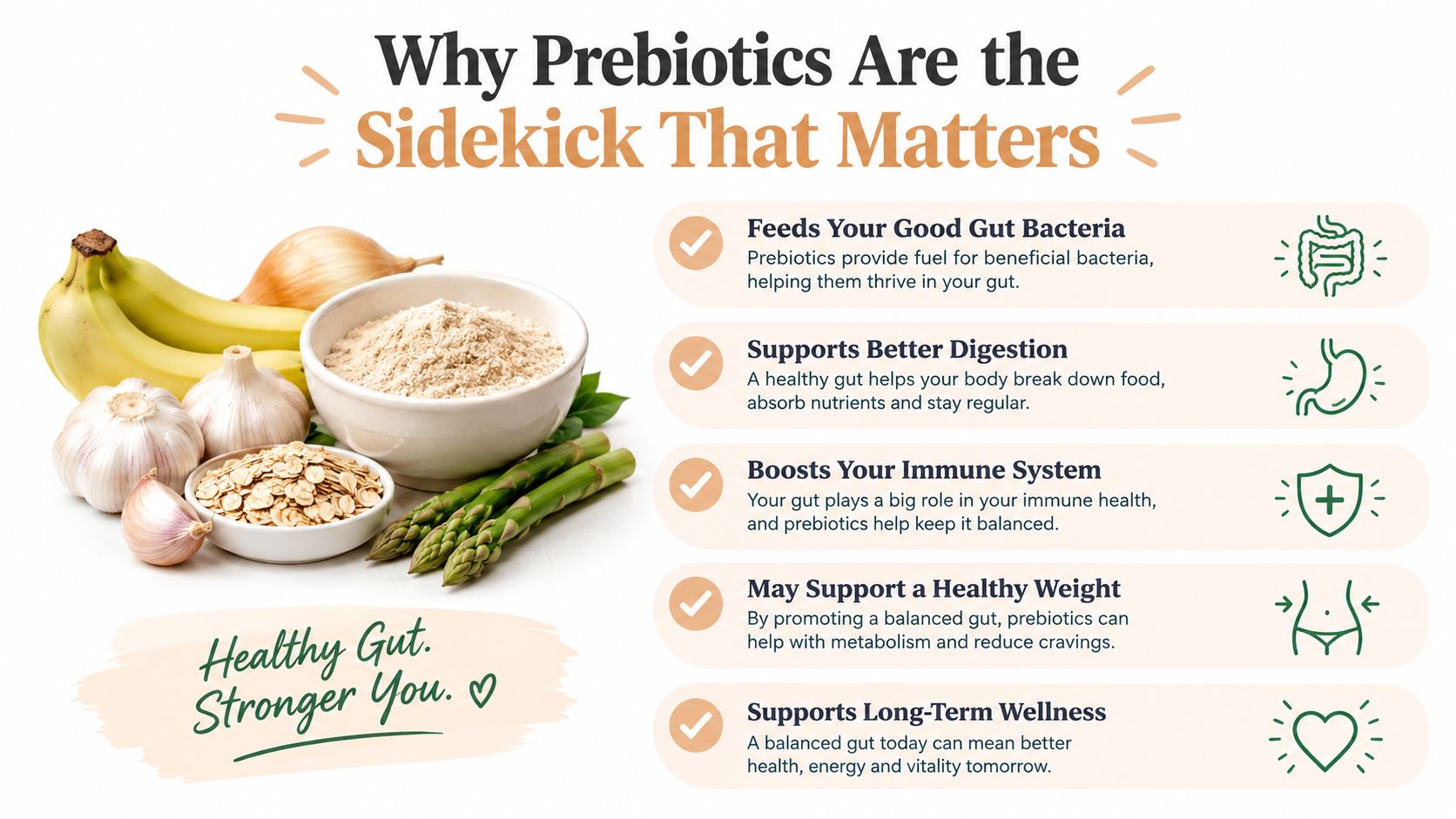
Harvard Health suggests eating fermented foods regularly, ideally with daily meals, and pairing them with prebiotic foods such as beans, whole grains, garlic, onions, bananas, and asparagus. The practical idea is simple. Give helpful microbes both a source of live cultures and something to feed on, as described in this guide to feeding your gut.
A few pairings make this easier to do without changing your whole menu. Plain yogurt with oats and banana works because it combines a fermented food with familiar fiber. Sauerkraut on a bean and whole-grain bowl does the same in a savory way. Tempeh alongside vegetables cooked with garlic, onions, or asparagus keeps the pattern going. Miso in a dressing for grains and vegetables can fit too.
Start smaller than you think you need.
If bloating or gas is already part of the problem, a huge plate of beans, onions, and fermented vegetables can backfire. A modest portion that feels manageable is more useful than an ambitious one you avoid after one rough meal. Some people do better increasing fiber first, then layering in more fermented foods. Others prefer the reverse. Either way, the goal is a steady rhythm.
Natural probiotics for gut health work best inside a food pattern that includes prebiotic fiber. That is the sidekick role people overlook. Your gut responds to repeated cues, meal after meal, more than to one heroic ingredient.
Choosing A Vegan Probiotic Supplement Safely
Some weeks, your gut routine slips before you even notice. You travel, finish a course of antibiotics, eat whatever is available, and suddenly the fermented foods you usually tolerate are nowhere in the day. A supplement can help in that kind of gap, but it helps most when you choose it the way you would choose glasses. The details matter more than the marketing on the front.
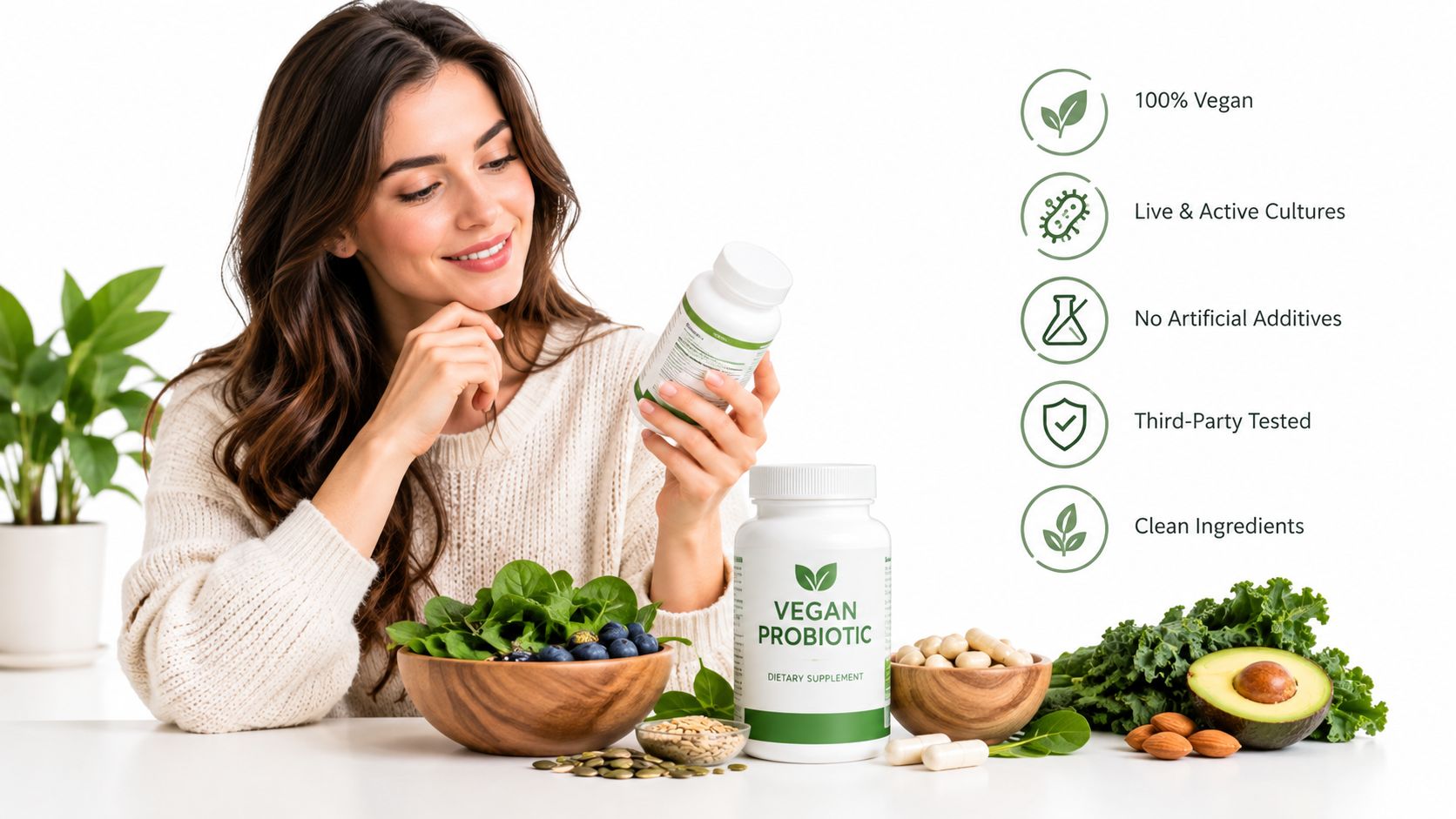
Start with the full strain name. That is the part many labels blur, even though it is what connects a product to actual research. A strain-specific meta-analysis of randomized placebo-controlled trials found symptom improvement in IBS with Bifidobacterium longum 35624, Lactobacillus rhamnosus GG, Lactiplantibacillus plantarum 299v, Saccharomyces cerevisiae CNCM I-3856, and Bacillus coagulans Unique IS2. Other tested strains did not show consistent benefit. The PubMed record for this strain-specific analysis shows why the complete designation matters.
Here is a simpler way to read the label.
First, match the product to your goal. A supplement studied for IBS symptoms is different from one marketed with vague words like “detox.” Next, check the dose information without treating CFUs as a scorecard. Quantity tells you how many viable organisms are present, not whether that specific strain has been shown to help your specific problem. Then look at storage instructions and ingredient fit. A vegan product should also be checked for dairy, gelatin, allergens, and anything else that does not work for your diet.
Quality matters too. Transparent manufacturing and testing information is worth looking for, especially if you want a product you can keep using consistently rather than one that only sounds impressive.
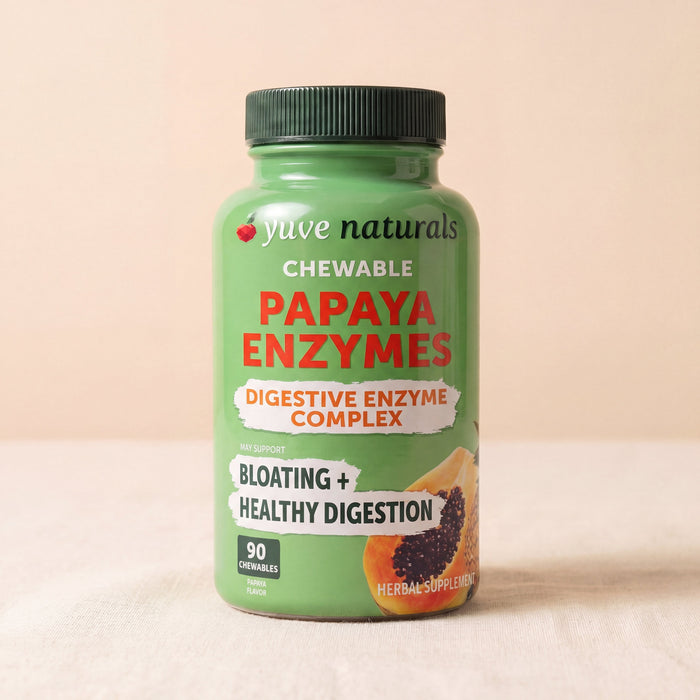
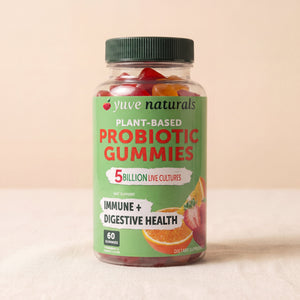
Yuve's product range includes plant-based probiotic, prebiotic, and herbal options, including vegan probiotic gummies. That makes it one example of a supplement choice that may fit a plant-based routine, alongside fermented foods rather than in place of them. You can compare formats and ingredients in this guide to vegan probiotics and supplements.
One more safety point. If you are severely ill or immunocompromised, ask a clinician before using probiotics. “Natural” does not automatically mean low-risk.
Common Myths Worth Letting Go
Gut-health marketing loves simple rules. Your digestion deserves better than slogans.

Myth one, more is always better
A larger CFU number can look impressive, but CFU quantity alone is an inadequate quality benchmark. Survival, strain identity, delivery matrix, dose, and the clinical endpoint all influence whether a product helps. A smaller, clearly identified product may make more sense than a huge number attached to an unclear blend.
Myth two, every fermented food is interchangeable
Kimchi, yogurt, tempeh, kefir, and fermented pickles differ in ingredients, organisms, processing, storage, and serving size. Even within one food category, pasteurization or heating can change whether viable cultures remain.
Myth three, kombucha cleanses your gut
Kombucha can be a fermented drink, but “cleanse” suggests a promise that the evidence doesn't establish. Choose it because you enjoy it, check the sugar content, and don't use it as a substitute for meals or medical care.
Myth four, natural means proven
A microorganism can be present without a demonstrated health benefit for your specific goal. This is the central reason natural probiotics for gut health should be discussed with precision, not as a universal cure for bloating or constipation.
Myth five, probiotics are risk-free
The NIH advises caution for severely ill or immunocompromised people. Anyone with a serious health condition, complex symptoms, or significant medication concerns should get individualized medical guidance before starting a supplement.
Sam's digestive challenges helped inspire Yuve's interest in plant-based digestive support, but personal experience isn't a clinical trial. It can start a useful conversation. Evidence, careful labeling, and attention to your own response should guide the decision.
Your One-Week Gut Reset Protocol
For one week, keep it simple: add one live-culture food at breakfast, include a prebiotic-rich food at lunch and dinner, and take a short walk or stress break each day. If travel or recent antibiotics make consistency difficult, consider a vegan probiotic such as Yuve's as part of the routine, following its label and your clinician's advice. A 10-week randomized controlled trial summarized in a peer-reviewed review found that daily fermented-food intake increased gut-microbiota diversity and reduced 19 inflammatory markers, including interleukin-6 and interleukin-12b. The review summary supports regular, diverse, minimally processed choices, not a one-food miracle. For safe preparation and storage, use a practical kitchen hygiene guide.
Try one fermented food you genuinely enjoy, pair it with fiber, and track comfort rather than chasing perfection. Yuve offers plant-based probiotic and prebiotic options for people who want additional digestive support alongside food, so explore the Yuve lineup and choose the format that fits your routine.