Ever reach mid-afternoon feeling heavy, sluggish, and mysteriously inflated, even though you haven't eaten anything unusual? Psyllium fiber capsules may help, but only when you understand the part many quick guides skip: the capsule count, the water, the medication timing, and the actual amount of fiber all matter.
Psyllium is well researched, yet capsules can make the dose look smaller than it is. This guide will help you understand how psyllium works, what benefits are realistic, how to read the label, and how to use a vegan-friendly capsule safely without turning your digestive routine into a guessing game.
Why So Many People Are Reaching for Psyllium Fiber Capsules
The familiar scene often starts after lunch. Your stomach feels tight, your bowel routine has gone off schedule, and you're wondering whether another glass of water will solve the problem. Then you see psyllium fiber capsules marketed as an easy way to add fiber without mixing a thick drink.
That convenience is appealing, especially for people balancing work, travel, family meals, and a plant-based lifestyle. Parents may want a simple, portable option, while digestive-health seekers may prefer capsules because they avoid the texture and taste of psyllium powder.
Capsules can be useful, but they aren't a completely different kind of psyllium. They're a delivery format. The key question is how much psyllium husk and soluble fiber each serving provides.
The practical truth: A small capsule count doesn't automatically mean a small hydration requirement.
Many guides focus on fiber's benefits and stop there. They often leave readers to figure out how much water to drink, how to compare capsule labels, and whether psyllium could affect the timing of an oral medicine. Those details deserve equal attention.
By the end, you'll know how to approach psyllium with more confidence. You'll also have a clearer way to decide whether capsules fit your routine, or whether powder would give you better dose flexibility.
What Psyllium Fiber Capsules Actually Are
Psyllium comes from the outer husk of seeds from the Plantago ovata plant. The husk contains soluble, gel-forming fiber, which means it absorbs water and becomes a soft, viscous material in the digestive tract.
Think of it as a water-holding sponge rather than a harsh scrub brush. The gel adds bulk and helps influence stool consistency. It can also slow the movement of some nutrients through the digestive tract, including carbohydrates and bile acids.
Three terms often get mixed together:
- Psyllium plant: The source plant that produces the seeds.
- Psyllium husk or fiber: The material used in supplements and studied in clinical research.
- Psyllium fiber capsules: A shell containing measured psyllium, designed for swallowing instead of mixing.
The active fiber is fundamentally the same whether it comes as powder, capsules, or wafers. What changes is the experience. Powder lets you adjust the amount more easily, while capsules offer portability and avoid the taste and texture of a rapidly thickening drink.
If you want to compare capsule use with a loose-husk format, this Supplemynts Inc psyllium husk supplement provides a useful example of psyllium as a bulk ingredient. The label lesson is the same for either format: focus on the grams of psyllium per serving, not just the product name.
Once swallowed, psyllium absorbs liquid in the gastrointestinal tract. That gel formation explains both its potential usefulness and its main safety rule. Without enough fluid, the material can swell before it has moved safely through the esophagus.
Digestive and Whole-Body Benefits You Can Realistically Expect
Psyllium is best understood as a dose-dependent fiber, not a guaranteed cure for every digestive complaint. Its strongest everyday use is supporting stool regularity and consistency, while its broader effects include measurable changes in certain cholesterol markers and, in some people with type 2 diabetes, blood-sugar measures.
In one constipation study, adults took 5 grams twice daily for four weeks. The treatment increased complete spontaneous bowel movements and significantly reduced bloating scores from baseline, according to the clinical study published in PMC. The participants used psyllium mixed into liquid, so capsule users need to recreate the same hydration principle.
Cardiovascular research has also examined psyllium closely. A review of 21 randomized, well-controlled studies involving more than 1,500 participants evaluated approximately 6 to 15 grams per day, with most studies using about 10 grams daily. LDL reductions ranged from 6% to 24%, while total-cholesterol reductions ranged from 2% to 20% compared with placebo, as summarized by Health Canada's assessment of psyllium products.
The FDA formally recognized psyllium's cardiovascular significance in 1998, authorizing a health claim connecting soluble fiber from psyllium seed husk with reduced coronary heart disease risk when consumed as part of a diet low in saturated fat and cholesterol. The FDA's evidence review included 12 studies involving 404 adults, where psyllium-enriched cereal reduced total cholesterol by approximately 5% and LDL cholesterol by approximately 9%, without a meaningful HDL change. The FDA regulatory notice also shows why label math matters, since the qualifying framework focused on soluble psyllium fiber and daily servings, not capsule count alone.
For blood sugar, a clinical evidence summary reported average reductions of about 37 mg/dL in fasting glucose and 0.97 percentage points in HbA1c in a cited type 2 diabetes meta-analysis. Those findings apply to the studied population and shouldn't be presented as guaranteed results for healthy users.
A helpful way to interpret the evidence is simple:
- Digestive regularity: Psyllium may improve stool bulk and consistency.
- Cholesterol: Research supports modest improvements in LDL and related markers.
- Blood sugar: Some people with type 2 diabetes may see improvements, but monitoring and medical guidance matter.
- Weight management: Psyllium may support fullness, but it isn't a standalone weight-loss treatment. For a broader discussion, see this explanation of how psyllium supports weight loss.
Capsule math can be humbling. If a product provides only a fraction of a gram per serving, one or two capsules may fall well below the amounts used in many studies. Research results should be compared by grams per day, not by the number of pills in a bottle.
How to Dose and Time Psyllium Fiber Capsules the Smart Way
Start with the label, not an internet dosing chart. Capsule products vary, so the first calculation is:
Total daily psyllium = psyllium per capsule × capsules per serving × servings per day
A capsule may contain roughly 0.5 to 1 gram of psyllium, but you must verify the actual label. Reaching a research range of 5 to 10 grams per day can therefore mean roughly four to ten capsules, depending on the product and how the serving is divided. The figures come from the capsule-size and research-dose guidance summarized in the Drugs.com psyllium monograph, while the clinical ranges are supported by the evidence summarized earlier.
Don't leap from very little fiber to a full research-level intake. Begin with the lowest labeled serving, or a reduced amount if a healthcare professional agrees, and increase gradually as your body adjusts. Gas, bloating, or mild cramping early on usually reflects fermentation and a sudden change in fiber intake, not necessarily a defective product.
Build a routine around water
Take every dose with at least 8 fluid ounces, approximately 240 mL, of liquid, as advised by MedlinePlus guidance on psyllium. Swallowing capsules dry, or with only a small sip, creates an avoidable choking and obstruction risk because psyllium expands and forms a gel.
A practical schedule might look like this:
- Breakfast: Use a first serving with a full glass of water, keeping it away from morning medicines.
- Lunch: Add another serving only if the label and your tolerance support it.
- Dinner or bedtime: Use the remaining labeled serving with enough liquid, and don't take it immediately before lying down.
The exact schedule depends on your goal and medication routine. People who work shifts can anchor psyllium to their first and last substantial meals instead of forcing it into conventional morning and evening times. Travelers should keep water available rather than treating capsules as a dry, grab-and-go supplement.
For broader meal-planning ideas, Thermomix diet resources can help you build fiber-rich meals around a consistent routine. Psyllium works best as part of an overall eating pattern, not as a replacement for vegetables, fruit, legumes, and whole grains.
Keep medicines separate
Psyllium's gel can delay or reduce the absorption of some oral medicines. A practical safety approach is to separate psyllium from other oral medications by at least two hours, then ask a pharmacist for product-specific advice, especially for medicines with a narrow therapeutic range.
Use this fiber intake guide to think about your total daily fiber, including food. More isn't automatically better, and your target should reflect your digestive tolerance and health goals.
Psyllium Capsules vs Psyllium Powder
Capsules and powder contain the same basic fiber, but they solve different problems. Capsules suit the person who wants a taste-free option at work or while traveling. Powder works better for someone who needs flexible dosing, dislikes swallowing pills, or wants to mix fiber into a drink at home.
The most important misconception is that capsules eliminate the hydration requirement. They don't. Powder makes the water requirement visually obvious because you see the gel forming in the glass. Capsules hide that process, which can make them feel easier while making careful swallowing even more important.
| Criterion | Capsules | Powder |
|---|---|---|
| Convenience | Portable and ready to use | Requires measuring and mixing |
| Dose flexibility | Limited by capsule size and serving instructions | Easy to adjust gradually |
| Taste | Little to no direct taste | May have a noticeable texture or flavor |
| Hydration risk | Easy to underestimate the amount of liquid needed | Water is built into preparation |
| Travel-friendliness | Practical for offices, bags, and trips | Less convenient without a cup and mixing space |
Powder also makes it simpler to approach larger amounts without swallowing many capsules. Capsules may be preferable for smaller, consistent servings, but the label still determines whether the product provides a meaningful amount of psyllium.
Choose the format that matches your behavior: The best option is the one you can use consistently and safely, not the one with the most attractive front-label promise.
People who struggle with swallowing pills should not force the capsule format. Someone who dislikes thick drinks may find capsules more realistic, provided they drink the required liquid every time. This guide to psyllium fiber powder offers another perspective for readers comparing preparation and texture.
How to Choose a High-Quality Vegan Psyllium Capsule
All fiber capsules are not interchangeable. I wouldn't buy a psyllium capsule without knowing how much psyllium it contains per capsule and per serving. “Fiber supplement” is too broad a description to tell you whether the bottle matches the amount you intend to take.
Start with the Supplement Facts panel
Look for the mass of psyllium husk or psyllium fiber, not just the number of capsules. A serving may contain several capsules, so calculate the amount delivered by one serving and by the full daily directions.
Then check the capsule shell. Cellulose-based shells, often described as vegetarian or vegan capsules, avoid gelatin. That distinction matters for people following a vegan lifestyle and for shoppers who want the ingredient source to be transparent.
Look beyond the front label
A sensible label audit includes:
- Ingredient clarity: Prefer a short ingredient list that identifies psyllium and the capsule material directly.
- Testing information: Look for credible contaminant and heavy-metal testing rather than relying only on words such as “clean.”
- Additive review: Notice fillers, artificial colors, sweeteners, and unexplained proprietary blends.
- Medication guidance: Choose packaging that clearly addresses timing and absorption concerns.
- Serving math: Confirm that the stated serving provides an amount you can realistically take with adequate water.
Organic certification may appeal to some shoppers, but it doesn't replace checking the fiber amount, shell material, or testing documentation. A polished design also can't tell you whether the product delivers enough psyllium to resemble a studied intake.
For a broader framework, use this guide to choosing a clean-label digestive support supplement. The same principle applies here: read the back panel before trusting the front panel.
A vegan capsule can be a thoughtful fit for plant-based shoppers, but “vegan” describes the shell and ingredient sourcing. It doesn't remove the need for water, gradual use, or medication spacing.
Safety, Side Effects, and When to Talk to a Clinician
The most common adjustment symptoms are gas, bloating, mild cramping, and stool changes. Starting with the lowest labeled amount and increasing gradually can make the transition easier, especially if your current diet is low in fiber.
Stop and seek medical advice for warning signs such as severe abdominal pain, vomiting, inability to swallow, chest pain, or failure to pass stool or gas. These symptoms aren't routine adjustment effects.
Psyllium may affect the absorption of oral medicines, so keep doses separated by at least two hours unless a pharmacist gives you different product-specific instructions. This is especially important if you take diabetes, thyroid, cardiovascular, or other prescription medicines.
Speak with a healthcare professional before starting if you have:
- Swallowing difficulties or dysphagia
- A known intestinal blockage
- Rectal bleeding
- Kidney disease
- A significant digestive condition
- Prescription treatment for glucose or lipid management
Psyllium can be a useful adjunct to a fiber-rich diet, but it isn't a substitute for prescribed treatment or individualized medical care. If you're taking medication that requires precise blood levels, ask your pharmacist to help you build the schedule.
Your Daily Psyllium Capsule Routine
A simple routine beats a heroic one. Start conservatively, pay attention to how your body responds, and adjust only when you can maintain the water and medication-spacing requirements.
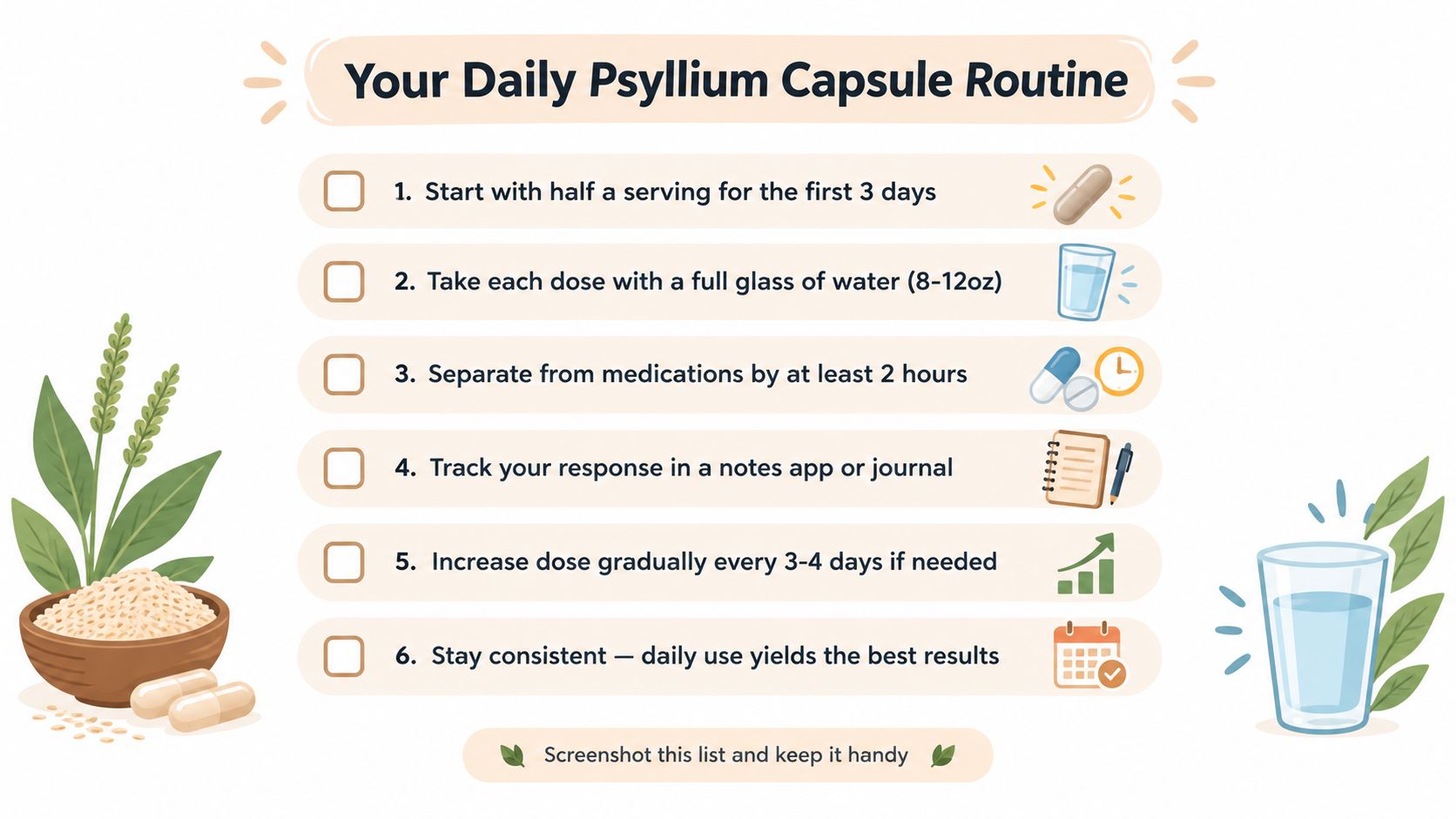
Keep this checklist nearby:
- Start low: Begin with half a serving if appropriate for you and permitted by the product directions.
- Drink fully: Take each dose with a full glass of water, at least 8 fluid ounces or 240 mL.
- Protect medication timing: Keep psyllium separate from oral medicines by at least two hours unless your pharmacist advises otherwise.
- Track your response: Note stool consistency, bloating, comfort, and any changes that matter to your goal.
- Increase gradually: Give your digestive system time to adapt before adding more.
- Review the label: Recalculate the daily psyllium amount whenever you change products.
If your routine includes vegan, gelatin-free supplements, keep the same label discipline across the whole cabinet. Clean ingredients and plant-based capsules are useful markers, but they don't replace dose clarity or safe administration.
Have you found a capsule routine that works with your meals, work schedule, or medications? Share what has helped, and explore related Yuve gut-health resources as you build a routine that feels supportive rather than stressful.
Yuve offers vegan, gelatin-free supplements designed to complement a thoughtful gut-health routine, including plant-based options for digestive support and everyday wellness. Visit Yuve to explore the range and choose products that fit your clean-label, plant-based approach.