Meta title: Non GMO Supplements Guide for Clean, Vegan-Friendly Choices
Meta description: Learn what non GMO supplements really mean, how to read labels, where GMO risks hide in vegan formulas, and how to choose cleaner supplements with confidence.
You're standing in front of a shelf of supplements, trying to make a smart choice, and every bottle seems to shout something different. Vegan. Organic. Clean. Natural. Non-GMO. Third-party tested. Suddenly, buying a simple supplement feels weirdly complicated.
If that sounds familiar, you're not overthinking it. Labels can be helpful, but they can also leave out the exact details you want to know. If you care about plant-based living, ingredient transparency, and what's really inside your capsules or gummies, understanding non GMO supplements can make shopping a lot less stressful.
Feeling Lost in the Supplement Aisle
A lot of people start supplements for a good reason. Maybe you want better digestion, more consistent energy, or extra support for a plant-based diet. Then you flip over the bottle and hit that tiny ingredient panel full of words that sound more like a chemistry set than something you'd willingly swallow.
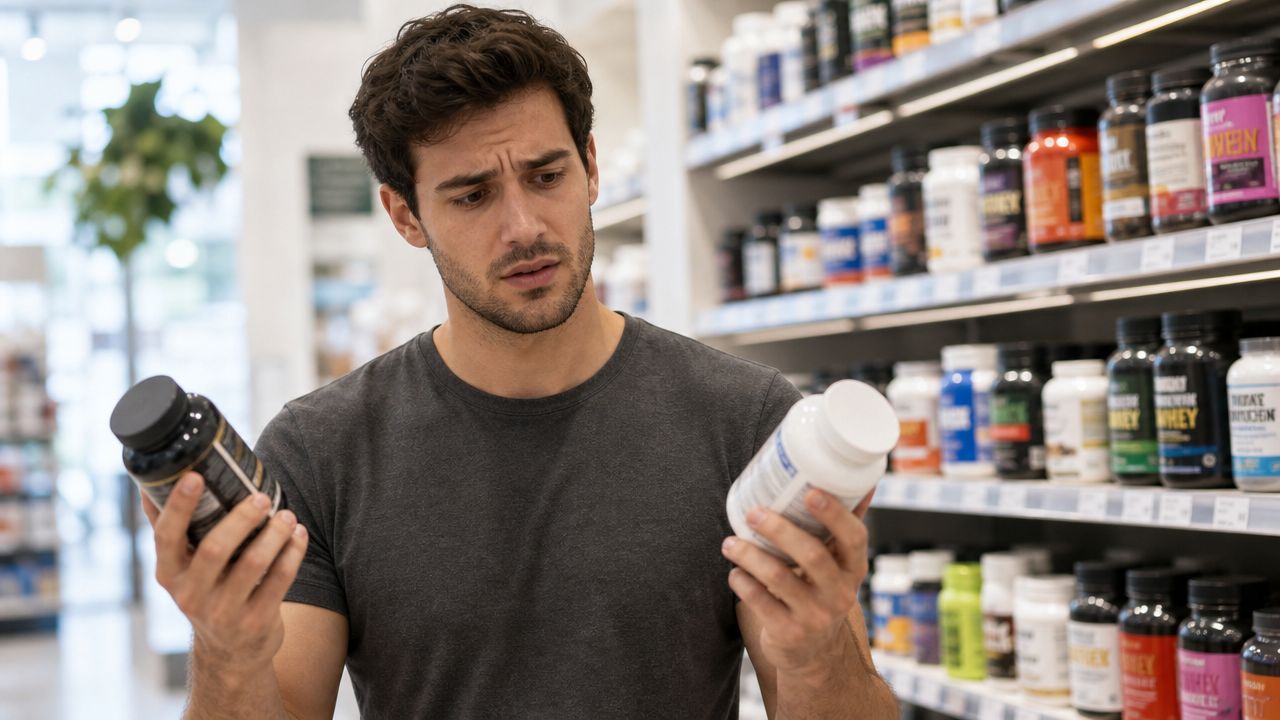
You're not alone. Supplements are mainstream, not a niche habit. The dietary supplement market was estimated at USD 209.52 billion in 2025, and the CDC reported that 57.6% of U.S. adults used at least one dietary supplement in the previous 30 days in 2017 to 2018, according to Grand View Research's supplement market overview.
That matters because when so many people use supplements, label clarity stops being a nice bonus and starts being basic consumer protection.
Why the label overload feels so frustrating
Front labels usually highlight the feel-good parts. Back labels tell the fuller story.
A bottle might say vegan on the front, but the back panel may include fillers, flavors, capsule materials, or processing-related ingredients that raise different sourcing questions. That disconnect is where many shoppers get stuck.
Practical rule: If a supplement only makes sense from the front of the bottle, you don't know enough yet.
What this means for you
If you've ever wondered, “Is non-GMO just marketing?” or “Does vegan automatically cover this?” those are smart questions. They're exactly the questions a careful shopper should ask.
Non GMO supplements sit inside a very large wellness market, which means your choices matter. So does your ability to separate a meaningful claim from a vague one.
What Does Non-GMO Actually Mean for Your Supplements
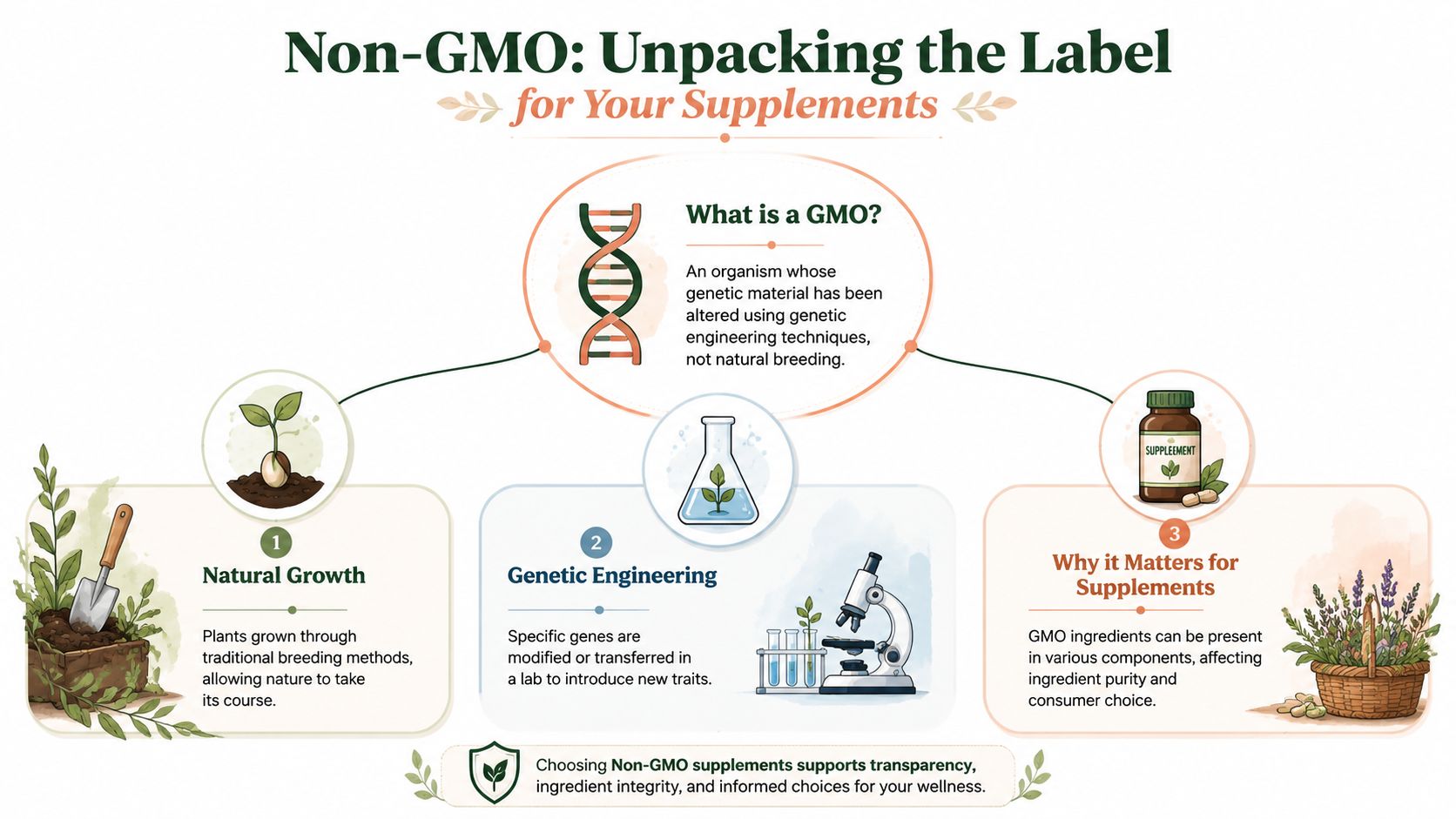
GMO stands for a genetically modified organism. In plain language, it refers to an organism whose genetic material has been changed using genetic engineering rather than traditional breeding.
A simple way to think about it is gardening. Traditional breeding is like growing two tomato varieties and selecting the plants with traits you want over time. Genetic engineering changes the process by altering or transferring specific genetic traits in a lab.
What non-GMO means on a supplement label
For supplements, non-GMO means the product is made without ingredients sourced from genetically engineered organisms. The focus is on ingredient origin and supply chain control.
That sounds simple until you remember a supplement isn't just one nutrient. It can include the active ingredient, capsule material, binders, fillers, flavorings, sweeteners, enzymes, and probiotic-related inputs. Each one has its own sourcing trail.
If you want a broader food-level primer too, Yuve's guide to what are non-GMO foods is a helpful companion read.
What non-GMO does not mean
People often get tripped up here.
Non-GMO doesn't automatically mean:
- Organic
- Higher potency
- More effective
- Better absorbed
- Free from additives
It speaks to how ingredients are sourced, not to every possible quality question.
Non-GMO is a sourcing claim first. It tells you something important, but it doesn't tell you everything.
Why shoppers care anyway
For many people, especially vegan and eco-conscious shoppers, non-GMO is part of a bigger values picture. You may want products that align with ingredient transparency, supply chain accountability, and more intentional purchasing.
That's a perfectly reasonable reason to care. You don't need to turn it into a miracle claim to make it meaningful.
Decoding the Labels and Understanding the Rules
If you buy supplements regularly, one seal matters more than a lot of front-label language. That's the Non-GMO Project Verified butterfly.
Why does that seal carry weight? Because it signals a verification process that goes beyond a brand printing “non-GMO” on its own packaging.
Why the butterfly matters
The Non-GMO Project describes GMO as genetic engineering and uses its butterfly mark to help consumers identify products aligned with GMO avoidance. It also notes that more than 70% of Americans do not want GMOs in the products they buy, and more than 80% of consumers actively look for the Non-GMO Project Verified label, as explained on the Non-GMO Project's GMO facts page.
That tells us the label has become more than a technical sourcing detail. It's a trust signal shoppers recognize.
What the seal is trying to verify
A credible non-GMO claim isn't about glancing at a finished bottle and saying, “Looks fine.”
It usually involves checking whether ingredients were sourced from non-GMO origins and whether the company can document that clearly. In practical terms, that means a supplement brand may need to account for major ingredients, smaller inputs, and manufacturing records.
For consumers, the takeaway is simple:
- Look for third-party verification
- Be cautious with vague front-label claims
- Treat transparency as part of quality
Where the FDA fits in
This part surprises a lot of people. The FDA states that it does not have authority to approve dietary supplements for safety and effectiveness before sale. That's a big reason third-party programs matter so much in this category.
If you want to compare non-GMO claims with another common standard, Yuve also has a useful explainer on USDA certified organic supplements.
When the government doesn't pre-approve supplements before they hit shelves, shoppers have to lean harder on transparent brands and independent verification.
A quick label-reading mindset shift
Don't ask only, “Does this bottle have a nice seal?”
Ask:
| What to ask | Why it matters |
|---|---|
| Is the claim third-party verified? | Independent review is stronger than self-claimed marketing |
| Does the full ingredient list make sense? | Risk can hide in minor ingredients |
| Does the brand explain its sourcing clearly? | Brands that do the work usually show their work |
That small shift makes supplement shopping much less passive.
The Sneaky Places GMOs Can Hide in Vegan Supplements
A lot of people assume vegan equals non-GMO. I get why. If you've already chosen a plant-based product, it feels like you've cleared the big hurdle.
But vegan and non-GMO answer different questions. Vegan tells you the product avoids animal-derived ingredients. Non-GMO asks how the ingredients were sourced and handled.
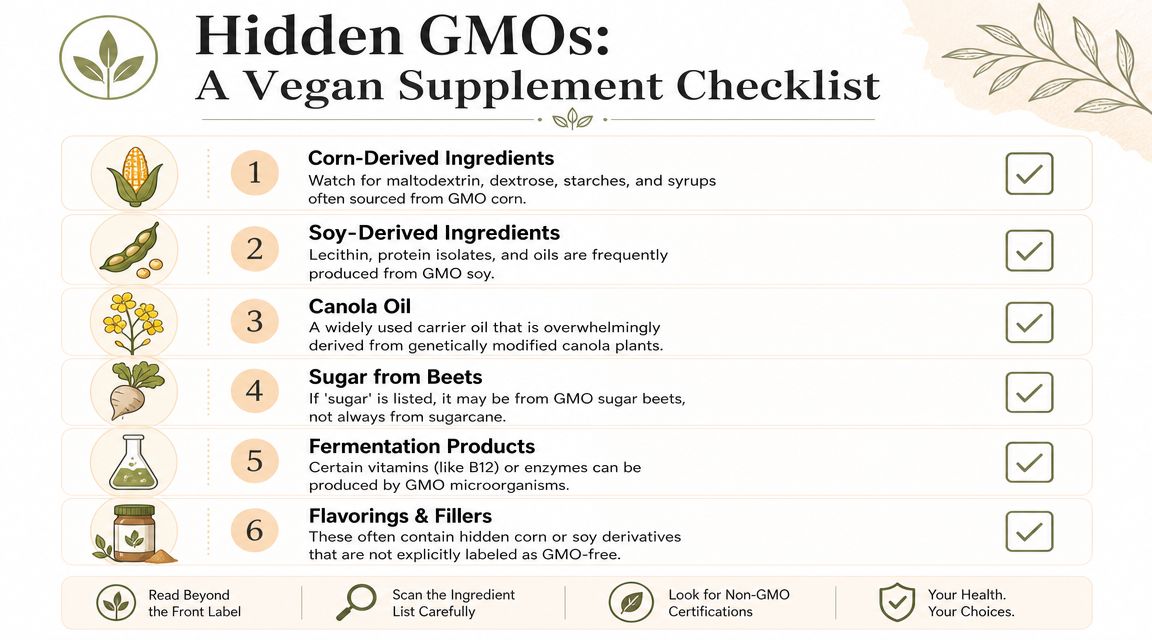
Life Extension notes that common high-risk GMO crops like soy, corn, and sugar beets are processed into ingredients used in supplements, including lecithin, vitamin B12, and various excipients. It also explains that cross-contamination and complex supply chains mean a vegan label alone isn't a guarantee of non-GMO status in its guide to what non-GMO supplements are.
The overlooked place to check
The front of the bottle gets attention. The Other Ingredients list deserves more.
The FDA requires dietary supplements to include a Supplement Facts panel and an Other Ingredients list for things like fillers, binders, excipients, preservatives, sweeteners, and flavorings. That's often where sourcing questions hide.
Common vegan supplement risk points
Here are a few places worth slowing down and reading carefully:
- Corn-derived ingredients like maltodextrin or certain starches can show up as functional helpers rather than headline ingredients.
- Soy-derived ingredients such as lecithin may appear in softgels, powders, or blends.
- Sugar beet derivatives can enter flavored or sweetened formulas.
- Fermentation-based ingredients can get trickier than people expect, especially with some vitamins, enzymes, probiotics, or related production inputs.
- Capsules and excipients may be vegan and still raise sourcing questions.
Why probiotic and vitamin sourcing can get fuzzy
This is an area eco-conscious shoppers often overlook. You may be focused on whether a probiotic capsule is dairy-free or whether a B12 product is vegan, but that still doesn't fully answer the non-GMO question.
The issue isn't only the finished nutrient. It's the ingredient provenance and the manufacturing controls behind it.
A clean-looking front label can still leave sourcing gaps. The back label tells you where to get curious.
What this means when you shop
If you're vegan, gluten-free, and trying to buy more thoughtfully, don't assume one good label covers every concern. Read the whole package. Ask where ingredients come from. Look for verification when the ingredient category is more complex.
That extra minute in the aisle can save you a lot of uncertainty later.
A Personal Story Why We Choose Non-GMO
A lot of wellness journeys start in a very unglamorous place. You feel off. Your digestion is unpredictable. You try one product, then another, and instead of feeling supported, you feel more skeptical.
That kind of frustration is familiar in the Yuve story too. Sam's own digestive struggles shaped the search for supplements that felt clean, reliable, and easier to trust. Not just products that sounded healthy, but products that held up when you looked closely at the ingredient list.
When “healthy” still feels unclear
Many people know this feeling. You're trying to do something kind for your body, and yet every purchase comes with a little doubt.
Is this plant-based in a meaningful way? Is the formula simple enough? Can I understand where these ingredients came from?
Those aren't picky questions. They're the questions people ask when they've spent enough time dealing with symptoms, label fatigue, or trial-and-error wellness shopping.
Why non-GMO becomes personal
For some brands, non-GMO is a marketing line. For people who've struggled to find supplements they feel good about taking every day, it becomes more personal than that.
It becomes a trust issue.
It's the difference between “This bottle says the right things” and “I'd feel comfortable handing this to someone I love.”
The human side of higher standards
That's one reason the non-GMO conversation matters so much to eco-conscious and plant-based shoppers. It's not only about avoiding one category of ingredients. It's about whether a company treats sourcing, documentation, and transparency as real responsibilities.
When you've had digestive issues or felt burned by confusing labels, that kind of care matters. A lot.
Your Practical Checklist for Choosing Clean Supplements
Shopping for non GMO supplements gets easier when you stop trying to decode every claim at once. A short checklist works better.
Start with what you can verify. Then move to what you can question.
Five things to check before you buy
1. Look for meaningful verification
Credible non-GMO verification is a matter of traceability. It requires confirming that major inputs, minor ingredients, and excipients are sourced from non-GMO origins through supply-chain documentation and sometimes on-site inspections, as described by Paragon Labs' explanation of Non-GMO Project verification for supplements.
That means a serious claim is about systems, not slogans.
2. Read past the active ingredient
A vegan digestive formula may sound clean until you read the fillers or flavor system. The active ingredient is only part of the story.
3. Scan the Other Ingredients list slowly
This is where many shoppers miss the details. If you don't recognize several ingredients, that's your cue to pause and research rather than assume.
A simple comparison trick
If you're comparing two products, make a mini side-by-side:
| Checkpoint | Product A | Product B |
|---|---|---|
| Third-party non-GMO claim | ||
| Full ingredient list easy to understand | ||
| Brand explains sourcing | ||
| Fit for your values and diet |
It sounds basic, but it keeps you from being swayed by the prettiest front label.
Useful resources when you want to dig deeper
If you want a broader framework for evaluating quality beyond non-GMO alone, Yuve's article on best third-party tested supplements is worth reading.
And if you're someone who compares gummy formulas for ingredient simplicity and lifestyle fit, even outside the vegan category, product pages like this Artnaturals biotin formula can be useful for practicing how to read a label with a more critical eye.
A quick visual can help make the process feel less abstract:
Bottom line: The best supplement label is the one that stays clear when you flip the bottle over.
Common Questions About Non-GMO Supplements
Are non-GMO supplements healthier
Not necessarily in the way many people assume. Current understanding is that the main benefit of non-GMO supplements is transparency in sourcing and avoiding genetically engineered ingredients, not a built-in advantage in nutrient content or clinical potency. GMO and non-GMO supplements are expected to provide similar nutritional benefits, as explained in this non-GMO supplement guide.
So if a non-GMO product costs more, you're usually paying for sourcing standards, documentation, and verification, not automatically “more nutrition.”
Is organic the same as non-GMO
No. They overlap, but they're not identical claims.
Organic includes non-GMO avoidance as part of the standard. But a non-GMO product is not automatically organic. A supplement can be non-GMO and still not meet organic requirements for how ingredients were grown or processed.
Can a supplement be 100 percent GMO-free
This gets complicated fast. Because of testing limits, cross-contact, and supply-chain complexity, the practical standard is usually avoidance and verification, not an absolute purity promise.
That's one reason third-party programs matter. They focus on traceability and reasonable control measures instead of impossible perfection.
If I care about wellness broadly, should I care about this too
If ingredient sourcing matters to you, yes. It fits into the same bigger picture as third-party testing, transparency, and reading labels carefully.
And if your supplement routine connects to exercise recovery too, you might also like this practical guide on how to alleviate muscle stiffness, which is another good reminder that feeling better usually comes from a combination of smart daily choices, not one magic fix.
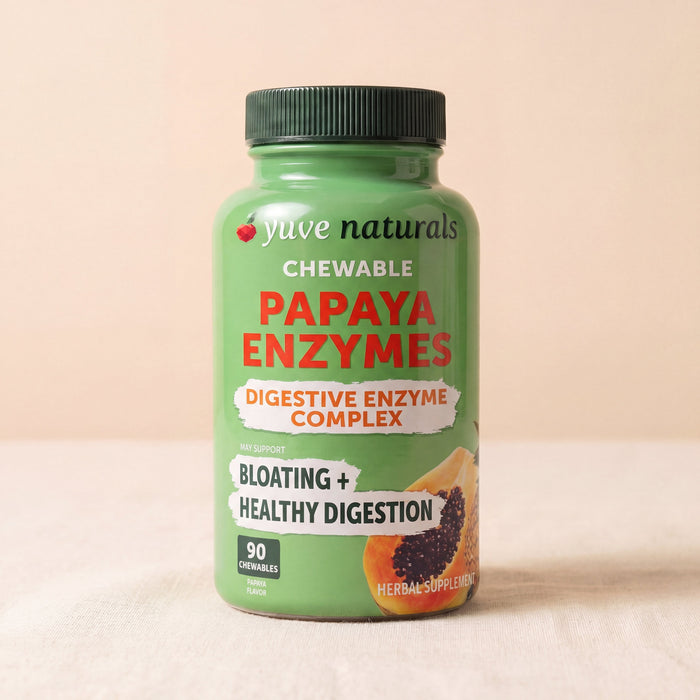
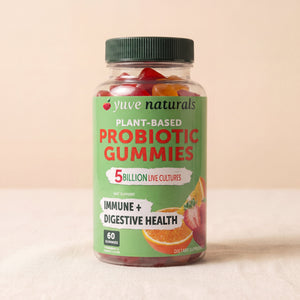
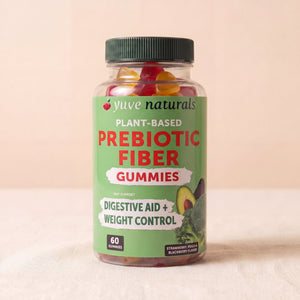
If you want vegan supplements that align with the label-reading principles in this guide, take a look at Yuve. Their plant-based formulas are built for people who care about gut health, clean ingredients, and more confident supplement choices.