Ever feel like your stomach starts the day calmly, then turns into a balloon by mid-afternoon? You eat what seems like a perfectly normal meal, yet bloating, irregular bowel movements, or that heavy, unsettled feeling show up anyway.
That frustration is real, and it's also why people search for probiotics with Bifidobacterium lactis. This species is among the better-studied probiotic options for bowel-function outcomes in adults, but there's an important detail many labels gloss over: B. lactis isn't one single, interchangeable ingredient. The exact strain, dose, and health outcome all matter.
I've had my own seasons of digestive discomfort, when every meal felt like a guessing game. What helped me most wasn't chasing the loudest supplement claim. It was learning to ask better questions: Which strain was studied? For what symptom? At what dose? And for how long?
Why Your Gut Might Need Bifidobacterium Lactis
A sluggish digestive day can make everything feel harder. You may be distracted by pressure in your abdomen, frustrated that you haven't had a comfortable bowel movement, or hesitant to eat because you don't want to make the feeling worse. You're not failing at gut health. Digestion is influenced by food, stress, movement, medications, and the individual makeup of your intestinal community.
Bifidobacterium animalis subspecies lactis, commonly shortened to B. lactis, is a friendly bacterial species used in many probiotic products. It's been studied for outcomes such as bowel-movement frequency, stool consistency, intestinal transit, immune markers, and diarrhea duration. That doesn't mean every product containing B. lactis will produce every one of those effects. It means researchers have found useful signals for particular strains and situations.
A 2022 systematic review identified 1,551 studies, then included 14 studies in its qualitative review and 13 in its meta-analysis of B. lactis research (PubMed's review of B. lactis bowel outcomes). Across those trials, supplementation improved defecation frequency and, with short-term use, reduced colonic transit time. In plain English, some people moved their bowels more often and food waste moved through the colon more quickly.
The practical takeaway: Choose a probiotic based on the strain and the outcome you care about, not simply the words “probiotic” or “B. lactis” on the front of a bottle.
This article focuses on the details that make product selection less confusing. You'll learn what B. lactis does, where the strongest evidence sits, why strains such as HN019 and BB-12 shouldn't be treated as identical, and how to read a vegan probiotic label without needing a microbiology degree.
What Bifidobacterium Lactis Actually Does in Your Gut
Think of your gut as a busy neighborhood. B. lactis is one helpful resident, not the entire community and not a permanent landlord. It travels through your digestive system, interacts with the intestinal environment, and may influence how contents move and how the body responds to signals from the gut.
From the acid challenge to the large intestine
A probiotic has to survive enough of the journey through the upper digestive tract to reach the area where it was studied. Researchers care about this because a strain can look promising in a laboratory but behave differently once it encounters stomach acid, bile, food, and the rest of your gut ecosystem.
B. lactis belongs to the Bifidobacterium group. Many products also include Lactobacillus strains, but those organisms aren't interchangeable. Different strains have different abilities to tolerate the digestive environment, interact with intestinal cells, and influence outcomes such as transit or immune activity.

Why the strain name belongs on the label
“Bifidobacterium lactis” gives you the genus and species, but the strain designation adds another layer of identity. HN019, BB-12, and Bi-07 are examples of strain-level names associated with different research histories. Two strains from the same species may not have the same tested dose or the same evidence for a particular symptom.
That's why a generic blend can be difficult to evaluate. If the label hides strain identities inside a proprietary mixture, you can't easily compare the formula with the study you're reading.
Science Corner
Researchers can't measure “gut health” with one universal test. In B. lactis studies, they may track whole-gut transit time, which describes how long material takes to move through the digestive tract, along with bowel-movement frequency and stool consistency.
The 2022 meta-analysis found improved defecation frequency, a reduction in colonic transit time with short-term use of 14 days or less, and better stool consistency in people without gastrointestinal symptoms (the systematic review and meta-analysis). It found no clear benefit for abdominal pain or bloating. That distinction matters. A probiotic may support regularity without being a guaranteed solution for every uncomfortable abdominal sensation.
Proven Health Benefits Backed by Research
The strongest case for B. lactis is not a sweeping promise about every aspect of wellness. It's a more focused story involving bowel regularity, intestinal movement, selected immune markers, and diarrhea duration in children. The results are meaningful, but they're also strain- and population-dependent.
A randomized, triple-blind, placebo-controlled trial studied adults with functional gastrointestinal symptoms taking B. lactis HN019. The high-dose group received 17.2 billion CFU per day, and whole-gut transit time fell from 49 ± 30 hours to 21 ± 32 hours over 14 days. The low-dose group received 1.8 billion CFU per day, with transit time falling from 60 ± 33 hours to 41 ± 39 hours. The placebo group didn't improve (the HN019 dose-ranging trial).
That's a useful example of why dose deserves attention. It doesn't prove that taking more is always better, but it does show a dose-related motility pattern in that specific trial.
A closer look at the research
| Population | Benefit | Study Type | Key Result |
|---|---|---|---|
| Adults across B. lactis trials | Bowel regularity | Systematic review and meta-analysis | Defecation frequency increased, with SMD 0.26, 95% CI 0.13 to 0.39 (review data) |
| Adults using B. lactis for 14 days or less | Faster colonic movement | Meta-analysis | Colonic transit time decreased, with SMD -0.34, 95% CI -0.62 to -0.07 (review data) |
| Adults without gastrointestinal symptoms | Stool consistency | Meta-analysis | Stool consistency improved, with SMD 0.76, 95% CI 0.44 to 1.08 (review data) |
| Healthy older adults using HN019 for 3 to 6 weeks | Innate immune function | Meta-analysis of four controlled trials | Phagocytic capacity and natural-killer-cell tumoricidal activity improved (strain-specific review) |
| Children in a Bayesian network meta-analysis | Diarrhea duration | Analysis of 73 randomized studies involving 12,315 children | B. lactis had the highest probability of reducing duration, with an estimated reduction of 2.13 days versus placebo or no treatment, 95% CI -3.06 to -1.22 (clinical literature summary) |
The immune findings deserve careful wording. For HN019, the pooled analysis found an SMD of 0.74 for polymorphonuclear neutrophil phagocytic capacity and 0.43 for natural-killer-cell tumoricidal activity. Those are immune markers, not proof that a probiotic prevents every infection or replaces medical care.
If you enjoy fermented baking projects, you can also explore DBakerAid™ probiotic baking advice for a practical look at how probiotic concepts fit into food preparation. Food and supplements aren't automatically equivalent, so keep the specific strain and tested formulation in mind.
Which B. Lactis Strains Are Worth Your Money
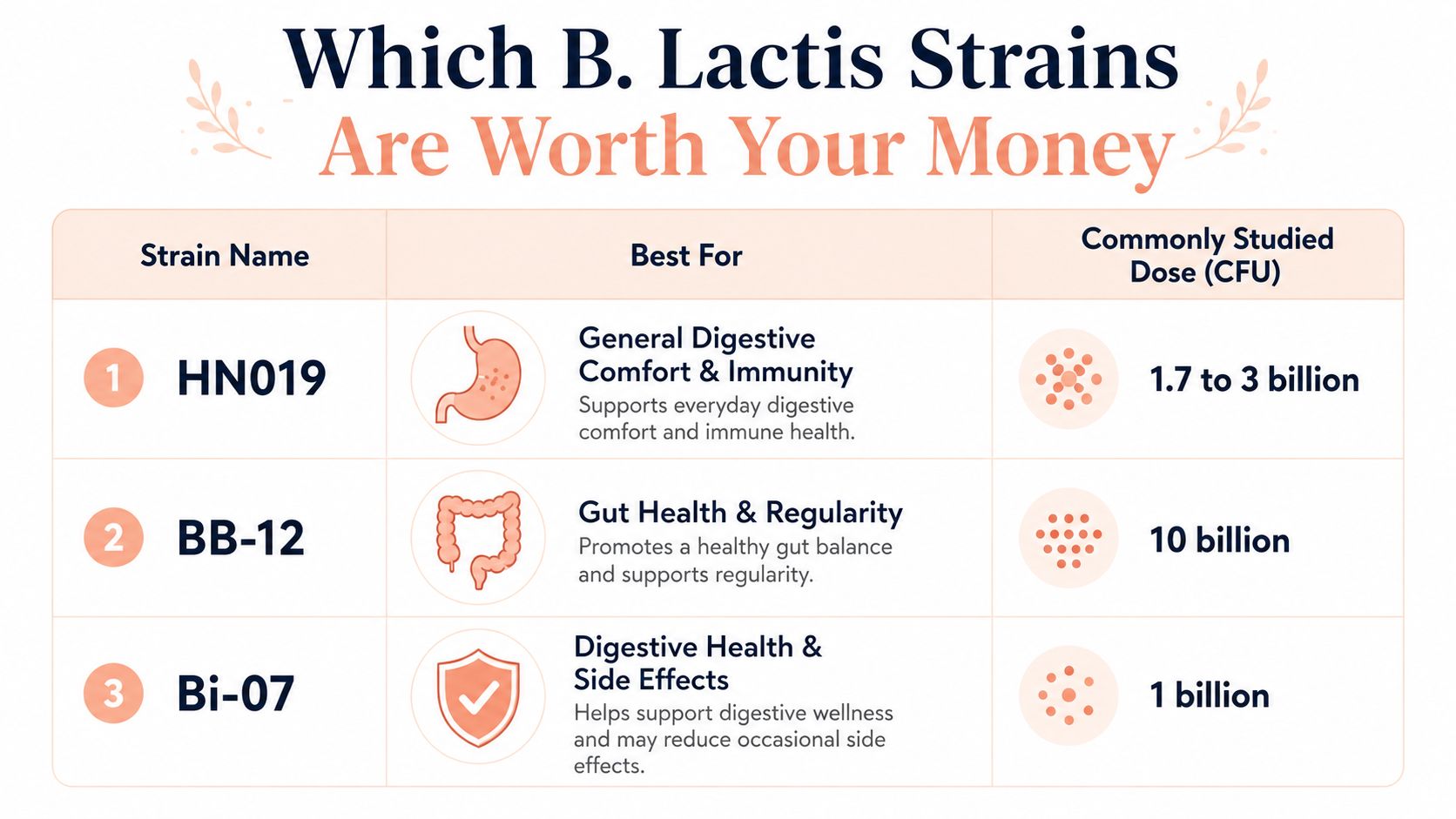
The short answer is that “worth your money” depends on your goal. HN019 has especially relevant research for intestinal transit and selected immune outcomes. BB-12 has a broad history in digestive and pediatric research. Bi-07 appears in research focused on digestive health and immune support. None should be treated as a universal winner.
Strains are not interchangeable
HN019 is the clearest example of dose-dependent evidence in this article. In the adult trial described above, the tested doses were 17.2 billion CFU per day and 1.8 billion CFU per day, and the observed transit changes differed between those groups (HN019 clinical trial). That doesn't tell you that every HN019 product will recreate the result. It tells you that the dose and formulation used in research are part of the evidence.
BB-12 is widely discussed in clinical probiotic literature, including research involving children and digestive outcomes. Bi-07 also has a research history, but the relevant result depends on the specific outcome and population. A label that says only “B. lactis” leaves you without enough information to match the product to a study.
A label-reading comparison
| Strain | Research focus | CFU dose shown in the evidence |
|---|---|---|
| HN019 | Digestive transit and selected innate immune markers | 1.8 billion and 17.2 billion CFU per day in a dose-ranging adult trial (HN019 trial) |
| BB-12 | Digestive health, regularity, and pediatric diarrhea research | Dose varies by study and outcome. Match the product label to the specific evidence rather than assuming one standard dose. |
| Bi-07 | Digestive health and immune-related outcomes | Dose varies by study and outcome. Look for the complete strain name and an expiration-date potency statement. |
For a deeper look at one commonly discussed strain, see Bifidobacterium lactis BB-12. The useful question isn't “Does this contain B. lactis?” It's “Does this contain a named strain with evidence relevant to what I'm trying to improve?”
Be cautious with any product promising dramatic relief from bloating based only on the species name. A 2025 review emphasized that B. lactis effects vary by strain, life stage, and outcome, while a 2025 trial found HN019 wasn't superior to placebo for chronic constipation (recent strain-specific evidence). Positive findings are real, but they don't transfer automatically from one product to another.
How to Choose a High-Quality Vegan Probiotic
A vegan probiotic can fit both your nutrition preferences and your practical needs, but “vegan” alone doesn't tell you whether the formula is well documented. You still need to inspect the label for strain identity, potency, storage, and quality controls.
Start with five label checkpoints

- CFU at expiration: Look for a live-culture count guaranteed through the expiration date, not only at the time of manufacture. A product can lose viability during storage, so the timing of the guarantee matters.
- Complete strain naming: The label should identify the genus, species, and strain where applicable. “Bifidobacterium lactis” is more informative than “probiotic blend,” but a named designation such as HN019, BB-12, or Bi-07 gives you a better basis for comparison.
- Independent testing: A third-party testing seal or clear quality-control information can help verify that the finished product matches its label. Don't confuse attractive packaging with evidence of testing.
- Storage instructions: Follow the product's instructions. Some formulas need refrigeration, while others are designed for room-temperature storage. Heat, moisture, and time can affect live cultures.
- Vegan certification and ingredients: Check for plant-based capsules or gummies, gelatin-free ingredients, and a clear vegan statement if that matters to you. A vegan formulation can also make the product easier to fit into an ethical or plant-based routine.
Watch for hidden details
Proprietary blends are frustrating because they may list a total amount without telling you how much of each strain is present. That makes it difficult to compare the formulation with human research.
Prebiotics can also appear in a formula. They're fermentable fibers that help provide fuel for beneficial microbes, but they may increase gas for people who are sensitive to rapid fiber changes. Start with the label directions and pay attention to how your body responds.
For more context on plant-based formulas, explore vegan probiotics and supplements. Bring the same critical eye to every brand, including the one you ultimately choose.
Safety, Side Effects, and What to Expect
B. lactis products are generally well tolerated, but a new probiotic can change the digestive conversation at first. Gas, mild bloating, or a temporary change in stool pattern may happen as your gut adjusts. That doesn't automatically mean the product is harmful, but persistent or severe symptoms deserve attention.
The HN019 dose-ranging trial reported no adverse events during its study period (the clinical trial report). That's reassuring, but one study can't predict every individual response. Your medical history, immune status, medications, and underlying condition all matter.
A gentler way to begin
If you're sensitive, avoid starting several new supplements at once. Begin with the product's lower suggested serving when the label allows it, or ask a healthcare professional whether a gradual introduction makes sense for you.
Keep a simple note of:
- Bowel pattern: Record whether regularity changes.
- Comfort: Notice gas, pressure, cramps, or bloating.
- Timing: Write down when you take the product and whether meals affect your response.
- Other changes: Include new foods, antibiotics, or medications that could influence digestion.
A sensible boundary: Stop and contact a healthcare professional if symptoms are severe, worsening, or accompanied by signs that need medical evaluation.
People with serious immune compromise, significant underlying illness, or complex medical treatment should speak with their healthcare provider before using live-microbe supplements. Ask your pharmacist or clinician about medication timing and possible interactions, especially if you're taking prescription treatments or recovering from an acute illness.
One more important distinction: B. lactis may support bowel function, but it isn't a diagnosis for constipation, IBS, inflammatory disease, or unexplained abdominal pain. Seek medical guidance for persistent symptoms, bleeding, fever, unintentional weight loss, or a major change in bowel habits.
Real-World Use Cases and Daily Integration
A vegan adult looking for a plant-based routine may care about ingredient transparency and strain identification. A parent may be researching B. lactis because a child has diarrhea, while an adult with irregularity may care more about transit time and stool consistency. Someone focused on general wellness may be interested in immune markers, but should remember that immune research doesn't equal a promise of disease prevention.
The best routine is usually the one you can follow consistently. Take the product according to its label, pair your broader routine with varied fiber-rich foods as tolerated, and avoid changing five variables at once. That way, you'll have a better sense of what your body is responding to.

A simple daily rhythm
- With breakfast: A meal can make a supplement easier to remember, though the product's own directions come first.
- With prebiotic foods: Oats, beans, onions, garlic, bananas, and other fiber-containing foods can support a varied diet. Increase fiber gradually if it tends to trigger gas.
- For dairy-related discomfort: A probiotic won't replace lactase when lactose is the problem. Use a product designed for that specific need, such as Yuve Lactase Enzymes, according to its label.
- For tracking: Give your routine enough time to observe a pattern, while staying alert to symptoms that need professional care.
I've heard many versions of the same small win from people working on their digestion: fewer “surprise” bathroom days, a more predictable routine, or less anxiety around meals. Those experiences can be encouraging, but they're personal responses, not proof that every reader will have the same result.
If HN019 is the strain you're researching, you can read more about Bifidobacterium lactis HN019. Then compare the strain, dose, expiration-date guarantee, storage instructions, and dietary standards before choosing a product. Share your own gut-health experience with someone you trust, or discuss it with a qualified healthcare professional if symptoms continue.
Visit Yuve to explore plant-based probiotic options and digestive-support supplements that fit a vegan routine. Choose a product with a clearly stated strain and follow the label directions, then give yourself a calm, consistent routine for noticing how your digestion responds.