Ever stood in the supplement aisle feeling like you need a science degree just to pick a vitamin? One bottle promises "clinically proven" results while another shouts "doctor recommended," but what does that even mean? If you’ve ever felt overwhelmed by the endless options, you’re not alone.
We've all been there-staring at a wall of products, feeling a mix of hope and frustration, just wanting to find something that will genuinely help with our energy, digestion, or wellness goals. It's frustrating when you're just trying to feel better.
This guide is here to cut through that noise. We're going to give you the tools to become a more confident, informed shopper. Together, we'll break down what makes a supplement truly science-backed in simple terms, no PhD required, so you can make choices that actually work for you.
What Does "Science-Backed" Really Mean?
At its core, a science-backed supplement is one whose key ingredients are supported by credible, high-quality human research-not just marketing hype or a single person's good experience. Think of it as the difference between a friend's recommendation and a conclusion drawn from hundreds of people in a controlled study.
Learning to spot this difference is the first step toward choosing products that actually deliver on their promises.
A Quick Guide to Scientific Evidence
Not all "science" is created equal. A glowing testimonial or a small-scale study doesn't carry the same weight as a large, well-designed clinical trial. To make sense of it all, experts use a "pyramid of evidence" to rank the quality of scientific research. It’s a pretty intuitive system.
Here's how it generally breaks down:
- The Base (Weakest): Personal stories, anecdotes, and expert opinions. These can be interesting starting points, but they aren't scientific proof.
- The Middle: Observational studies (like case-control or cohort studies) and smaller trials. These are a step up and can suggest a potential link between an ingredient and a health outcome, but they don't prove cause and effect.
- The Peak (Strongest): The gold standard-Randomized Controlled Trials (RCTs) and meta-analyses. RCTs are carefully designed to minimize bias, and meta-analyses review the combined results of multiple high-quality studies to draw a powerful conclusion.
This pyramid shows how different types of research stack up, from personal experiences at the bottom to comprehensive reviews at the top.

The key takeaway is simple: the higher up the pyramid the evidence comes from, the more trustworthy the claim is. For instance, while you explore supplements, you might also look into the science-backed health benefits of infrared saunas, which similarly rely on this hierarchy of evidence. Understanding this framework is your best tool for spotting the difference between clever marketing and solid research.
Decoding Common Supplement Claims
Marketers love using buzzy phrases that sound official but might not mean much. Here's a quick guide to help you translate some of the most common claims you'll see on a bottle.
| Common Claim | What It Likely Means | What to Look For Instead |
|---|---|---|
| "Clinically Proven" | The company may have sponsored a small study, or they might be referencing a study on a similar, but not identical, ingredient. | Look for references to randomized, double-blind, placebo-controlled trials on the exact ingredient at the exact dose used in the product. |
| "Doctor Recommended" | This could mean anything from a single paid endorser to a broad survey of physicians. It's often vague and lacks context. | Independent third-party certifications (NSF, USP) and evidence from multiple, high-quality studies published in reputable journals. |
| "Patented Formula" | A patent protects an invention; it does not guarantee effectiveness or safety. It just means the formula is unique. | Evidence that the specific, patented formula has been tested in human clinical trials and shown to be effective. |
| "Based on Science" | This is a very broad claim. It could refer to preliminary lab studies (on cells or animals), which don't always translate to humans. | Citations to human clinical trials (RCTs or meta-analyses). Check if the studies are relevant to the product's claims. |
Seeing these phrases isn't always a red flag, but it should be a signal to dig a little deeper and ask for the proof behind the promise.
How to Spot Genuinely Reliable Research
So, how can you tell if the "science" a brand is touting is the real deal? It can feel like you need a PhD just to decipher the claims on a bottle, but I promise, it's not as complicated as it seems. Let's walk through what high-quality research actually looks like.

Think about it this way. Imagine you're testing a new plant food on two identical houseplants. One gets the new food (the test group), while the other just gets regular water (the control group). This simple setup is the heart of what’s known as a Randomized Controlled Trial (RCT), the gold standard in clinical research.
The Power of a Good Comparison
In a proper RCT, researchers randomly split participants into different groups. That randomness is the secret sauce-it ensures both groups are as similar as possible right from the start. That way, any difference you see at the end is almost certainly because of the supplement, not some other random factor.
One group gets the actual supplement, and the other gets a placebo-a sugar pill that looks identical but contains no active ingredient. This is crucial for isolating the real effects from the "placebo effect," which is the very real phenomenon where people start to feel better just because they believe they're getting a helpful treatment.
The best studies take it one step further and are double-blind. This means neither the people in the study nor the researchers handing out the pills know who is getting the real deal until the study is totally over. This brilliant step removes any chance of unconscious bias sneaking in and messing with the results.
Size and Scope Matter
When it comes to research, bigger is almost always better. A study with 1,000 participants will give you much more trustworthy results than one with just 10. Larger groups help average out all the little individual quirks and give us a much clearer picture of whether an ingredient truly works.
It’s like taking a political poll. Would you trust a survey of a few thousand voters more than asking five of your friends? Of course. The same logic applies here.
You also have to ask who (or what) was studied. Research on mice or cells in a petri dish can be an interesting first step, but it doesn’t mean you’ll see the same effects in a complex human body. We always want to look for human clinical trials.
Meet the Meta-Analysis: The Best of the Best
So, what's even more powerful than one well-designed RCT? A meta-analysis. This is basically a "study of studies." Researchers find all the high-quality RCTs on a specific ingredient, then pool all that data together to get the most powerful and reliable conclusion possible.
A meta-analysis gives us a bird's-eye view of the evidence. For example, a 2023 meta-analysis that combined the results of 26 different RCTs found that hydrolyzed collagen significantly improved skin hydration and elasticity. By combining data, these super-studies can spot trends that might be too subtle to catch in a single, smaller trial.
Your Quick Research-Checking Toolkit
Feeling a little more confident? Good. Here’s a quick checklist you can use to vet the science behind any supplement you're considering.
- Is it an RCT? Look for key phrases like "randomized," "double-blind," and "placebo-controlled."
- How many people were in it? More participants usually means stronger evidence.
- Was it on humans? Don't be fooled by animal or lab studies-they’re just preliminary.
- Who funded it? Be a little skeptical if the study was funded by the company selling the product. Look for independent research.
- Where was it published? Studies in respected, peer-reviewed journals have been checked over by other experts, which adds a huge layer of credibility.
Getting a handle on these basics is a game-changer, but the supplement label itself holds a ton of clues. To take your skills to the next level, check out our guide on how to read supplement labels.
Key Ingredients Proven to Support Your Body
Alright, now that we know how to spot solid research, let's get to the fun part: the ingredients themselves. When you’re wrestling with things like bloating or just feeling completely drained, knowing which specific compounds are proven to help is a total game-changer. Think of this as your shortlist of science-backed all-stars for gut health, immunity, and energy.
We'll dive into some of the most well-researched ingredients you'll find in high-quality supplements. For each one, we'll look at what the science says it does and, more importantly, what that means for how you feel every day.

Probiotics for Gut Harmony
If your gut were a garden, probiotics would be the friendly gardeners tending to the soil. These beneficial bacteria, especially strains from the Lactobacillus and Bifidobacterium families, are the true superstars of the digestive world. We’ve all been there-that uncomfortable, balloon-like feeling after a meal that can derail your entire day.
The science on this is really encouraging. A huge body of research shows that specific probiotic strains help bring balance back to your gut microbiome. They essentially work by crowding out the less helpful bacteria, creating a healthier, more supportive environment inside your digestive tract.
What does this mean for you? A calmer, more predictable digestive system. It translates to less bloating, more regular digestion, and a happier gut after you eat. It’s all about creating an internal ecosystem where your body can truly thrive.
Digestive Enzymes for Effortless Digestion
Have you ever eaten a perfectly healthy meal, only to be hit with that dreaded post-meal gas and discomfort? Dun, dun, dun-unwelcome gas. Yikes! Sometimes, your body just needs a little extra help breaking everything down. That's exactly where digestive enzymes come into play.
Think of enzymes as tiny molecular scissors. They meticulously snip apart the proteins, fats, and carbohydrates in your food into smaller, more manageable pieces that your body can easily absorb.
- Papain (from papaya): This enzyme is a powerhouse for breaking down tough proteins, like those in meat.
- Bromelain (from pineapple): Much like papain, bromelain also goes to work on proteins and is well-regarded for its soothing properties.
- Lactase (for dairy): This is the one and only enzyme that can break down lactose, the sugar in milk. If dairy gives you trouble, a lack of this enzyme is often the culprit.
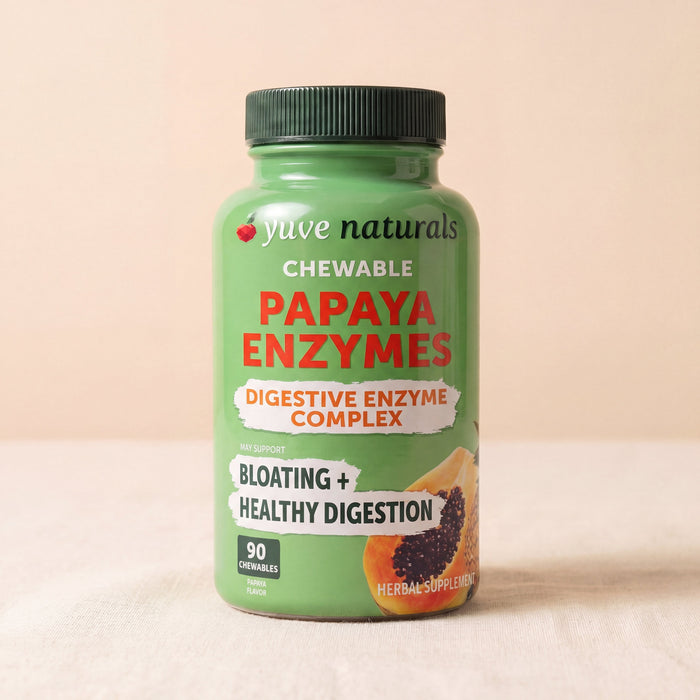
Taking a digestive enzyme supplement before a meal is a proactive way to give your body’s natural processes a hand. This was a turning point for our founder, Sam. After struggling for years with discomfort after eating, he discovered his body simply needed extra enzyme support. For him, and for so many others, it’s the key to enjoying food without the fear of what comes next. That’s why Yuve Vegan Digestive Enzymes are a core part of our lineup-they provide that crucial support to make every meal a comfortable one.
Vitamins and Minerals for Energy and Immunity
When it comes to your overall well-being, a few key vitamins and minerals are backed by a mountain of research. They are the fundamental building blocks that keep your immune system sharp and your energy levels from cratering.
There's a reason the market for these essentials is booming. The global dietary supplements market was valued at around USD 209.5 billion in 2025 and is projected to more than double by 2035. This incredible growth is fueled by people like us who are taking a proactive approach to their health, with vitamins leading the way.
Let's zoom in on three of the most critical players.
Vitamin B12 for Cellular Energy
That feeling of being tired all the time is an all-too-common complaint, and sometimes, a B12 deficiency is the silent culprit. This vitamin is absolutely essential for creating red blood cells-the tiny taxis that carry oxygen throughout your body. Without enough B12, your cells are literally starved for oxygen, which leaves you feeling sluggish and foggy. This is especially important for anyone on a plant-based diet, since B12 is found almost exclusively in animal products.
Vitamin D for Immune Defense
Often called the "sunshine vitamin," Vitamin D’s job goes far beyond supporting bone health. It’s a master regulator of your immune system. Study after study has shown that having adequate Vitamin D levels helps your immune cells function correctly, making your body better prepared to fend off challenges.
Zinc for Immune Function and Repair
Zinc is another immune powerhouse. It's vital for the development and function of your immune cells and plays a critical role in managing your body's inflammatory response. Think of it as the mechanic that keeps your immune system’s complex machinery running smoothly and efficiently.
What This Means For You: Getting enough of these core nutrients isn’t just about avoiding a deficiency; it’s about actively fueling your body for resilience and vitality. It gives you the solid foundation you need to feel your best, day in and day out.
For a deeper look into this topic, check out our guide on natural supplements for your immune system, where we explore even more ingredients that can help you stay strong and healthy.
Your 5-Step Checklist for Choosing Safe Supplements
Alright, feeling a bit more confident about what "science-backed" really means? Let's put that knowledge to work. Think of this as your practical guide for cutting through the noise in the supplement aisle and making choices you can feel good about.
It's a simple, five-step checklist you can use to vet any product, from probiotics to protein powders.
This isn't just theory for us at Yuve; it's personal. Our founder, Sam, was once in the same boat, wrestling with his own frustrating digestive issues. He got tired of supplements packed with fillers that didn't do what they promised. This very checklist grew out of his personal mission to find clean, effective solutions backed by solid science.

1. Check Ingredients and Dosages
This is where you get to be the detective. The first thing you should always do is flip that bottle over and get friendly with the "Supplement Facts" panel. Don’t just glance at the list of ingredients-really look at the dosages and compare them to what the clinical studies suggest.
Ask yourself: is the amount of the active ingredient enough to actually do anything? For instance, if studies show you need 500 mg of an herb for a specific benefit, a product that only contains 50 mg is likely just "window dressing." It won't deliver the results you're looking for.
This is a dealbreaker for us. Every single ingredient in Yuve's Vegan Digestive Enzymes, from Papain to Bromelain, is included at a dosage designed to provide real digestive support.
2. Look for Third-Party Certifications
Since the FDA doesn't approve supplements for effectiveness before they hit the shelves, independent certifications are your best measure of quality. These organizations act as a neutral third party, testing products to confirm they actually contain what the label claims, are free from nasty contaminants, and are made according to safe manufacturing practices.
Look for these seals on the bottle:
- NSF Certified for Sport: This is one of the toughest certifications out there, screening for more than 270 banned substances.
- USP Verified: This seal confirms the supplement meets high standards for quality, purity, and potency.
- Non-GMO Project Verified: This simply assures you the product was made without genetic engineering.
Doing your homework here is key. Look for evidence of Third-party supplement testing as it adds a crucial layer of trust and accountability.
3. Read the Entire Label
Go beyond the main ingredients and take a hard look at the "other ingredients" list. This is where you’ll find the fillers, binders, and other additives. While some are necessary to create a stable pill or capsule, others are just cheap fluff.
Keep an eye out for things you might want to skip:
- Artificial colors and flavors
- Common allergens like gluten, soy, or dairy
- Sweeteners such as sucralose or aspartame
Sam’s goal was to create products he'd feel good about taking himself, which meant no junk. That’s why Yuve supplements are always vegan, non-GMO, and free from gluten, gelatin, and artificial additives.
4. Vet the Brand’s Transparency
A brand you can trust is an open book. They should make it easy to find out about their sourcing, manufacturing standards, and testing protocols. Do they talk about where their ingredients come from? Do they share information on their quality control process?
If a brand is proud of how they make their products, they’ll want to tell you about it. If you have to dig through their website just to find basic quality info, that can be a red flag. Transparency builds trust, and it's something we take very seriously.
5. Listen to Your Body
Finally, and this is the most important step: pay attention to how a supplement actually makes you feel. Even the most perfectly formulated, science-backed product might not be the right match for your unique body chemistry.
When you start something new, try to introduce it one at a time so you can clearly tell what effect it’s having. Does it actually help with your bloating? Do you notice a real difference in your energy levels? Or do you just feel a bit... off? Your personal experience is the final piece of the puzzle.
A Bird's-Eye View of the Global Supplement Scene
Let's take a step back for a moment and look at the bigger picture. This hunger for better health isn't just a local trend-it's a massive, worldwide movement. When we understand who's buying supplements and where, it gives us a real sense of scale. It shows that the search for effective, science-backed solutions is something that connects all of us, no matter where we call home.
This global perspective helps explain why the market is so crowded with options and why the demand for trustworthy, high-quality products is skyrocketing everywhere.
Who's Driving the Market?
The global supplement industry is enormous, and different parts of the world have their own distinct flavor. North America, for instance, is what industry experts call a "mature" market. It's packed with health-savvy consumers who are proactively looking for products to support their well-being.
In fact, recent analysis shows North America commands a huge 35-36% share of the global market. The United States is the giant in the room, accounting for an incredible 91.4% of that share on its own. At the same time, the Asia Pacific region is exploding with growth, showing just how universal the desire for wellness has become. You can dig deeper into these market trends to see the full scope of this global shift.
Why You Need to Be Your Own Watchdog
With thousands of products lining the shelves, it's easy to assume some government agency is rigorously testing every single one. That’s a common misconception, and the reality, especially in the U.S., is quite different.
The Food and Drug Administration (FDA) does regulate dietary supplements, but the rules are very different from those for prescription drugs. Under a law called the Dietary Supplement Health and Education Act of 1994 (DSHEA), the responsibility for safety falls squarely on the manufacturer's shoulders.
Here’s what that really means: The FDA does not approve supplements for safety or effectiveness before they hit the market. The agency typically steps in only after a problem has been reported with a product already being sold.
This is a critical distinction. It places the burden on brands to self-police and on you, the consumer, to be incredibly selective about who you trust. This is precisely why things like brand reputation and third-party testing aren't just marketing buzzwords-they are non-negotiable for your safety and peace of mind.
This regulatory landscape is the very reason Yuve exists. We started this company out of our own frustration trying to find clean, reliable options. Our commitment has always been to go above and beyond the required standards, ensuring every single batch is rigorously tested for both purity and potency. We believe you should never have to guess about the safety or effectiveness of the supplements you take to feel your best. That promise is at the heart of everything we do.
Why Trust and Transparency Matter More Than Ever
Taking a look at who uses supplements today tells you a lot about modern wellness. It's not a fringe practice for extreme athletes or biohackers anymore; it's gone completely mainstream. Millions of us are using supplements as a practical way to feel our best while navigating busy, demanding lives.
The data backs this up. It’s no surprise that adults are the biggest users-we’re all juggling careers, families, and personal ambitions, looking for that extra edge to support our energy and well-being. But there's another trend that really catches our attention.
The market for children’s supplements is growing fast. This tells us that parents are actively looking for reliable, science-backed ways to support their family’s health right from the start. That’s something that resonates deeply with us here at Yuve.
How We Shop for Wellness
It’s also interesting to see how we’re all buying these products. While a huge number of sales still happen in physical stores, online shopping has opened up a whole new world. It makes it easier than ever to find high-quality, specialized products that meet specific dietary needs-like vegan, non-GMO, and allergen-free options.
This is exactly why Yuve is so focused on creating plant-based supplements you can trust, for the whole family, and making them easy to find online. We get it. You’re not just buying another item; you’re making an investment in your family’s health. That requires a level of trust that we are committed to earning every single day.
Understanding these trends brings us back to one simple truth: choosing a brand that’s transparent and dedicated to quality is more critical than ever. It's about finding a partner for your health journey, not just picking a product off a shelf.
The Numbers Tell the Story
The sheer size of the supplement market confirms just how many people are making their health a priority. A few key stats from recent industry reports really stand out:
- Over-the-counter dietary supplements made up about 76% of the total market revenue in 2025.
- Adults are the largest consumer group, accounting for nearly 46% of the market.
- The infant segment is on track to see the fastest growth, projected at almost 11% in the coming years.
- Even with the boom in e-commerce, offline retail channels still held a dominant 68.90% of the revenue share in 2025.
These numbers paint a clear picture of a growing, society-wide commitment to proactive health. You can dig deeper into these dietary supplement market dynamics here.
In such a crowded space, knowing you're choosing a brand that puts quality and transparency first is everything. To learn more about what that looks like, check out our guide on the best third-party tested supplements.
Answering Your Top Questions About Supplements
Alright, let's get practical. Understanding the science behind supplements is one thing, but knowing what to expect when you actually start taking them is another. We've compiled some of the most common questions we hear to give you straight-up answers, no fluff.
How Long Until I See Results?
This is probably the number one question we get. The honest answer? It really depends on the supplement and your goals.
Some products give you pretty quick feedback. Take something like Yuve’s Vegan Digestive Enzymes, for example. You pop one before a meal and you should feel a difference-less bloating, easier digestion-right away. The effect is almost immediate.
But for most supplements, like probiotics or vitamins, think of it more like a long-term investment in your health. It can take anywhere from four to twelve weeks to notice a real, lasting change. Your body needs time to do its work, whether that's replenishing low nutrient levels or shifting the balance of your gut microbiome. Patience and consistency are everything.
Can I Really Trust Online Reviews?
Online reviews can be a useful tool, but you have to know how to read them. They’re great for spotting red flags related to things like shipping problems, broken seals, or poor customer service.
When it comes to whether a product works, however, it gets tricky. A rave review could be a classic case of the placebo effect, while a one-star review might come from someone who quit after a week. Personal stories are powerful, but they aren't data.
Our take: Use reviews to gauge the company's reliability, but always circle back to the scientific evidence and third-party testing to judge quality and effectiveness.
Are More Expensive Supplements Actually Better?
Not always. A higher price tag can absolutely signal better ingredients, clinically-proven dosages, or extensive third-party testing. But just as often, it’s paying for a fancy marketing campaign or a celebrity endorsement.
Don't let the price be your main guide. Go back to that 5-step checklist we talked about earlier. A reasonably priced supplement that’s transparent about its sourcing, uses effective doses, and has the certifications to back it up is a much smarter choice than a pricey bottle that relies on hype.
At Yuve, our mission is simple: create transparent, science-backed supplements that genuinely help you feel better, without all the confusing jargon. We believe your path to wellness should be clear and straightforward.