Some days your body feels like it’s speaking in riddles. You eat a normal lunch, then your stomach puffs up by mid-afternoon, your energy falls off a cliff, and your mind gets weirdly buzzy or heavy.
If that sounds familiar, 5 elements chinese medicine offers a different way to read those signals. Not as random symptoms, and not as a sign that you’ve “failed” at wellness, but as clues.
Feeling Out of Sync? An Ancient Map to Modern Wellness
Maybe your pattern looks like this. You wake up motivated, sip your coffee, answer messages, push through work, then by 3 p.m. your belly feels tight, your focus disappears, and suddenly even deciding what to make for dinner feels exhausting.
A lot of us start by looking only at food. Was it the beans? Too much salad? Not enough protein? Sometimes that helps. Sometimes it doesn’t.
Traditional Chinese Medicine takes a wider view. It asks how your digestion, stress, emotions, sleep, and even the season might be interacting. That’s why people exploring Chinese acupuncture often notice that practitioners ask about far more than one symptom. They’re looking for a pattern.
In this framework, the Five Elements act like a wellness map. They connect body systems, emotions, and natural rhythms through five organizing patterns: Wood, Fire, Earth, Metal, and Water. Instead of asking only, “What symptom do I have?” this system asks, “What feels out of balance underneath it?”
Big idea: Your bloating, low energy, and emotional frazzle might not be separate problems. They may be part of one pattern.
That’s one reason this old framework still feels surprisingly modern. It gives language to what many people already sense. Your body changes with stress. Your appetite changes with worry. Your energy changes with the season.
If you already think about herbs and stress support, Yuve’s guide to adaptogenic herbs is a helpful companion to this bigger picture.
The good news is that the Five Elements don’t require you to memorize mysterious terms or overhaul your whole life. You just need a simple way to recognize the patterns.
Meet the Five Elements Wood Fire Earth Metal and Water
The Five Elements Theory, also called Wu Xing, originated during the Zhou Dynasty and was documented in the Huangdi Neijing around 300 B.C. It links Wood, Fire, Earth, Metal, and Water to specific organs, seasons, and emotions, creating a diagnostic blueprint still used in Traditional Chinese Medicine today, as described in this overview of the Five Elements in TCM.
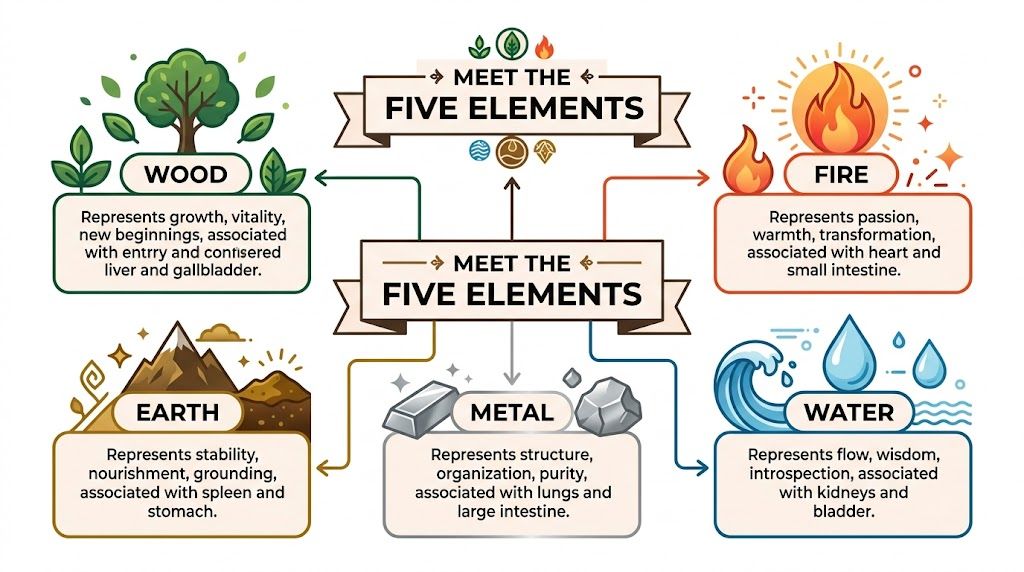
The Five Elements at a glance
| Element | Organs | Season | Emotion | Flavor | Energy |
|---|---|---|---|---|---|
| Wood | Liver, Gallbladder | Spring | Anger | Sour | Growth, movement, direction |
| Fire | Heart, Small Intestine | Summer | Joy | Bitter | Warmth, connection, expression |
| Earth | Spleen, Stomach | Late summer | Worry | Sweet | Nourishment, grounding, digestion |
| Metal | Lungs, Large Intestine | Autumn | Grief | Pungent | Structure, boundaries, release |
| Water | Kidneys, Bladder | Winter | Fear | Salty | Restoration, depth, resilience |
Wood feels like forward motion
Think of Wood as a young tree pushing upward in spring. It wants movement, growth, and a clear path.
In the body, Wood relates to the liver and gallbladder. Emotionally, it’s associated with anger. That doesn’t just mean yelling. It can also look like frustration, irritability, feeling stuck, or getting snappy when your day goes sideways.
When Wood feels balanced, you tend to feel flexible and decisive. When it doesn’t, life can feel jammed up.
Fire is warmth and connection
Fire is the height of summer. It’s bright, social, expressive, and animated.
It relates to the heart and small intestine and is linked with joy. In balance, Fire can feel like warmth, laughter, ease, and emotional openness. Out of balance, that same energy can feel scattered, overexcited, or emotionally “too much.”
If Wood says, “Go,” Fire says, “Shine.”
A useful shortcut is this. Wood moves, Fire radiates, Earth nourishes, Metal organizes, Water restores.
Earth is the center of digestion
This is the element many gut-health readers instantly connect with. Earth relates to the spleen and stomach, the season of late summer, and the emotion of worry.
Earth energy is about transforming food into nourishment and helping you feel steady. If Earth is struggling, digestion may feel sluggish, heavy, bloated, or unpredictable. Mentally, you might notice overthinking or that looping “what if” brain.
Earth often becomes the star of the show when someone says, “I don’t feel awful all the time, but I just never feel comfortably settled after meals.”
Metal helps you sort and release
Metal is autumn energy. Crisp, clear, and structured.
It connects to the lungs and large intestine and is linked with grief. Metal has to do with boundaries, order, and letting go. Physically and emotionally, this element is about taking in what’s useful and releasing what isn’t.
That’s why Metal can feel so relevant for people working on both elimination and emotional processing. The theme is similar in both cases. Keep what nourishes you. Release what doesn’t.
Water stores your reserves
Water belongs to winter. It’s deep, quiet, and conserving.
It relates to the kidneys and bladder and the emotion of fear. Balanced Water energy feels resilient, grounded, and steady under pressure. When it’s depleted, you may feel worn down, hesitant, or like your internal battery never fully recharges.
Water is less about quick energy and more about your reserves. It’s your long-game stamina.
Why this framework sticks
The reason 5 elements chinese medicine has lasted is simple. It gives people a way to notice patterns that don’t fit neatly into one box.
You’re not just “a person with bloating.” You might be someone whose digestion gets worse when stress rises, whose mind races when meals are irregular, or whose energy drops hard in winter. The elements give those patterns shape.
The Dance of Harmony - Generating and Controlling Cycles
The Five Elements aren’t five isolated boxes. They interact more like a garden ecosystem, where one force feeds the next and another keeps it from taking over.
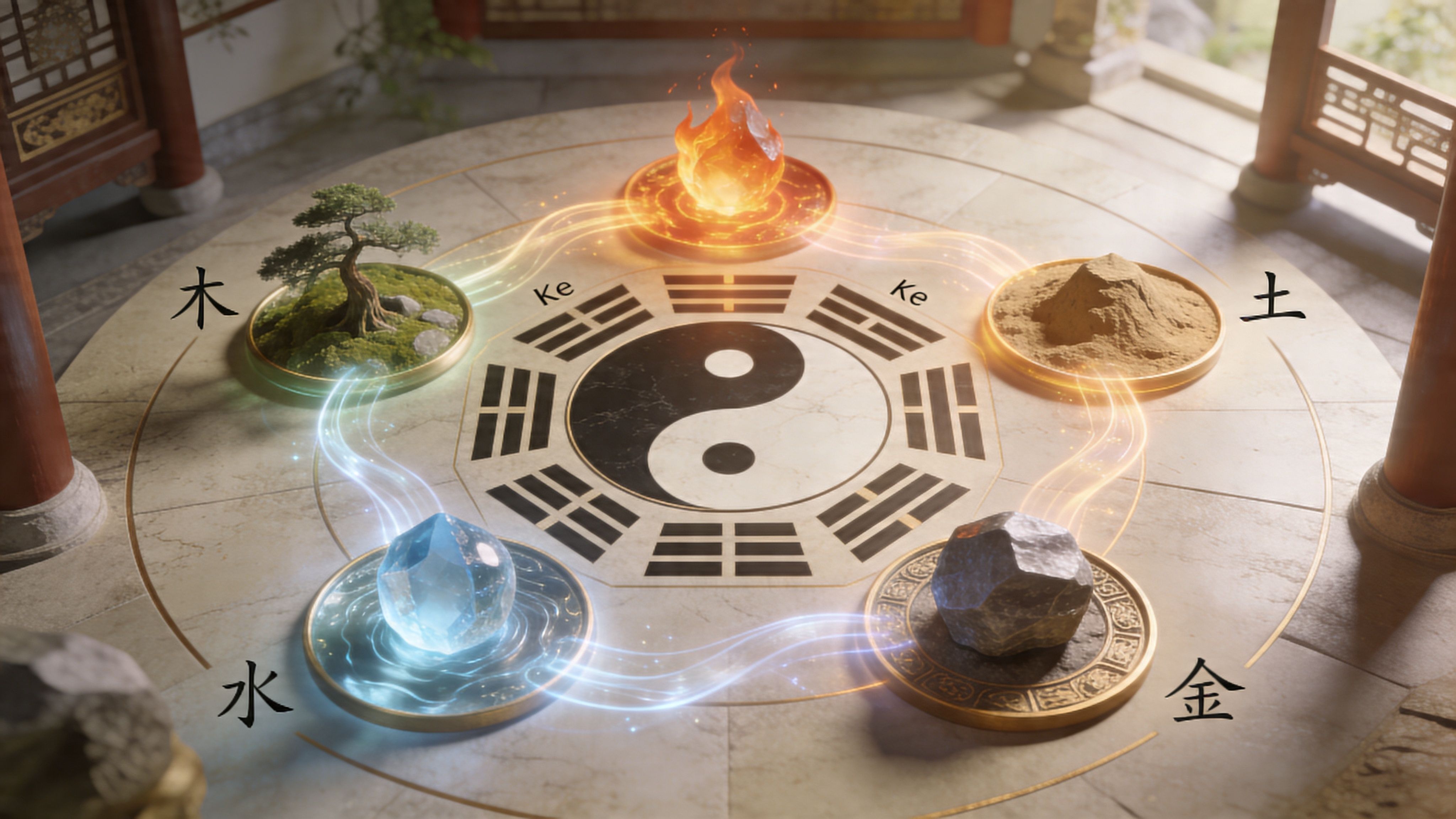
According to Healthline’s explanation of the Five Elements, two primary cycles govern health in TCM: the Sheng cycle, where elements nourish one another, and the Ke cycle, where they balance one another. That same source notes that excessive Wood can “invade” Earth, a common way practitioners describe stress-related digestive issues like bloating.
The Sheng cycle nourishes growth
The Generating cycle is the supportive loop:
- Water nourishes Wood
- Wood fuels Fire
- Fire creates Earth
- Earth bears Metal
- Metal enriches Water
This is the “helping” pattern. One element acts like a good neighbor to the next.
If you like concrete images, think of watering a plant. The water feeds the wood. The wood becomes fuel. The fire leaves ash that returns to earth. The earth yields metal. Metal gathers water through condensation. Around it goes.
The Ke cycle creates healthy limits
The Controlling cycle is the regulating loop:
- Wood penetrates Earth
- Earth dams Water
- Water extinguishes Fire
- Fire forges Metal
- Metal chops Wood
This isn’t a bad thing. It’s how the system avoids chaos.
A healthy body needs both nourishment and restraint. Too little control and one pattern can run wild. Too much control and something gets suppressed.
Think balance, not battle. In TCM, control isn’t punishment. It’s a way the system stays stable.
Why stress and digestion often show up together
The theory finds its practical application. A classic example is Wood overacting on Earth.
In plain English, that can look like this: stress rises, frustration builds, meals become rushed, and suddenly digestion gets cranky. You feel bloated, uncomfortable, maybe even oddly “full” and unsettled after eating foods that were fine last week.
That doesn’t mean stress is the only cause of digestive symptoms. It means this framework gives you a way to understand why tension and gut discomfort often travel together.
What practitioners look for
A practitioner may look for patterns through conversation, pulse, tongue, and sensory observations. The point isn’t to label you forever. It’s to identify which relationship seems out of rhythm right now.
That’s one reason the system feels less rigid than people expect. You’re not stuck as one thing. Your pattern can shift with season, stress, sleep, and daily habits.
Eating for Your Element - A Vegan-Friendly Guide for Gut Health
If you care most about bloating, digestion, and energy, Earth usually deserves your attention first. In TCM, Earth is tied to the spleen and stomach, which makes it the center of how you receive, transform, and use nourishment.
When Earth feels supported, meals tend to land better. Energy feels steadier. Your mind often feels less spinny too. When Earth is struggling, you might notice bloating, heaviness, a sluggish afternoon, or that classic overthinking spiral. Dun, dun, dun, unwelcome gas. Yikes.
If you eat plant-based, this doesn’t mean your diet is “wrong.” It usually means your body may need more rhythm, warmth, simplicity, or support for breakdown and absorption. Yuve’s article on plant-based nutrition is a useful place to pair practical nutrition with this energetic lens.
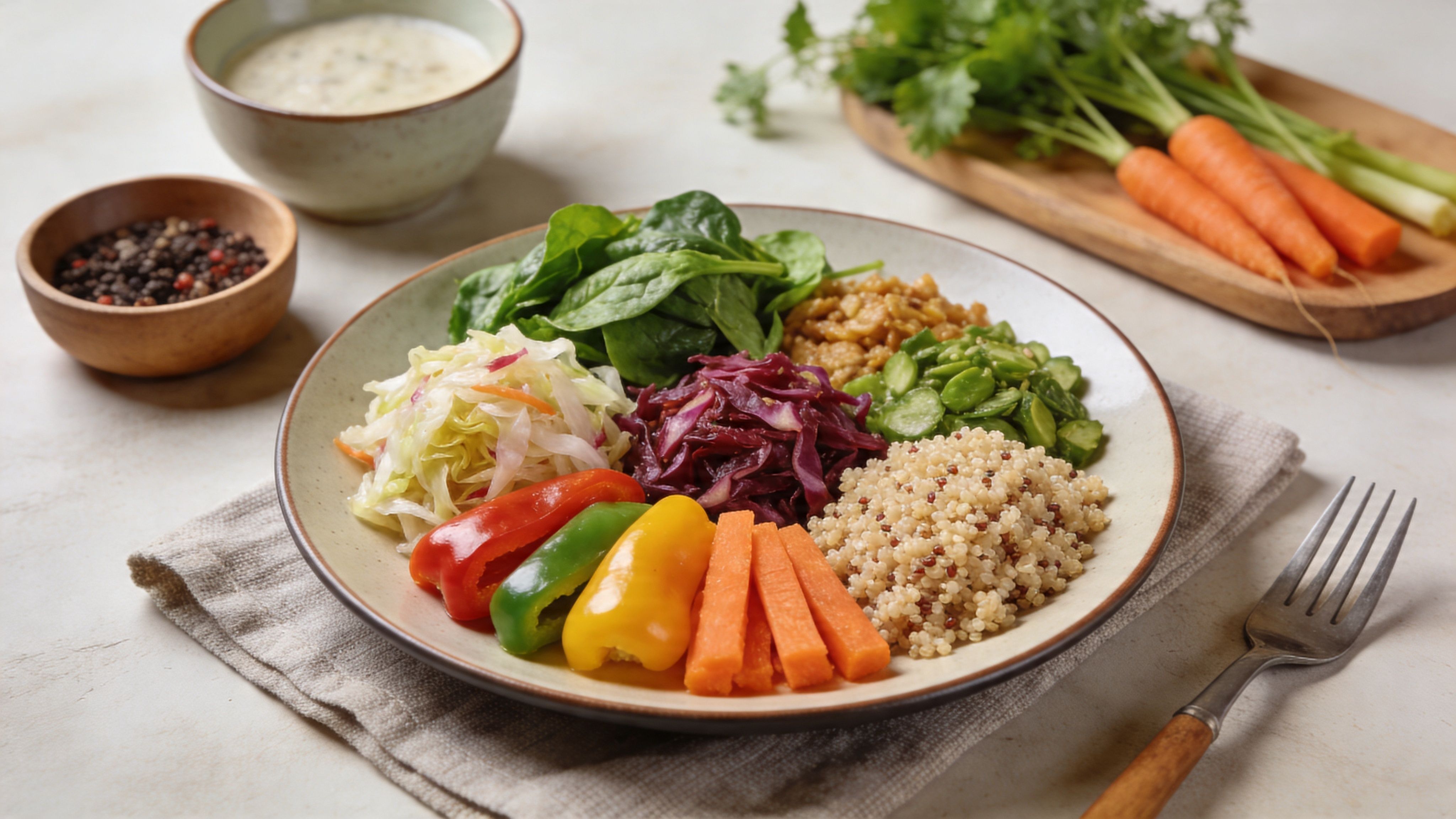
Start with the Earth element plate
Earth-supportive eating usually looks less chaotic and more grounding. That often means meals that are cooked, balanced, and easy to digest.
A helpful Earth-focused vegan plate might include:
- Warm base foods like oats, rice, quinoa, or sweet potato
- Cooked vegetables such as carrots, squash, zucchini, or greens
- Gentle plant proteins like tofu, lentils, or chickpeas, prepared in a way you digest well
- Simple fats from tahini, olive oil, or avocado in amounts that feel good for you
- Warming extras like ginger, cinnamon, or lightly cooked herbs
The keyword here is tolerability. A “healthy” meal isn’t helpful if it leaves you bloated and wiped out.
What Earth imbalance can look like in daily life
Sometimes readers expect digestive imbalance to be dramatic. It can be, but often it’s sneakier than that.
You may notice:
- After-meal fatigue where lunch makes you want a nap
- Puffiness or bloating even after wholesome foods
- Food indecision because your stomach feels unpredictable
- Mental rumination that gets louder when your body feels unsettled
- Cravings for quick comfort foods when energy dips
That Earth pattern can be especially frustrating for vegans and vegetarians because many nutritious foods are fiber-rich, bulky, or require good digestive capacity. Beans, cruciferous vegetables, and big raw salads can be wonderful for some people and a lot for others.
Practical rule: Build from what your body can handle consistently, not from what looks perfect on paper.
Vegan foods that often feel grounding
You don’t need a rigid Five Elements pantry. You need meals that create steadiness.
These foods often fit the Earth-supportive theme well:
- Root vegetables - sweet potatoes, carrots, beets
- Cooked whole grains - oats, rice, millet, quinoa
- Legumes - lentils, chickpeas, split peas, if they work for you
- Soft, warming meals - soups, stews, porridges
- Gentle sweetness from whole foods - squash, pumpkin, dates in modest amounts
Earth is traditionally associated with the sweet flavor, but in this context that points to natural, nourishing sweetness rather than heavy sugary foods. Think roasted carrots, not candy.
A simple way to support the other elements too
Even if Earth is your main focus, the rest of the system still matters. The easiest approach is to think in themes.
Wood support
Wood likes movement and flow. Meals with a little brightness can feel supportive, such as adding lemon, herbs, or lightly sour flavors if they sit well for you. Lifestyle matters here too. A short walk or stretch before dinner can help a tense day soften.
Fire support
Fire appreciates warmth and joy. Shared meals, mindful eating, and not inhaling your food at your laptop can matter more than people realize. Digestion isn’t only chemistry. It’s also context.
Metal support
Metal connects with release and structure. Regular mealtimes and enough hydration can support that sense of order. For some people, a quieter eating environment helps too.
A quick visual refresher can help if you want to hear these ideas explained out loud:
Water support
Water tends to do better when life isn’t constantly overdrawn. If you’re under-slept, over-caffeinated, and always pushing, your digestion may feel that strain too. Rest supports the gut more than many people want to admit.
What this means for modern gut health
I don’t think you need to follow Five Elements food therapy perfectly to benefit from it. In fact, trying to “do it right” can become its own stressor.
The value lies in this: 5 elements chinese medicine helps you match your meals and habits to your current pattern instead of forcing one ideal diet all the time. If you’re bloated, chilled, tired, and overwhelmed, your body may need something different than it does in a high-energy summer week.
For many people, the first win isn’t dramatic. It’s simple. Less heaviness after meals. More stable energy. Fewer random digestive surprises. That matters.
A Personal Story - How Sam Found Digestive Peace
Sam’s story started the way many gut stories do. He wasn’t trying to become a wellness person. He was just tired of feeling uncomfortable after eating.
His pattern was frustratingly familiar. Some meals felt fine one day and heavy the next. Stress made everything worse. The more his digestion acted up, the more he worried about food, and the more he worried, the more unsettled his stomach seemed to get.
Through the Five Elements lens, that looked a lot like Earth under pressure. Nourishment wasn’t landing well. Meals didn’t feel grounding. Even food decisions started to feel loaded.
What helped wasn’t one magic fix. It was a series of smaller shifts. Simpler meals. More consistency. Less random grazing. More attention to how food felt in his body, not just how healthy it sounded.
“Small wins count. A calmer stomach after lunch can change the whole tone of your day.”
That kind of change can sound modest until you live it. When digestion eases up, you often get more than digestive relief. You get mental space back. You stop negotiating with your body all day.
Sam’s experience is one reason this topic matters so much at Yuve. Gut discomfort doesn’t stay neatly in the gut. It spills into energy, mood, confidence, and daily life.
If you’ve been stuck in the loop of “I eat well, so why do I still feel off?” you’re not difficult and you’re not doing everything wrong. Sometimes your body just needs a steadier, more supportive rhythm.
The Science Corner - Does The 5 Elements Theory Actually Work
Let’s be honest. Many readers frequently pause at this point. The Five Elements can sound poetic, but you may still wonder whether any of it holds up beyond tradition.
That’s a fair question.
What science can and can’t say
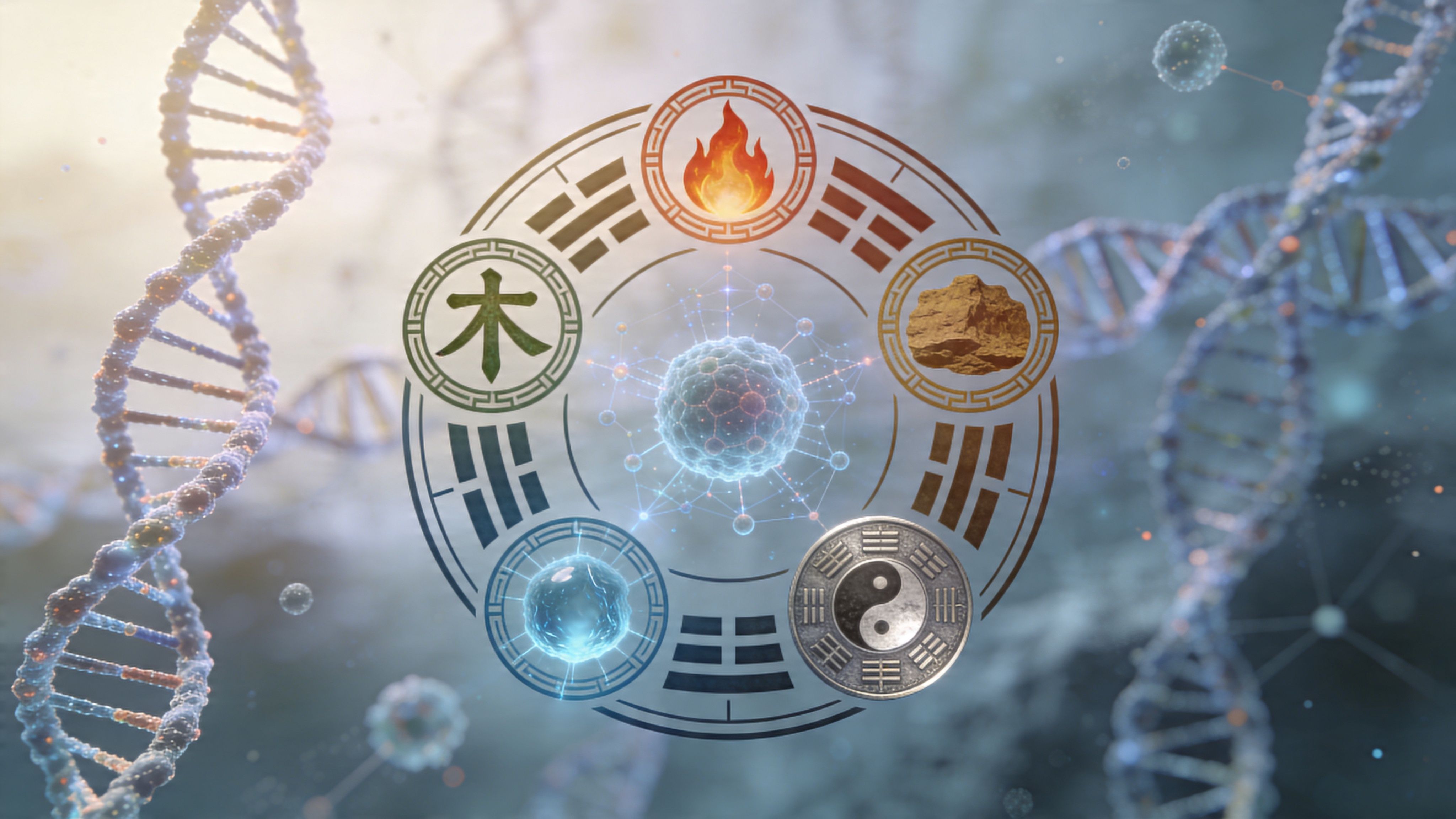
The first thing to know is that the Five Elements are best understood as a diagnostic and therapeutic framework, not a literal modern biological model. Science doesn’t measure “Wood excess” the way it measures blood glucose.
But that doesn’t mean the practices built around this system are irrelevant. It means we have to ask a slightly different question. Not “Can a lab test prove the element itself?” but “Do interventions inspired by this framework produce measurable outcomes?”
That’s a much more useful conversation.
What emerging evidence suggests
One cited example comes from a source describing a 2025-2026 meta-analysis of 15 randomized controlled trials, which reported that practices aimed at balancing the Metal element, including specific qi gong exercises, reduced IBS symptoms by 42%, while herbal formulas supporting the Water element boosted energy by 35% in fatigued individuals, according to this summary discussing Five Elements outcomes.
If those findings hold up under broader review, they don’t “prove” the Five Elements in a literal sense. What they do suggest is that interventions organized through this traditional logic may have real-world effects people can feel.
What this means for you
Here’s the practical translation.
- If a framework helps identify patterns, that can improve personalization.
- If a practice reduces symptoms, many people care less about whether the language is ancient or modern.
- If a system encourages whole-person assessment, it may catch relationships that symptom-only approaches miss.
That’s one reason many people like combining tradition with evidence-minded wellness. You don’t have to choose between them. Yuve’s resource on science-backed supplements fits well with that balanced mindset.
Ancient language and modern research don’t have to be enemies. Sometimes they’re describing the same human experience from different angles.
A grounded takeaway
Skepticism is healthy. Blind dismissal isn’t.
The most sensible approach is to stay curious, keep standards high, and notice what changes in your own digestion, energy, and resilience. If 5 elements chinese medicine helps you identify a pattern, choose gentler meals, respect seasonality, and support your stress response, that alone can make it useful.
You don’t have to treat it like dogma. You can treat it like a practical lens.
Your 5 Elements Quick-Start Plan for More Energy
You don’t need to memorize textbooks to start using this system. A few small habits can make the Five Elements feel less abstract and far more helpful.
Try one anchor habit for each element
-
Wood in spring
Add gentle movement before or after meals. A short stretch, a walk around the block, or a few deep breaths can help when stress makes your digestion feel tight and stuck. -
Fire in summer
Eat one meal a day without multitasking. Let your nervous system know it’s safe to receive food. Slowing down can change how a meal feels. -
Earth in late summer
Choose one grounding meal you can repeat easily. Think oatmeal with cinnamon, a simple grain bowl, or soup with cooked vegetables and legumes. Repetition can be soothing when digestion feels chaotic. -
Metal in autumn
Create more rhythm. Try eating meals at fairly regular times and give yourself a pause between bites. Structure can support both digestion and elimination. -
Water in winter
Protect your reserves. Go to bed a little earlier, lower the “always on” pace when possible, and favor warm, nourishing foods over cold grab-and-go meals.
Use this checklist when you feel off
Instead of asking only “What should I cut out?” ask:
- Am I eating in a rushed or stressed state?
- Does my body want cooked, simpler meals right now?
- Have I been overthinking, overworking, or undersleeping?
- Does this feel like a digestion problem only, or a bigger stress-energy pattern?
- What season am I in, and am I living against it?
Keep it simple enough to repeat
The best Five Elements routine is the one you’ll use.
A realistic starting plan might look like this:
- Morning - warm breakfast and a few minutes of movement
- Midday - pause before lunch and eat sitting down
- Afternoon - notice whether stress or food triggered the slump
- Evening - choose a cooked meal and step away from screens while eating
That’s not fancy. It is effective because it brings your body back into rhythm.
Your first goal isn’t perfection
Aim for more steadiness, not a complete personality makeover. Better digestion often starts with ordinary things done consistently.
If your body feels less bloated, less frantic, and a little more predictable, you’re already moving in the right direction.
Frequently Asked Questions About The 5 Elements
Do I have just one element
Not exactly. Everyone contains all five elements. In practice, one pattern may stand out more strongly at a given time, or one may seem like your long-term tendency.
That’s why this system feels flexible. You’re not locked into a single label.
Is 5 elements chinese medicine mainly about emotions or organs
Both. The framework links organs, emotions, seasons, and physiological functions together. That can feel unusual at first, but it’s part of what makes the system useful for pattern recognition.
For example, digestion and worry are both associated with Earth. That doesn’t mean worry causes every gut issue. It means the relationship matters.
Can I use this if I already take supplements or follow another wellness plan
Yes. Many people use the Five Elements as a lens, not a replacement for everything else. It can help you think more clearly about timing, seasonality, and what kind of support feels most relevant right now.
Do I need acupuncture to benefit from this approach
No. People often explore the Five Elements through food choices, daily routines, breathwork, seasonal living, and self-observation. Acupuncture may be part of the picture for some, but it isn’t the only way in.
Do I have to stop eating my favorite foods
Usually, no. This approach is about balance and support, not punishment. You can still enjoy favorite foods while paying closer attention to how, when, and in what context they work best for your body.
What’s the best place to start if I feel overwhelmed
Start with Earth. Support digestion first with regular meals, more cooked foods if they help, and less rushed eating. When digestion feels steadier, the rest often becomes easier to notice.
If you’re ready to turn these ideas into everyday gut support, explore Yuve. Their plant-based wellness approach fits beautifully with a balanced, whole-person view of digestion, energy, and immunity.