Lactobacillus plantarum 299v, now often named Lactiplantibacillus plantarum 299v, is one specific, heavily studied probiotic strain, and the two outcomes with the most human research behind it are abdominal pain in irritable bowel syndrome and iron absorption. Those results belong to that exact strain, not to every product whose label reads Lactobacillus plantarum.
So before you spend money on another bottle, ask the question most labels are built to dodge. Which strain is inside, and is it the one that got tested?
A front label saying "Lactobacillus plantarum" tells you the species and nothing more. It doesn't tell you whether you're holding the organism that showed up in the trials or a relative nobody has studied in humans. That gap between species and strain is where most probiotic purchases go wrong, and closing it changes how you read every product page you land on.
What follows is the evidence sorted by what it supports, from the irritable bowel data to the smaller iron work, plus the label checks that separate a genuine match from a hopeful guess.
What Lactobacillus Plantarum 299v Is and Why the Strain Name Decides
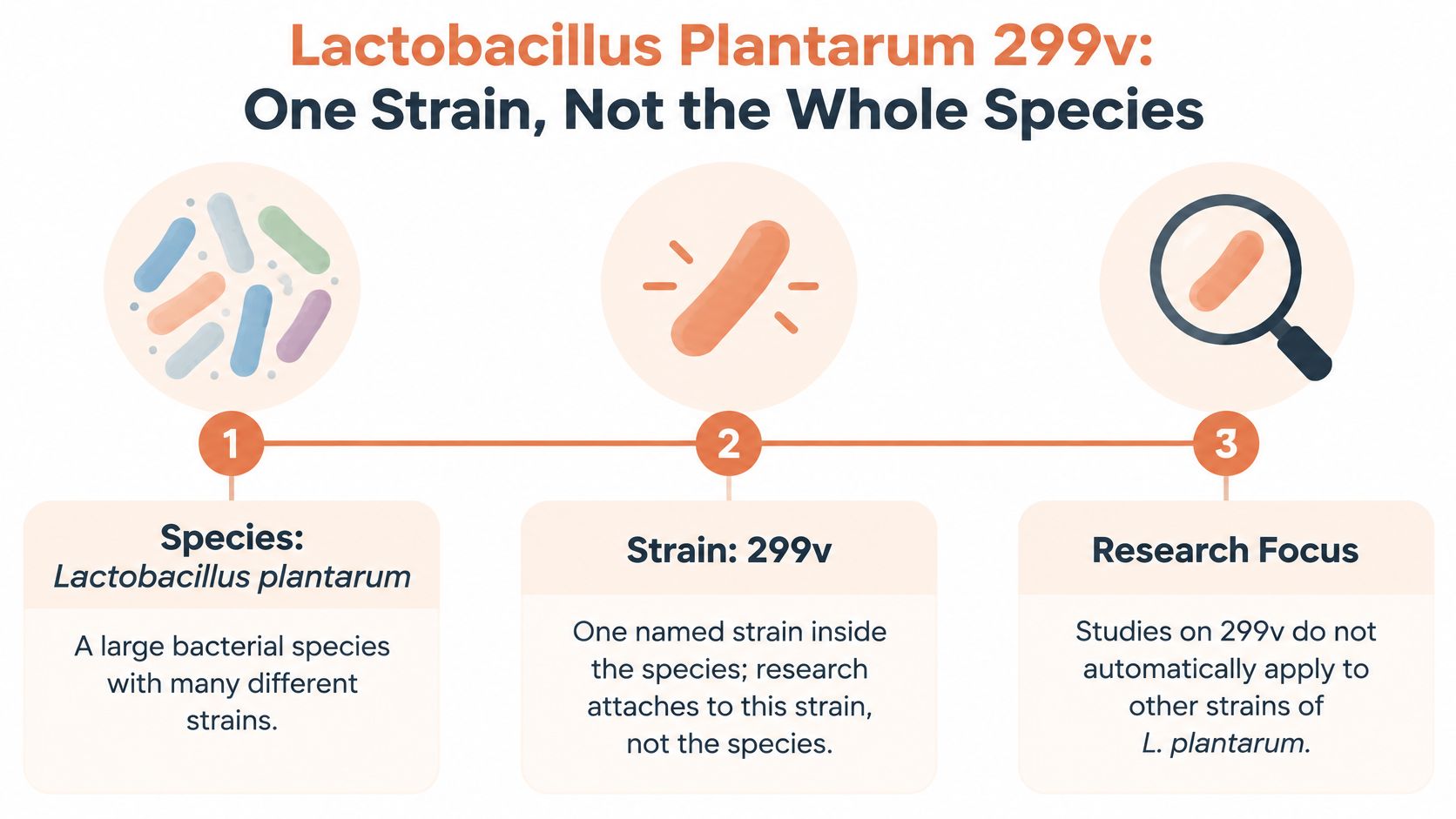
Lactobacillus plantarum is a species, a wide category that holds many different bacteria. 299v is one named strain inside that category, and the research hangs on the strain, not the category.
Reading a label that says Lactobacillus plantarum and assuming the studies apply is like reading "Labrador" on a kennel card and assuming you know that particular dog's temperament and medical history. The breed narrows things down. It doesn't identify the animal.
The strain itself was isolated at Lund University in Sweden from the intestinal mucosa of a healthy human, roughly three decades before a 2021 review of the field. By that review the strain had been described in more than 170 scientific publications, including over 60 human clinical studies, which makes it one of the most extensively investigated L. plantarum strains available, as Probi's account of the strain's history records. Commercial use followed early: the Swedish ProViva drink launched with 299v in 1994, and the research has stayed concentrated on gastrointestinal outcomes, particularly abdominal discomfort and flatulence.
Some labels print the culture collection number, DSM 9843. That string is one of the few quick confirmations you can check on a bottle.
The consequence matters more than the history. Because many L. plantarum strains exist, each with its own file, evidence for 299v doesn't transfer automatically to another strain, and it certainly doesn't transfer to a product that lists only the species. The iron work sharpens the point, since those researchers credited the live organism itself rather than fermentation byproducts, a pH shift, or added organic acids. A capsule of dead cells, or one labeled at species level only, can't be assumed to behave the same way.
Three label details decide whether you have a match, and each one gets a full explanation further down. The full strain designation (L. plantarum 299v or DSM 9843, never just the species), the live-cell count guaranteed at the end of shelf life rather than at manufacture, and a brand that cites human trials on that exact strain instead of gesturing at the species.
How 299v Compares With Other Probiotic Strains
Is 299v better than the probiotic already sitting in your cabinet? Nobody can answer that with a ranking, because there's no head-to-head trial pitting 299v against another named strain with a winner at the end. Anyone who tells you strain X beats strain Y across the board is selling something.
What you can compare is depth. 299v has one of the longest continuous research files of any L. plantarum strain, and its best-supported use is abdominal pain in adults with irritable bowel syndrome. That's a narrow claim, and it's a real one.
A three-question test for any strain
- Which outcome was measured? Bloating, pain frequency, stool consistency, iron absorption and transplant complications are different endpoints, and a win on one says nothing about the others.
- In which people? Adults with IBS, healthy women of reproductive age and children recovering from a transplant are three separate populations with three separate risk profiles.
- At what dose, for how long? A four-week daily capsule regimen is not the same experiment as a two-week course at half the strength.
Say a brand promotes a strain with strong data for antibiotic-associated loose stools. That's a legitimate result. It also tells you nothing about whether the same organism will touch your 4 p.m. bloating.
Rule of thumb: a product claiming to match 299v should name the strain, use a comparable live-cell dose, and point to human trials run on that exact strain.
The word "probiotic" isn't a ranking, it's a category, in the same way "painkiller" doesn't tell you whether to take it for a headache or a sprained ankle. Swapping to a cheaper product on the strength of 299v studies is a guess dressed up as a decision.
Comparing files gets concrete fast. Our breakdown of B. infantis 35624 covers a strain studied for a different set of symptoms, and reading the two side by side shows how little a shared genus really tells you. Choosing a probiotic is personal, and you deserve the right questions in hand before you choose.
Key Human Studies and What They Tested
Five human studies sit behind most of what this strain is claimed to do, and they split into two uneven piles: a larger body of work on IBS symptoms, and a smaller one on iron absorption.
| Study focus | Participants | Outcome measured | Result |
|---|---|---|---|
| IBS symptom trial, randomized and placebo-controlled | 214 randomized, 204 completed | Abdominal pain severity and frequency over four weeks | Significant reduction versus placebo |
| Earlier IBS study cited in the FDA GRAS notice | 40 patients | IBS symptoms | An early, smaller study that preceded the larger randomized trials |
| Iron absorption in women with low iron stores, randomized and placebo-controlled | Women with low iron stores | Non-heme iron absorption over four weeks | Higher absorption than placebo |
| Iron absorption with an iron-containing meal, study 1 | 14 healthy women of reproductive age | Fractional iron absorption | 17.4% rose to 22.4% |
| Iron absorption with an iron-containing meal, study 2 | 28 healthy women of reproductive age | Fractional iron absorption | 20.9% rose to 24.5% |
How to read a row without overreading it
Start with the participant column, because it tells you whether the row applies to you at all. The largest trial on the board randomized 214 people, 108 to the strain and 106 to placebo, and 204 finished the full four-week double-blind period, according to the FDA's GRAS notice for strain 299v. That same document records an earlier IBS study of 40 patients, which shows how the evidence base grew from small preliminary work into bigger randomized research.
Then look at duration. Four weeks shows up repeatedly. That is a useful hint about how long to give a trial before you judge it, and a warning against expecting a two-day turnaround.
The iron rows deserve a closer look than the summary allows. 14 and 28 healthy women of reproductive age is a small pair of studies, and both measured short-term fractional absorption rather than whether anyone's deficiency resolved, as the Science.gov collection of iron-absorption studies lays out. The percentage gains, 17.4% to 22.4% and 20.9% to 24.5%, describe how much iron from a single meal entered the blood. A stronger number on a lab measurement is weaker evidence for correcting low iron stores over time, which is why the IBS pile carries more practical weight than the iron pile.
Notice what the table cannot tell you. None of these rows tested general bloating in healthy adults, mood, immunity, or any endpoint in children, so a product leaning on 299v data for those claims is borrowing credibility the studies never earned.
Match the row to your goal before you assume the strain will help you. If your goal sits outside the abdominal-pain and iron-absorption endpoints above, that question belongs in a doctor's office.
How 299v Was Tested for IBS Abdominal Pain
The cleanest test of this strain took adults who met Rome III criteria for irritable bowel syndrome and gave them a daily capsule or a placebo for four weeks. Neither the participants nor the researchers knew who received which, which is what makes a result trustworthy in the first place.
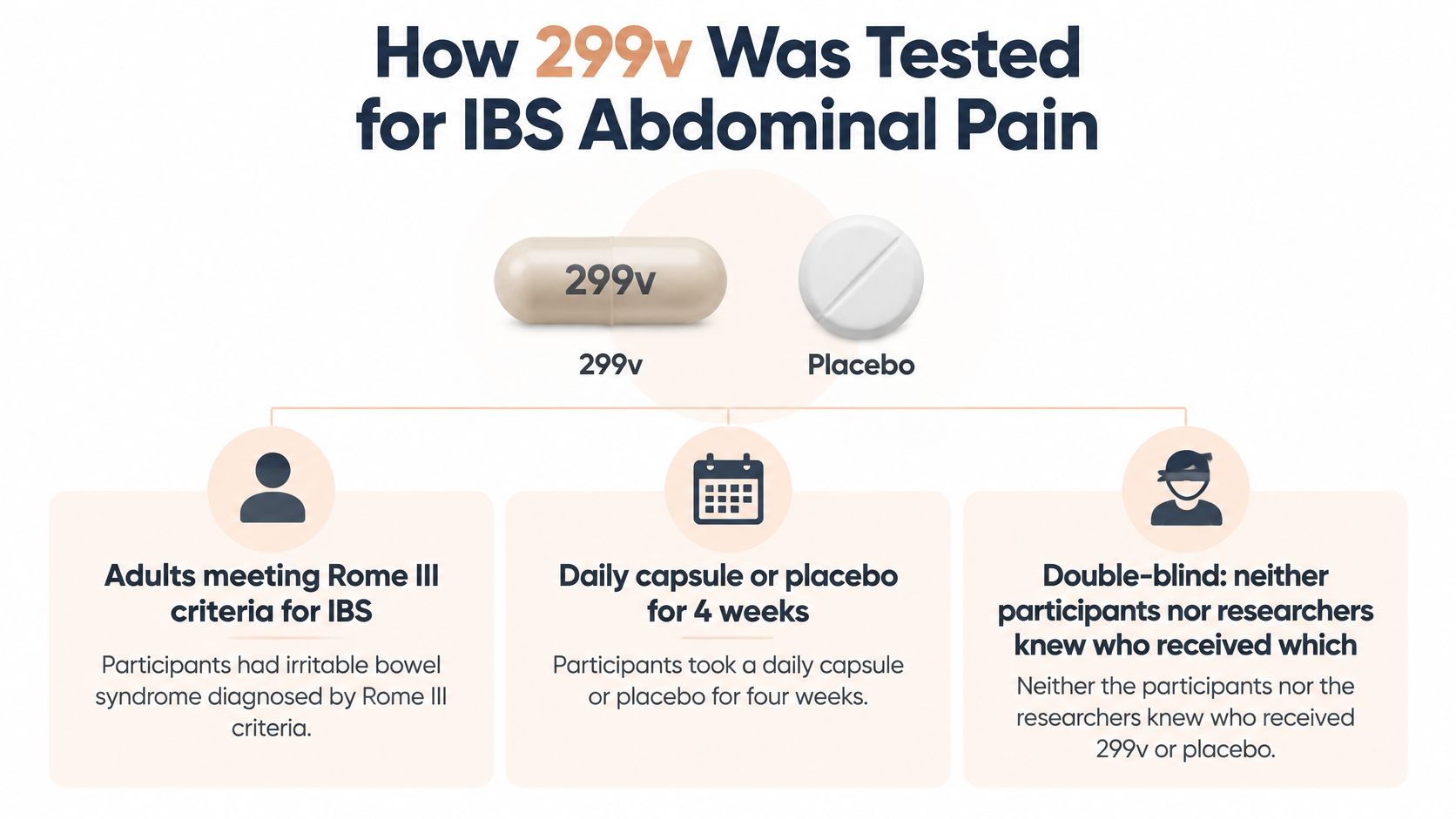
The numbers were modest and consistent. Mean pain severity came out at 0.68 with the probiotic versus 0.92 with placebo, and daily pain frequency at 1.01 versus 1.71. Both differences were statistically significant, according to the four-week IBS trial report.
What a drop from 0.92 to 0.68 actually feels like
Think of it as turning down the volume rather than switching off the noise. Fewer days when cramping shows up, and milder cramping when it does. That's a meaningful change if you've been planning your mornings around your gut, and it's a completely different promise from "cures IBS."
Tolerability held up. There was no significant difference in treatment-related side effects between groups, and one transient vertigo event was reported in the probiotic group. If you've abandoned supplements before because they made you feel worse, that result matters as much as the pain scores.
Where the trial stops
The study doesn't show that IBS is cured, that damage is reversed, or that every subtype responds the same way. Someone whose main problem is constipation, or whose symptoms flare around specific foods, isn't automatically the person in that trial.
What you can do with the finding is borrow the method. Track pain, bloating, stool pattern and the feeling of incomplete evacuation separately, in a simple daily note, because lumping them together hides exactly the pattern a clinician needs. Give any product at least four weeks before you decide, and bring the log with you if symptoms persist. If you're still sorting out whether your symptoms fit IBS at all, our guide to probiotic supplements for IBS covers the basics before you start experimenting.
Iron Absorption as a Promising Mechanism, Not a Fix
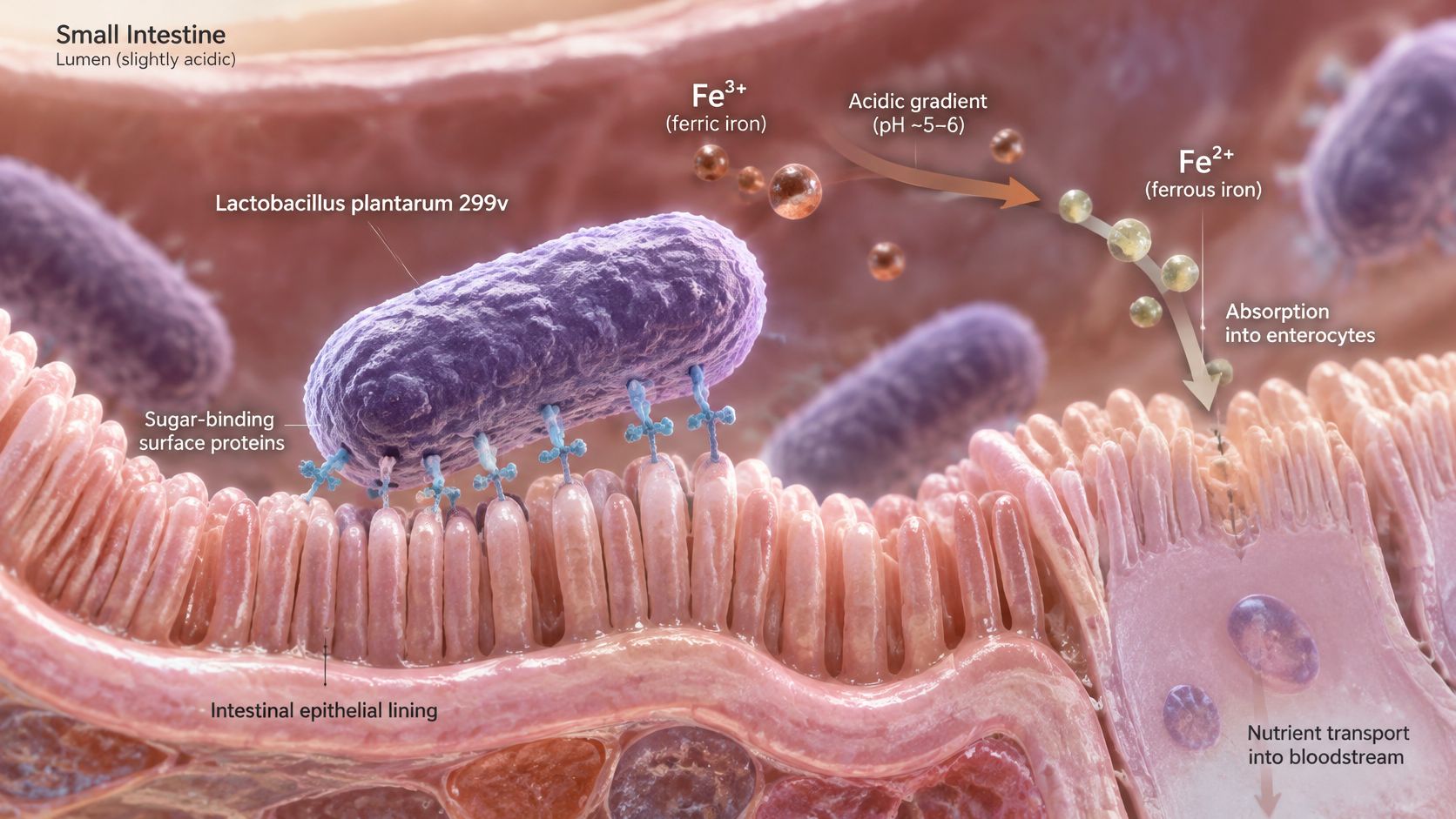
The iron story starts with a plausible physical mechanism. The live bacteria appear to stick to the intestinal lining through a mannose-binding system, which puts them in direct contact with the cells that control absorption. Extra acidification in that neighborhood may then help convert ferric iron (Fe3+) into the more absorbable ferrous form (Fe2+).
Why the bacteria might help iron at all
Non-heme iron, the form in spinach, lentils, oats and most plant foods, is the harder form for your body to absorb. It arrives in the ferric state and needs help converting before it can cross into the bloodstream. A bacterial population sitting on the gut wall, slightly acidifying the local environment, is a small but real lever on that step.
In a randomized, placebo-controlled study of women with low iron stores, four weeks of supplementation increased non-heme iron absorption compared with placebo, and the researchers attributed the effect to live Lp299v rather than to fermentation products, pH adjustment or added organic acids, as described in the review of Lp299v and iron physiology. That distinction matters for a practical reason: it points to the living strain doing the work, so a product needs to match the studied organism, not just the species name.
The strain identity point is sharper here than anywhere else in the article. The women in that trial received the 299v strain, so the evidence applies to products labeled Lactobacillus plantarum 299v or Lp299v. A capsule listing only "Lactobacillus plantarum" has not been tested for this effect, and plantarum is a wide species.
What the strain can't do
It doesn't replace iron treatment, and it hasn't been shown to correct diagnosed anemia. Absorption is a measurement of how much iron moves across the gut wall in a test setting. Anemia is a clinical diagnosis with a cause, sometimes blood loss or a diet issue, sometimes something that needs a doctor's eyes.
The iron evidence also sits earlier in its life than the IBS evidence: fewer studies, a narrower population, and absorption endpoints rather than symptom relief. Promising mechanism, thin human data.
Judge this with bloodwork, not with how your stomach feels. Ferritin, hemoglobin, transferrin saturation and tolerability are the four things worth tracking, and a supplement that "feels fine" tells you nothing about your iron status.
Practical details matter more than people expect. In these studies the strain went in alongside an iron-containing meal, so timing isn't incidental. Phytates in grains and legumes bind iron, and tea or coffee with a meal works against you. If you're plant-based and stacking non-heme sources all day, small changes around those blockers often do more than any capsule; Gym Snack ferritin-friendly snacking tips offer a practical starting point for pairing iron-rich foods well.
A vegan reader who's tired by mid-afternoon and ready to order the strain tonight has a better first move: a ferritin and hemoglobin test. Fatigue has a long list of causes and low iron is only one of them. Then decide with your clinician whether the strain is an add-on.
And note who wasn't in these trials: men, children and pregnant people weren't studied the same way. The mechanism is promising. It isn't a fix.
For a closer look at how live cultures interact with the gut lining, this short explainer is a good primer.
Safety and Who Should Check With a Doctor First
Safety questions about 299v split into two very different populations, and the split is the whole point. In generally healthy adults, the strain has been well tolerated in the IBS research. In people with severely compromised immunity, the picture changes, and the most informative trial here is one where the strain didn't work.
A 2025 phase 3 randomized, placebo-controlled trial gave the strain to 161 children and adolescents undergoing allogeneic hematopoietic-cell transplantation and found no benefit in preventing gastrointestinal acute graft-versus-host disease. Stage 1 to 4 disease occurred in 16% of the probiotic group versus 15% with placebo, and grades 2 to 4 in 26% versus 29%, according to the 2025 phase 3 transplant trial. No Lp299v bacteremia occurred, and serious adverse events didn't differ between groups.
Read that carefully, because it's easy to spin in either direction. The strain didn't cause harm in a fragile population. It also didn't prevent the complication.
Being safe in a high-risk trial is not the same as being appropriate for every high-risk person.
There's a second lesson buried in that trial. Microbial signatures differed between the groups without the studied outcome improving, which undercuts the assumption that a favorable shift in gut bacteria automatically becomes a clinical benefit. Biology doesn't work that linearly.
When to call your care team first
- During cancer treatment. Ask the oncology team before adding any probiotic, and bring the bottle so they can read the strain name and count.
- After a transplant. Immunosuppression changes the risk math, and the transplant team should make this call, not a label.
- With a low white cell count or a central line. These are the situations where a live organism deserves a conversation rather than a guess.
- When you're severely ill or immunocompromised. This includes uncontrolled disease flares and anything that has you in and out of hospital.
The tone here is caution, not alarm. For a healthy adult with cramping and bloating, this is a well-studied organism with a long safety record. For someone mid-chemo, the question isn't whether the strain is generally safe. It's whether it's safe for you, now, and only your care team can answer that.
Check the Label and Decide Your Next Step
Six checks, each with the reason it earns its place.
- Find the full strain designation. You want Lactiplantibacillus plantarum 299v, L. plantarum 299v, or DSM 9843. A species name with no strain number is a red flag, because it can't be traced back to any human trial.
- Read the live-cell count at the end of shelf life. A number measured at manufacture tells you what was in the capsule months ago, not what's in it when you swallow. Compare the stated count with the dose used in the studies you care about.
- Confirm the format protects live cells, and follow the storage directions. Freeze-dried cultures, protective capsules and clear refrigeration instructions all exist for a reason. A product that ignores survival is a product that assumes it.
- Match the product to your goal. IBS-type abdominal pain is the best-supported use. Iron absorption belongs in a conversation with your doctor and a lab result, not a cart.
- Look for published research on that exact strain and dose. Species-level claims are everywhere, and they're the easiest thing in the world to print.
- Look for third-party testing or a clear satisfaction guarantee. Purity and potency testing tells you someone outside the brand checked the contents.
Yuve's Gut Health & Digestion range includes plant-based probiotics, prebiotics and digestive enzymes, and our Vegan Probiotic Gummies carry 5 billion live cultures in every gummy. Read the label for the strain name before assuming a match with 299v, since a gummy at that count is a different product from a capsule used at a studied dose, and that comparison is exactly the one worth making. If you want the longer version of this checklist, what to look for when buying probiotics goes deeper.
Three ways to decide your next step
If cramping and bloating are your main complaint, choose a product that names 299v or DSM 9843 explicitly, track pain, bloating, stool pattern and incomplete evacuation separately for at least four weeks, and bring the log to your clinician if nothing shifts.
If low iron is the concern, get ferritin and hemoglobin checked first, keep any prescribed iron treatment exactly as prescribed, and treat the strain as a possible add-on discussed with your doctor rather than a replacement.
If you're in cancer treatment, had a transplant, or have weakened immunity, talk to your care team before buying anything. That conversation comes before every other item on this list.
A species name on the front of a bottle is a category, not a receipt.
Our founder, Sam, spent years being told her bloating was something to live with, and Yuve grew out of that frustration. We'd like to hear where you are in this. Which strain are you taking, how long did you give it, and what changed? Leave a note in the comments, because the next reader deciding between two bottles learns more from your four weeks than from any product page.
Frequently Asked Questions About Lactobacillus Plantarum 299v
Is Lactiplantibacillus plantarum 299v the same as L. plantarum 299v? Yes. It's the newer genus name for the identical named strain, so either spelling on a label should point you to the same research file. Check for the 299v or DSM 9843 designation either way.
Does it help IBS? In the four-week adult trial, people taking the strain reported less abdominal pain and fewer painful days than those on placebo. That's a promising result for symptom relief, not a cure, and it doesn't mean every IBS subtype responds the same way.
Can it fix low iron? It supported iron absorption in small studies of women, mostly alongside an iron-containing meal. It is not a replacement for iron treatment and shouldn't be judged by how you feel. Use ferritin, hemoglobin and transferrin saturation to see whether anything is changing.
Is it safe? It was well tolerated in the adult IBS research, with side effects similar to placebo. In a 2025 transplant trial in children and adolescents it caused no bacteremia and no excess serious adverse events, but it also didn't prevent graft-versus-host disease. Anyone with a weakened immune system should ask a clinician before using it.
How long before I judge it? Give it at least four weeks of daily use, which matches the trial designs, and track your symptoms in a simple log. Consistency and honest tracking will tell you more than any single good or bad day.
Three things to carry out of here: the strain name is the whole ballgame, the strongest evidence is for IBS abdominal pain in adults, and iron support is a mechanism rather than a cure.
Yuve makes plant-based gut supplements for people who want their digestive support to match their values, and our Gut Health & Digestion range pairs probiotics with prebiotics and digestive enzymes so you can build a routine that fits your day. If you're ready to compare labels with the six checks above in hand, come see what's in Yuve's gut health lineup and read each strain name before you decide. Your gut has been sending signals all along, and now you've got the vocabulary to answer them.