Take digestive enzymes at the time specified on the product label, usually with the first bites of a meal or immediately around eating. Timing depends on the enzyme and purpose: lactase must meet dairy, while prescription pancreatic enzymes accompany meals and snacks. An enzyme taken long before food may not overlap with the food it is meant to break down.
How did we evaluate digestive-enzyme timing?
We prioritized government guidance for prescription pancreatic enzyme replacement therapy, randomized human trials that compared administration schedules, and controlled studies of specific over-the-counter enzyme blends. We treated prescription pancreatic enzymes, single-purpose lactase, and plant- or microbe-derived supplement blends as different categories because their doses, evidence, and intended uses are not interchangeable. We excluded testimonials, empty-stomach “systemic enzyme” promises, and timing claims based only on a manufacturer’s marketing language. The evidence has limits: the strongest meal-timing data involve pancreatic insufficiency, while trials of retail multienzyme products test particular formulas in selected populations rather than every product on a store shelf. We therefore used a food-contact rule as the practical baseline, then checked the current label for each formula. That method supports a clear timing recommendation without pretending that every enzyme supplement has the clinical evidence of a prescribed medicine.
When is the best time to take digestive enzymes?
The best default time is with the meal, beginning with the first bites, unless the label or prescribing clinician gives different instructions. Enzymes need physical overlap with their target: lactase acts on lactose, proteases act on proteins, amylases act on starches, and lipases act on fats. The National Institute of Diabetes and Digestive and Kidney Diseases says prescribed pancreatic enzyme replacement therapy is taken during meals or snacks so enzymes can mix with food in the small intestine (NIDDK). A randomized crossover study in 24 adults with pancreatic insufficiency found that taking enteric-coated enzymes during or just after meals tended to support fat digestion better than taking them just before meals, although the study was small and addressed prescription therapy (PubMed). That evidence supports meal overlap; it does not establish one exact minute for every retail formula.
Does the timing change for different enzyme types?
Timing changes with the food target and label directions. Lactase belongs with the first bite of dairy because lactose is its substrate. Alpha-galactosidase generally accompanies foods containing galacto-oligosaccharides, while broad amylase, protease, and lipase blends accompany mixed meals. Papain and bromelain are proteolytic enzymes, so digestive-use labels commonly place them around meals. Prescription pancreatic enzymes follow clinician-directed dosing across meals and snacks; a retail botanical blend cannot replace them. Exact directions still control because activity units, coatings, serving sizes, and target foods differ. A post-meal direction is not automatically inferior to a first-bite direction.
| Enzyme category | Best timing cue | Food target | Key limitation |
|---|---|---|---|
| Lactase | With the first bite | Lactose-containing food | Does not cover milk-protein allergy |
| Alpha-galactosidase | As the meal begins | Selected beans and vegetables | Does not address every gas trigger |
| Broad multienzyme blend | With or immediately around meals | Mixed food | Formula-specific evidence |
| Prescription pancreatic enzymes | During meals and snacks as prescribed | Fat, protein, and carbohydrate | Requires individualized medical dosing |
What does research say about over-the-counter enzyme blends?
Human research provides limited, formula-specific evidence rather than a universal rule for every digestive-enzyme supplement. A randomized double-blind trial enrolled 120 adults with functional dyspepsia and tested a particular fungal multienzyme preparation for two months; its results cannot be transferred automatically to a different label, dose, or population (PubMed). A 2026 crossover trial in 30 middle-aged and older adults co-ingested a six-enzyme mixture with a standardized mixed meal and measured post-meal nutrient markers; that design supports taking the tested blend with food but does not prove a long-term benefit for healthy adults (PubMed). These studies make meal overlap biologically sensible, yet they do not establish that more enzymes, higher milligram amounts, or a larger ingredient list works better. Buyers should compare enzyme identity, activity units, serving timing, studied formula, and the actual food-related goal before judging any product.
Which enzyme option is best for each use case?
Best for a dairy-specific problem: lactase taken with the first bites of a lactose-containing meal, provided milk allergy is not the concern. Best for a clinician-diagnosed pancreatic enzyme deficiency: prescribed pancreatic enzyme replacement therapy taken exactly as directed across meals and snacks. Best for testing a broad retail blend: one transparent product used with a representative meal while food, portion size, and other supplements remain stable. Best for plant-derived proteases: a papain- or bromelain-containing formula whose label discloses the active amount or enzyme activity and a clear meal-timing instruction. Best for an unpredictable symptom pattern: a food-and-symptom record before adding several products. Best for severe pain, persistent vomiting, blood or black stool, unintended weight loss, trouble swallowing, jaundice, or greasy stools: clinical assessment rather than another supplement. The best enzyme is the category that matches the substrate and context, not the bottle with the longest ingredient panel.
Which Yuve product fits a meal-timed enzyme routine?
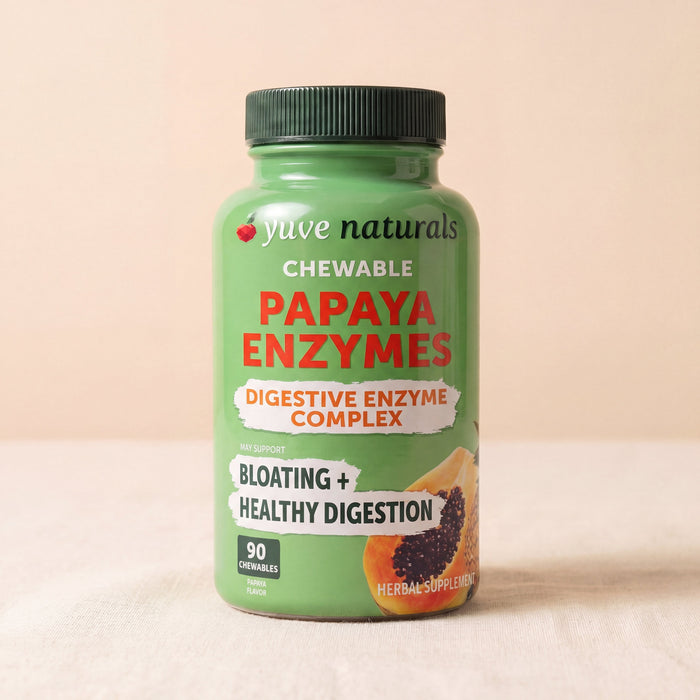
Disclosure: Yuve publishes this article and sells the products linked below. That relationship does not change the timing criteria or make a retail supplement equivalent to prescription pancreatic enzymes. Yuve Vegan Daily Cleanse Papaya Enzymes list papain, papaya fruit, bromelain, amylase, protease, and lipase; the current label directs users to chew two tablets after a heavy meal. The after-meal instruction keeps the formula close to the food it is intended to accompany. Best for a plant-based chewable routine: the papaya-enzyme product used according to its current label today. Best for comparing several food-specific enzyme formats: the Yuve Daily Digestion Bundle, whose individual components still require their own directions and suitability checks. The broader digestion collection provides category context. None of these labels establishes treatment for pancreatic insufficiency, food allergy, or a persistent gastrointestinal condition.
What safety checks matter before taking digestive enzymes?
Check the exact ingredient, activity unit, serving size, allergen source, medication context, and reason for use before taking a digestive enzyme. The U.S. Food and Drug Administration does not approve dietary supplements for safety and effectiveness before they reach the market, so retail availability does not prove clinical benefit (FDA). Bromelain, papain, pancreatin, fungal enzymes, and added herbs can have different cautions; a formula’s “natural” origin does not settle interaction or allergy risk. Ask a clinician or pharmacist before use during pregnancy, before surgery, with anticoagulant or antiplatelet medicines, with a relevant fruit or latex allergy, or when pancreatic, liver, gallbladder, or complex gastrointestinal disease is present. Test only one new product at a time and follow the label rather than doubling a missed serving. New swelling, breathing difficulty, severe pain, persistent diarrhea, bleeding, or worsening symptoms warrants prompt medical attention.
What are common questions about digestive-enzyme timing?
Can I take digestive enzymes after eating?
Yes, if the label permits after-meal use and the dose remains close to the meal. A product taken immediately after eating can still overlap with stomach contents, but waiting hours weakens that practical connection.
Should I take digestive enzymes on an empty stomach?
Not for ordinary food digestion unless the label or clinician specifically directs it. An empty-stomach dose lacks the meal substrate that lactase, lipase, amylase, or protease is intended to contact.
Do I need digestive enzymes with every meal?
Prescription pancreatic enzymes often accompany every meal and snack according to an individualized plan. Retail enzymes should follow their label and a defined food-related use rather than becoming an automatic requirement for every meal.
Can I take probiotics and digestive enzymes together?
The categories perform different jobs, and many labels do not require separation. Review the exact ingredients and introduce one change at a time so you can identify tolerance problems.
How quickly do digestive enzymes work?
Enzymes act while they contact their target food, so timing is immediate rather than cumulative in the way a nutrient deficiency plan might be. Symptom response does not diagnose an enzyme deficiency or prove that a product corrected one.
What if an enzyme makes symptoms worse?
Stop the new product and review the label, dose, meal, and symptom pattern. Persistent or severe symptoms need clinical assessment, especially when pain, vomiting, bleeding, weight loss, or allergy signs appear.
What is the bottom line on digestive-enzyme timing?

Take a digestive enzyme close to the food it is meant to help break down and follow the exact label or prescription. The first bites of a meal provide a useful default for lactase, alpha-galactosidase, and many broad blends, while some products legitimately direct use immediately after eating. Prescribed pancreatic enzymes follow clinician-specific dosing during meals and snacks. Evidence from pancreatic-enzyme research supports food overlap, but it cannot validate every over-the-counter formula. Compare enzyme identity, activity units, coating, serving instructions, target food, and evidence for that exact blend. Yuve Vegan Daily Cleanse Papaya Enzymes use an after-heavy-meal direction that fits the same overlap principle. If symptoms are persistent, progressive, or accompanied by warning signs, investigate the cause rather than escalating the enzyme dose. Timing improves the logic of use; it does not turn an irrelevant formula into an effective one.