You've made the careful switch to plant-based, gluten-free foods, yet your stomach still balloons by afternoon. Then comes the supplement aisle, packed with bottles promising clean ingredients, huge CFU counts, and effortless gut health. Choosing among the best vegan gluten-free probiotics shouldn't require guesswork. The useful question is not which label sounds nicest, but whether the strains, dose, delivery system, and quality checks match your actual digestive concern.
Why Your Stomach Needs Friendly Bacteria
Bloating can turn an ordinary day into a series of calculations. You wonder whether lunch was too large, whether a new snack contained a hidden trigger, or whether the probiotic you started is helping at all. That uncertainty feels especially frustrating when you're already managing food sensitivities or following a strict gluten-free and vegan routine.

Probiotics are live microorganisms that may support the balance of microbes in your digestive tract. That doesn't mean every product works for every person. A formula chosen for general digestive maintenance may not be the best fit for someone dealing with recurring bloating, and a product with a large number on the front label may not contain the strains most relevant to that goal.
The category has also grown far beyond a niche supplement shelf. Recent estimates place the global probiotics market at about USD 71.9 billion in 2025, USD 77.4 billion in 2026, and USD 114.95 billion by 2030, with longer-range projections reaching as high as USD 417.09 billion by 2035 or USD 469.1 billion by 2036, depending on methodology, according to Precedence Research's probiotics market estimates. The same source gives possible growth rates ranging from 6.05% for 2026 to 2034 to 8.5% for 2025 to 2030.
A bigger market creates more choice, but it doesn't remove the need to read the label carefully.
Strain identity beats a dramatic front label
Think of a probiotic strain like a named tool. A screwdriver and a measuring tape are both useful, but they solve different problems. In the same way, the genus and species names alone may not tell you enough. The complete strain identity is more useful when you're trying to connect a product with a particular digestive outcome.
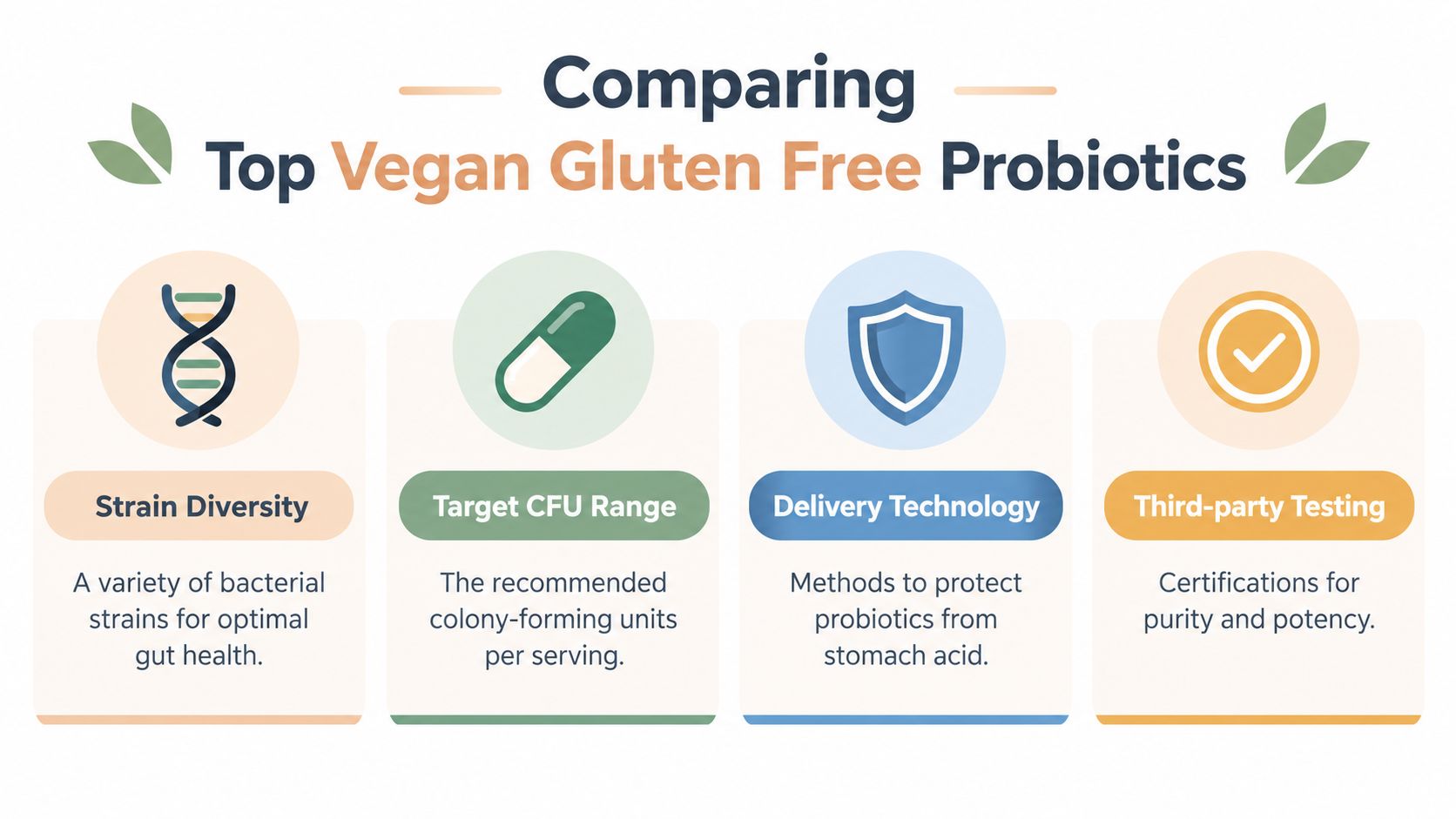
This guide uses a simple decision framework:
- Outcome: Are you shopping for daily support, occasional bloating relief, or a sensitive-digestion routine?
- Strain: Does the label identify the microorganisms clearly?
- Dose: Is the CFU amount appropriate for the intended use?
- Delivery: Can the bacteria remain viable and survive the journey through the stomach?
- Verification: Does the manufacturer explain testing, storage, and potency through expiry?
That approach helps us move past “vegan” and “gluten-free” as the entire decision. Those attributes matter, especially for people avoiding animal-derived ingredients, wheat, barley, rye, dairy, or cross-contact. They are the starting point, not the finish line.
What Vegan Gluten Free Probiotics Actually Mean
A vegan probiotic should avoid animal-derived ingredients and materials. That includes obvious concerns such as gelatin capsules, but shoppers may also want to check the full inactive-ingredient list and ask how the cultures are produced. A plant-based label is helpful, while transparent manufacturing information gives you a clearer picture of what you're buying.
A gluten-free probiotic should be made without gluten-containing ingredients and should address contamination risk. This distinction matters for anyone with celiac disease or a medically advised gluten-free diet. “Gluten-free” isn't a substitute for checking the product's certification, facility practices, and current label.
Dairy-free and lactose-free are related but separate filters. A vegan product will generally avoid dairy ingredients, but shoppers with significant digestive sensitivity should still confirm that the label says what they need it to say. A capsule can look simple while containing excipients, flavorings, or prebiotic ingredients that don't suit every stomach.
Clean label is useful, but incomplete
Many probiotic roundups organize recommendations around vegan, gluten-free, dairy-free, and non-GMO claims. Those filters make shopping faster, but Healthline's probiotic supplement coverage reflects a broader gap in this type of content. Product comparisons often provide limited detail about strain-specific evidence, clinical endpoints, and which people may need to avoid formulas containing prebiotic additives or fermentable ingredients.
That gap explains why two products can both be vegan and gluten-free yet feel very different in practice. One may suit routine maintenance, while another contains a combination chosen for a more specific digestive purpose. A long ingredient list isn't automatically more effective, and a short one isn't automatically gentler.
For a friendly explanation of how the two categories work together, read understanding prebiotics and probiotics. Prebiotics are ingredients that help support certain existing microbes, while probiotics provide live microorganisms. Some people tolerate that combination beautifully. Others with sensitive digestion may want to introduce each component carefully.
You can also explore Yuve's vegan probiotics supplements for a plant-based, gluten-free option. Before buying any formula, use this mindset:
- Confirm the dietary fit. Look for vegan and gluten-free statements that match your needs.
- Identify the target. Choose based on the symptom or routine you want to support.
- Inspect the complete strain names. Don't rely on a vague “proprietary blend.”
- Check the potency language. Find out whether the CFU count applies through expiry.
- Review the delivery and storage directions. A convenient product is easier to use consistently.
How to Compare Top Probiotic Picks by Real Outcomes
The best vegan gluten-free probiotics aren't necessarily the ones with the largest CFU count. Start with the reason you're taking one, then compare the formula against that reason.
| Your situation | What to prioritize | Main trade-off |
|---|---|---|
| Daily digestive maintenance | Clearly identified strains, a moderate target dose, and easy storage | More organisms doesn't automatically mean better results |
| Recurring bloating | Strains connected with digestive outcomes and a delivery system designed for survival | A targeted formula may contain more ingredients to assess |
| Sensitive digestion | A short, transparent ingredient list and careful review of prebiotic additives | A simpler product may offer less strain diversity |
| Travel or busy routines | Shelf stability, clear storage directions, and potency through expiry | Convenience depends on following the label exactly |
Daily maintenance versus targeted support
Independent probiotic roundups commonly place vegan, gluten-free formulas between 11 billion and 100 billion CFU per serving, according to Fortune's probiotic comparison for women. That range is broad for a reason. Product design, strain choice, intended use, and stability all affect how meaningful the number is.
Examples in that review include a 53.6 billion AFU vegan capsule with 24 strains and a shelf-stable, gluten-free profile, along with a 100 billion CFU vegan capsule formula. Expert commentary in the same source describes 12 to 20 billion CFU as typically sufficient for general digestive maintenance, while formulas around 50 billion CFU with clinically studied strains such as HN019 or L. reuteri may be used for more targeted bloating or digestive support.
That doesn't make the higher number a universal winner. Someone who wants a consistent daily habit might prefer a moderate formula with straightforward labeling. Someone focused on a recurring symptom may care more about whether the strain combination has been studied for that kind of concern.
Diversity can help, but it can also complicate the decision
A multi-strain product offers variety, which some shoppers find appealing. Yet “more strains” only becomes meaningful when the product identifies them clearly and explains why they're included. A formula that lists multiple organisms without strain-level detail makes it difficult to compare with clinical research.
For a food-based perspective, sourdough bread for gut health offers useful context about fermented foods and digestive routines. Sourdough may fit some people's eating patterns, but it isn't automatically gluten-free, and it shouldn't be treated as an equivalent substitute for a labeled gluten-free probiotic supplement.
Match the product to your trigger pattern
Keep a short symptom log while you evaluate a product. Record the food context, timing of discomfort, stool changes, and any new additives. If a formula contains inulin, chicory root, or another prebiotic ingredient, note that separately because the additive, rather than the probiotic organisms, could be affecting your symptoms.
For people with IBS-like symptoms or strong food sensitivity, low-FODMAP compatibility and ingredient transparency may matter more than an impressive strain count. For people concerned about immune support, the label should still identify the organisms and provide a realistic description of intended use rather than promising broad protection.
A helpful comparison asks four questions:
- Can I identify the strains?
- Does the dose fit my goal?
- Will the product remain stable in my real life?
- Can the manufacturer show how potency and purity are checked?
That is a more useful shortlist than choosing by star ratings alone.
Reading Probiotic Labels Like an Expert
A probiotic label should answer a basic question: how many live microorganisms will you receive when the product reaches the end of its stated shelf life?
The CRN and IPA best practices for probiotics recommend stating the quantity of live microorganisms in colony-forming units, or CFUs, at the end of shelf life, rather than only listing the amount present when the product was manufactured. That distinction is easy to miss. A product can leave the factory with a high count and still need better stability information before you can judge the dose you'll receive near expiry.
Use this label-reading sequence
First, find the strain names. Look for the genus, species, and strain designation where available. A label that only says “multiple probiotic cultures” gives you less information than one that names the organisms precisely.
Next, locate the CFU statement. Check whether the count applies per capsule, serving, or full daily dose. Then look for language connecting that count to expiry.
Then, inspect the date and storage instructions. “Best by” or expiration information matters only when you store the product as directed. Heat, humidity, and light can create problems for live cultures, so a bathroom cabinet may be a poor location even when the bottle looks sealed.
Finally, look for testing details. Third-party testing, identity checks, contamination screening, and potency verification can all strengthen confidence. The manufacturer should be able to explain what was tested and when.
Practical rule: A CFU number without a clear shelf-life statement is an incomplete quality story.
Delivery changes the real-world dose
Shelf-stable products may use lyophilized, or freeze-dried, bacteria, or spore-forming technologies to avoid refrigeration. Delayed-release and enteric designs aim to protect cultures from stomach acid before they reach the intestine.
An independent comparison reported that stability-tested capsules using DRcaps-type technology retained about 95% viability at 77°F for 18 months, compared with roughly 40% for standard capsules under the same benchmark. Those figures come from the comparison at Air Fryer Bite, and they illustrate why delivery technology deserves attention alongside the CFU number.
You'll find more label guidance in Yuve's explanation of probiotics and gluten-free supplements. The central lesson is simple: potency, protection, and storage work together. A shelf-stable product may suit travel, while a refrigerated formula may require more planning. Neither format wins automatically. The better choice is the one with transparent stability information that you can store correctly.
Building a Gentle, Bloat-Friendly Routine
A probiotic routine works best when it feels ordinary. Take it at the time your label recommends, connect it with an existing habit such as breakfast or brushing your teeth, and avoid changing several digestive variables at once.
Start with a calm baseline. If you've just changed your diet, added a probiotic, increased fiber, and begun eating new fermented foods all in the same week, you won't know what caused a reaction. Introduce one major change at a time and write down what happens.
Sam's digestive challenges with dairy and gluten helped shape Yuve's focus on plant-based, allergen-conscious supplements. That experience is familiar to many people who want to enjoy meals without mentally reviewing every ingredient afterward. The useful takeaway isn't that one product solves every stomach problem. It's that a consistent, carefully selected routine can reduce the daily guesswork.
A simple routine for sensitive digestion
- Choose one clear goal. Start with daily maintenance, occasional bloating, or a specific concern you're discussing with a healthcare professional.
- Follow the product directions. Don't assume that taking more will produce faster relief.
- Keep meals predictable at first. Familiar foods make symptom tracking easier.
- Watch the supporting ingredients. Prebiotic fibers and sweeteners may affect sensitive people differently from the probiotic cultures.
- Review your notes before switching. Look for patterns rather than judging the product after one uncomfortable afternoon.
Yuve's Vegan Probiotic Gummies are labeled vegan and gluten-free and provide 5 billion live plant-based cultures per serving, as described in the product information supplied for this article. That makes the product relevant for someone seeking a convenient plant-based format, although your personal goal and tolerance still determine whether it's the right fit.
The U.S. regulatory context also matters. Probiotic powders are regulated as dietary supplements under DSHEA, and the FDA doesn't require pre-market review, so manufacturers carry much of the responsibility for quality and label accuracy, as explained by BSG Consulting Group's overview of probiotic testing and verification.
If bloating is your main concern, use this guide to probiotics for bloating alongside your symptom notes. Seek medical advice for persistent, severe, or worsening symptoms, especially if you have a diagnosed digestive disorder, are immunocompromised, or are choosing a product for a child.
Here's a short routine you can screenshot:
- Morning: Take the product according to its label and drink water.
- During the day: Eat slowly and note foods that repeatedly precede discomfort.
- Evening: Record bloating, stool changes, and any unusual symptoms.
- Weekly: Check whether the routine feels sustainable and whether the product remains within its storage and expiry guidance.
Consistency matters more than dramatic experimentation. A product you remember and store properly is more useful than an impressive bottle that sits unopened in a cupboard.
When to Choose a Specific Probiotic Strategy
For general gut maintenance, choose a vegan, gluten-free formula with clearly named strains, a sensible dose, and directions you can follow every day.
For occasional bloating after rich meals, look for strain information connected with digestive support and consider whether the product includes additives that might aggravate your symptoms. Probiotics work as part of a routine, not as an instant reset button.
For sensitive digestion, prioritize a transparent ingredient list, careful allergen controls, and a delivery system that protects viability. If you're managing celiac disease, IBS, or ongoing unexplained symptoms, involve a qualified healthcare professional rather than relying on a supplement label alone.
For travel, shelf stability and clear storage instructions can be decisive. For a targeted concern, strain-specific evidence and potency through expiry should be essential.
The best vegan gluten-free probiotics are the ones that align with your goal, your trigger pattern, and your real schedule. Start with the label, then pay attention to your body.
Yuve offers plant-based, vegan, and gluten-free probiotic options designed for convenient daily gut-health support, including probiotic gummies with live plant-based cultures. Visit Yuve to compare the available formulas and choose a routine that fits your digestion, dietary needs, and everyday life.