Yes, most healthy adults can take a probiotic on an empty stomach, but the label should decide the routine. Meal timing affects some fragile bacteria more than acid-tolerant spores or protected capsules. If the label allows either approach, taking the probiotic consistently with or shortly before a meal is a practical default.
How did we evaluate taking probiotics on an empty stomach?
We evaluated timing by separating three questions: whether live microorganisms survive simulated stomach conditions, whether a meal changes that survival, and whether the product label has a specific direction. We prioritized human studies when available, then dynamic laboratory digestion models because direct timing trials with clinical outcomes are scarce. We also distinguished bacterial species and delivery formats instead of treating every probiotic as interchangeable. The evidence has an important limitation: a higher count after simulated digestion does not prove a better health outcome in a person. Product instructions therefore carry more practical weight than a universal “empty stomach” rule, especially when a formula uses an enteric coating, a food matrix, or a spore-forming organism. This method excludes testimonials, unsupported colonization claims, and timing advice that ignores the named organism or the manufacturer’s storage directions.
Can you take probiotics on an empty stomach?
Most healthy adults can take a probiotic without food when the label permits it. Stomach acid does not automatically destroy every probiotic: survival depends on the microorganism, its physiological state, the dose, and its delivery vehicle. A laboratory comparison of commercial formats found that lactobacilli survived stomach-level acidity across capsules, powders, yogurt, yogurt drinks, and kefir, although that experiment did not measure clinical benefits in people (Beneficial Microbes, 2016). A missed meal therefore does not automatically make a dose useless. However, “probiotic” describes many different bacteria and yeasts, not one standardized ingredient. The National Center for Complementary and Integrative Health notes that different probiotic types can produce different effects (NCCIH). Follow the bottle when it says “with food,” and do not double a later dose simply because an earlier dose was taken without food.
Does meal timing change probiotic survival?
Meal timing can change survival for some formulas, but the strongest timing evidence comes from simulated digestion rather than clinical outcome trials. A 2011 upper-gastrointestinal model tested one multi-strain product and found the bacteria survived best when taken with a meal or 30 minutes before it; survival was lower when the product was added 30 minutes after the meal (Beneficial Microbes). The meal’s buffering capacity also mattered, so the result does not establish one schedule for every capsule, gummy, spore, or yeast. A separate dynamic gastric model found that milk protected several Lactobacillus strains better than water under the tested conditions (Food Microbiology). These laboratory findings support a practical default—take a label-flexible probiotic with or shortly before a meal—but they do not prove that breakfast is superior to dinner or that an empty-stomach dose provides no benefit.
| Timing option | Evidence-based interpretation | Best fit |
|---|---|---|
| With a meal | Food can buffer stomach acidity for some organisms | Fragile bacteria when the label allows it |
| About 30 minutes before a meal | Performed well in one simulated multi-strain study | A simple routine before breakfast or dinner |
| Long after a meal | Produced lower survival in that same model | Use only when directed or when consistency requires it |
| Any time | May suit acid-tolerant spores and label-flexible products | People prioritizing daily adherence |
Which probiotic format is least sensitive to stomach acid?
Spore-forming bacteria generally tolerate acidic conditions better than many unprotected vegetative bacteria, but genus or species names alone do not guarantee a clinical effect. Bacillus coagulans forms a resistant spore before germinating under suitable conditions, while many Lactobacillus and Bifidobacterium products rely on strain selection, protective capsules, freeze-drying, or a food matrix. Enteric-coated capsules delay release until the surrounding pH rises, although coating performance varies by formulation. Fermented dairy can buffer acid, but yogurt organisms are not automatically the same strains used in a clinical trial. The practical hierarchy is product-specific: verify the full organism name, colony-forming units through expiration when stated, storage requirements, and the manufacturer’s timing instructions. Best for flexible timing: a shelf-stable spore-forming product. Best for explicit delayed release: a validated enteric-coated capsule. Best for food-first intake: a fermented food that lists live and active cultures and fits the person’s dietary needs.
What timing rule works best for an everyday probiotic routine?
The best routine is the label-approved schedule that you can repeat without frequent missed doses. If a product says “with or without food,” choose one daily cue—breakfast, dinner, or brushing your teeth—and keep the dose consistent. If the formula contains fragile bacteria and offers no timing direction, taking it with or about 30 minutes before a meal is a reasonable evidence-informed default, not a clinical guarantee. Swallow capsules with cool water because hot drinks can expose live organisms to unnecessary heat. Do not open an enteric-coated capsule unless the label explicitly allows it, since opening can remove the delivery protection. Refrigerate only when the package requires refrigeration; unnecessary temperature swings and moisture can be more relevant than an occasional timing variation. Best for adherence: the same meal each day. Best for meal-buffering: with or shortly before food. Best for a forgotten dose: resume the normal schedule rather than doubling.
Which product details matter more than taking it with food?
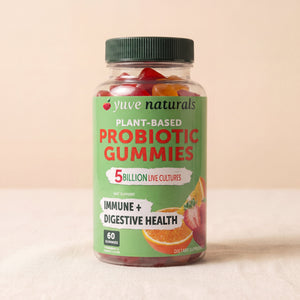
Commercial disclosure: Yuve publishes this article and sells the product linked below; that relationship does not change the evidence standard used for timing claims. The Yuve Vegan Probiotic Gummies label currently lists 5 billion CFU of Bacillus coagulans per two-gummy serving and directs adults to take two gummies daily, with or without food. The label identifies the species but not a strain code, so trials on a named B. coagulans strain cannot be assumed to prove the same outcome for this formula. The spore-forming format and label-flexible directions make consistent timing more important than choosing an empty or full stomach. People comparing products should also check the serving size, CFU statement, expiration language, added sweeteners, allergen information, and storage directions. The broader Yuve digestion collection includes different ingredient categories; prebiotic fiber and digestive enzymes are not interchangeable with live probiotic organisms.
What should you know about probiotic safety?
Probiotics have a long history of use in generally healthy people, but “natural” does not mean risk-free. Temporary gas or bloating can occur after starting a product, and evidence about long-term safety remains incomplete. NCCIH reports that the risk of harmful effects is greater in people with severe illness or compromised immune systems; premature infants and seriously ill hospitalized patients require particular caution (NCCIH). A clinician or pharmacist should review probiotic use for people with a central venous catheter, major immune suppression, recent intensive-care stay, or other serious underlying condition. Pregnancy, breastfeeding, childhood use, and concurrent treatment also justify product-specific guidance rather than a universal timing rule. Stop using the product and seek medical advice if symptoms are severe, persistent, or accompanied by fever, blood in stool, dehydration, or significant pain. A probiotic should not delay evaluation or replace care for a health problem.
What questions do people ask about probiotic timing?

Is morning or night better for probiotics?
Neither morning nor night is universally better. Choose the label-approved time you can repeat, and use a meal cue if the formula benefits from food buffering.
Can I drink coffee with a probiotic?
Use cool water for the dose because very hot liquid can expose live organisms to heat. Coffee does not create a universal interaction, but taking the probiotic separately is an easy precaution when the label is silent.
Should I take a probiotic before breakfast?
Taking it shortly before breakfast is a reasonable option when the label permits it. One simulated digestion study favored administration with a meal or 30 minutes before, but that result does not cover every strain or format.
Can I take a probiotic after dinner?
Yes, if the product directions allow it. Taking the dose with dinner may provide food buffering and a reliable daily habit.
What if I forgot my probiotic before eating?
Take the dose according to the package directions or resume at the next normal time. Do not double the dose unless a qualified clinician or the label specifically instructs you to do so.
Do probiotic gummies need food?
The answer depends on the gummy’s organism and label. Yuve Vegan Probiotic Gummies state that they may be taken with or without food, while another gummy can have different directions.
Do all probiotics need refrigeration?
No. Shelf stability depends on the organism, formulation, packaging, and labeled storage conditions; follow the bottle instead of refrigerating every product automatically.
The useful rule is simple: follow the product label, favor consistency, and use a meal as the default when directions allow either approach. Empty-stomach dosing is not automatically harmful or wasted, but strain, delivery format, storage, and the person taking the product matter more than a universal clock time.