Some probiotic cells do survive stomach acid, and plenty do not. In one dynamic model of the human upper gut, three commercial Lactobacillus strains came back at only 1.0% to 43.8% of their starting count when they were delivered in water, then at 80.5% to 197% when those same strains arrived in milk. Same bacteria, wildly different outcome.
If you've been swallowing a capsule every morning and still ending the day with a hard, swollen belly, that gap explains a lot. You didn't do it wrong. The bottle never promised what you assumed it promised, and the thing that decides your fate isn't the word probiotic on the front label. It's the strain you bought, the minutes it spends in acid, and what surrounds it on the way down.
Stick with me and you'll know how to read a survival claim, why a meal can change the math entirely, and how to tell a lab result apart from a real change in how your gut feels.
Do Probiotics Survive Stomach Acid
Some cells make it and many don't, and the split is not random. Your stomach commonly sits at roughly pH 1.5 to 3.0, which is a serious barrier by itself, and anything that clears it still walks into bile salts and digestive enzymes in the small intestine, according to the Journal of Dairy Science upper-gastrointestinal model study00575-0/pdf).
So the honest answer is that survival depends on the strain, the exposure time, the acidity, the growth phase of the culture, and whether you took it with food. A label that says "probiotic" guarantees none of those things. That's the first idea worth holding onto, because it reframes every shopping decision you'll make after this.
Here's where readers get tangled. Two careful tests can produce opposite headlines, one showing almost everything recovered and the other showing almost nothing left. Both are accurate for the specific cells in that specific test.
How many probiotic cells survive acid
| Test setup | Survival or loss | Plain-English read |
|---|---|---|
| Three Lactobacillus strains in water, log phase | 1.0% to 43.8% recovery | Most cells can be lost before the intestine |
| Same three strains delivered in milk | 80.5% to 197% recovery | A food matrix can sharply raise measured recovery |
| L. acidophilus subsp. johnsonii in water | 93.9% recovery | One strain can be highly acid tolerant |
| Same johnsonii strain in milk | 202.4% recovery | Over 100% is a counting comparison, not growth in the stomach |
| Simulated full gastrointestinal passage | About 1 to 4 log10 CFU/g lost | About 90% to 99.99% fewer live cells |
| Often-cited expected gastric loss | About 2 log10 CFU/g | A start near 8 log10 CFU/g is sometimes advised |
| Two hours at pH 2 | Survival under 10% | Strong acid plus time is the harshest row |
| Two hours across pH 2 to 4 | About 20% to 40% survival | A milder average still leaves a large loss |
One number up there looks like a typo at first glance. That 202.4% compares the end of the test with the study's own starting measurement, so read it as "more cells were recovered than the baseline count," not as bacteria breeding inside your stomach. The full-passage losses come from a published gastrointestinal simulation review, which also notes that a drop of about 2 log10 CFU per gram is often expected and that starting near 8 log10 CFU per gram is sometimes advised to leave meaningful numbers alive.
What a log drop actually means
Each log is a tenfold drop. One log means 90% of the cells are gone, two log means about 99%, and four log means 99.99%. A product advertising 10 billion CFU that loses four log is down to roughly one million live cells, which is why "billions at manufacture" and "billions that arrive" are different promises.
Use that table as a lookup, not a verdict. The rows below tell you which one matches your strain, your dose, and your breakfast.
Why a Small pH Change Matters
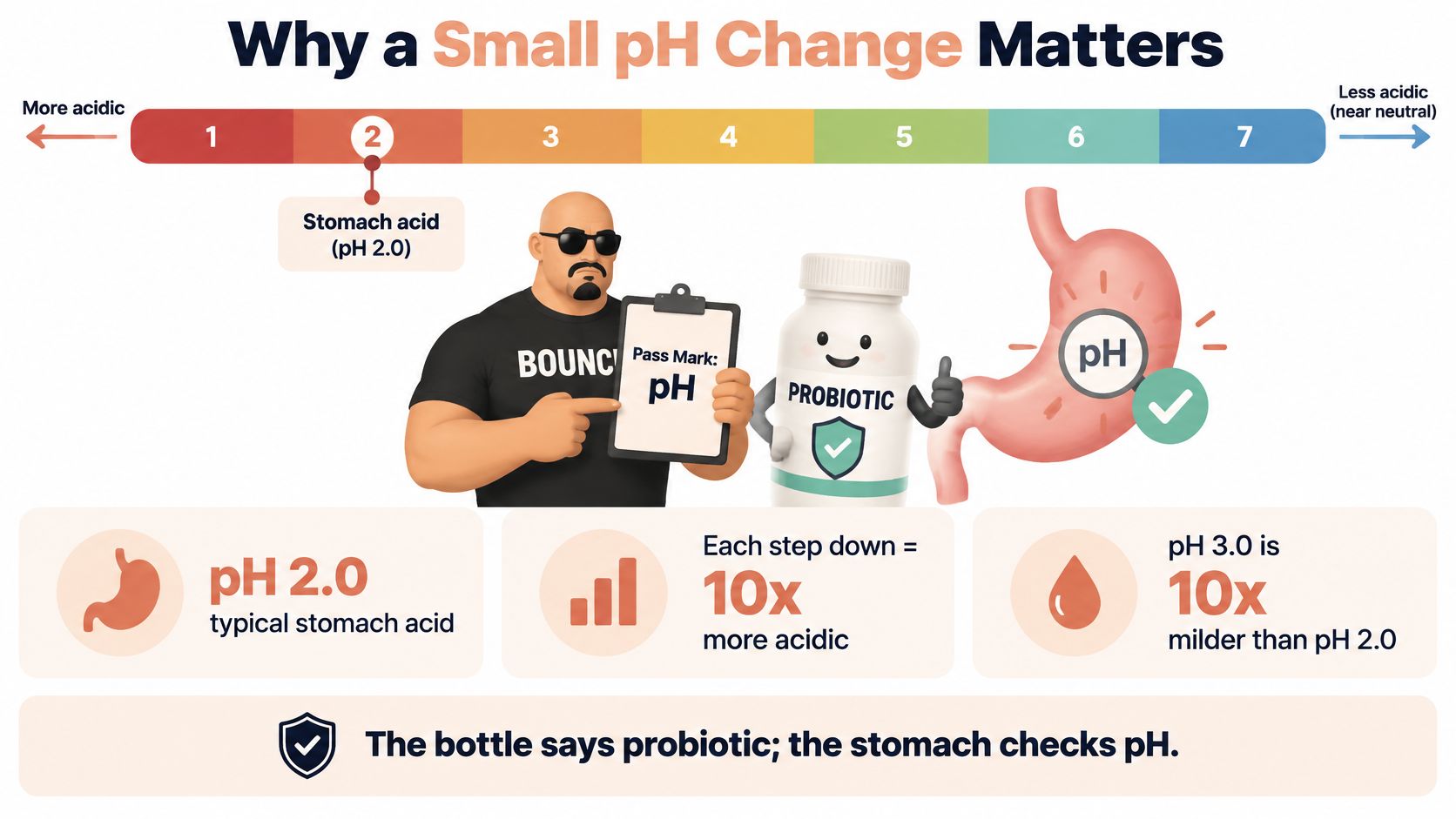
Your stomach works like a door with a bouncer, and the pass mark is pH. The bouncer is strict. The pH scale runs from 0 to 14, and every single step down multiplies acidity tenfold, so pH 2 is ten times harsher than pH 3 and a hundred times harsher than pH 4.
That ladder is why small shifts produce enormous swings. When researchers screened Lactobacillus plantarum in gastric juice, pH itself came out as the strongest determinant of whether the cells survived, ahead of the other conditions they varied. So a strain that sails through one acid test can fail in a second test sitting half a step more acidic.
Survival also gets harder across the board as acidity climbs, though acid-tolerant organisms, including certain Lactobacillus and Bifidobacterium strains, cope better than the rest. Tolerance lives in the strain, not the species name on the front of the bottle.
And your stomach is a moving target, not a fixed chemistry set. Acidity shifts up and down through the day. Food buffers the acid when you eat, so pH rises for a while, then drifts back down as the stomach empties. Your baseline also differs from your partner's, your sibling's, and your own stomach ten years ago.
What to ask: which strain, at which pH, for how long, and with what else in the mix. If a product can't answer those four, "acid resistant" is decoration.
Keep this in mind the next time you see a confident claim on a label, then look at the illustration below, which puts the scale and the bouncer side by side.
Any single pH result is a snapshot taken on one afternoon in one lab. Treat it that way.
Strains and Minutes in Real Gastric Fluid
Two bottles sitting side by side on the same shelf can behave nothing alike, and the reason usually lives in tiny print.
A 2024 study tested eight probiotic bacteria in real human gastric fluid, sampling survival at 30, 60, 120, and 180 minutes. More than 80% of the strains were susceptible to the fluid. One strain lost less than 1 log CFU/mL in both human and simulated gastric fluid. The team also ran simulated fluid at pH 2.2 ± 0.1 and pH 2.8 ± 0.1, and strain-specific differences stayed significant throughout, per the University of Ghana gastric fluid study.
Half an hour is not the same test as three hours. If your stomach empties slowly, which happens with heavy or fatty meals, your cells sit in acid far longer than a two-hour lab clock allows.
Species names hide the strains that matter
"Lactobacillus" is a genus, not a personality. A product can share a genus with a battle-hardened strain and still contain the fragile kind. Marketing categories like "women's probiotic" or "daily blend" hide the same problem, because they describe an audience, not a microbe.
What you want is the full designation, letters and numbers included, the way you'd want a car's exact model rather than the word sedan. Strains that form protective spores behave differently from classic Lactobacillus strains, and we compare the two in Bacillus coagulans vs Lactobacillus.
Strain first: a full designation on the label tells you more than a big CFU number ever will.
Even a tough strain still has to face whatever you swallow it with. That's the next variable, and it's the one you control most easily.
How a Meal Changes the Acid Test
Take the same dose two ways and you're effectively running two different experiments.
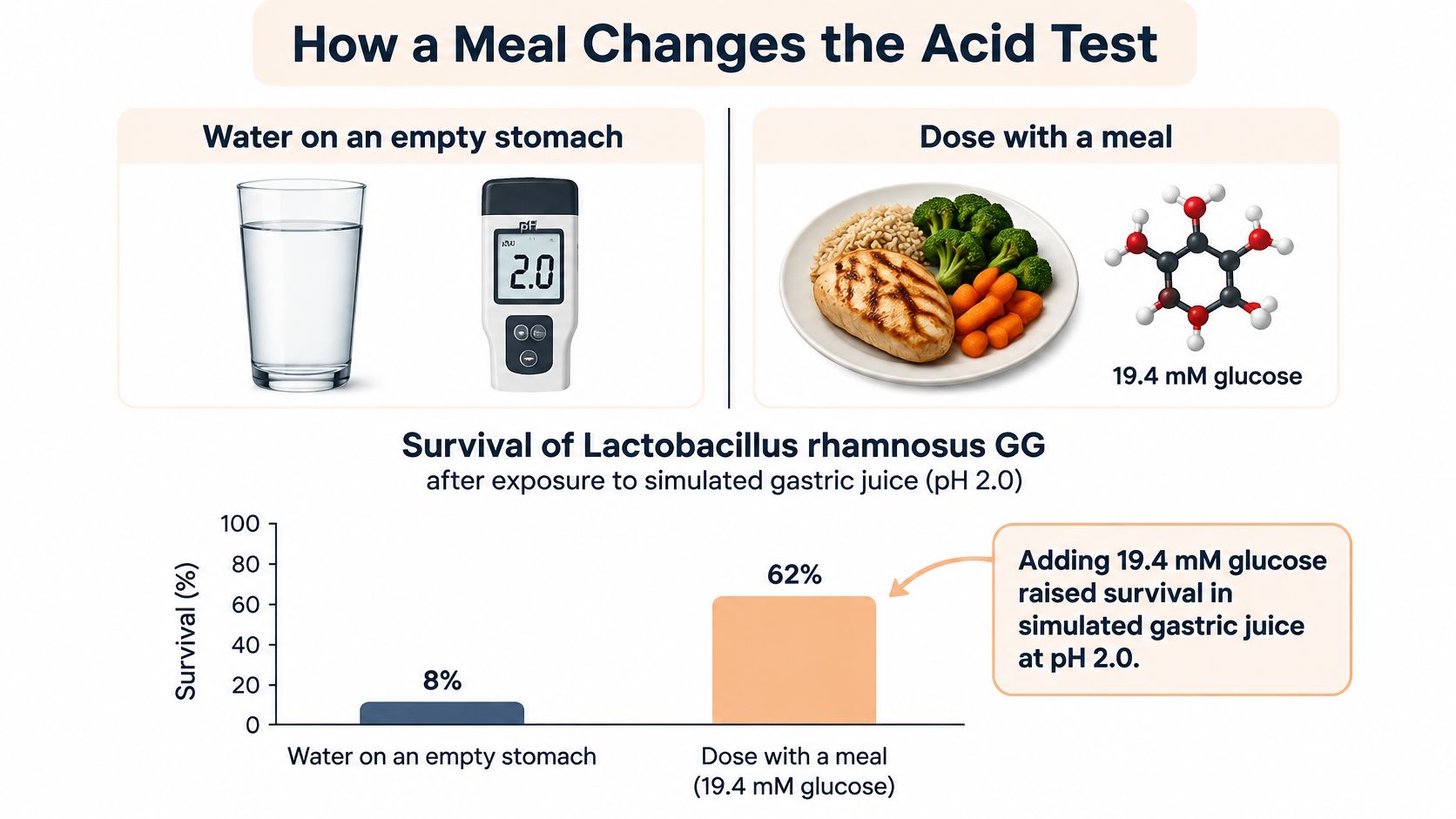
In simulated gastric juice at pH 2.0, adding 19.4 mM glucose increased survival of Lactobacillus rhamnosus GG by as much as 6 log10 after 90 minutes, according to the Applied and Environmental Microbiology study. The proposed mechanism is metabolic protection: a sugar the cell can use gives it the energy to keep its own interior from turning acidic.
Translate that into your kitchen. Cells with fuel around them hold up better than cells dropped into plain water on an empty stomach.
If you'd rather watch than read, this short walkthrough covers the same stomach-acid question from a different angle.
What the food study actually showed
A 2025 lab study of 20 probiotic-labelled foods and five supplements sold in Turkey found that 75% of the foods met their label claims and 55% of samples contained strains fully resistant to simulated gastric acidity. Dairy-based products performed significantly better than the supplements, per the 2025 market survey of probiotic foods.
Don't turn that into a dairy rule. Milk results may not carry over to a vegan meal, and a food can match its label at manufacture while still losing cells in acid.
For anyone skipping dairy, think in terms of what a plant meal brings: carbohydrates the cells can use and enough bulk to slow the ride down, which gives acid less of a clean shot. A dry capsule on an empty stomach offers neither. I'm describing a mechanism, not a tested finding, because no study here measured plant meals specifically.
Take your dose with a meal you actually sit down to eat, not with a glass of water on your way out the door.
Timing is where many people improvise. We go deeper on that in the best time to take probiotics, and the short version is that no single clock fits every gut. Judge the product by its named strain and its post-digestion data, not by the starting CFU alone.
Coatings and Bare Cells Under Acid
A coating works like a rain jacket. It will not keep cells bone dry, but it changes how much acid reaches them. Microencapsulation wraps cells in a protective material, and an enteric coating is built to stay intact in the stomach and open further along the digestive tract, the same logic described in this peer-reviewed tablet development study.
Lab tests on Lactobacillus plantarum put that logic to work. Cells wrapped in a poly-L-lysine coat were exposed to pH 2 alongside bare cells, and the bare cells shed viability fast while the coated ones held up far better. The coated cells still lost ground, especially as the acid exposure stretched on.
Read that result carefully. The coat slowed the damage. It did not stop it.
Delivery format and simulated acid loss
| Format | Condition | What happened | Limit |
|---|---|---|---|
| Uncoated L. plantarum | pH 2 for 1 hour | Heavy viability loss | One coating study, not every product |
| Uncoated L. plantarum | pH 2 for 2 hours | Loss deepened with longer exposure | Longer acid time compounds the loss |
| Poly-L-lysine coated L. plantarum | pH 2 for 1 hour | Smaller loss than bare cells | Coat reduced loss but did not stop it |
| Poly-L-lysine coated L. plantarum | pH 2 for 2 hours | Loss continued, still below uncoated | Still a meaningful drop by two hours |
| Unencapsulated L. rhamnosus GG | Simulated gastric phase | Large share of viability lost | One strain, in vitro |
| Same unencapsulated LGG | After simulated intestinal phase | Small fraction still viable | Acid is only the first stress |
| Pea-protein microencapsulation of LGG | Gastric and intestinal phases | Most cells still viable through both phases | Lab result for one strain, not symptom proof |
The vegan angle on coatings
Gelatin capsules are the default in this category, which leaves plant-based readers hunting for alternatives. Pea protein is one candidate being tested as a coating material, and early digestion-model work on LGG suggests it can hold cells together through the gastric and intestinal phases where bare cells faded quickly.
That is still bench science. One strain, one lab model, no one swallowing anything. It tells you a plant-based coat can survive the acid test, and it says nothing yet about whether your bloating eases.
Format differences between products are real, though. A simulated digestion comparison of commercial products found that some preparations showed no measurable change after two hours at pH 1.5 while others began significant viability losses after only 30 minutes. The coat printed on the box is not the test.
Survival Is Not the Same as Feeling Better
Three separate claims get folded into one headline, and that mix-up costs you money.
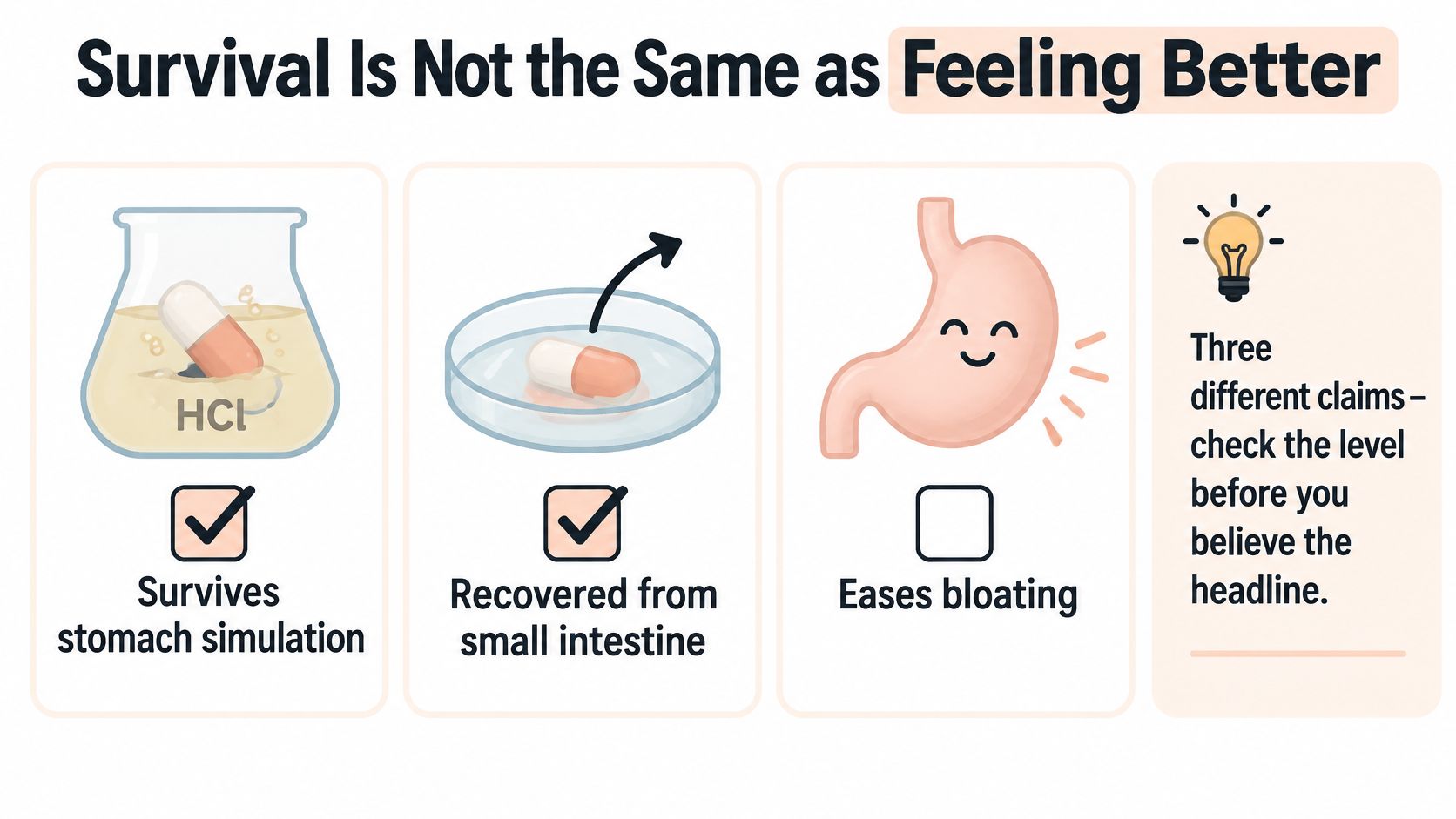
Surviving a stomach simulation, being recovered alive from the small intestine, and easing your bloating are different achievements. A product can manage the first and fail the second. It can manage both and still do nothing for the symptom that made you open your wallet.
Each rung of evidence is harder to earn than the one before it. A lab model only needs a beaker of acid. A symptom trial needs real people, real meals, and weeks of tracking. When a box shouts "survives stomach acid," it is usually announcing the easiest rung and hoping you assume the hardest one.
Here's a ladder you can apply to any bottle in thirty seconds.
- A full strain designation. Genus, species, then letters and numbers. If the label stops at "Lactobacillus," keep reading the shelf, because a genus alone tells you almost nothing about how those cells behave in acid.
- CFU guaranteed at the end of shelf life. A count at manufacture tells you what was in the jar in the factory, not what is left when you twist the cap open months later.
- A simulated digestion result. Evidence that cells came out the other side of a lab model.
- A human recovery study. Evidence that live cells turned up in stool samples from real people.
- A trial on the symptom you care about. Bloating, gas, regularity, comfort after meals. This is the only rung that answers the question you paid for.
Surviving acid, reaching the intestine alive, and easing bloating are three separate claims. Check which one the marketing is actually making.
In-vitro results are preliminary by definition. A big label count can still leave far fewer live cells once acid, bile, and enzymes have finished with it, and no number on a box tells you how your gut will respond. A product that only clears the first rungs is not automatically useless. It has not shown you the proof you were hoping for yet.
Which habit or timing has helped your bloating, and which one wasted your money? Tell us in the comments, because someone reading this at 2 a.m. needs your answer more than ours.
Frequent Questions About Probiotics and Stomach Acid
Do all probiotics survive stomach acid
No. Survival changes with the strain, the acidity it meets, the time it spends there, and the food or coating around it. A famous species name on a label tells you very little on its own, and two products from the same genus can produce opposite results.
Does taking a probiotic on an empty stomach always kill it
Not always. A meal usually brings fuel and a gentler pH, while an empty stomach is often more acidic and offers the cells nothing to work with. Some people do fine either way, so there's no single timing rule that fits every gut.
If some cells die, is the product pointless
Not automatically. A large starting count can still leave a useful number of survivors, and dead cells may still interact with your gut and immune system. Losing the vast majority of cells is a fair reason to question a brand's marketing, though.
Can a stomach simulation predict how I will feel
No. Simulations measure whether cells survive, not whether your bloating eases or your digestion calms down. Treat them as one clue about product quality, never as a symptom forecast.
Should I check with a clinician first
Yes, especially if you have IBS, a weakened immune system, or take regular medication. Individual needs vary enough that professional guidance is worth the appointment.
Pick a Daily Probiotic and Start
You don't have to guess alone, and you don't have to overhaul your kitchen this week. Five small moves, done in order, will get you further than any product swap.
- Check the strain line before the CFU number. Look for full designations and a live culture count guaranteed at the end of shelf life, not a vague blend. Our guide to what to look for when buying probiotics walks through the label line by line.
- Take it with a real meal. Not a sip of water at the sink. Food is the variable the research supports most directly, and it costs you nothing.
- Give the routine a fair run. Digestive support products such as probiotics and enzymes often show results within one to two weeks of consistent use, so judge after a fortnight rather than after day one.
- Track the right signals. Note bloating, reflux, and how calm your stomach feels an hour after eating, then compare week one with week three instead of relying on a general impression.
- Look past the capsule. Daily habits matter too, and this overview of gut health advice from Courier Pharmacy covers fiber, hydration, and meal rhythm alongside supplementation.
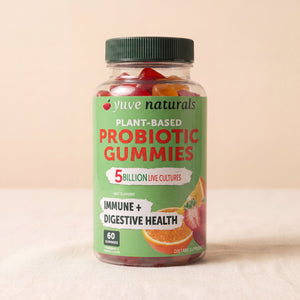
For a plant-based daily option, our Vegan Probiotic Gummies carry five billion live cultures in every gummy and fit into a routine you'll keep, at $27.49 one-time or $23.37 on subscription. Keep them next to your plate, take one with dinner, and let the habit do the work while you watch for changes over those first couple of weeks.
If something here finally made the label make sense, say so below. Your experience is the part of this guide that no study can write.
Your gut deserves a plan that matches what the research shows, and Yuve makes that easy to start. Our plant-based probiotics, prebiotics, and digestive enzymes are built for daily consistency, so you can pair one with a real meal and give your stomach a calmer stretch instead of another guess. Visit Yuve to find the routine that fits your plate and your week.