Ever feel like your stomach turns into a balloon by afternoon, while the supplement aisle insists the answer is a capsule labeled 100 billion CFU? You're not alone. Bloating is frustrating enough without having to decode strain names, storage instructions, and a parade of giant numbers.
A high potency probiotic can be useful, but more live cultures don't automatically mean better gut health. The better question is whether the product contains the right strains, delivers viable organisms through its expiration date, and matches the health goal you're trying to support. This guide will help you read the label with more confidence, understand what CFU really means, and choose a clean formula without getting swept up in potency marketing.
Why Bigger CFU Numbers Do Not Always Mean Better Gut Health
The biggest number on a bottle is often the easiest feature to compare. One product says 10 billion, another says 50 billion, and another announces an even larger total in bold print. If you're dealing with bloating or unpredictable digestion, it's understandable to think the highest count must offer the strongest support.
I don't think that assumption holds up. Probiotic effects are strain-specific and condition-specific, and several analyses suggest that benefits can plateau instead of increasing indefinitely. A high-CFU formula may be appropriate for a particular clinical purpose, but a massive, untargeted blend isn't automatically a smarter choice for everyday digestive support.
The category itself is growing rapidly. One market forecast estimated the global probiotics market at USD 86.01 billion in 2025, with a projection of USD 144.76 billion by 2030, implying a 10.7% CAGR over that period. Another forecast estimated USD 113.97 billion in 2025 and projected USD 301.17 billion by 2033, reflecting a 12.8% CAGR from 2026 to 2033. Grand View Research's probiotics market overview also identified Asia-Pacific as the largest regional market in 2025.
That expansion gives shoppers more choices, but it also gives brands more room to compete through attention-grabbing claims. A premium product should earn your trust through strain identification, viable counts, stability testing, and a clear intended use, not merely through a larger front-label number.
What you'll learn from the label
When a probiotic hasn't helped, that doesn't mean your gut is “broken” or that you need to keep escalating the dose. It may mean the strain wasn't suited to your goal, the product lost viability during storage, or the formula wasn't studied for the symptoms you're experiencing.
Use this quick filter:
- Purpose: What outcome are you trying to support?
- Strain: Which exact microorganisms are included?
- Dose: Does human research support that amount for that purpose?
- Viability: Is the CFU count guaranteed through expiration?
- Fit: Is the formula compatible with your dietary preferences and health history?
For a helpful starting point on how a lower-count product can still fit a thoughtful routine, read Yuve's guide to 10-billion probiotic formulas. The central lesson is simple: potency is a quality question, not a number competition.
Decoding CFU Counts and the Power of Specific Strains
CFU means colony-forming units. In plain English, it estimates the number of living microorganisms capable of forming colonies under test conditions. It's useful, but it doesn't tell you whether every organism will survive digestion, interact with your existing microbiome, or support the outcome you want.
Think of a probiotic like a garden. The CFU count tells you how many seeds you're planting. The strain tells you what kind of seeds they are. Throwing more seeds onto the soil doesn't guarantee a healthier garden if you're planting varieties that don't suit the climate.

Four questions to ask about CFUs
First, find the serving size. A bottle may display a total CFU count for a serving rather than for one capsule or gummy. Check the Supplement Facts panel before comparing products.
Next, look for strain-level detail. “Lactobacillus” or “Bifidobacterium” identifies broad groups, but a full strain designation gives you more useful information. Closely related strains can behave differently, so evidence for one strain shouldn't automatically be transferred to another.
Then, connect the strain to the goal. The NIH Office of Dietary Supplements probiotic fact sheet explains that probiotic efficacy is strain- and indication-specific. It also notes an example involving LGG, where evidence-based use for infectious diarrhea may require at least 10^10 CFU per day. That doesn't mean every digestive complaint requires that amount, and it doesn't make LGG the right choice for every person.
Finally, ask whether the dose has human support. The World Gastroenterology Organisation states that there's no universal probiotic dose. Its examples range from 100 million CFU per day for one IBS strain to products requiring 300 to 450 billion CFU taken three times daily, depending on the product and intended benefit. The organisation's global guideline reinforces the point: dose belongs beside strain and indication, not above them.
Why a blend needs more explanation
A blend can contain many strains and still leave you with little information about what each one contributes. That isn't necessarily a flaw, but a transparent label should make it possible to trace the formula to testing and research.
A systematic review of 70 probiotic studies found daily dosing ranging from 1 × 10^6 to 4.5 × 10^11 CFU, across 54 products and 108 strains. The review in PMC shows why “high potency” has no single universal definition.
Practical rule: Match the strain and dose to your goal first. Use the total CFU count as supporting information, not as the entire decision.
The Survival Journey From Bottle to Gut
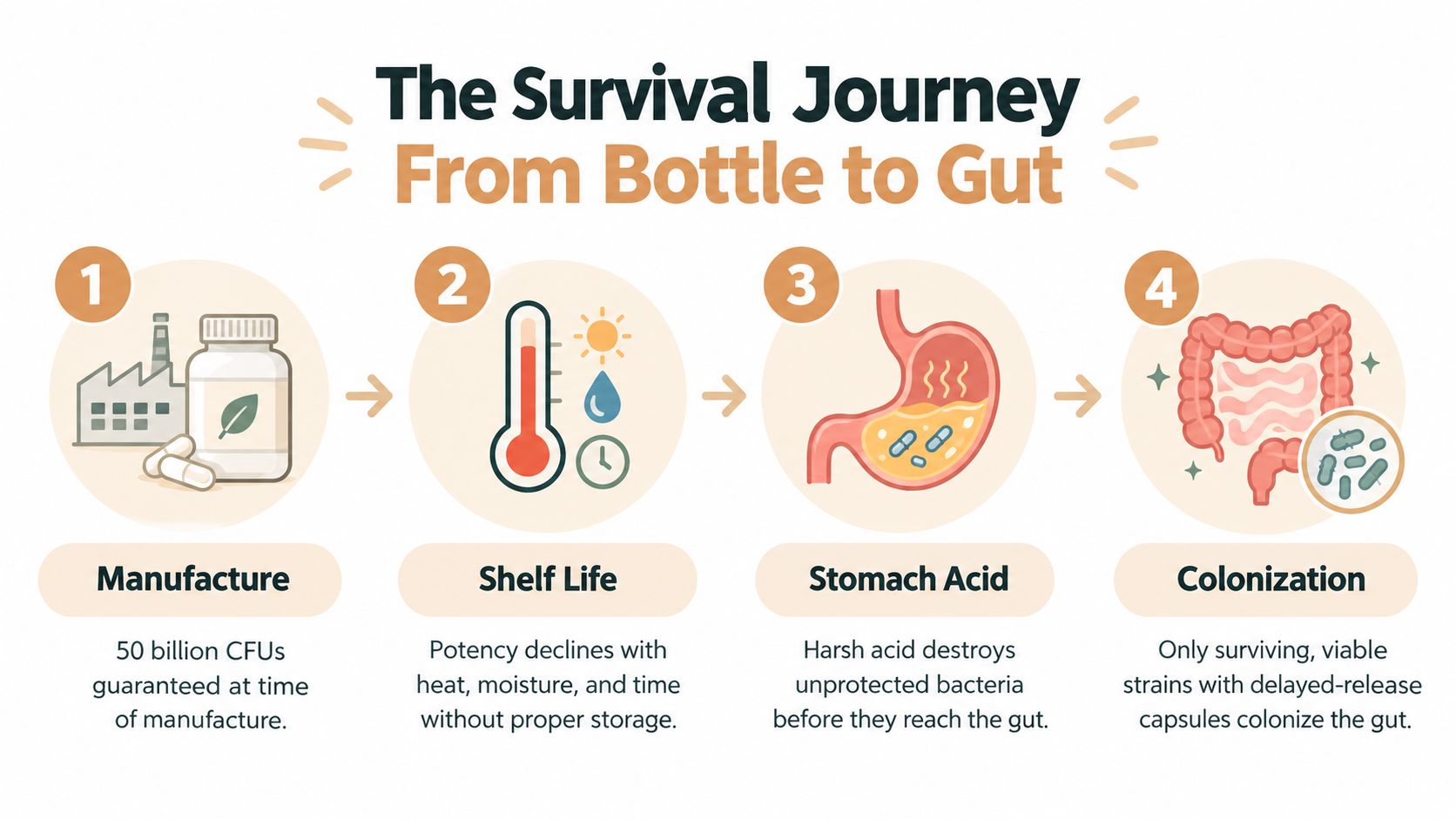
A probiotic's journey doesn't end when it leaves the factory. Live microorganisms face storage conditions, moisture, heat, stomach acid, bile, and the physical process of moving through the digestive tract. The number printed on the bottle matters only if the product can preserve enough viable organisms by the time you take it.
A practical benchmark for high-potency products is delivery of at least 10^6 CFU per gram or milliliter at the end of shelf life. Many effective daily intakes reported in the literature fall in the 10^8 to 10^9 CFU per day range, depending on the strain, population, and health outcome. Frontiers in Microbiology's review of probiotic viability emphasizes that manufacturing, storage, transit, and gastrointestinal exposure all influence how many cells remain viable.
The label date matters
Some products state potency at manufacture, while others support the stated count through expiration. Those are not equivalent claims. If a formula starts with a high count but declines substantially during storage, the number you swallow may differ from the number advertised at production.
Look for:
- End-of-shelf-life potency: The manufacturer should explain whether the CFU guarantee applies through expiration.
- Validated stability testing: Real-time testing can show how the finished product performs under expected storage conditions.
- Packaging controls: Moisture-resistant containers, protective capsules, and appropriate seals can help preserve live cultures.
- Clear storage directions: A product that requires refrigeration should say so plainly.
The Frontiers review reports that lower temperatures materially improve probiotic survival compared with warmer storage conditions. That's why a bottle left in a hot car, humid bathroom, or sunny kitchen may face more stress than one kept according to its instructions.
Here's a short visual explanation of the path from manufacturing to the intestine:
A higher dose can affect recovery
Potency can influence how quickly and how long administered strains are recovered after consumption. In a controlled human study, a 70-billion-CFU multispecies probiotic produced earlier and longer fecal recovery of all four administered strains than a 7-billion-CFU version. Viable cells were still recovered at the end of dosing in the higher-dose group when recovery failed for some low-dose recipients. The clinical study summary supports a nuanced interpretation: dose can shape recovery dynamics, but it doesn't guarantee a health benefit.
For storage guidance, read Yuve's explanation of whether probiotics need refrigeration. Follow the product's own directions rather than assuming every high potency probiotic behaves the same way.
When High Doses Plateau and Safety Considerations
A larger dose can change exposure, but it may not keep improving symptoms once you reach an evidence-supported range. In a meta-analysis of gastrointestinal probiotic trials, several lower-to-moderate dose bands were associated with significant benefit, including 10^7 to 10^8 CFU per day, 1 to 9 × 10^9 CFU per day, and 1 to 5 × 10^10 CFU per day. The very high band of 1 to 9 × 10^11 to 10^12 CFU per day wasn't statistically significant in that analysis. The gastrointestinal probiotic meta-analysis makes the practical point clear: more isn't a universal upgrade.
That doesn't mean high-potency products are pointless. It means the dose-response relationship depends on the strain, condition, study design, and person taking the product. A targeted formula may be more sensible than a mega-dose blend with no clear connection to your goal.
Safety deserves space on the label
Large reviews summarized by the American Academy of Family Physicians found no significant increase in short-term adverse events. Long-term effects remain largely unknown, and rare bloodstream infections have been reported in people who are immunocompromised or have cancer. The AAFP evidence summary is a useful reminder that “generally safe” doesn't mean “right for everyone.”
Talk with a healthcare professional before starting a high potency probiotic if you're immunocompromised, receiving cancer treatment, pregnant, breastfeeding, or managing a diagnosed gastrointestinal condition. Parents should also ask a pediatric healthcare professional before giving a child a concentrated formula.
Mild gas, rumbling, or changes in bowel habits can happen when you introduce a new supplement, but worsening or persistent symptoms need attention. A probiotic shouldn't be used to dismiss severe abdominal pain, dehydration, persistent vomiting, blood in stool, or other symptoms that require medical evaluation.
The safest dose is the one supported for your purpose and appropriate for your health history.
A clean label and a large CFU number can coexist, but neither replaces strain evidence, safety screening, or professional guidance when your circumstances call for it.
Choosing Clean and Vegan Formulations for Daily Relief
Gut-health decisions are personal. Some people are trying to manage bloating after meals, while others want a plant-based option that fits a vegan routine without gelatin, gluten, or unnecessary ingredients. The formula has to work on paper and in your actual life, because a product you can't tolerate or remember to take won't become a reliable habit.
Yuve's founder, Sam, began from personal digestive challenges and the frustration of finding options that felt both effective and aligned with a plant-based lifestyle. That experience informs the brand's focus on vegan, non-GMO, gluten-free, and gelatin-free nutrition. Those attributes don't prove that a probiotic will resolve your symptoms, but they can matter when you're choosing a product you plan to use consistently.

What “clean” should mean to you
“Clean” can be a helpful shorthand, but it isn't a scientific measure by itself. Read the complete ingredient list and ask practical questions:
- Capsule material: Is it gelatin-free if that matters to your diet?
- Allergen fit: Does the label identify ingredients you need to avoid?
- Added fibers: Could prebiotic ingredients worsen gas or bloating for you?
- Strain transparency: Does the label name the organisms clearly?
- Quality documentation: Can the manufacturer explain testing and storage?
The Yuve guide to vegan probiotic supplements can help you think through plant-based formulation choices. A vegan formula isn't automatically more effective, just as a non-vegan formula isn't automatically unsuitable. The important question is whether the ingredients, evidence, and delivery format fit your needs.
Choose consistency over drama
A supplement should fit beside an existing daily habit, such as breakfast or brushing your teeth. Store it exactly as directed, keep the container closed, and avoid placing it somewhere exposed to heat or moisture.
If dairy is your specific trigger, a probiotic may not address the underlying issue. A digestive enzyme designed for lactose digestion can be a more direct tool for dairy meals, while an IBS-friendly snack, hydration, slower eating, or evaluation of recurring symptoms may address a different part of the picture.
Your goal isn't to win a CFU contest. It's to choose a transparent formula that you can take correctly and evaluate calmly over time.
Your Practical Checklist for Probiotic Success
Before buying a high potency probiotic, turn the front label over. The back panel usually tells you far more about whether the product deserves your attention.
Start with these label checks
- Identify the strains. Look for genus, species, and strain designations where available. A broad word such as “acidophilus” gives less information than a traceable strain identity.
- Check the CFU timing. Find out whether the stated count is guaranteed at manufacture or through the expiration date. End-of-shelf-life viability is the more useful measure for what you'll consume.
- Match the dose to the purpose. The World Gastroenterology Organisation says dosing should be based on human studies showing benefit, rather than one universal target. Don't assume the highest count is suitable for bloating, IBS, antibiotic-associated diarrhea, or general maintenance.
- Read storage instructions. Heat, moisture, and time can reduce viability. Follow refrigeration directions when the product requires them, and keep capsules away from steamy bathrooms and hot vehicles.
- Review the full formula. Check for gelatin, gluten, allergens, sweeteners, added fibers, and other ingredients that may not agree with you.
Build a routine you can actually follow
Take the product according to its label. Don't add extra servings because you're impatient for results, and don't introduce several new supplements at the same time if you're trying to identify what affects your digestion.
Keep a short record of the product, dose, meals, bowel changes, and bloating. That simple note can help you distinguish a temporary adjustment from a poor fit, a food trigger, or a symptom that deserves medical attention.
Small habit, useful signal: Change one variable at a time so you can tell what your body is responding to.
If you're taking antibiotics, ask a pharmacist or clinician how to space the products. If symptoms are severe, persistent, or interfering with hydration and daily activities, pause self-experimentation and seek appropriate care.
Final Thoughts and Common Probiotic Questions
Gut health rarely follows a straight line. You might have a week where bloating settles, then discover that a meal, medication, travel day, or stressful schedule changes the picture. That doesn't mean you've failed. It means digestion is responsive to several moving parts, and a useful supplement should be judged by evidence, tolerance, consistency, and fit.
A high potency probiotic can make sense when its exact strains and dose match a studied purpose. It's less convincing when the product relies on a giant CFU headline while leaving shelf-life viability, storage, and strain identity unclear.
Frequently asked questions
Can probiotics be taken with antibiotics?
Ask a pharmacist or healthcare professional about timing and spacing. The right approach can depend on the antibiotic, the probiotic strains, and your health history.
How long does it take to notice a difference?
There's no universal timeline. Some people notice digestive changes quickly, while others see no meaningful benefit from a particular formula. Evaluate your symptoms without escalating the dose on your own.
Can children take high-potency probiotics?
Children shouldn't automatically receive an adult high-CFU formula. A pediatric healthcare professional can help select an age-appropriate strain, dose, and format, especially when a child has ongoing digestive symptoms or another medical condition.
Does a higher CFU count guarantee better results?
No. Research summarized by the NIH, the World Gastroenterology Organisation, and systematic reviews shows that strain, indication, and evidence-matched dosing matter more than the biggest number alone. If you're still confused by labels, you can share your gut-health journey in the comments and discuss your questions with a qualified healthcare professional.
Yuve offers clean, vegan probiotic options designed for people who want plant-based digestive support without gelatin, gluten, or unnecessary complexity. Visit Yuve to explore the available formulas and choose a product that fits your routine, dietary preferences, and approach to evidence-matched gut health.