Ever feel like your stomach inflates like a balloon by afternoon? You're not alone, and it's not always just what you ate. If you're learning how to relieve bloating, start by sorting your pattern first, because bloating isn't one problem. We'll match your symptoms to a likely driver, then test one fix at a time so you can see what helps.
Match Your Bloating to Its Likely Cause
A 2025 population survey published in a study indexed by PubMed found that 39% of respondents experienced bloating during the previous 24 hours, while 89% reported at least one gas-related symptom. That doesn't make it comfortable, but it does mean you're far from alone in this.
Bloating is a feeling of fullness, tightness or visible swelling. It isn't one condition. Swallowed air, slow stool transit, fermenting carbohydrates, hormone shifts and a medical condition can all feel similar at 4 p.m., yet they need different first moves.
Find your row
| Your Pattern | Likely Driver | First Move |
|---|---|---|
| Swelling and belching after meals | Swallowed air or eating too fast | Slow down and cut straws, gum and fizzy drinks |
| Hard or infrequent stools with pressure | Slow transit or constipation | Build fluids and gradual soluble fiber for 2-4 weeks |
| Bloating after dairy, beans, onions or garlic | Fermentation of specific carbohydrates | Run a structured low-FODMAP trial |
| Bloating during perimenopause or menopause | Hormone shifts that can change gut motility and sensitivity | Log symptoms and discuss options with a clinician |
| Bloating with weight loss, blood in stool or vomiting | Possible condition that needs diagnosis | See a clinician promptly |
The perimenopause row deserves special notice. The 2025 survey of nearly 600 women aged 44 to 73 published by The Menopause Society found that 77% reported bloating during perimenopause or menopause, while 89% said they had tried self-management strategies such as dietary changes, stress management or supplements.
Try a simple three-day log before you change anything. Note meals, stool frequency and form, and when bloating starts and peaks. Patterns that feel random often line up once you see timing on paper.
Pick the row that fits most days, not your worst day. That's your starting point.
Then jump to the section that handles that row. You don't need to try every fix in this guide. You need the right one first.
Quick Relief Steps for a Bloated Afternoon
When your waistband suddenly feels two sizes too small, you need a same-hour plan, not a new diet. These steps won't diagnose a cause, but they can help trapped gas move and tight abdominal muscles relax.
This visual sums up the first moves to try when pressure builds.
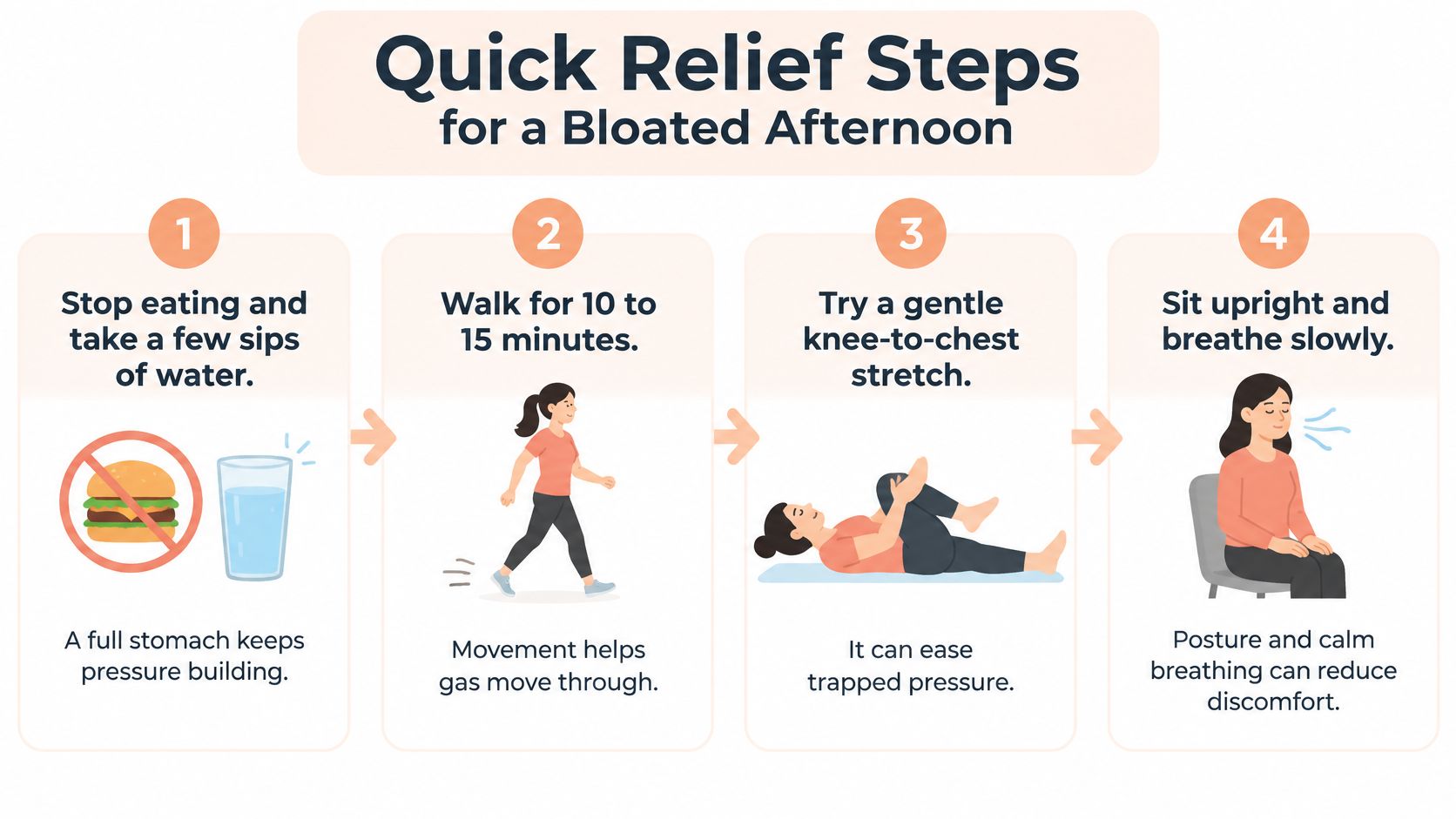
Your same-hour plan
- Stop eating and sip water. A full stomach keeps pressure building, so give digestion a pause.
- Walk for 10 to 15 minutes. Gentle movement helps trapped gas move through your intestines.
- Loosen your waistband and sit upright. Slumping compresses your abdomen, while upright posture gives it room to soften.
- Breathe slowly for two minutes. Breathe into your lower ribs so your belly can rise and fall instead of bracing.
- Try warmth. Place a warm, not hot, heat pad on your belly for about 10 minutes to ease tight muscles.
- Pause air-swallowing habits. If you've been eating fast or sipping fizzy drinks, set those aside until pressure eases.
- Log it. Note the time, your last meal and your last stool so your three-day log has real data.
Most episodes ease within a few hours. If yours doesn't, don't just push through and add another remedy. Sudden severe pain or any alarm sign means stopping self-care and getting medical help.
If afternoon bloating has become a regular part of the menopause transition for you, it can help to look at support built for that stage of life, and you can shop for perimenopause support from Lila while you track whether your pattern lines up with other symptoms. Keep the log either way, because timing tells you more than guessing does.
Daily Habits That Stop Gas and Support Regular Stools
The same meal can leave one person comfortable and another feeling pressure. Your daily pattern offers clues: swallowed air may contribute to belching, while hard or infrequent stools point toward slow transit. Match the habit to the pattern, then change one thing at a time.

Swallowed air can add to gas and pressure. The Mayo Clinic guide to gas and gas pains lists eating or drinking quickly, talking while chewing, chewing gum, sucking hard candy, using a straw, drinking carbonated beverages and smoking as habits that can increase air in the digestive tract.
Try a one-week experiment: eat more slowly, put away the straw and gum, and skip fizzy drinks. Notice whether belching or afternoon pressure changes. Carbonated drinks also add carbon dioxide, making them a straightforward habit to test on its own.
The fiber rule for slow transit
If hard or infrequent stools are your main pattern, focus on regularity. Eat meals at consistent times, drink enough fluids, walk regularly and add soluble fiber gradually, such as oats. Start with a small serving and build up over time rather than making a sudden change.
Track stool frequency, form, straining and bloating for 2-4 weeks before judging whether the routine helps. A quick increase in fiber can worsen gas and distension, and adding a large amount of bran at once can be uncomfortable. Small, steady changes give you a clearer way to see what your gut tolerates. For more guidance on gradually increasing fiber, read how to relieve constipation naturally.
This video demonstrates daily movement and meal habits to pair with the checklist.
Five habits to choose from
- Slow the first bites: Put your fork down between bites while you settle into a meal.
- Ditch the straw: Drink from a glass and test skipping carbonated drinks with lunch.
- Walk after meals: Choose an easy 10-minute walk instead of sitting straight back down.
- Add soluble fiber slowly: Begin with oats at breakfast before changing other fiber sources.
- Keep meal times regular: A predictable routine can support regular bowel habits.
Practical rule: Choose one habit this week and track what changes. If you alter several things at once, it is harder to tell which one helped.
Find Your Food Triggers Without Cutting Everything
I do NOT think you need to cut every healthy plant food to feel better. Legumes, onions, garlic, wheat and some fruits are nutritious, yet they can trigger bloating in sensitive people. That matters a lot if you eat vegan or plant-rich meals and rely on those foods for protein and fiber.
The checklist below shows a calmer way to test foods without shrinking your diet for good.

The five FODMAP groups
FODMAPs are fermentable carbohydrates. Gut bacteria ferment the portions you don't absorb, which creates gas. Sensitivity differs by group and by portion, so you may tolerate lentils but not garlic, or a small serving but not a large one.
| FODMAP Group | Common Foods | How to Test It |
|---|---|---|
| Fructans | Onion, garlic, wheat-based bread and pasta | Small portion of one food, then build up over several days |
| Galacto-oligosaccharides (GOS) | Chickpeas, lentils, kidney beans | Small portion, then build up over several days |
| Lactose | Milk, soft cheese, ice cream | Small glass of milk or one serving of soft cheese |
| Excess fructose | Apple, pear, mango, honey | One piece of fruit or one teaspoon of honey |
| Polyols | Sorbitol in stone fruit, mushrooms, cauliflower, sugar-free gum | Small portion of one item |
Run a structured trial
- Log your baseline for one to two weeks. Record bloating, stool frequency, pain and food intake.
- Replace major sources for about 2-6 weeks. Swap out onions, garlic, wheat-based products, legumes and selected fruits, ideally with a registered dietitian.
- Reintroduce one group at a time. Test one group over several days and note symptoms before moving on.
- Keep what doesn't trigger you. Bring back every tolerated food and don't stay in elimination.
A Cambridge review in Proceedings of the Nutrition Society reports approximately 50-80% response rates when the diet is implemented appropriately. In one cited trial, 61% of participants achieved a predefined IBS-severity improvement and 39% did not.
What that means for you is simple. The approach helps many people, but not everyone, and the reintroduction phase is not optional. Treating elimination as permanent can reduce fiber variety and nutritional adequacy.
Protect protein and diversity while you test. Tofu, quinoa and oats are useful vegan swaps that keep meals satisfying. If dairy is the group you're reintroducing, Yuve Lactase Enzymes are a go-to for dairy nights, taken with or before dairy so you can test the food without unnecessary discomfort.
Your goal isn't the smallest possible diet. It's the widest diet you can enjoy comfortably.
If you're unsure whether a reaction is a sensitivity or something else, our overview of how to identify food sensitivities can help you structure your notes before you start.
Which Enzymes, Probiotics and Fiber Really Help
Evidence for probiotics, prebiotics and other microbiome-targeted treatments for functional abdominal bloating remains limited. A 2024 review of microbiome-targeted treatments also notes that major European and American guidelines do not recommend probiotics specifically to treat bloating.
The right choice depends on strain, dose, constipation status and diagnosis. No generic product suits every pattern, and some fermentable prebiotic ingredients can increase gas during an active flare. Match the supplement to the likely trigger, and test one product at a time.
The one-at-a-time trial rule
- Change one variable: Start one product while keeping your food and habits steady.
- Track three signals: Each evening, note bloating, stool frequency and pain.
- Set a review point: Digestive support products often show results within 1-2 weeks of consistent use, so reassess then.
- Stop what doesn't help: Adding more products makes it harder to tell what is helping or aggravating symptoms.
For a clearer distinction between categories, read this guide to digestive enzymes vs probiotics. Enzymes act on food being digested, while probiotics are taken as a daily routine and judged over time.
Choose according to your pattern. Vegan Daily Cleanse Papaya Enzymes are papaya enzymes intended to ease bloating and support smooth daily digestion. Lactase Enzymes are for dairy-containing foods, taken with or before them. Prebiotic Fiber Gummies, made with inulin from chicory root, support beneficial gut bacteria, but may be a poor fit during an active gas flare. Probiotic Gummies may suit someone looking for a daily probiotic routine.
Customer experiences can offer context, not a guarantee. Nicole said, “GI tract is calmer and I have less discomfort after eating.” Jessica said, “My stomach is noticeably calmer.” These are examples, not promises.
Use your log to judge the result. At your review point, compare bloating, stools and pain with your starting pattern. If they have not improved, stopping that product is a sensible outcome, not a failure.
When Bloating Needs a Doctor, Not a Diet Plan
Some bloating needs diagnosis, not another elimination diet. The NHS bloating guidance advises arranging medical evaluation when bloating occurs regularly, persists despite dietary changes, or appears with unintentional weight loss or blood in the stool.
Book a routine appointment if bloating keeps returning most weeks, dietary changes haven't helped, or you're losing weight without trying. Bringing clear notes helps your clinician help you faster.
Signs that need faster care
- Vomiting, diarrhea or constipation: Especially when these arrive with bloating and stomach pain.
- Fever or a lump: Bloating with fever, or a lump or swelling in the abdomen, needs assessment.
- Can't pass stool or gas: Inability to pass stool or gas, or to urinate, warrants urgent care.
- Emergency signs: Severe, sudden abdominal pain with a swollen stomach, vomiting blood or severe breathing difficulty requires emergency care.
Also mention persistent vomiting, anemia, progressive distension or new symptoms later in life. These are reasons to stop self-experimenting and get checked.
A clinician or pharmacist may discuss evidence-based constipation options such as polyethylene glycol if slow transit is the driver. Prescription options require medical evaluation, so don't try to source them on your own.
What to bring
- Your symptom log: Include meals, stools, pain and when swelling peaks.
- Your full list: Write down medicines and supplements, including doses.
- Your questions: Ask what testing, if any, makes sense for your pattern.
Asking for a check is a smart step, not a failure. You deserve an answer, not more guessing.
Common Bloating Questions Answered
Why does my stomach look flat in the morning but bigger by evening? Gas and food build up through the day, so visible swelling often peaks later. Your three-day log will show whether that pattern holds for you.
Is bloating always caused by gas? No. Swallowed air, slow transit and fermentation of carbohydrates can all contribute, which is why the pattern table is the right starting point.
How long should an episode last? Most ease within a few hours after a meal. Bloating that lasts most days is worth a check.
Can a probiotic fix bloating on its own? The evidence is limited, so treat it as one variable to test with a review point, not as a cure.
Does bloating mean I'm gaining weight? Not necessarily, since a bloated belly can look larger without fat gain. Unintended weight loss, though, is a reason to see a clinician.
Start Your Two-Week Bloating Plan Today
Pick the row from the first table that fits most days. Then run one habit change and one food or supplement test for two weeks, using the same log. Rate your bloating from 1 to 10 each evening and keep that as your only daily score.
At the two-week review, keep what helped and drop what didn't. If any warning sign appears, book a clinician visit instead of starting another test. A few weeks of small, tested changes beats months of guessing, and one calmer evening is a real win worth noting.
Match your Yuve partner to the trigger you found. Vegan Daily Cleanse Papaya Enzymes are papaya enzymes meant to ease bloating and smooth daily digestion, so they're a fit for heavy meals. Lactase Enzymes are chewable tablets taken with or before dairy, priced at $20.99 one-time or $17.84 on subscription. Once your gut has settled, Vegan Prebiotic Fiber Gummies with inulin from chicory root support beneficial bacteria, priced at $22.10 one-time or $18.79 on subscription.
Explore our Gut Health and Digestion range, tell us which pattern matched you, and share your bloating wins in the comments. We'd love to hear what your log revealed.
Ready to put your two-week plan into practice with support matched to your trigger? Visit Yuve to explore our vegan Papaya Enzymes, Lactase Enzymes and Prebiotic Fiber Gummies, choose the one that fits the pattern you found, and start your first one-at-a-time test today.