Probiotics are most useful with antibiotics for preventing antibiotic-associated diarrhea, reducing risk by about 38% to 42%, while evidence that they rebuild microbiome diversity remains mixed. Strains such as Lactobacillus rhamnosus GG and careful dose timing can make the approach more targeted.
You may be taking antibiotics for a sinus infection, dental procedure, or another bacterial illness and suddenly noticing loose stools, bloating, or a stomach that feels completely out of rhythm. It's frustrating, especially when you're already trying to recover. The good news is that you don't have to choose between blindly taking a probiotic and ignoring your gut entirely.
The useful question is more specific: Can a particular probiotic, used at the right time, help with a particular antibiotic-related problem? The answer is often yes for diarrhea prevention, but probiotics aren't interchangeable, and they shouldn't be marketed as a guaranteed way to rebuild your entire microbiome.
Why This Topic Matters for Your Gut Health
You take an antibiotic for a sinus infection, dental procedure, or another bacterial illness. The infection begins to improve, but your digestion changes: stools become softer, gas increases, or meals suddenly feel less appealing. A short prescription can leave your gut feeling out of rhythm, especially if bloating was already bothering you.
That connection matters because antibiotic-associated diarrhea, or AAD, can make recovery harder. More than one-third of patients taking antibiotics develop AAD, and 17% of AAD cases are fatal, according to The National Center for Complementary and Integrative Health explains the evidence and safety considerations. These figures describe the seriousness of the clinical problem, particularly in hospitals and among children receiving antibiotics. They do not predict what will happen to every person with a prescription.
Research has therefore examined whether probiotics can reduce diarrhea during treatment. One cited meta-analysis found a pooled relative risk of 0.58, a number needed to treat of 13, and a 42% relative reduction in risk compared with control. A later adult analysis reported AAD in 13.7% of probiotic users versus 18.8% of controls, an absolute risk reduction of 5.1%, an NNT of 20, and a pooled risk ratio of 0.63. The adult analysis is summarized by the American Academy of Family Physicians.
Those results support a focused use of probiotics. They do not settle the broader question of whether probiotics restore the microbiome's full diversity after antibiotics. The gut is an ecosystem, not a single switch, so preventing diarrhea and rebuilding the original microbial community are different goals. Background on the science of gut health can help clarify that distinction.
The practical takeaway: probiotics have their clearest role as targeted support for antibiotic-associated diarrhea, while strain choice, timing, and personal health status still matter.
If a household dog has digestive concerns, product selection and the animal's health status also deserve attention. A separate resource on canine gut health support covers that pet-focused topic.
How Antibiotics Affect Your Microbiome
Antibiotics can improve an infection while also changing the wider microbial community in the intestine. The gut microbiome includes organisms that help process food, interact with the gut lining, and compete with microbes that may cause trouble when they multiply too freely. Antibiotics work more like a broad cleanup crew than a laser beam, so helpful bacteria may be affected along with the bacteria involved in the infection.
The result depends on the medication and the person's starting microbiome. Some antibiotic classes affect groups such as Bacteroidetes and Firmicutes differently, so the balance between these communities can shift rather than disappear uniformly. With fewer competing microbes active, less helpful organisms may gain room to grow. Changes in bile processing, fermentation, and water movement through the bowel can then contribute to loose stools.
Why diarrhea can appear during treatment
Antibiotic-associated diarrhea, or AAD, does not by itself mean the treatment failed. The medication may have changed the intestinal environment enough to affect bowel function. Symptoms can range from mild looseness to more serious diarrhea, and the cause is not identical in every case.
Evidence discussed in the NIH-hosted review identifies AAD as a clinically important side effect and describes findings that probiotics may lower its risk. The review also discusses guidance from the World Gastroenterology Organisation. Its probiotic guidance, first issued in 2009 and updated later, described strong evidence for preventing AAD in adults and children receiving antibiotics. The same discussion cites a 2016 meta-analysis reporting that probiotics may reduce the risk of Clostridioides difficile-associated diarrhea in patients receiving antibiotics. The broader safety and usefulness questions are covered in Read the NIH resource on probiotic usefulness and safety.
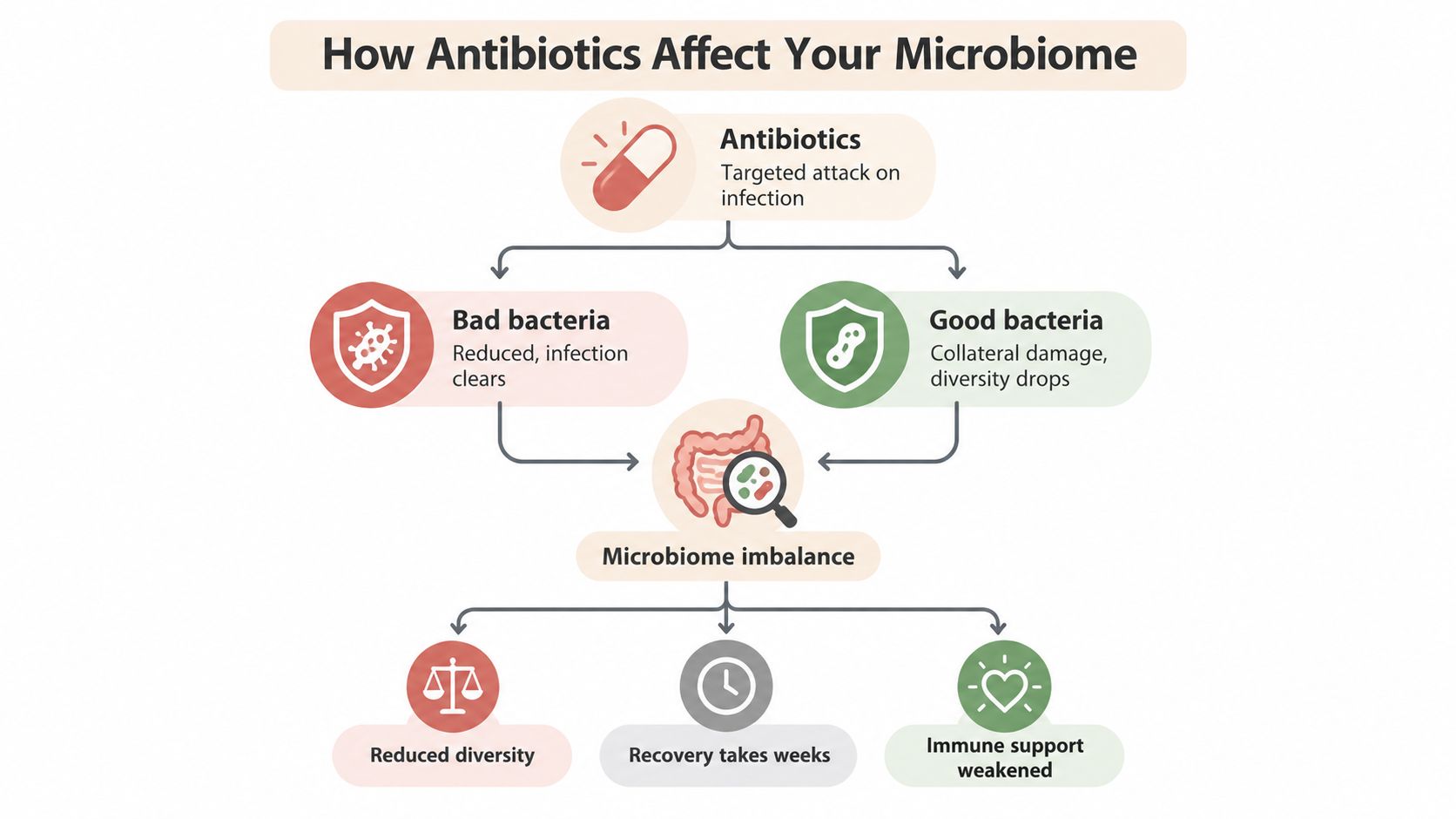
A useful distinction is that diarrhea prevention and microbiome recovery are separate outcomes. A probiotic strain might support bowel regularity without replacing the many organisms, functions, and interactions present before treatment. That is why the antibiotic, the strain, and the person's health status all matter when interpreting results.
For another plain-language look at antibiotic-related concerns, including why medication effects deserve attention, you can read BacteriaFAQ.com on Salmonella dangers. Take antibiotics only as prescribed, and discuss medication questions or persistent diarrhea with a clinician.
Here's a short visual explanation of the broader gut-health context:
The key distinction is symptom support versus microbiome restoration. A probiotic may help reduce diarrhea without returning the microbial community to its previous composition. Keeping those goals separate makes it easier to judge a product by the outcome its particular strain has been studied for.
When and How to Take Probiotics with Antibiotics
Timing can feel confusing because the antibiotic and the probiotic are both connected to bacteria, but they don't serve the same purpose. Many clinicians recommend separating doses so the antibiotic is less likely to act directly on the probiotic organisms before they have a chance to pass through the digestive tract.
The exact schedule depends on the antibiotic, the probiotic strain, and the product directions. A simple plan can reduce guesswork.
A practical timing routine
- Start as soon as practical. A clinician resource from the International Scientific Association for Probiotics and Prebiotics says most studies showing benefit started probiotics as soon as practical, either before antibiotics or within 1 to 2 days after starting them. Review the ISAPP clinician resource on probiotic use alongside antibiotics.
- Create space between doses. A commonly used approach is to take the probiotic several hours away from the antibiotic. Yuve's guidance recommends a 2- to 3-hour separation, but follow the label and ask a pharmacist if your prescription schedule makes that difficult. You don't need to create an elaborate timetable. If your antibiotic is taken in the morning, the probiotic may fit later in the day, provided that timing matches the product instructions.
- Continue beyond the last antibiotic dose. The same ISAPP resource says studies commonly continued probiotics for 7 to 14 days after antibiotics ended. Continuing during that window can help you maintain a consistent routine while your digestive symptoms settle.
- Use the stated dose. CFU means colony-forming units, a way of describing viable microorganisms in a product. More isn't automatically better. The strain, dose, formulation, and reason for use matter more than choosing the largest number on a label.
- Keep taking the antibiotic as prescribed. Don't change, skip, or stop prescription treatment because you're using a probiotic. If side effects become severe or your symptoms change, contact the prescribing clinician.
For a broader explanation of daily routines, see Yuve's guide to the best time to take probiotics. It can help you think about consistency without turning your supplement schedule into a second job.
A simple rule: start promptly, separate doses, follow the product directions, and continue for the studied period rather than taking a probiotic indefinitely by default.
If you're managing nausea, take note of how your body responds. A probiotic may not be the right next step if it worsens discomfort, and persistent diarrhea needs medical attention rather than more supplements.
Which Probiotic Strains Actually Help
A person taking antibiotics may see a shelf full of “probiotic blends” and assume more strains mean better protection. The label alone cannot answer that question. Probiotic is a category, not one uniform treatment. Strains can behave differently, so evidence for one strain should not automatically be applied to another.
Lactobacillus rhamnosus GG, often written as L. rhamnosus GG, has some of the clearest evidence for preventing antibiotic-associated diarrhea (AAD). A practical clinical guide identified sufficient evidence for specific products and highlighted a minimum daily dose of 2×10^9 CFU. A network meta-analysis ranked it highly for efficacy, with an OR of 0.28, and tolerability. See the PubMed record for the strain-specific evidence.
How the options compare
| Option | What the evidence suggests | What to check |
|---|---|---|
| Lactobacillus rhamnosus GG | Strongly studied for AAD prevention, with a reported OR of 0.28 in a network meta-analysis | The full strain name and stated dose |
| Multistrain formulation | A meta-analysis reported a pooled RR of 0.40 for multistrain products, compared with 0.60 overall | Which strains are included, not only the word “blend” |
| Single-strain product | May be appropriate when that exact strain has evidence for the goal | Whether the research matches AAD prevention |
| Saccharomyces boulardii | A yeast probiotic discussed in clinical guidance and research, but product choice and safety still matter | Your health history and the product's specific directions |
The multistrain results do not mean every combination will outperform every single-strain product. Benefits can vary with the probiotic type and a person's baseline AAD risk. A crowded label is not proof of a better result.
Yeast probiotics belong to a distinct category. Yuve's resource on probiotic Saccharomyces boulardii provides further background. If you are researching products for a pet, keep human and animal formulations separate and consult a species-appropriate probiotic guide for dog owners.
When comparing products, check three details:
- Exact strain identification: “Lactobacillus” alone does not show whether the product matches the research.
- Clear dosing information: The label should state how much to take and how to store it.
- A relevant purpose: A product studied for AAD prevention is a more logical choice for antibiotic-related diarrhea than one making broad microbiome claims.
The practical takeaway is simple: match the strain and product details to the outcome you want, rather than choosing by strain count alone.
Do Probiotics Restore Your Microbiome After Antibiotics
This is the question many people care about. You may not only want fewer loose stools. You may want your gut to feel like itself again, with a microbial community that's diverse, stable, and resilient.
The honest answer is that probiotics may help with some clinical symptoms, but they haven't been shown to reliably restore microbiome diversity after antibiotics. A 2024 systematic review examined seven studies. One found probiotics counteracted antibiotic-related diversity loss, one found the opposite, and four found no effect. That spread of results points to an intervention that depends heavily on the strain, the antibiotic, the person, and the outcome being measured. Read the systematic review on PubMed.
Why the distinction matters
Microbiome diversity is a laboratory concept describing the variety and distribution of microbial groups. Diarrhea is a lived symptom. Those two outcomes can move independently.
A 2023 systematic review and meta-analysis reported that probiotics given during antibiotic treatment didn't support preventing low-diversity dysbiosis, meaning the evidence didn't show that probiotics reliably preserve gut microbial diversity during therapy. The full review is available through PMC.
That doesn't erase the evidence for diarrhea prevention. It changes the promise you should expect. A probiotic may influence digestion, microbial interactions, or the intestinal environment in ways that reduce symptoms without recreating the exact microbial community you had before treatment.
A realistic goal is selective symptom management, not guaranteed microbiome reconstruction.
This is also why broad claims about “rebuilding your gut” deserve a closer look. Ask what the product has been studied for. Does the evidence concern diarrhea, diversity, constipation, immune markers, or something else? If the answer is vague, the marketing may be doing more work than the science.
Your digestive system also has its own capacity to adjust over time. Supportive habits such as regular meals, adequate fluids, and foods you tolerate can help you feel steadier, but they shouldn't be presented as a proven replacement for strain-specific clinical evidence. If symptoms persist, a healthcare professional can help determine whether the issue is an antibiotic side effect or something requiring separate evaluation.
Safety, Special Groups, and Simple Next Steps
Probiotics are often well tolerated, but they aren't automatically appropriate for everyone. Children, people with weakened immune systems, those who are seriously ill, and people with complex medical conditions should speak with a healthcare professional before taking probiotics alongside antibiotics. Parents should ask a pediatric clinician about the exact strain, dose, and duration rather than assuming an adult product is suitable for a child.
The child-specific evidence reinforces that point. A 2026 review found that Limosilactobacillus reuteri DSM 17938 may reduce AAD only when given for up to 21 days or with amoxicillin-clavulanate, with no benefit from shorter use or longer follow-up. Another 2026 systematic review of 47 clinical studies on probiotics or synbiotics in frequent infections reported 20 studies with positive effects, 10 with no effect, and 2 with negative effects, while raising concern about possible transfer of antibiotic resistance genes via probiotics. Review the findings on PubMed.
Prebiotic foods can provide fuel for existing gut microbes, but introduce fiber gradually if bloating is already bothering you. Beans, whole grains, fruit, vegetables, and other plant foods may fit into a balanced eating pattern, yet your tolerance matters. A sudden jump in fiber can make gas worse, dun, dun, dun, unwelcome gas.
Use this checklist:
- Confirm the purpose: Choose AAD prevention if that's your actual goal.
- Match the strain: Look for named strains, such as L. rhamnosus GG, when appropriate.
- Separate doses: Follow the product and pharmacist guidance.
- Watch symptoms: Seek medical advice for severe, persistent, or worsening diarrhea.
- Consider your health status: Ask before use if you're in a vulnerable group.
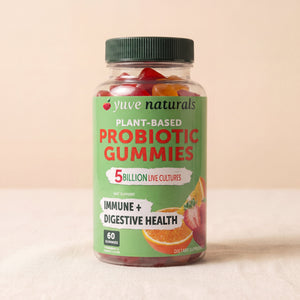
Yuve Vegan Probiotic Gummies are one plant-based product option for readers seeking a clearly formatted probiotic routine. Use the label directions and discuss the choice with your healthcare professional if you're taking antibiotics or have a condition that affects immune function.
Visit Yuve to explore vegan probiotics and other plant-based gut-health supplements that can fit into a practical digestive routine. Choose a product based on your specific goal, follow the timing guidance, and speak with a healthcare professional when antibiotic side effects or safety concerns go beyond ordinary digestive upset.