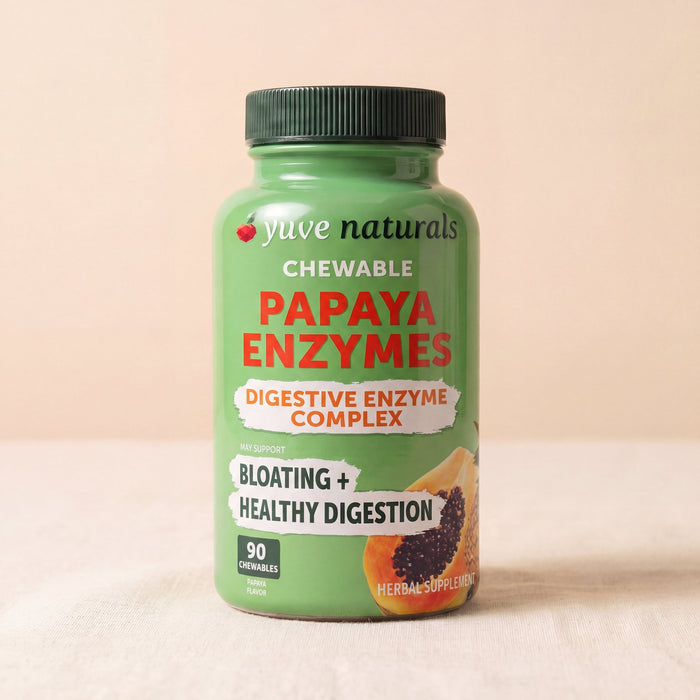
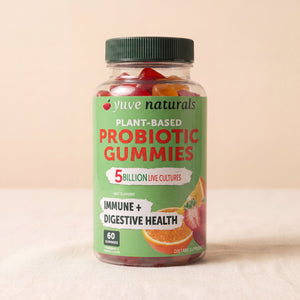
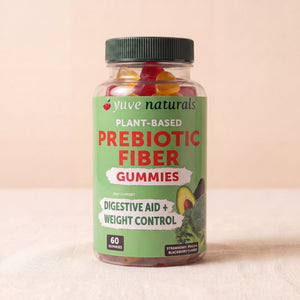
Ever notice your stomach feels like a balloon by mid-afternoon, even though lunch was just a salad and a handful of chickpeas? You're not imagining it, and you're not doing plant-based eating wrong.
Sorting out vegan probiotics and prebiotics is where most of the confusion starts. One is a live microbe you swallow. The other is fiber that feeds the microbes you already have. Once you can tell them apart, the label in your hand stops being a guessing game, and you can pick the one that matches your actual symptom instead of the biggest number on the tub.
Probiotics vs Prebiotics at a Glance
Vegan probiotics are live microorganisms that have to survive the trip through your stomach and arrive in a stated amount before they can do anything for you. Vegan prebiotics are nondigestible fibers and carbohydrates, like inulin and oligosaccharides, that feed the bacteria already living in your colon. That's the whole difference in two sentences.
Think seeds and fertilizer. A probiotic is a seed you plant. A prebiotic is the food that helps a garden grow, whether or not you planted anything new. Experts working with the Food and Agriculture Organization and World Health Organization defined probiotics in 2001 as "live microorganisms which when administered in adequate amounts confer a health benefit on the host," a definition an international panel reaffirmed in 2014, as described in this review of probiotic and prebiotic science. Notice what's missing from that definition: any mention of plants.
What vegan actually changes
Being vegan changes the manufacturing, not the biology. Cultures get grown on plant-based media instead of dairy, and the finished dose goes into a cellulose capsule, a pectin gummy or a powder rather than gelatin. So the pack should say vegan and gelatin-free, and it should list every carrier and excipient, not just the headline culture.
| Feature | Probiotics | Prebiotics |
|---|---|---|
| What it is | Live microorganisms | Nondigestible fiber or carbohydrate that feeds gut microbes |
| Vegan sources | Plant-based cultures delivered in non-animal capsules or gummies | Chicory root inulin, legumes, oats, onions, garlic, resistant starch |
| How it works | Adds beneficial microbes that must survive the trip through your gut | Ferments in the colon to fuel microbes already present |
| What the label should show | Named strains and viable count through shelf life | Named fiber type and grams per serving |
Practical rule: if your week looks like toast, pasta and coffee, start with prebiotic food. If a named strain has been studied for your specific symptom, buy that probiotic first.
How Vegan Probiotics Work Once They Reach Your Gut
A probiotic is a seed, and seeds are picky. Whether yours sprouts depends on surviving stomach acid, arriving in a big enough dose, and being the right strain for the job you hired it for.
Reading a strain name
Labels give you three layers. Genus (Lactobacillus, Bifidobacterium, Bacillus), then species (acidophilus, lactis, coagulans), then a strain code like NCFM or Bi-07. That last bit is the part people skip, and it's the part that matters, because two strains inside the same species can behave completely differently in your gut.
CFU stands for colony-forming units, which is a count of living cells. A tub shouting a huge CFU number is telling you what was alive at manufacture, not what's alive the month you eat it. Look for a count guaranteed through the end of shelf life.
What the bloating trial measured
A double-blind, placebo-controlled trial in people with functional bowel disorders tested two named strains together, Lactobacillus acidophilus NCFM and Bifidobacterium lactis Bi-07, given twice daily for a total of 2 × 10^11 colony-forming units per day for eight weeks. At four weeks the probiotic group reported a bloating score of 4.10 versus 6.17 for placebo, a statistically significant difference in bloating severity. By eight weeks the scores were 4.26 versus 5.84, and the change in severity stayed statistically significant.
Plain English: people taking those two specific strains, at that specific dose, felt less bloated than people taking a lookalike pill. Not "probiotics are good for the gut." Those strains, that dose, that length of time.
When a label won't tell you the strain code and the shelf-life count, it's asking you to trust a number it can't back up.
Vegan formulas add one more check. The cultures are grown and encapsulated with plant carriers, so read the full ingredient list for the capsule shell, the sweetener and any flow agents. Your action step before buying anything: find the strain, find the CFU, find the date.
Plant-Based Prebiotic Foods and Fiber Types
Prebiotics aren't one ingredient. They're a family of fibers and starches your gut bacteria ferment, and each member feeds a slightly different crowd of microbes at a slightly different speed. That matters because your gut response depends on both the fiber type and the dose, not just the fact that a food is plant-based.
| Food | Main prebiotic fiber | Practical note |
|---|---|---|
| Chicory root | Inulin | Concentrated source often used in fiber gummies; start with a small dose |
| Garlic and onions | Fructans | Frequent bloating trigger; try small amounts first |
| Oats | Beta-glucan | Gentle soluble fiber; build up portions over one to two weeks |
| Lentils and chickpeas | Galacto-oligosaccharides and resistant starch | Rinse canned beans and increase servings gradually |
| Asparagus | Inulin-type fructans | Keep servings modest if you're sensitive to fructans |
| Cooled potatoes or rice | Resistant starch | Cooling after cooking increases resistant starch content |
Why the same category can feel totally different
Fermentation is the good part and the annoying part at once. Your bacteria break fiber down and release short-chain fatty acids, which is the payoff. They also release gas, and a big load of a fast-fermenting fiber makes that gas arrive faster than you'd like.
Say dinner is a bowl of lentil soup with a small spoonful of onion cooked into it. Now compare that to a plate of pasta under a raw garlic-heavy sauce. Both are plant prebiotic sources. The soup usually sits better, because the portion of fructans is smaller and the lentils bring a slower mix of fibers. Same category, very different evening.
This is why we like a slow, practical approach. A food can be nourishing and still be a poor fit for your current gut, especially if you are sensitive to fructans or suddenly raise your fiber intake. For a wider shopping list, our guide to prebiotic fiber sources breaks down which foods carry which fiber.
Food is a starting point, not a promise
One prebiotic food will not fix every digestive complaint. Microbiomes differ, symptoms have different causes, and a fiber that helps one person feel regular may leave another person bloated. Use food as a steady input, then watch what your body does with it.
Pick two foods you already tolerate, keep the portions modest, and build from there. That's a better first move than buying three new products in one order.
Do Vegans Need Probiotics If the Diet Is Already Plant-Rich
Fair question. If you're eating beans, oats and vegetables most days, your gut is already getting fed. Why pay for a capsule?
A systematic review of nine observational studies in healthy vegans found vegan diets commonly higher in fiber and lower in saturated fat and protein than omnivorous diets, with vegan participants showing an increase in the bacterial phylum Bacteroidetes and a higher abundance of the genus Prevotella. Your food choices really do reshape the community living in there.
What that doesn't prove: that a vegan diet prevents bloating, or that every vegan carries the same microbes. Observational studies show associations, not guarantees.
Where a supplement still earns its place
The BIOME randomized controlled trial enrolled 399 healthy UK adults with low baseline fiber intake and compared a six-week blend containing more than 30 plant ingredients with a probiotic intervention. The plant-based intervention changed 57 species-level microbiome groups versus 14 in the control comparison, a broader shift than a single strain produced.
Read the limits:
- Short and specific: six weeks, healthy adults, low baseline fiber, not people with diagnosed gut conditions.
- A structured blend, not a normal diet: participants took a designed high-fiber plant blend, not whatever they usually ate.
- Microbiome change isn't symptom relief: more shifted groups doesn't automatically mean a calmer belly.
If you're curious how fermented plant foods fit alongside this, we've mapped the vegan sources of probiotics worth knowing.
Whole-food variety is the foundation. A supplement is the top-up, not the substitute.
Add one new plant food every few days. If a specific symptom is still there once your fiber base is steady, that's when a named strain becomes worth testing.
Who Should Check With a Clinician First
Most healthy adults with occasional bloating can reasonably try a probiotic from a reputable maker. But vegan doesn't mean risk-free, and I'd rather say that plainly than sell you a comfort story.
A probiotic is still a live microorganism. A gelatin-free capsule or a plant-based label doesn't remove the risks tied to live cultures, contamination, strain-specific effects or an interaction with your medical situation.
What the safety literature flags
Pediatric guidance summarized in this review of probiotic safety states that routine probiotic use can't be supported for critically ill children, and rare cases of bacteremia, fungemia and sepsis have been reported in immunocompromised or otherwise vulnerable patients. That's not a reason for panic in a healthy adult. It is a reason for triage.
Sort yourself into one of three groups
- Generally consider, with care: healthy adults with occasional bloating or gas, no immune issues, no central line. Start low, change one thing at a time, and keep a symptom note.
- Ask a clinician first: premature infants, anyone immunocompromised or critically ill, people with a central venous catheter, cardiac valve disease or short-gut syndrome, and any parent choosing a product for a sick child. This isn't gatekeeping, it's the group where the rare cases happened.
- Stop and call a clinician: fever, severe abdominal pain, or blood in your stool. Don't wait to see whether the gummy "settles in."
Our detailed breakdown of who should not take probiotics walks through the medical situations worth a conversation before you order.
Strain identity and documented quality control matter more than a large CFU number alone. A product that names its organism, states its shelf-life count and publishes its testing gives your clinician something to evaluate. A tub with a giant number and no strain code gives them nothing.
How to Start Prebiotics Without the Bloat
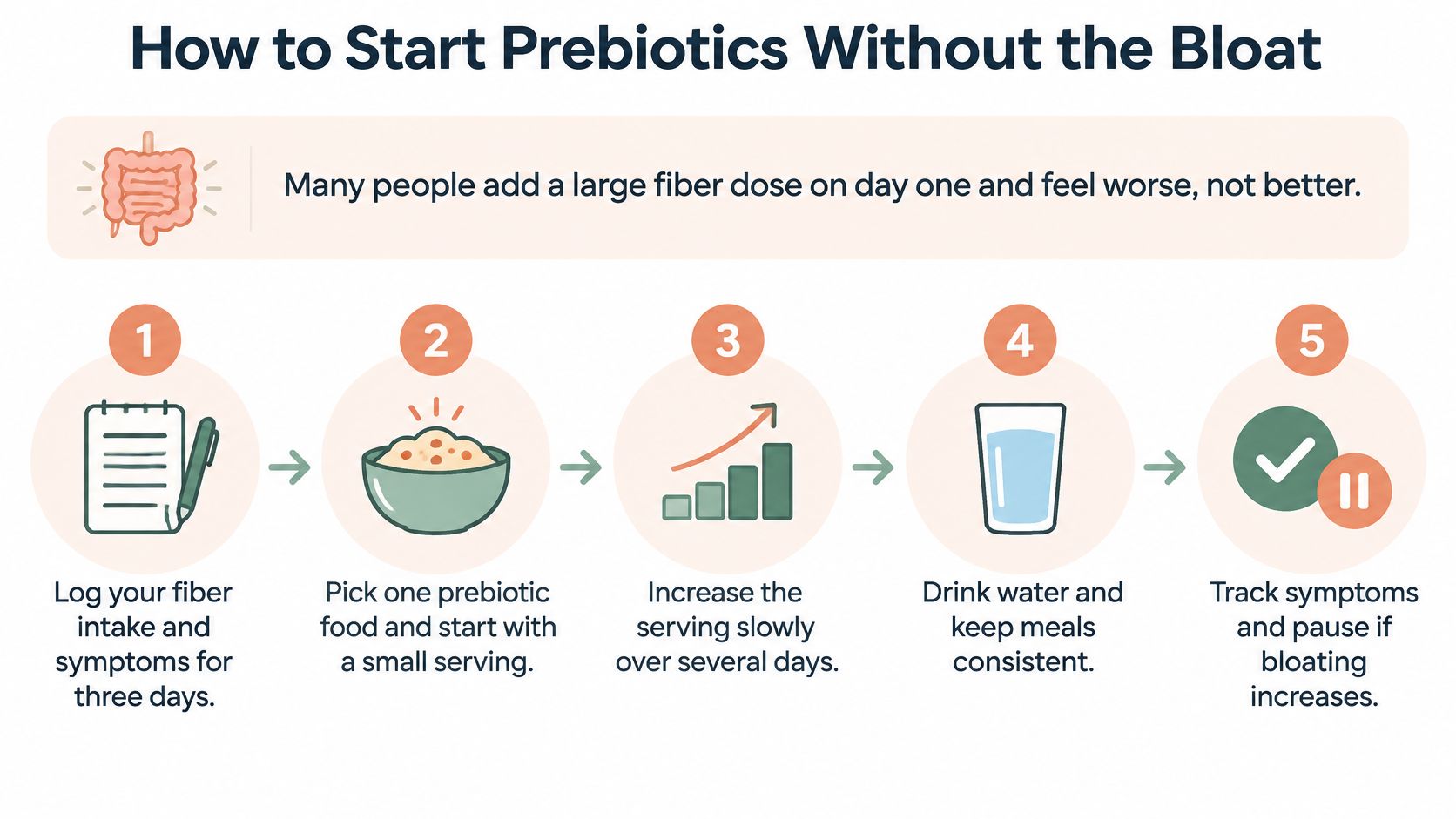
A common pattern goes like this: someone decides to fix their gut on a Monday, takes a full fiber dose that day, and by Tuesday feels worse than before. Then they conclude fiber is the enemy. The jump was the problem, not the fiber.
Here is the gentle version of the ramp, step by step.
- Log three days first. Write down what you eat and how your belly feels by evening. You need a baseline before you change anything, otherwise later symptoms have nothing to be compared against.
- Pick one prebiotic food you already tolerate and add a small serving once a day. One food, not four. A single change means a single suspect if something goes wrong.
- Hold that amount for about a week. Boring is the point. Your gut bacteria adjust their fermentation pace gradually, and rushing them is what produces the gas.
- Increase in small steps, and keep logging. Water helps, and keeping the rest of your meals consistent makes the log readable. If you change three things at once, the log tells you nothing.
- If cramps, pain or diarrhea show up, drop back to the last comfortable amount and stay there a while. That is data, not failure.
- Add a probiotic only once your fiber base has felt steady for two weeks. The fiber is the foundation; the probiotic is the addition.
The dose evidence behind that caution
For adults with irritable bowel syndrome, the National Center for Complementary and Integrative Health reports that prebiotic doses above 20 grams per day can cause flatulence, bloating, abdominal pain, cramps and diarrhea. Smaller amounts are not automatically symptom-free either. The same evidence summary describes fructan fibers differently depending on their type: some eased gassiness at low intakes in people with IBS, while inulin-type fructans tended to increase it.
So the type matters as much as the amount. A fiber that helps you at a small serving can hurt at a large one, and a fructan blend that suits your friend may not suit you at all. This is why the grams on the label deserve more attention than any wellness claim beside them.
If you would like a visual walkthrough of pacing and symptom tracking, this video is a useful companion.
Stay with that one tolerated food, keep the servings modest, and treat new gas as a signal to step back rather than push harder.
A Checklist for Choosing Vegan Gut Products
A 2025 meta-analysis of 29 randomized controlled trials involving 1,633 participants found prebiotic supplementation produced a larger standardized increase in Bifidobacterium abundance than probiotic supplementation, with standardized mean differences of 1.09 versus 0.40. Synbiotics showed no consistent overall effect, though they increased selected strains such as B. angulatum, B. longum and B. breve.
Feeding the microbes you already have moved that marker more than adding new ones. And pairing a strain with its fuel only counts when that exact pair has been tested, because the benefits were strain-specific rather than universal.
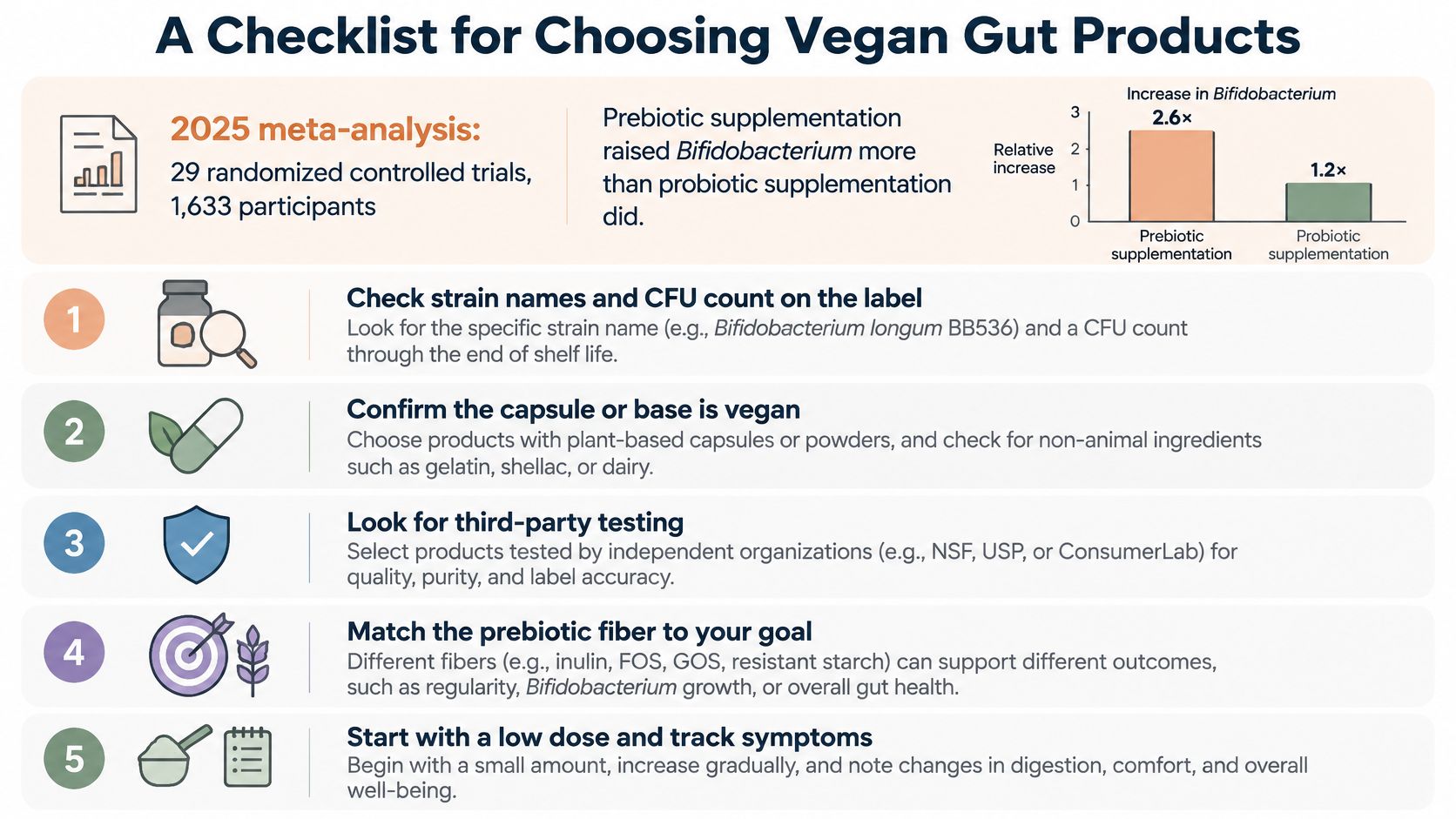
Six things to find on the pack
- Genus, species and strain code, all three, not just "probiotic blend."
- CFU stated through shelf life, not only at manufacture.
- Named fiber type and grams per serving, so you can control your dose.
- A specific outcome, like digestive regularity, rather than a vague wellness promise.
- Vegan, non-GMO and gluten-free status printed on the pack, not just in an ad.
- A full allergen statement, including the carriers and sweeteners.
Strain specificity isn't limited to digestion, either. If you're comparing products for other areas of the body, this look at urogenital health probiotic research from Momotaro Apotheca shows how differently the evidence lines up once you move beyond the gut.
Match your complaint to a starting point
| Your main complaint | Start with | What to check on the label |
|---|---|---|
| Bloating on a low-fiber diet | Prebiotic fiber, small serving, ramped over one to two weeks | Named fiber type and grams per serving |
| Bloating with a specific symptom and a studied strain | Named probiotic strain at a studied dose | Genus, species, strain code and CFU through shelf life |
| Gas after beans, lentils or oats | Food prep and portion first, supplement second | Fiber type and serving size |
| General daily maintenance | Prebiotic base first, then stack a probiotic | Vegan, non-GMO and gluten-free status plus full allergen list |
| Recent antibiotics, travel or a diagnosed gut condition | Clinician-guided named strain | Strain identity and documented quality control |
Say you're bloated and your week is mostly white bread and coffee. You'd start with a small serving of fiber, hold it, and only then consider a strain. That's exactly how our Vegan Prebiotic Fiber Gummies, built on chicory root inulin, and Vegan Probiotic Gummies are meant to be used: prebiotic base in place first, probiotic stacked on top.
Build Your Vegan Gut Routine This Week
Yuve founder Sam knows the frustrating version of this story: bloating after beans and dairy turned every meal into a calculation, and guessing at supplements didn't help. What changed things was a slow prebiotic start plus a clearly labeled strain. The win wasn't a miracle. It was a calm evening.
Week one is deliberately unexciting. One tolerated prebiotic food, a small serving, logged each night, no new supplement yet. You're building a baseline you can trust.
Once that base feels steady, our Vegan Probiotic Gummies deliver 5 billion live cultures in every gummy, and the Vegan Prebiotic Fiber Gummies use inulin from chicory root to support the growth of beneficial bacteria, at $22.10 one-time or $18.79 on subscription. They're designed to be stacked, and every Yuve product is vegan, non-GMO, soy-free, gluten-free, gelatin-free and made in the USA. If you're managing allergies alongside all this, Fresco Chocolate's food safety guide for allergy-conscious shoppers is a clear read on how to check a label properly.
If symptoms flare, hold your dose and revisit the triage groups rather than adding a third product. More isn't the answer when your gut is asking for less.
Tell us in the comments which plant food your stomach has made peace with, and which one still causes trouble. Our guides on bloating triggers and reintroducing foods pick up where this leaves off, and the fiber gummies are the sensible place to start this week.
We built our Vegan Prebiotic Fiber Gummies and Vegan Probiotic Gummies to work as a pair, so you can feed your gut first and add a named culture once things feel steady, without gelatin, soy or gluten anywhere in the routine. Browse the gut health range at Yuve, start with the fiber gummies at a small serving, and give your belly a week of calm before you ask it for anything more.