Ever had a lunch meeting become a scheduling problem because your stomach feels swollen, your energy drops, and you are silently calculating how far the nearest bathroom is? You search for an advanced digestive probiotic, then face a shelf of bottles making almost identical promises. The core problem isn't a shortage of products. It's knowing which label deserves your trust.
By the end of this guide, you'll have a practical way to judge any probiotic using five technical pillars: strain specificity, evidence-backed dosing, delivery, prebiotic support, and stability. You'll also know which marketing claims deserve a closer look, when probiotics may help, and why a higher CFU number alone doesn't make a formula advanced.
When Your Gut Feels Like the Loudest Voice in the Room
Your morning may start normally. Then lunch arrives, followed by a tight waistband, bubbling discomfort, or the familiar question, “Can I get through the afternoon without needing to leave?” Bloating can turn ordinary choices into calculations. You might avoid a restaurant, skip a presentation, or carry snacks you already know your stomach tolerates.
That frustration can make a probiotic seem like an obvious next step. The category has a long scientific history, but the modern market can still feel confusing. At the Pasteur Institute, Elie Metchnikoff connected fermented milk with the longevity of Bulgarian populations between 1905 and 1907, while Henry Tissier isolated Bifidobacterium in 1906. Lactobacillin was manufactured in Saint Petersburg beginning in 1912, and the term “probiotic” appeared in 1965. The FAO and WHO later standardized a definition in 2001 as live microorganisms that, when administered in adequate amounts, confer a health benefit on the host. This clinical history review traces that progression from theory to commercial products.
The category is now global rather than niche. A 2026 industry estimate valued the global probiotics market at USD 73.13 billion in 2025 and projected USD 77.40 billion in 2026 and USD 134.50 billion by 2034, with a projected compound annual growth rate of 7.15%. The same report estimated that Asia Pacific represented 48.35% of the market in 2025. The market analysis shows why shoppers now encounter so many variations.
A crowded shelf doesn't give you better information. A better evaluation method does.
An advanced digestive probiotic shouldn't just sound impressive. It should give you enough information to answer five questions:
- Which exact strains are included?
- Is the stated dose connected to research?
- Will the organisms survive storage and the digestive journey?
- Does the formula include a meaningful food source for beneficial microbes?
- Can the manufacturer support its quality and label claims?
That framework helps replace guesswork with a calmer decision. It also protects you from the assumption that every digestive symptom needs the same solution. Bloating, irregular bowel habits, antibiotic-related disruption, and IBS symptoms can have different causes, so a formula designed for one situation may not be the right match for another.
What Makes a Probiotic Advanced
The word advanced should describe the way a probiotic is designed, not just the way its bottle looks. A useful formula connects its organisms, dose, delivery method, and quality controls to a specific purpose.

The five pillars to look for
1. Strain specificity. “Lactobacillus” is a genus, and a species name gives you more information, but a complete strain code gives you the most useful identity. Choosing only a genus is like asking for “a tool” when you need a screwdriver. You need the exact tool for the job.
2. A clinically connected CFU dose. CFU means colony-forming units, a way of describing viable microorganisms. A large number can look impressive, but it doesn't tell you whether that dose was studied for your target symptom. A thoughtful label connects the quantity to a formulation or research context rather than using a high count as a substitute for evidence.
3. Survival-focused delivery. Stomach acid, moisture, heat, and time can affect living organisms. Delayed-release capsules, acid-resistant coatings, and protective packaging are design choices intended to preserve viability. They don't automatically prove effectiveness, but they show that the manufacturer has considered the journey from bottle to intestine.
4. Prebiotic synergy. Prebiotics are fibers that can serve as fuel for certain gut microorganisms. Ingredients such as inulin or FOS may support a formula's overall design, although they can also cause gas for some people. A prebiotic should be included for a clear reason, not added as decorative label language.
5. Stability and verification. A quality formula should tell you how it should be stored and how viability is protected through its expiration date. Third-party testing can add useful oversight, especially when the label makes claims about identity, purity, or potency.
These pillars overlap, but they aren't interchangeable. A product can identify strains clearly and still provide little information about shelf stability. Another can offer a high CFU count while hiding each strain's individual dose inside a proprietary blend.
A broader digestive-support routine may also include hydration and minerals. If you're comparing options, this natural electrolyte supplement pack is a separate resource to evaluate alongside, not instead of, a probiotic label.
The technical reason this framework matters is that probiotics don't act through one universal “good bacteria” effect. Research describes strain-dependent mechanisms that can include pathogen exclusion, support for the intestinal barrier, production of organic acids and other metabolites, and interaction with immune signaling. This review of probiotic mechanisms explains why a documented strain and viable delivery matter more than a slogan.
An advanced digestive probiotic is therefore best understood as evidence engineering. The formula should make it easier, not harder, to see what you're taking and why.
Strains That Actually Do the Heavy Lifting
A strain name is useful only when you know what evidence supports it. That's where probiotic shopping gets tricky. Species names can appear on labels without giving you a clear answer about the exact strain, dose, or symptom studied.
The supplied clinical evidence supports a broad principle: probiotics are not interchangeable. Effects can differ according to the organism, combination, host, dose, duration, and condition. Multi-strain or bifidobacteria-containing formulas may perform better than generic single-strain lactobacillus products in some gastrointestinal situations, including IBS and antibiotic-associated diarrhea, but that doesn't mean every blend will work for every person. The American Academy of Family Physicians review explains why matching the formulation to the outcome matters.
Here's a responsible way to read commonly discussed strain names without pretending that one label applies universally:
| Strain or formulation | Primary benefit to investigate | Key evidence question | Typical research CFU |
|---|---|---|---|
| Lactobacillus rhamnosus GG | Diarrhea or antibiotic-related support | Is this exact strain and indication studied in the product's dose? | Not established in the supplied evidence |
| Saccharomyces boulardii | Travel-related or diarrhea-related support | Does the evidence match the person's condition and medical context? | Not established in the supplied evidence |
| Bifidobacterium lactis | Digestive comfort and bowel symptoms | Which exact strain is present, and what outcome was measured? | Not established in the supplied evidence |
| Lactobacillus acidophilus NCFM | General digestive support | Does the label identify NCFM and provide a research-linked dose? | Not established in the supplied evidence |
| Multi-strain formulations | Broader digestive coverage | Are the strains and individual amounts disclosed rather than hidden? | Not established in the supplied evidence |
The table's blank dose column is intentional. The verified material supplied for this guide doesn't establish a single “typical research CFU” for these named examples, and it would be misleading to fill the space with invented numbers. A label that gives you a strain name but no meaningful dose context leaves an important question unanswered.
Match the strain to the symptom
A person with recurring bloating isn't automatically looking for the same formula as someone recovering from antibiotics. The NIH Office of Dietary Supplements reports that flatulence declined with all tested probiotics in the reviewed evidence, while abdominal distension improved with products containing Bifidobacterium breve, Bifidobacterium infantis, Lactobacillus casei, or Lactobacillus plantarum. The NIH professional fact sheet makes the practical point clear: the organism and combination matter.
For a deeper look at one commonly discussed digestive species, explore Bifidobacterium lactis and probiotic support. Then return to the label and ask whether the product names the complete strain, states the amount per strain, and explains the intended use.
Chasing the biggest bacterial count is less useful than choosing a formula with identity, purpose, and transparency. A smaller, well-documented formulation can be easier to evaluate than a much larger number hidden behind vague wording.
How to Read a Probiotic Label Like a Pro
A probiotic label should answer practical questions before you spend money. Start at the organism name, not the front-of-bottle promise.

Read from identity to expiration
Look for the genus, species, and strain designation. Lactobacillus rhamnosus GG tells you more than “probiotic blend,” because the letters identify a particular strain. The full designation doesn't guarantee that the formula will help you, but it gives you a trail to follow when checking evidence.
Next, inspect the CFU statement. Ask whether the count is guaranteed through expiration or measured only at manufacture. A manufacturing-time number may not represent the quantity remaining at the end of the product's shelf life. Storage instructions matter here, too. If the bottle requires refrigeration, leaving it in a hot car can work against the manufacturer's stability assumptions.
Delivery language can provide another clue. Delayed-release vegetable capsules, enteric coatings, microencapsulation, and moisture-protective blister packs are all attempts to protect viable organisms. Treat them as design information, not proof that the product works. The key question is whether the company connects the delivery system to stability or testing.
Prebiotic inclusion deserves a closer look. Inulin and FOS may support microbial growth, but added fiber can be uncomfortable for some people who already experience gas or distension. A clean label should disclose the amount and identify why the ingredient is present.
Claims deserve a reality check
In the United States, dietary supplements don't require FDA pre-approval before marketing. However, structure/function claims on a label must be truthful, not misleading, and substantiated by the manufacturer. The FDA also distinguishes those claims from disease-risk and nutrient-content claims. The FDA's consumer guidance gives the legal context for reading phrases such as “supports digestive health” with appropriate care.
Be cautious with:
- Proprietary blends: They may conceal the amount of each individual strain.
- Vague CFU ranges: They make it difficult to judge the delivered dose.
- Universal promises: “Fixes your gut” doesn't identify a strain, condition, or measurable outcome.
- Disease language: A supplement label shouldn't casually imply treatment for a diagnosed disease.
Use this quick test: Can I identify the organism, dose, expiration guarantee, storage requirement, and evidence target? If several answers are missing, the bottle may be advanced in appearance but basic in documentation.
A short label-reading demonstration can also help you spot these details visually:
For another practical buying lens, see what to look for when buying probiotics.
The Honest Truth About Probiotics for Healthy People
You may not need a daily probiotic just because you're interested in gut health. The NIH consumer fact sheet says there are no official recommendations for probiotic use in healthy people, and a 2026 meta-analysis found that supplementation did not produce statistically significant changes in gut microbiota diversity among healthy populations. The NIH consumer fact sheet is a useful antidote to broad marketing promises.
That doesn't mean probiotics never help. It means the benefit depends on the match between the person, the symptom, the strain, the dose, and the duration. Someone experiencing a specific digestive problem may have a more relevant reason to investigate a targeted product than someone hoping to create a dramatic, measurable transformation without symptoms.
| Condition or scenario | Evidence strength | Strains most studied |
|---|---|---|
| Healthy person seeking general microbiome optimization | Limited or uncertain | No universal strain recommendation |
| IBS-related symptoms | Mixed and indication-specific | Varies by trial and formulation |
| Antibiotic-associated situations | Product and scenario-specific | Certain multi-strain products and other selected formulations |
| Bloating or abdominal distension | Mixed, with some strain-specific findings | Includes selected bifidobacteria and lactobacilli |
| Acute infectious diarrhea | Depends on organism, setting, and patient | Not interchangeable across products |
IBS deserves special caution. A 2026 updated systematic review found that probiotics significantly improved IBS severity scores but didn't significantly improve IBS-related quality of life. The review in the Journal of Gastroenterology and Hepatology shows why symptom relief and an overall feeling of wellness shouldn't be treated as the same outcome.
A separate umbrella meta-analysis found a 26% lower risk of bloating in one pooled risk-ratio analysis, with RR 0.74, 95% CI 0.64 to 0.84, and P < 0.001. Yet another odds-ratio analysis in the same evidence discussion didn't show a significant change, with OR 1.60, 95% CI 0.59 to 2.61, and p = 0.65. The umbrella meta-analysis illustrates why one positive result doesn't settle the entire question.
Before buying, ask yourself:
- Have I recently taken antibiotics?
- Is bloating recurring or linked to a specific food?
- Am I dealing with diarrhea, constipation, or both?
- Does my current diet include the fiber I tolerate?
- Could stress, sleep, medication, or another health issue be contributing?
The American Gastroenterological Association recommends that symptomatic children and adults with IBS use probiotics only in the context of a clinical trial. It gives similar clinical-trial guidance for Crohn's disease and ulcerative colitis, while suggesting specific multi-strain products for pouchitis and certain antibiotic-associated prevention scenarios. Read the AGA guidance before using a probiotic for a diagnosed gastrointestinal condition.
Why a Clean Vegan Formulation Changes the Equation
A clean vegan formulation matters most when it reflects the evaluation framework rather than replacing it. Vegan status can help people who avoid animal-derived ingredients, but it doesn't prove strain quality, dose accuracy, or clinical usefulness by itself.
A shelf-stable capsule can be practical for someone who doesn't want a product that depends on constant refrigeration. Still, you should verify the storage instructions and check whether the manufacturer guarantees viability through expiration. A capsule's material may also matter to people avoiding gelatin or dairy-based excipients, particularly when their digestive symptoms make ingredient simplicity a priority.
Multi-strain design can make sense when each organism has a defined role and the amounts are disclosed. The research reviewed earlier describes several possible probiotic functions, including barrier support, pathogen exclusion, metabolite production, and immune signaling. Those functions are strain-dependent, so “more strains” isn't automatically better. Complementarity needs documentation.
Plant fibers can add another layer. Inulin and FOS may provide prebiotic support, but they can also increase gas in sensitive people. Start by reading the amount, considering your current fiber intake, and paying attention to your own response rather than assuming every prebiotic is gentle.
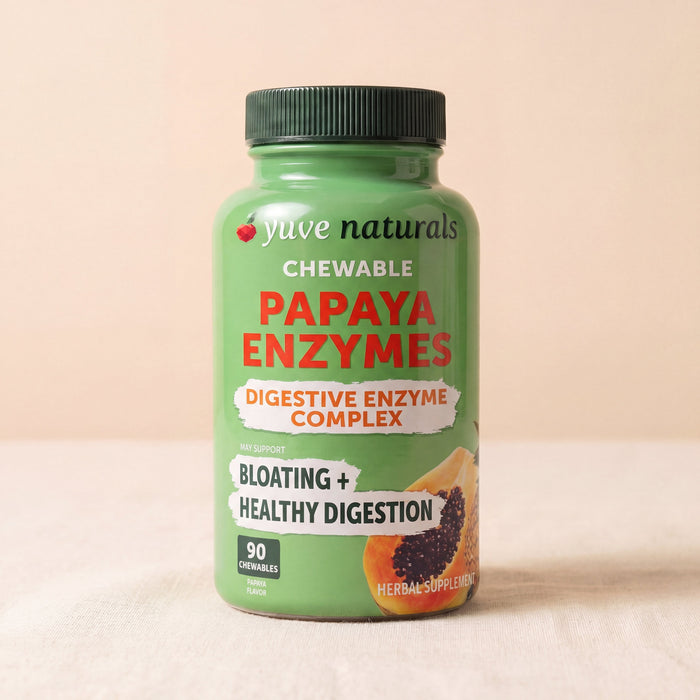
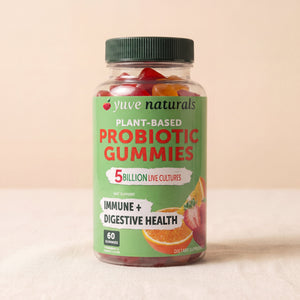
Yuve's vegan probiotics and supplements illustrate how a plant-based formulation can fit into this discussion. The publisher describes its products as vegan, non-GMO, gluten-free, and gelatin-free, and identifies its Vegan Probiotic Gummies as containing 5 billion live plant-based cultures. That product information tells you what is included, but you should still apply the same questions used for any supplement: which strains are present, how is viability handled, and what evidence matches your goal?
A transparent ingredient panel also helps you identify sweeteners, fibers, allergens, and unnecessary fillers. For a person whose afternoon is already organized around bloating, fewer unknowns can make a routine easier to evaluate. The point isn't to find a perfect bottle. It's to choose a product whose design makes sense for your symptoms and whose claims don't ask you to suspend judgment.
Your Quick Buying Checklist and Common Questions
Take this checklist with you when you compare an advanced digestive probiotic online or in a store. A “no” doesn't automatically make a product unsafe, but several missing answers should slow down the purchase.
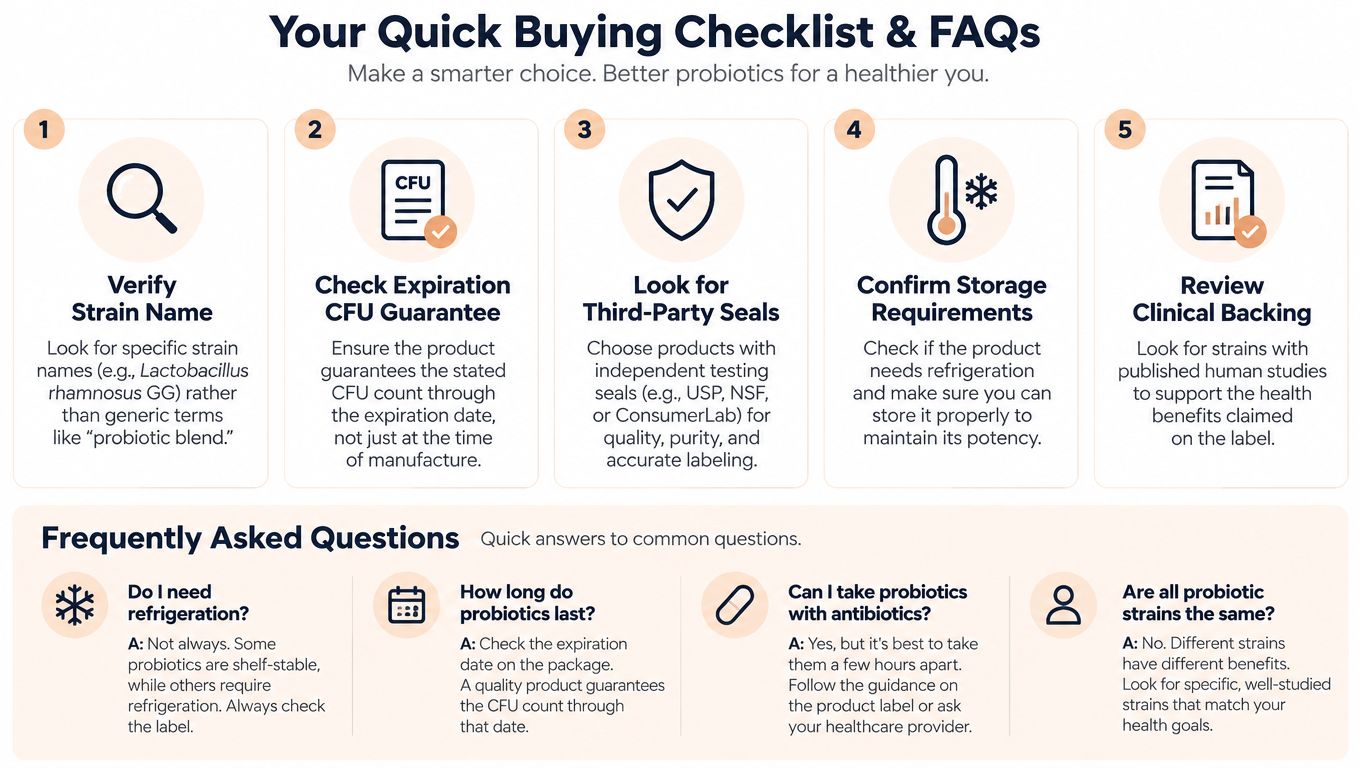
- Verify the strain name: Does the label show genus, species, and a full strain designation?
- Check the expiration guarantee: Is the CFU count stated through expiration rather than only at manufacture?
- Review the dose: Can you connect the amount to the intended symptom or research context?
- Inspect delivery technology: Does the product explain protection from moisture, heat, or stomach conditions?
- Look for testing information: Does the company discuss identity, purity, potency, or third-party verification?
- Assess prebiotic ingredients: Are inulin, FOS, or other fibers disclosed clearly and suited to your tolerance?
- Question sweeping claims: Does the label promise universal gut repair or disease treatment?
Frequently asked questions
Should I take a probiotic with food?
There isn't one universal timing rule that applies to every strain and formulation. Follow the product's directions, and consider your own tolerance. If taking it with a meal causes discomfort, ask a pharmacist or clinician whether another timing approach makes sense.
Does every probiotic need refrigeration?
No single storage rule applies to every product. Some are designed for room-temperature stability, while others require refrigeration. The label should tell you what the manufacturer expects. Heat and moisture can still affect living organisms, so follow the stated conditions.
Can I take a probiotic with antibiotics?
The answer depends on the antibiotic, the probiotic organism, and your health situation. Ask a pharmacist or clinician about timing and suitability rather than assuming that every probiotic can be taken alongside every medication.
Are probiotics safe during pregnancy?
Pregnancy changes the standard for supplement decisions. Talk with your obstetric clinician before starting a probiotic, especially if you have a medical condition, take medication, or are considering a product with several active ingredients.
How long should I try one?
There isn't a single evidence-backed trial length that applies to every strain, symptom, and product. Choose a clear outcome, such as bloating frequency or bowel comfort, record your response, and stop or seek professional guidance if symptoms worsen. Persistent, severe, or unexplained digestive symptoms deserve medical evaluation rather than repeated supplement experiments.
A smart purchase is not the bottle with the loudest promise. It's the one that gives you enough information to make a reasoned choice. If your symptoms are intense, new, or linked to a diagnosed gastrointestinal condition, involve a qualified healthcare professional.
Yuve offers plant-based digestive supplements, including probiotic products, for people who want a vegan option with a clearly stated ingredient approach. Visit Yuve to explore the range, then use the checklist above to decide whether a product matches your own digestive goals.