You've finished your antibiotics, but your stomach hasn't quite got the memo. Meals leave you bloated, your stools feel unpredictable, and the probiotic aisle offers more promises than clear answers.
The best probiotics to take after antibiotics aren't necessarily the ones with the biggest culture count. They're the ones whose strain, dose, and intended benefit match the evidence, with a plan that makes sense for your health. Let's make those choices easier, without pretending a gummy or capsule can instantly reset your gut.
Probiotic Strains With the Strongest Evidence
At Yuve, we believe post-antibiotic bloating deserves a practical conversation, not another vague promise about balance. If you've dealt with that uncomfortable, waistband-tight feeling, you're welcome to share your experience in the comments.
Antibiotics treat bacterial infections, but they can also affect beneficial gut bacteria. That disruption can contribute to loose stools and digestive discomfort during treatment or afterward. It doesn't mean you should stop a prescribed antibiotic, and it doesn't mean every symptom needs another supplement.
The useful question is narrower: Which probiotic has evidence for preventing antibiotic-associated diarrhea? That's different from asking which product will eliminate bloating or restore your entire gut community.
Strain first, then dose
The World Gastroenterology Organisation acute diarrhea guideline identifies Saccharomyces boulardii and Lactobacillus rhamnosus GG as having strong evidence in adults and children receiving antibiotics, with studied regimens including the strain-specific doses below.
Strains with strong evidence after antibiotics
| Strain | Evidence Strength | Studied Dose | What to Know |
|---|---|---|---|
| Saccharomyces boulardii CNCM I-745 | Strong evidence in adults and children | 5 billion CFU (250 mg) twice daily | A beneficial yeast, not a bacterium |
| Lactobacillus rhamnosus GG | Strong evidence in adults and children | 10 billion CFU twice daily | A bacterial strain with a well-studied dose |
| Blends and generic probiotics | Evidence is specific to the included strains | Use the dose tested for the exact strain or combination | Match each listed strain to a study before assuming benefit |
First, match the full strain name. Then compare the product's serving instructions with the studied dose, rather than assuming a higher total count is better.
These are study regimens, not personalized instructions for every adult or child. Age, health status, and the particular product still matter, so have a clinician or pharmacist confirm the appropriate plan.
Practical rule: A product that doesn't identify its strain can't be reliably matched to strain-specific evidence.
Our guide to probiotic Saccharomyces boulardii offers more context on the yeast option. The key distinction is simple: a familiar species name on the front of a bottle isn't enough to establish that the product matches what researchers tested.
How to Read a Probiotic Label Before You Buy
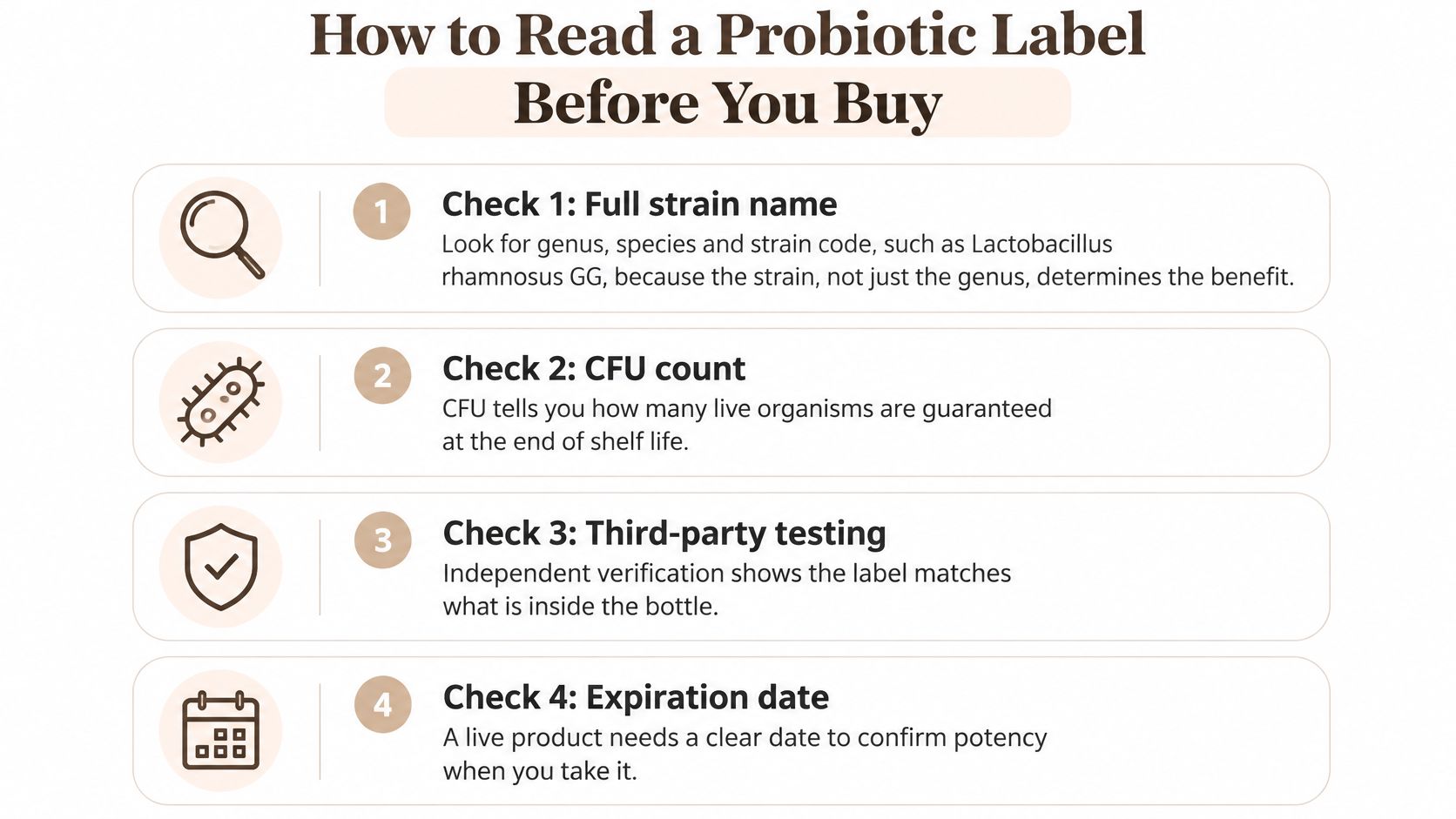
Turn the bottle around before you buy it. The front label may emphasize daily balance, digestive comfort, or billions of cultures, but the ingredient panel is where you can judge whether the product fits your goal.
Use this checklist to separate useful information from impressive-looking packaging.
The label checks that matter
- Find the complete organism name. Look for the genus, species, and strain identifier, such as Lactobacillus rhamnosus GG. “Lactobacillus” alone doesn't tell you whether the product contains the organism tested for your intended benefit.
- Check the live-culture guarantee. CFU means colony-forming units, a measure of viable organisms. Look for a count guaranteed through expiration, not just at manufacture, and follow the storage instructions because live organisms can lose viability.
- Compare the actual daily serving. Check whether the count applies to a single gummy or capsule, or to the full serving. A large total across a blend doesn't tell you how much of each individual strain you're getting.
- Read the rest of the ingredients. Check allergens, sweeteners, and dietary labels such as vegan or gluten-free when they matter to you. Also look for a clear expiration date and credible independent testing, while remembering that testing quality doesn't prove clinical effectiveness.
Our guide on what to look for when buying probiotics can help you keep those checks organized.
Applying the checks to a gummy
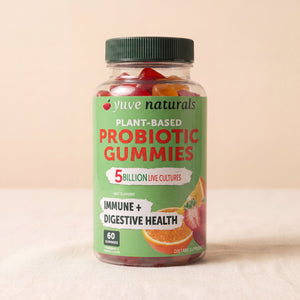
Yuve's Vegan Probiotic Gummies contain 5 billion live cultures in every gummy, in a daily plant-based format. That tells you the culture count and format, but it doesn't by itself establish a match to an antibiotic-associated diarrhea study.
Check which strains the current label names, whether their individual amounts are disclosed, and how the recommended serving compares with the relevant study. If you can't establish that match, don't treat the culture count as proof.
A convenient format can make a routine easier. It can't substitute for a documented strain and dose.
Once you know where to look, reading a label becomes a quick, repeatable habit rather than a guessing game.
When to Start Probiotics During Antibiotic Treatment
Should you wait until the prescription is finished? Don't automatically wait. If your clinician recommends a probiotic for prevention, beginning alongside antibiotic treatment is better supported than treating probiotics only as an aftercare step.
The World Gastroenterology Organisation evidence table describes S. boulardii regimens used throughout antibiotic therapy, reflecting the broader emphasis on use during treatment rather than only afterward.
This timeline illustrates a possible starting point, but the duration should be individualized.
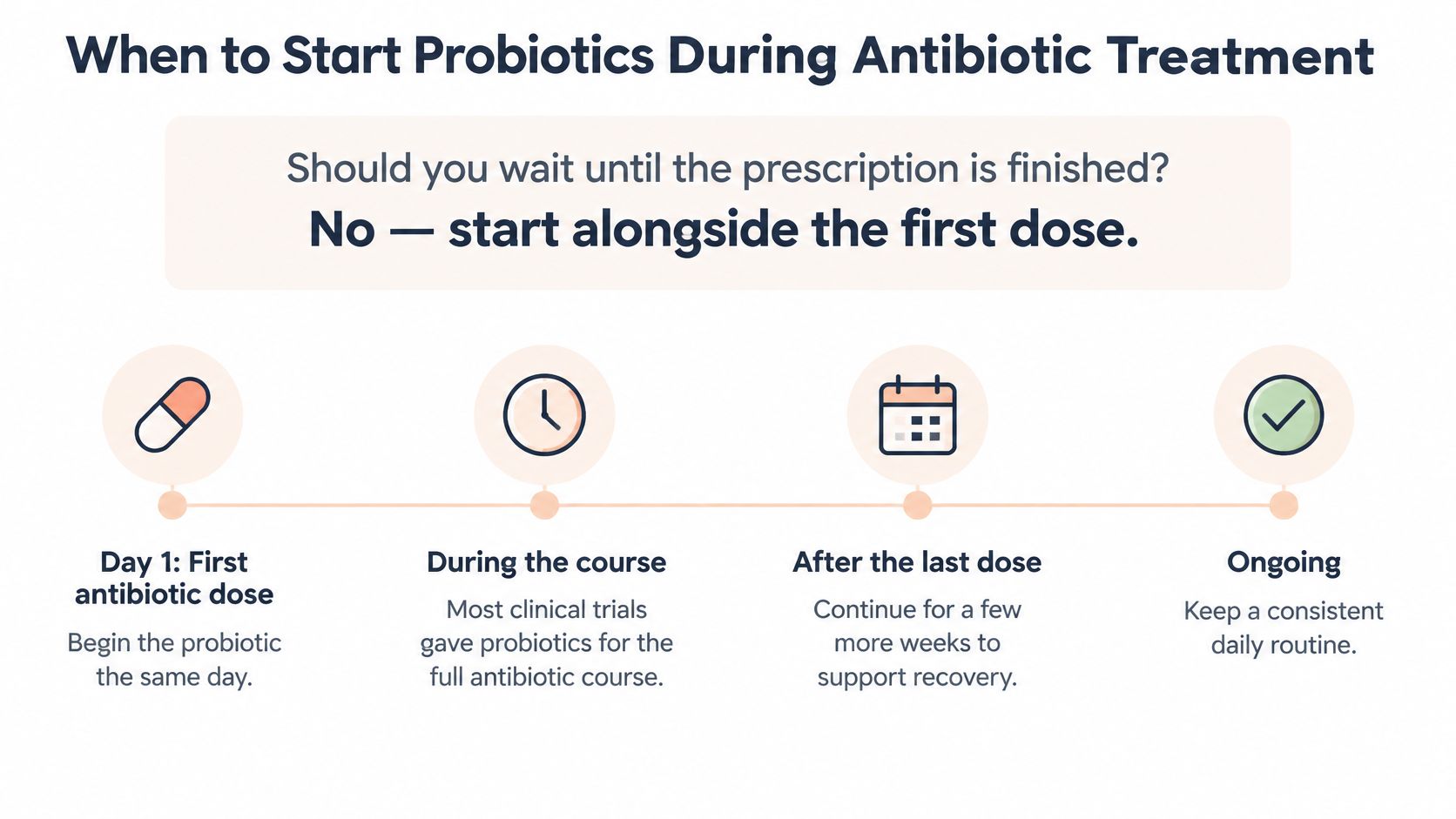
Timing options and what the evidence shows
| Timing | What the Evidence Shows | What to Do |
|---|---|---|
| Starting with the first antibiotic dose | Most clinical evidence evaluates use during treatment, including full-course regimens | Start on day one if your clinician agrees |
| Starting after the last antibiotic dose | Direct comparisons with starting during treatment are limited | Follow product instructions and clinician advice |
| Continuing one week after the course | Clinical-practice opinion supports this approach, but doesn't prove benefit | Ask your clinician whether to extend |
In a 2025 multinational clinical-practice survey, 60% of respondents supported continuing probiotics for one additional week after antibiotics. That describes respondents' practice preferences, not a trial proving that everyone benefits from extending treatment.
The timeline's suggestion to continue for additional weeks shouldn't be read as a universal prescription. If you've already finished your antibiotics, you haven't missed a mandatory recovery window, but prevention findings don't establish that starting afterward will reverse existing symptoms.
Make the schedule usable
Starting on the same day doesn't necessarily mean swallowing both products at the same moment. Ask your pharmacist whether your particular probiotic needs to be separated from your antibiotic.
Our digestive support products, including enzymes and probiotics, often show results within 1–2 weeks of consistent use. That general product expectation isn't proof of diarrhea prevention or complete microbiome recovery, and worsening symptoms shouldn't wait for a supplement to work.
For an additional discussion of probiotics and antibiotic use, you can watch the following video.
Ask your prescriber when to start, whether to continue afterward, and how to space the doses. Write the agreed schedule on the packet so you can follow it consistently.
What Research Shows About Preventing Diarrhea
In a Cochrane systematic review of 31 randomized controlled trials involving 8,672 people, Clostridioides difficile-associated diarrhea occurred in 1.5% of participants receiving probiotics, compared with 4.0% receiving placebo or no treatment. That's an encouraging difference, but it concerns a specific outcome, not every episode of loose stools or bloating after antibiotics.
The review reported a relative risk of 0.40, equivalent to roughly a 60% lower relative risk, and rated the evidence as moderate certainty. In everyday language, participants receiving probiotics were less likely to develop this type of diarrhea under the conditions studied, but the result wasn't a guarantee.
The visual summary highlights the review's scale; the correct comparison is a lower rate in the probiotic group.
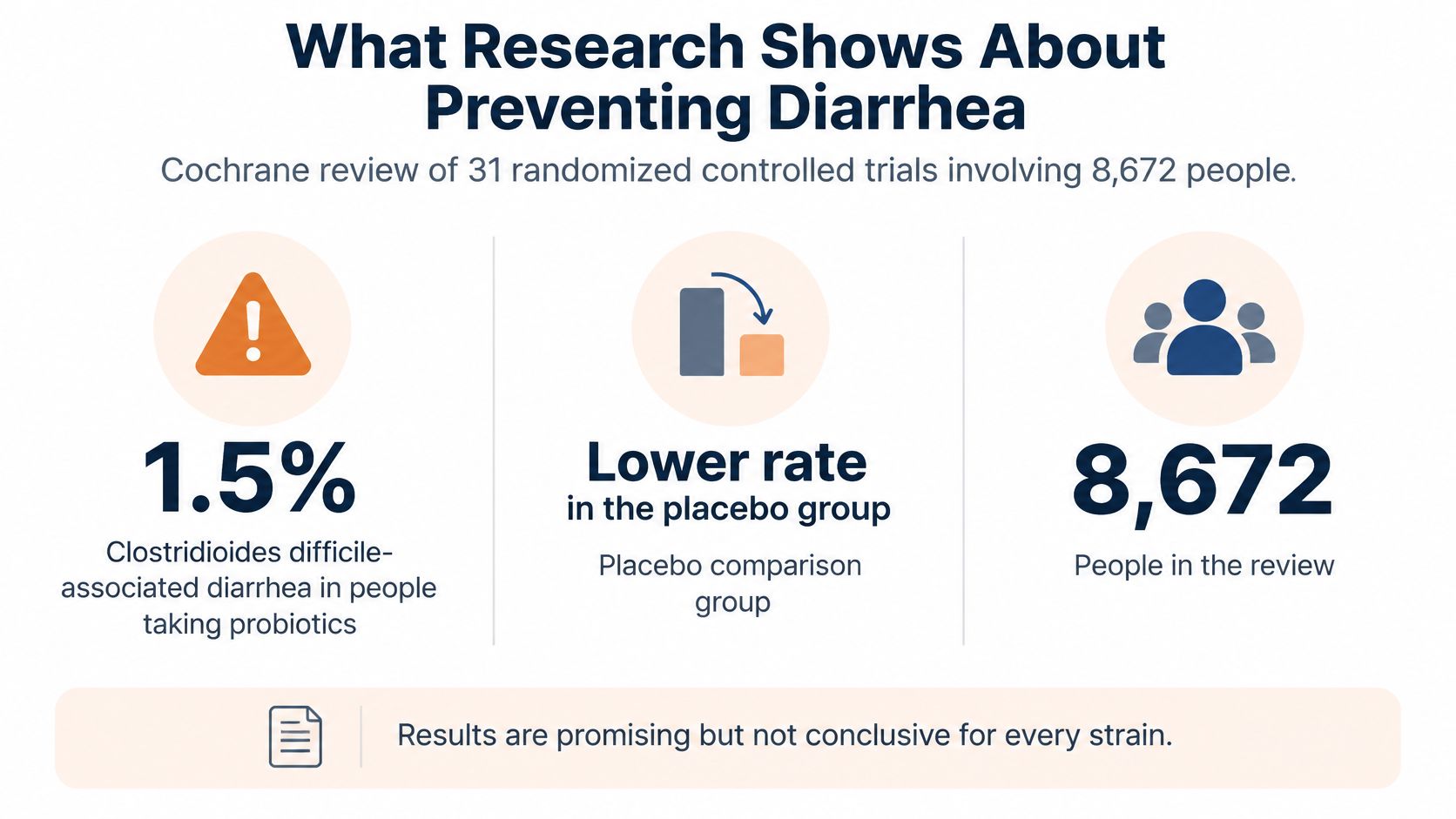
Relative benefit isn't a personal prediction
The review's number needed to treat was 42, meaning about that many people would need probiotics alongside antibiotics to prevent an additional case under the studied conditions. This makes the result more concrete than the relative reduction alone.
Think of a seatbelt. Wearing one can reduce risk without preventing every injury; similarly, a preventive intervention can help without making the unwanted outcome impossible.
Your individual likelihood of benefiting may differ from the study average. Your underlying risk, health, antibiotic treatment, and the probiotic preparation all affect how relevant a pooled result is to you.
The useful conclusion is “a carefully chosen probiotic may reduce a particular risk,” not “any probiotic will fix my gut.”
What the result doesn't prove
- Not universal diarrhea prevention. C. difficile-associated diarrhea is a particular condition, not a synonym for all antibiotic-related digestive symptoms.
- Not a brand-wide endorsement. A pooled finding doesn't establish that every commercial strain, blend, or gummy works.
- Not proof of complete recovery. Preventing diarrhea and restoring the gut's entire microbial community are different outcomes.
Choose a studied preparation rather than extrapolating from the word probiotic. Keep following your clinician's advice and hand-washing practices, and don't use a prevention supplement as a substitute for assessment when symptoms appear.
Who Should Check With a Doctor First
There's reassuring safety information, with important limits. The National Center for Complementary and Integrative Health describes a review of 23 studies involving 3,938 otherwise healthy children that found no serious probiotic-related side effects apart from the illness being treated.
The same resource describes 17 studies involving 3,631 nonhospitalized participants, in which probiotic use alongside antibiotics was associated with roughly half the likelihood of antibiotic-associated diarrhea. The evidence was considered tentative because study quality was moderate, and safety information remains incomplete.
That combination matters: possible benefit doesn't mean identical safety for everyone. Children's findings also shouldn't be stretched into a blanket claim about all patients or all products.
Get guidance before starting
Live microbes usually aren't the first thing we think of as a safety issue. But when the body's defenses are severely weakened, organisms that are tolerated by healthier people can pose greater risks.
Speak with your healthcare provider before use if you're:
- Very weak or seriously unwell. Don't assume an over-the-counter product is suitable during a significant illness.
- Living with a poorly functioning immune system. Your care team should assess whether live organisms are appropriate.
- Pregnant or nursing. Review the specific product rather than relying on a general probiotic recommendation.
- Taking medication or managing a medical condition. Bring the ingredient label and your current medication list.
Our guide to who should not take probiotics can help you prepare that conversation. For children, confirm the product and dose with their pediatric clinician rather than adapting an adult serving yourself.
Symptoms that need prompt attention
Call a clinician promptly for:
- Fever, particularly with new or worsening diarrhea.
- Blood in the stool, rather than assuming it's an expected medication effect.
- Severe belly pain, especially when persistent.
- Diarrhea that keeps getting worse, or signs of dehydration such as dizziness and difficulty keeping fluids down.
Don't stop a prescribed antibiotic on your own because your digestion feels different. Contact the prescriber so they can assess the symptoms and decide whether treatment needs adjusting.
Probiotics may support a care plan. They never replace medical assessment or treatment.
Adding Prebiotic Fiber to Your Recovery Routine
Probiotics and prebiotics sound almost interchangeable, but they do different jobs. Probiotics are live beneficial microbes; prebiotics are substances, including certain fibers, that beneficial microbes use as food.
Probiotics work like seeds, and prebiotics work like the soil and water that help them grow. Adding microbes and feeding the ones already living in your gut are related goals, and each calls for its own plan. Fiber supports the routine. It does not stand in for a studied probiotic preparation.
Food can be part of a gentle, sustainable digestive routine.
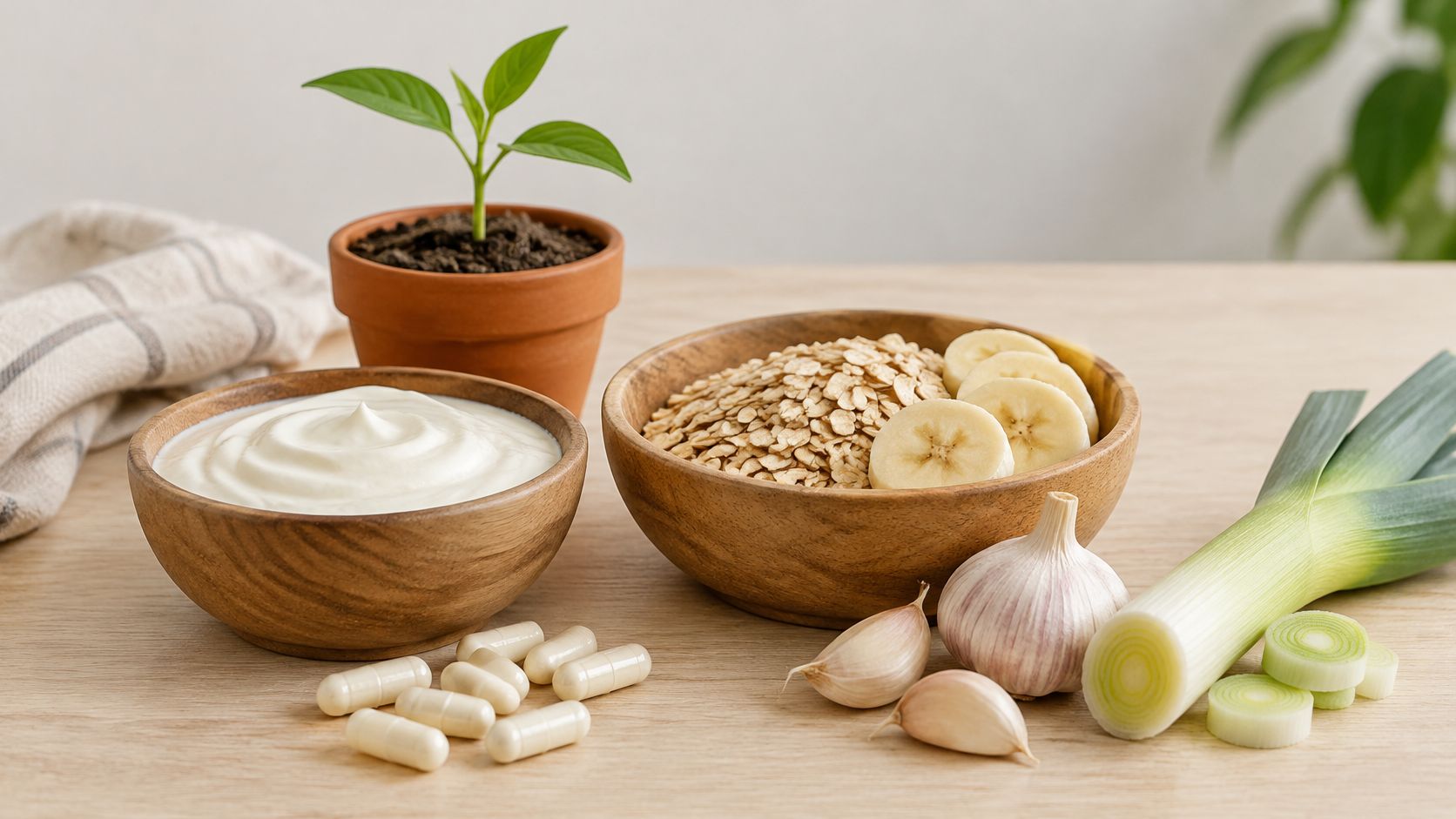
Build support without overloading your gut
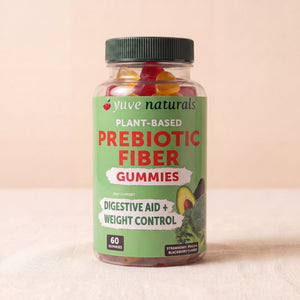
Our Vegan Prebiotic Fiber Gummies are a daily plant-based option containing inulin from chicory root, formulated to support the growth of beneficial bacteria in the gut. They cost $22.10 one-time or $18.79 on subscription.
Our Gut Health & Digestion range includes plant-based probiotics, prebiotics, and digestive enzymes. Most of our products are designed to be stacked, including Probiotic Gummies with Prebiotic Fiber Gummies, and stacking them is a convenience for your routine rather than a proven way to prevent antibiotic-associated diarrhea.
- Begin gradually. Start with the lowest labeled serving and increase gradually as tolerated.
- Watch your response. A sudden fiber increase can cause gas and bloating, which is rough on an already unsettled gut.
- Assess products separately. Check probiotic strain details on one label and fiber ingredients, serving instructions, and allergens on the other.
Direct evidence for prebiotic fiber during antibiotic treatment is thinner than the evidence behind specific probiotic strains and doses. Treat it as nutritional support, not a proven recovery shortcut. If discomfort persists well after treatment ends, that is a conversation for your clinician rather than a reason to keep raising the fiber dose.
For persistent discomfort, Restore Osteopathic Medicine's visceral manipulation describes a hands-on approach some people raise with their clinicians for ongoing gut complaints. It sits outside the supplement decision entirely, so weigh it with your care team rather than as part of a post-antibiotic routine.
“GI tract is calmer and I have less discomfort after eating.” - Nicole
Nicole's feedback describes one person's experience, not evidence that fiber resolves post-antibiotic symptoms. Small improvements can still matter, as long as expectations stay realistic.
Pick a Strain, Check the Dose and Call Your Doctor
The most useful purchase is one you can explain: what it contains, why that preparation fits your goal, and how you'll take it. You don't need the most crowded ingredient list or the biggest number on the shelf.
Use this order to turn a confusing decision into a manageable plan.
Your decision checklist
- Choose an identifiable preparation. Look for a studied strain such as Saccharomyces boulardii CNCM I-745 or Lactobacillus rhamnosus GG. Have your pharmacist confirm that the labeled serving matches an appropriate studied regimen rather than adjusting the dose yourself.
- Agree on timing. If you're still taking antibiotics, discuss starting during treatment and following the agreed schedule consistently. If you've finished, describe your current symptoms so the recommendation addresses your situation, not a prevention scenario that no longer applies.
- Monitor symptoms without chasing every fluctuation. Note stool changes, belly pain, and whether eating or drinking has become difficult. Fever, bloody stool, severe pain, or worsening diarrhea calls for clinical advice rather than another supplement purchase.
- Check suitability before use. If you're pregnant, nursing, taking medication, or managing a medical condition, consult your healthcare provider first.
Where a daily gummy fits
Yuve's Vegan Probiotic Gummies cost $27.49 one-time or $23.37 with a subscription. Consider them for this specific purpose only if your label check confirms that the named strains and serving match the relevant evidence and your clinician's recommendation.
A pleasant format is useful for consistency, but convenience isn't evidence of antibiotic-related benefit. Don't increase the labeled serving just to chase a study's total culture count.
If you'd like to share your recovery journey in the comments, tell us what questions helped you make a clearer decision. Getting your gut back after antibiotics can feel frustrating, and a comfortable meal or a more predictable day is a small win worth celebrating.
Frequently Asked Questions About Probiotics After Antibiotics
Which probiotic is best after antibiotics?
Choose by strain and studied use, not brand ranking. Saccharomyces boulardii CNCM I-745 and Lactobacillus rhamnosus GG are useful evidence-based names to discuss with your clinician.
Neither is automatically the best choice for every person. The full preparation, dose, health considerations, and whether you're trying to prevent diarrhea or address current symptoms all matter.
Should I start before or after my last antibiotic dose?
If your clinician recommends probiotics for prevention, starting during the antibiotic course is better supported than automatically waiting until afterward. Ask your pharmacist how to schedule your particular antibiotic and probiotic.
If the prescription is already finished, focus on your present symptoms and an appropriate next step rather than worrying that you missed a required supplement.
Do probiotics prevent all antibiotic-related diarrhea?
No. The review discussed here found a reduction in C. difficile-associated diarrhea, not complete protection from every digestive side effect.
A product that helps reduce a particular risk may still do little for bloating, and new diarrhea can require assessment even when you're already taking a probiotic.
Are probiotics safe during antibiotics?
Safety depends on the person and preparation. Reassuring findings in otherwise healthy children don't establish that all products are safe for people who are seriously ill or immunocompromised.
People with weakened defenses should get medical guidance before taking live microbes.
How long should I keep taking them?
Follow the product-specific plan agreed with your clinician. Much of the evidence concerns use throughout antibiotic treatment; extending afterward should be an individualized decision, not an automatic long-term routine.
Consistency matters, but so does reassessment. Continuing a product indefinitely isn't a substitute for investigating symptoms that persist or worsen.
Our plant-based range includes probiotic gummies, prebiotic fiber gummies, and digestive enzymes to help you build a considered digestive-support routine. Visit Yuve to compare labels, bring your chosen product to your pharmacist or clinician, and choose a plan that fits your antibiotic treatment and health needs.