Did the probiotic cause your diarrhea, or did you start it on a day your gut was already off?
You take something to help, then you are rushing to the bathroom, sure you made it worse. That frustration makes sense. A start date can sit beside a symptom the way a rain cloud sits over a picnic: close in time, not automatically the cause.
Soft stools that pass in a few days can be an ordinary adjustment. Blood, high fever, severe pain, or dehydration point to a different problem. Timing alone does not prove the capsule did it, and it does not sort those two paths. We can look past the calendar before you decide what to do next.
The Short Answer on Probiotics and Diarrhea
Probiotics can occasionally loosen stools, especially in the first few days, but diarrhea is not a common direct side effect in generally healthy people. That may feel surprising if your own stomach reacted on day two. Your experience matters, but it helps to see how often this happened when researchers compared thousands of people side by side.
The 2019 Cochrane review of probiotics for pediatric antibiotic-associated diarrhea analyzed 24 randomized trials involving 4,415 participants. Adverse events occurred in 4% of probiotic recipients (86 of 2,229) versus 6% of control participants (121 of 2,186), and no serious adverse event was attributed to probiotics. Reported symptoms included soft stools, abdominal cramping, nausea, and flatulence.
What the trials found about probiotics and diarrhea
| Study group | Outcome | With probiotic | Control group |
|---|---|---|---|
| Pediatric trials, Cochrane 2019 | Any adverse event | 4% (86 of 2,229) | 6% (121 of 2,186) |
| Pediatric trials, Cochrane 2019 | Antibiotic-associated diarrhea | 8% | 19% |
| Adult trials, 2025 meta-analysis | Antibiotic-associated diarrhea (relative risk) | RR 0.60 (40% lower) | RR 1.00 reference |
Read the table this way. In the probiotic column, a lower number means fewer cases. For children, antibiotic-associated diarrhea occurred in 8% of children receiving probiotics compared with 19% receiving placebo or no probiotic, an absolute difference of 11 percentage points. In everyday terms, out of 100 children in that setting, about 11 fewer developed that diarrhea.
Adults show a similar direction. A 2025 meta-analysis of 15 randomized trials involving 7,427 adults found probiotics reduced antibiotic-associated diarrhea by 40% overall (RR 0.60, 95% CI 0.43 to 0.82). That doesn't mean every product prevents diarrhea, and it doesn't prove your probiotic can't affect you. Strains, doses, and health conditions differ.
Averages describe a pattern across people, not a guarantee for your own gut.
That's the honest short answer to can probiotics cause diarrhea. Yes, they can loosen stools for some people at first. No, trials don't show healthy users getting diarrhea more often overall. If symptoms are persistent, severe, bloody, or dehydrating, treat that as a medical issue, not a supplement adjustment.
Why a Probiotic Can Upset Your Stomach at First
If your stomach reacted after starting a probiotic, you are not alone. You try to do something kind for your digestion, and your stomach answers with cramps and urgency. It can feel like your body rejected the plan before it had a chance to work.
A new probiotic works like a housemate who rearranges the kitchen on day one. Nothing is broken. You just cannot find the mugs while everyone adjusts. Your gut can react in a similar way while new organisms settle into an already busy microbial neighborhood.
This simple map shows the early reactions readers ask about most.
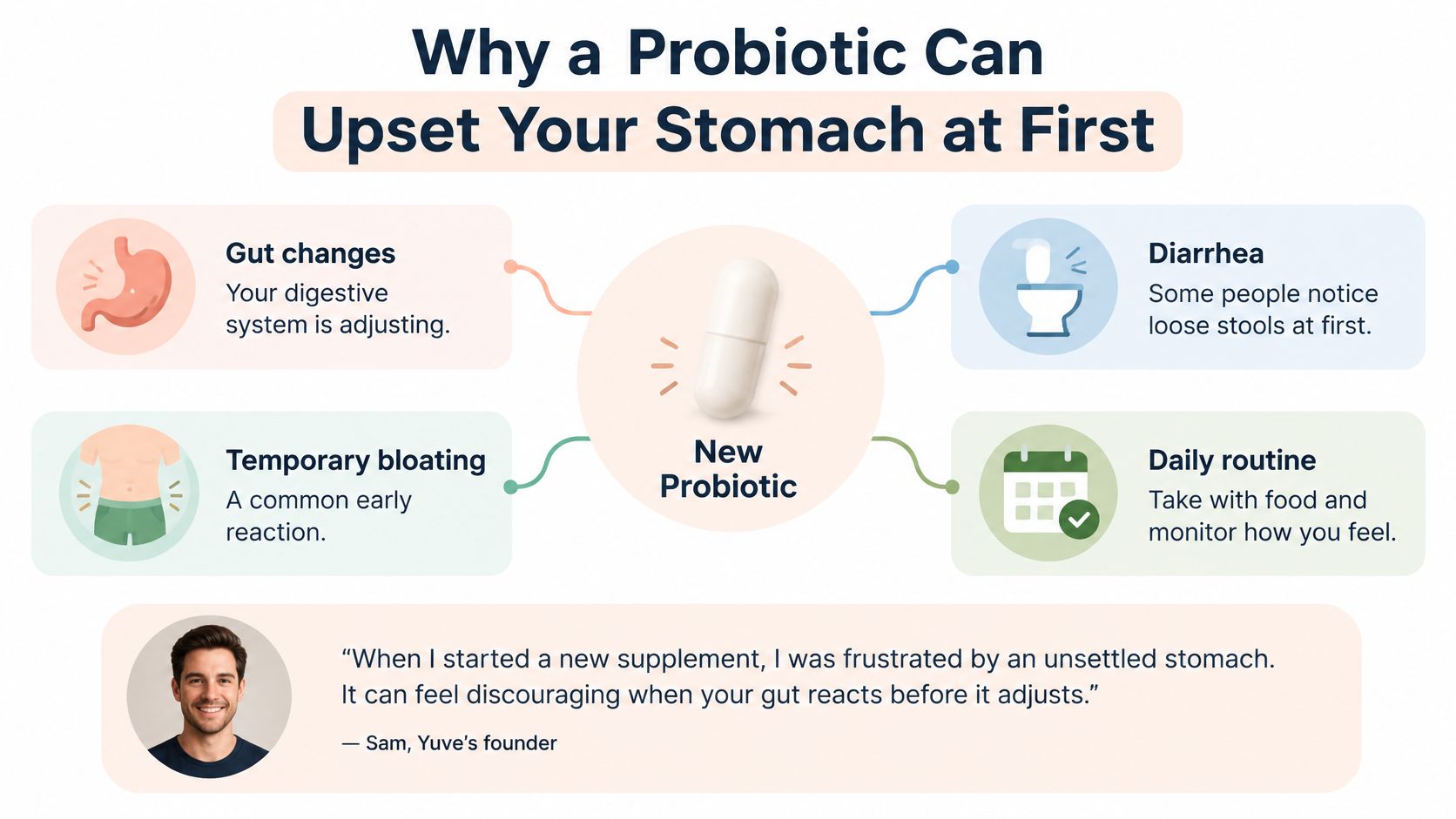
What may be happening inside
The Cleveland Clinic overview of probiotics explains that probiotics can occasionally trigger short-lived diarrhea or looser stools when first introduced, particularly at high doses or in people with sensitive gastrointestinal systems. Probiotic organisms can produce short-chain fatty acids and other metabolites. Those compounds can alter colonic water handling and motility, which means they can change how much water stays in stool and how quickly it moves through you.
A full-strength start is often more change than a sensitive gut enjoys. If you add a probiotic, a fiber drink, and a magnesium supplement in the same week, three new inputs arrive together, and you cannot tell which one caused the rumbles. An already reactive gut adds another layer. If beans, dairy, or a sudden salad habit reliably unsettle you, a new supplement may do the same at first.
Gas and cramping often travel with those looser stools. They are uncomfortable. A brief adjustment is generally self-limited, and it is not evidence of infection or intestinal injury.
We can use timing as a clue, not a verdict. Loose stools that begin within a day or two and then ease while the dose stays the same point toward adjustment. The calendar still does not prove the probiotic caused the change. A meal, an antibiotic, a virus, or extra fiber can land on the same days. Mild adjustment symptoms usually show up early and calm as your gut adapts. If stools worsen or stay loose beyond several days at a steady dose, pause and review instead of pushing through. Ordinary, self-limited looseness fades. Symptoms that intensify are a different problem from a short settling-in period.
Who Is Most at Risk and Why It Differs
Risk isn't spread evenly, and this point matters more than any general reassurance. A healthy adult with one soft stool after breakfast is in a different situation from a hospitalized patient or a premature infant with the same symptom. The person matters as much as the product.
The National Center for Complementary and Integrative Health guidance on probiotic usefulness and safety reports a long history of apparently safe use in healthy people. It also notes that serious complications, including infections, have occasionally occurred in people with severe illness or weakened immune systems. Seriously ill hospital patients and premature infants need benefits and harms weighed carefully with a healthcare professional.
Probiotic diarrhea risk by group
| Group | Risk level | What diarrhea may signal | Next step |
|---|---|---|---|
| Healthy adults | Low | Usually a mild, short-lived adjustment | Track for several days, then reassess |
| Adults taking antibiotics | Moderate | Often the antibiotic itself | Review timing with a clinician before adding more products |
| Older adults or postoperative patients | Elevated | Rare serious complications have been reported | Check with a healthcare provider first |
| Seriously ill or hospitalized patients | High | Possible complication needing care | Use only under clinical supervision |
| Premature infants | High | Possible serious infection | Seek medical advice before any probiotic |
| Immunocompromised people | High | Rare bacteremia or fungemia | Get clinician guidance before use |
For healthy adults, mild loose stools may reflect a transient gastrointestinal effect. For someone taking antibiotics, the antibiotic is often the more likely driver, even when the probiotic started on the same day. That's why changing products repeatedly can hide the pattern.
The higher rows deserve more caution. In an immunocompromised person, a premature infant, or someone who is seriously ill, diarrhea may signal a complication requiring prompt evaluation. Rare invasive infections, including bacteremia or fungemia, have been reported primarily in these high-risk groups.
A calm rule: Natural on the label doesn't mean automatically harmless for every body.
If you see yourself in a higher-risk row, don't guess. Read our guide on who should not take probiotics, then bring your medication list and health history to your clinician. That conversation is care, not overcaution.
Is the Probiotic or Something Else Causing It
Timing alone doesn't prove causation. A symptom can begin after you swallow a new gummy and still be caused by something that arrived on the same day. Many of us get stuck at that point, because our brains naturally connect the newest change with the newest symptom.
Say you start a probiotic on Monday. You also begin an antibiotic, eat a large bean burrito, and your child brings home a stomach bug. By Tuesday, you have loose stools. Blaming only the probiotic would be tidy, but it wouldn't be reliable.
Four quick checks
- New medicine check: Did you start antibiotics or another new medicine the same week?
- Food change check: Did you add much more fiber, dairy, spicy food, or sugar alcohols from protein bars and sugar-free gum?
- Household check: Is anyone at home, work, or school sick with vomiting or diarrhea?
- Dose check: Did symptoms begin the day you raised your dose or switched products?
If symptoms are mild, keep everything else steady for a few days. Don't add an anti-diarrheal product, a fiber powder, and a new tea all at once. Digestive support products often show results within 1 to 2 weeks of consistent use, so constant switching tells you very little.
A simple comparison can help. Lower or pause the probiotic while keeping food and medicines stable, then note whether stools normalize. If they improve only when you also stop dairy and recover from a stomach bug, you still don't have proof. No single clue identifies the cause.
Our guide on why diarrhea can happen after eating can help you spot meal-related patterns. Treat stool changes as useful information, not a final verdict on the product. Persistent symptoms deserve a red-flag check, not more guesswork.
When Diarrhea Needs a Doctor
Mild loose stools that ease within a few days can usually be managed at home. Some symptoms shouldn't be managed with patience. If you recognize any row below, contact a clinician promptly and don't assume the probiotic explains it.
Red-flag symptoms and the right next step
| Symptom | Why it matters | Next step |
|---|---|---|
| Blood in stool or black stools | Possible bleeding or serious infection | Seek medical care promptly |
| Fever with diarrhea | Possible infection | Contact a healthcare provider |
| Dizziness, very little urine or dry mouth | Fluid loss can become dangerous | Seek care the same day |
| Severe abdominal pain | May signal a complication | Seek urgent medical advice |
| Diarrhea lasting more than several days | Other causes are more likely | Book a clinician visit |
| Symptoms in an infant, pregnant or immunocompromised person | Higher-risk group | Consult a provider before continuing |
Blood, black stools, fever, and severe pain point away from a routine adjustment. Dizziness, very little urine, and a dry mouth suggest dehydration, which can become dangerous faster than people expect. Children and medically vulnerable adults can lose fluids quickly, so same-day advice is wise.
Persistent diarrhea also needs a broader look. Infection, antibiotics, food intolerance, and underlying gastrointestinal disorders can all sit behind the same symptom. Blaming the probiotic automatically may delay the test or treatment you need.
We ask customers who are pregnant, nursing, taking medication, or managing a medical condition to consult their healthcare provider before use. The same applies before giving a probiotic to an infant. If you're unsure, calling is the right move. Asking early is never overreacting.
Ease Side Effects and Decide Whether to Keep Going
If your symptoms are mild and no red flag is present, use one steady sequence. Changing five things at once may feel proactive, but it usually leaves you with less information. Start small, observe, then decide.
This five-step flow keeps the order clear.
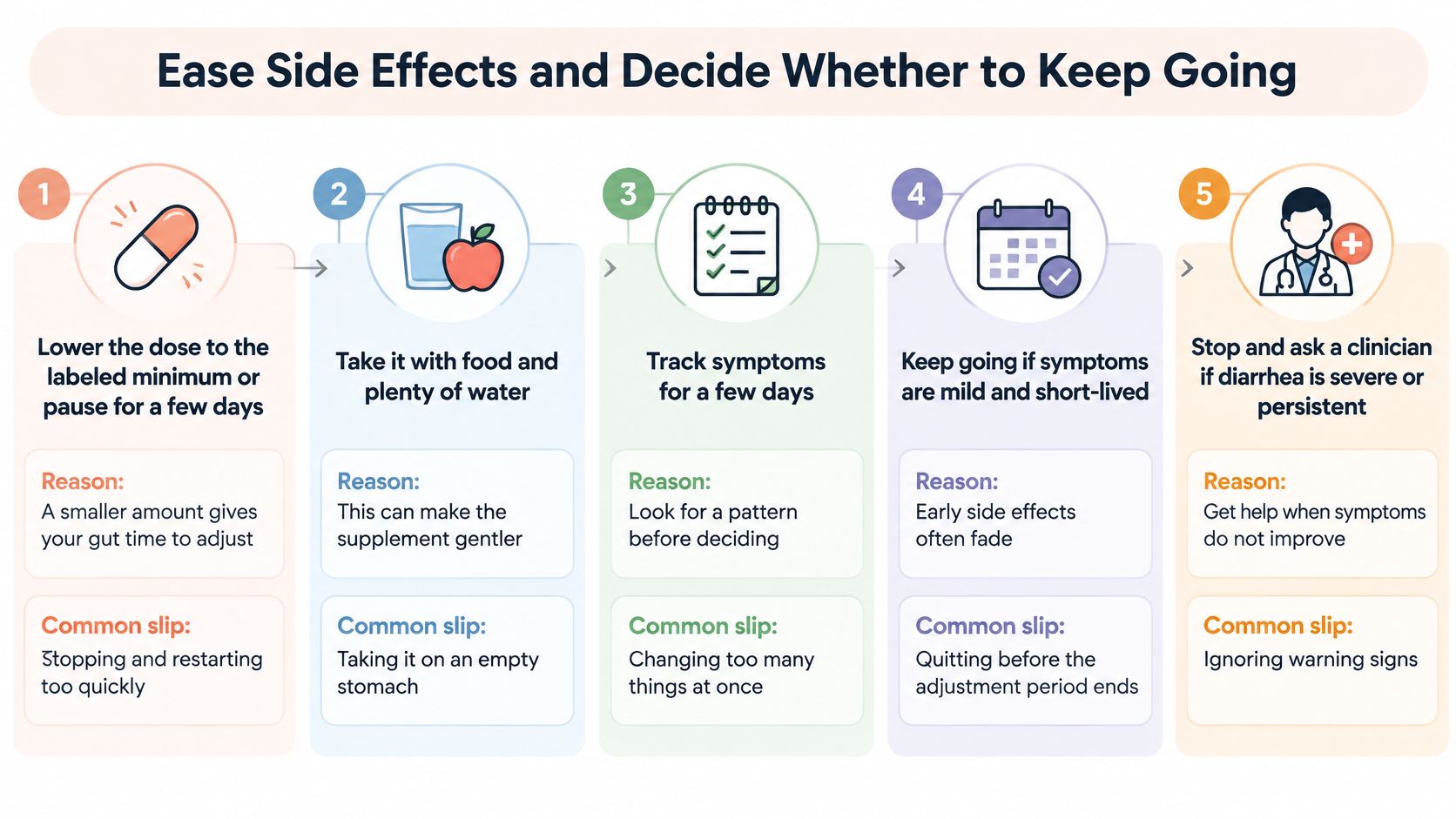
A gentle restart plan
- Lower or pause: Drop to the product's lowest labeled dose or pause for a few days. A smaller amount gives your gut time to adapt. The common slip is stopping for one morning, then restarting at full dose that night.
- Take it with a meal: Many people find food makes a supplement gentler on the stomach. Drink water steadily while stools are loose, rather than chugging a huge glass once.
- Add one thing only: Don't introduce several new supplements in the same week. You need to know what helped, what hurt, and what did nothing.
- Keep a seven-day log: Note dose, timing, meals, stool consistency, and severity from 1 to 10. Patterns are easier to see on paper than in a worried memory.
- Reassess after several days: If symptoms ease, restart slowly at the lowest dose. If they return strongly or persist, stop and follow medical guidance.
Our walkthrough on how to take probiotic supplements covers timing and consistency in more detail. For broader background, these gut health insights from Healtsy offer another plain-language resource you can compare with your own notes.
If you're a generally healthy adult with mild, short-lived symptoms and you want a transparent daily dose, our Vegan Probiotic Gummies provide 5 billion live cultures in every gummy. They're a daily plant-based option priced at $27.49 one-time or $23.37 on subscription. I do NOT think you should add a prebiotic on the same day. Once the probiotic feels settled, Prebiotic Fiber Gummies can be considered later, one change at a time.
The short video below reinforces the same pause, track, and restart approach before you make a final decision.
Many people give a product several weeks of consistent use before judging it, provided symptoms stay mild. These statements have not been evaluated by the Food and Drug Administration. This product is not intended to diagnose, treat, cure, or prevent any disease. Please share your own gut-health journey in the comments, including the small wins. Your notes may help another reader feel less alone.
Frequently Asked Questions
Can probiotics cause diarrhea in healthy adults
Not commonly. Mild, short-lived loose stools are possible when you first start, but diarrhea isn't a typical side effect for generally healthy people. Persistent symptoms deserve a wider check.
How long should loose stools last
Usually a few days at a steady dose, easing as your gut adapts. If symptoms worsen, don't keep increasing the dose. Pause, review other causes, and seek care for any red flag.
Should you stop your probiotic
For mild symptoms, lowering the dose or pausing briefly is usually the clearer test. Track what changes while keeping food and other supplements steady. Stop and contact a clinician if diarrhea is severe, bloody, feverish, or dehydrating.
Is diarrhea a sign it is working
That isn't established, so don't assume discomfort means progress. Loose stools are information about tolerance, not proof of benefit. A comfortable, consistent routine is a better goal.
Is it automatically safe with weakened immunity
No. People with weakened immune systems, serious illness, or recent major medical treatment should talk with a clinician before using a probiotic. Premature infants also need medical guidance before any use.
Ready for a simpler, plant-based routine you can start gently and track clearly? Explore our vegan gut-health gummies and practical digestion guides at Yuve, choose one product to begin with, and give your body time to tell you how it feels.